
Radio Control Helicopters
Mark Fadely [[email protected]]
It has been a great year for the helicopter community.
THIS IS THE busiest time of the year for me. It is helicopters, helicopters, and helicopters, 24/7.
I just returned from the IRCHA (International Radio Controlled Helicopter Association) Jamboree, at which I took 11,400 photographs. Fast frame rates on cameras can be a curse; now I have to go through and sort the photos. That takes a while. When I go to a once-a-year event such as the Jamboree, I definitely do not want to miss anything, so my camera gets a workout.
By the time you read this, 2008 will be almost over; I cannot believe it. This has been another accelerated year for this part of the hobby in all aspects. The flying is getting exponentially better, while the models and equipment are getting better by the minute.
Those who have been in this hobby for only a year have no idea how great they have it. Everything is so much easier, and the equipment is much more reliable.
'Tis the season to get lots of that new stuff. I hope Santa is good to everyone this year by bringing new helicopters, radios, and accessories to all of you. I have a few things on my wish list that I am hoping to be granted. I know my wife is looking forward to seeing another helicopter come into the house—not!
Shoot me an E-mail to let me know what you would like to see in this column. I like the events, but I know that many readers enjoy other aspects of the hobby more than the things I typically write about. I will research and write about any part of the hobby you want to see.
I appreciate having the feedback that you all have given. It helps me find a direction to go. Please come forward and let me know your thoughts going into 2009. I look forward to hearing from you.
Find Your Balance
There are many rotating parts of a helicopter that need balancing to run smoothly. One important and often ignored balance point is the fore/aft CG. If a model is tail-heavy, it will want to raise the nose; if it is nose-heavy, the tail will come up.
Many times, pilots notice these tendencies and adjust the trim lever to compensate for those conditions. Trimming is not going to work very well when the helicopter is in motion or inverted.
Imagine if your model were nose-heavy and you had trim dialed in to hold the helicopter level. If you flipped to an inverted hover, the nose would want to plant itself in the ground. Ouch! Unless you were excellent at inverted flight, this would be a "Red Alert" situation that might end badly.
A nose-heavy model will perform well in forward flight, but it will be terrible going backward. The opposite is true for a tail-heavy helicopter. If you are starting to get into more advanced aerobatics, it makes sense to check and adjust your CG, to get it as close to the main shaft as possible.
With electric-powered machines, you get the CG set and you are finished. With nitromethane-powered helicopters, it is not so simple. Since the fuel tank is never exactly under the main shaft, there is always a shift in CG during flight. If the tank is aft of the main shaft, the helicopter will become more nose-heavy during flight.
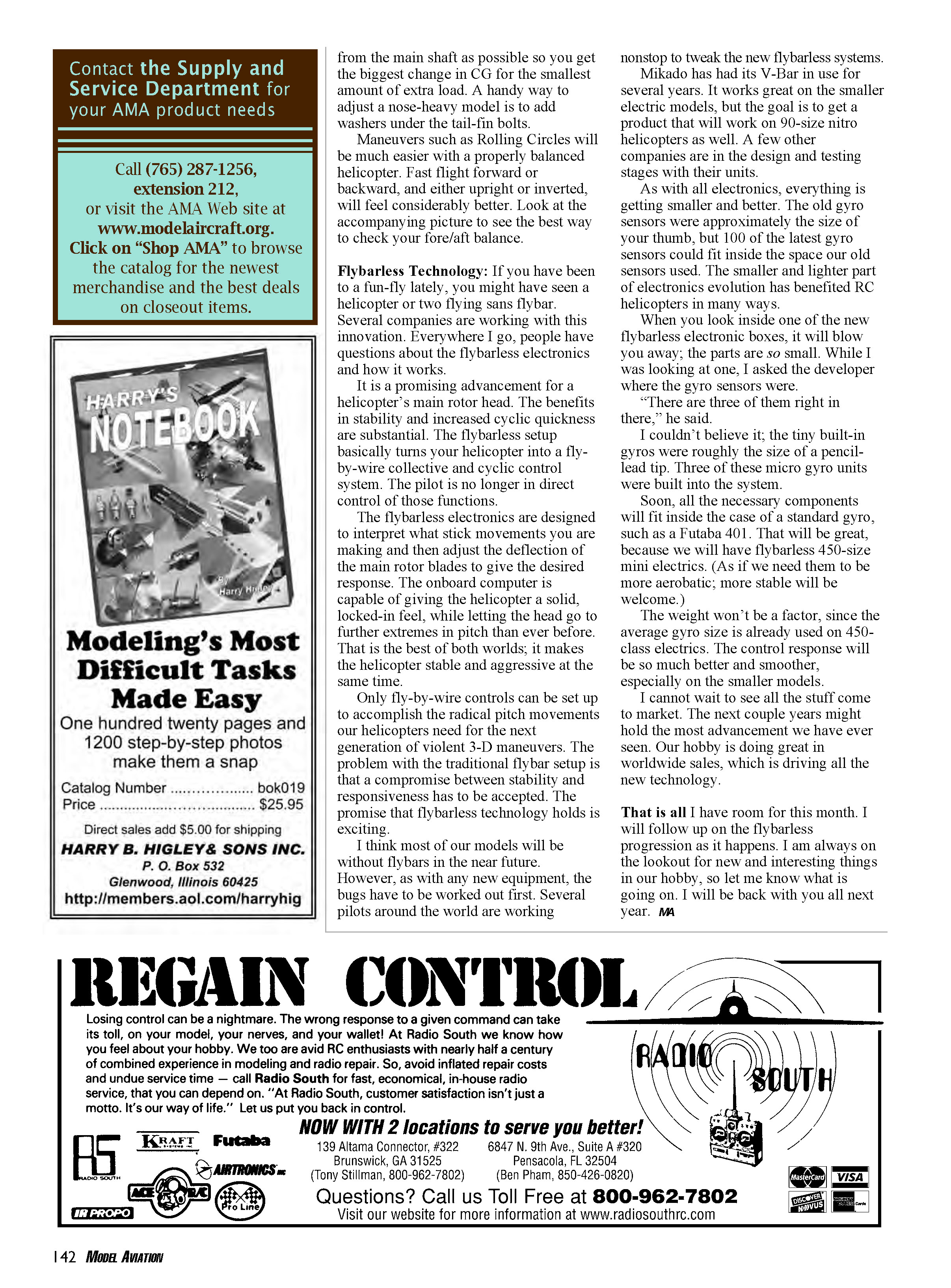
The best thing to do is balance the helicopter with roughly a half tank of fuel. It will be slightly tail-heavy during the first half of the tank and slightly nose-heavy for the remainder of the flight. That is assuming that your model has its tank aft of the main shaft. This compromise seems to work well, and most modern nitro helicopters' fuel tanks are located close to the main shaft.
There are various ways to change your model's CG. A convenient method is to move the receiver battery pack forward or aft.
Balance problems have been cropping up on some helicopters lately, because many of the new receiver battery packs are much lighter than the older ones. It is great to have light batteries, but many models were designed to use a certain battery weight, and their battery trays were positioned with that in mind.
Nobody wants to add weight to his or her helicopter to get it to balance; that should be a last resort. If you do have to add weight, make sure it is as far away from the main shaft as possible so you get the biggest change in CG for the smallest amount of extra load. A handy way to adjust a nose-heavy model is to add washers under the tail-fin bolts.
Maneuvers such as Rolling Circles will be much easier with a properly balanced helicopter. Fast flight forward or backward, and either upright or inverted, will feel considerably better. Look at the accompanying picture to see the best way to check your fore/aft balance.
Flybarless Technology
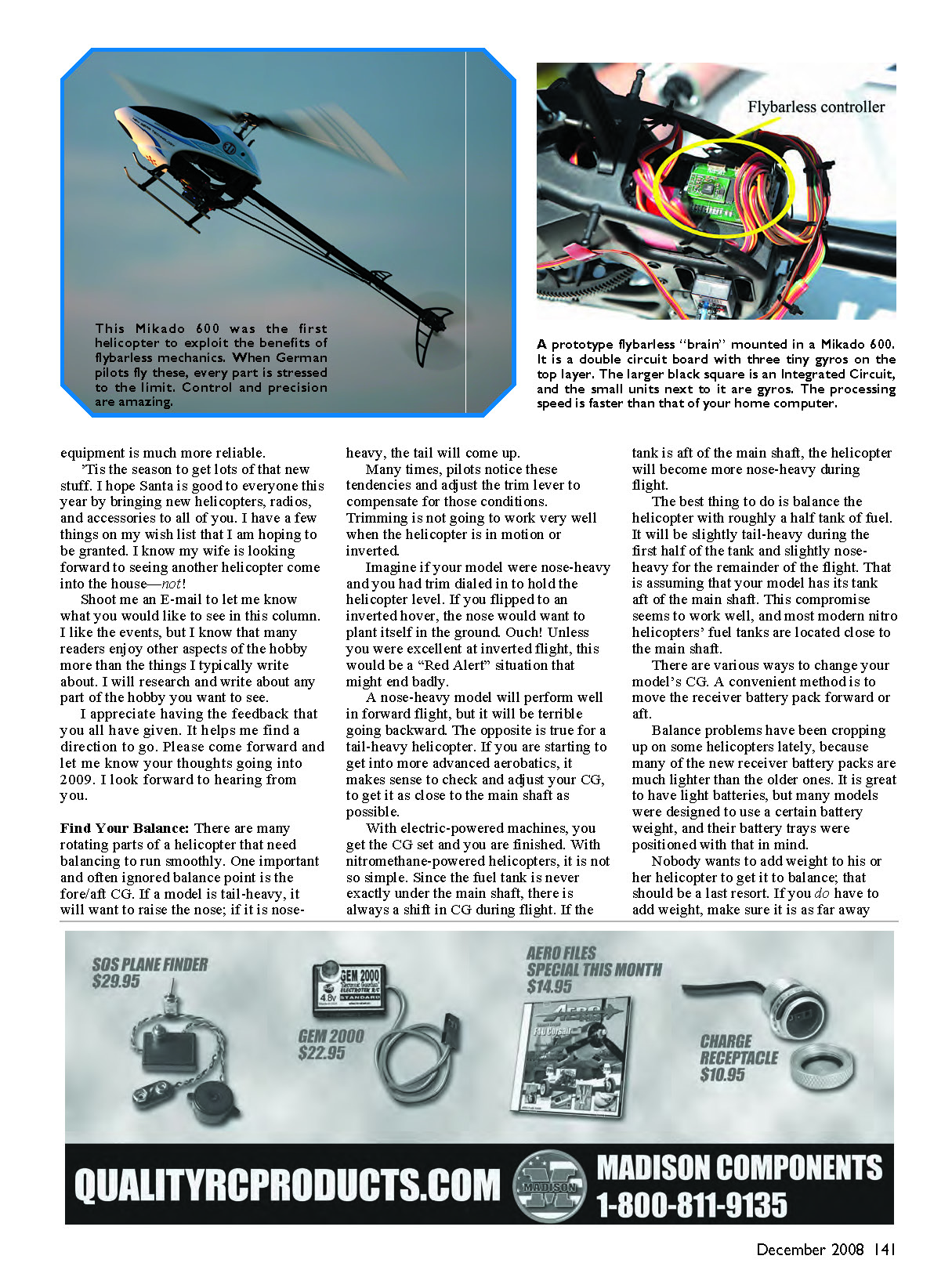
If you have been to a fun-fly lately, you might have seen a helicopter or two flying sans flybar. Several companies are working with this innovation. Everywhere I go, people have questions about the flybarless electronics and how it works.
It is a promising advancement for a helicopter's main rotor head. The benefits in stability and increased cyclic quickness are substantial. The flybarless setup basically turns your helicopter into a fly-by-wire collective and cyclic control system. The pilot is no longer in direct control of those functions.
The flybarless electronics are designed to interpret what stick movements you are making and then adjust the deflection of the main rotor blades to give the desired response. The onboard computer is capable of giving the helicopter a solid, locked-in feel, while letting the head go to further extremes in pitch than ever before. That is the best of both worlds; it makes the helicopter stable and aggressive at the same time.
Only fly-by-wire controls can be set up to accomplish the radical pitch movements our helicopters need for the next generation of violent 3-D maneuvers. The problem with the traditional flybar setup is that a compromise between stability and responsiveness has to be accepted. The promise that flybarless technology holds is exciting.
I think most of our models will be without flybars in the near future.
However, as with any new equipment, the bugs have to be worked out first. Several pilots around the world are working nonstop to tweak the new flybarless systems.
Mikado has had its V-Bar in use for several years. It works great on the smaller electric models, but the goal is to get a product that will work on 90-size nitro helicopters as well. A few other companies are in the design and testing stages with their units.
As with all electronics, everything is getting smaller and better. The old gyro sensors were approximately the size of your thumb, but 100 of the latest gyro sensors could fit inside the space our old sensors used. The smaller and lighter part of electronics evolution has benefited RC helicopters in many ways.
When you look inside one of the new flybarless electronic boxes, it will blow you away; the parts are so small. While I was looking at one, I asked the developer where the gyro sensors were.
“There are three of them right in there,” he said.
I couldn't believe it; the tiny built-in gyros were roughly the size of a pencil-lead tip. Three of these micro gyro units were built into the system.
Soon, all the necessary components will fit inside the case of a standard gyro, such as a Futaba 401. That will be great, because we will have flybarless 450-size mini electrics. (As if we need them to be more aerobatic; more stable will be welcome.)
The weight won't be a factor, since the average gyro size is already used on 450-class electrics. The control response will be so much better and smoother, especially on the smaller models.
I cannot wait to see all the stuff come to market. The next couple years might hold the most advancement we have ever seen. Our hobby is doing great in worldwide sales, which is driving all the new technology.
That is all I have room for this month. I will follow up on the flybarless progression as it happens. I am always on the lookout for new and interesting things in our hobby, so let me know what is going on. I will be back with you all next year. MA
Transcribed from original scans by AI. Minor OCR errors may remain.

