
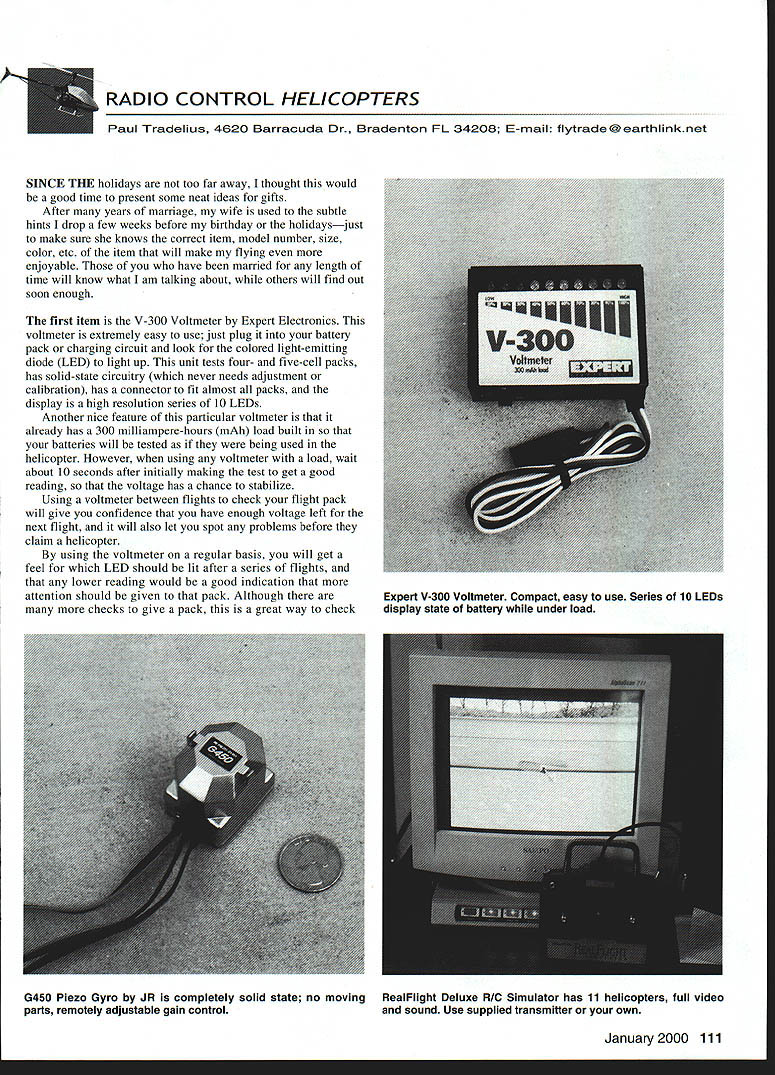

RADIO CONTROL HELICOPTERS
Paul Tradelius, 4620 Barracuda Dr., Bradenton FL 34208; E-mail: [email protected]
SINCE THE holidays are not too far away, I thought this would be a good time to present some neat ideas for gifts.
After many years of marriage, my wife is used to the subtle hints I drop a few weeks before my birthday or the holidays—just to make sure she knows the correct item, model number, size, color, etc. of the item that will make my flying even more enjoyable. Those of you who have been married for any length of time will know what I am talking about, while others will find out soon enough.
Voltmeter: Expert Electronics V-300
The first item is the V-300 Voltmeter by Expert Electronics. This voltmeter is extremely easy to use; just plug it into your battery pack or charging circuit and look for the colored light-emitting diode (LED) to light up. This unit tests four- and five-cell packs, has solid-state circuitry (which never needs adjustment or calibration), has a connector to fit almost all packs, and the display is a high resolution series of 10 LEDs.
Another nice feature of this particular voltmeter is that it already has a 300 milliampere-hours (mAh) load built in so that your batteries will be tested as if they were being used in the helicopter. However, when using any voltmeter with a load, wait about 10 seconds after initially making the test to get a good reading, so that the voltage has a chance to stabilize.
Using a voltmeter between flights to check your flight pack will give you confidence that you have enough voltage left for the next flight, and it will also let you spot any problems before they claim a helicopter.
By using the voltmeter on a regular basis, you will get a feel for which LED should be lit after a series of flights, and that any lower reading would be a good indication that more attention should be given to that pack. Although there are many more checks to give a pack, this is a great way to check.
Gyros: JR G450 Piezo Gyro
The new G450 Piezo Gyro is the latest in a series of remote gain-control gyros from JR. Those of us who have been in this hobby for a while can still find a few of the older mechanical gyros in our box of spare parts, but they are becoming more and more rare with each passing day.
In their time, the mechanical gyros were the best we had—and we loved them. It took a large amount of current (battery) to power the spinning wheels in the gyro, which sensed any yaw movement, and then processed the signal to a correcting tail-rotor response. However, these new piezo gyros take us a step ahead by having no moving parts to wear out, providing almost unlimited service life, requiring less power from our battery packs (since there are no moving parts), and by having a 10-times-faster response time than the older mechanical gyros.
I can't imagine any better reasons to get one if you are in the market for a new gyro. Weighing just 3½ grams, the G450 can be mounted just about anywhere with double-stick tape.
Possibly one of its best features is a spare connector that can be plugged into a spare channel to adjust the gain during flight. Some of the newer transmitters can change this gain adjustment from one flight mode to another, thereby fine-tuning the gyro to the particular maneuver you want to perform.
The only note of caution here is to be careful if you have been using a mechanical gyro on your helicopter, and then switched to a piezo gyro. The piezo gyros are so much faster in their processing and dynamic range that previous tail-rotor settings may have to be changed. Remember, when all else fails, read the instructions.
For those of you who are new to helicopters, a gyro can be a mixed blessing. Although gyros really tame the tail down when set up properly, they can be a nightmare if they are not understood.
The two basic adjustments are direction and gain.
- Direction: By direction, I mean that the gyro is sending the proper correction to the tail-rotor servo. If not, and the helicopter is spinning to the right, the gyro will command it to spin even more to the right rather than stop the rotation.
This problem can be easily fixed on the workbench by hooking up the gyro and turning on the transmitter and receiver with the gyro on the table in front of you. Move the tail-rotor stick to the right and see which way the servo moves. Twist the gyro to the left, and observe if the servo moves in the same (right) direction.
The idea here is that any movement of the gyro to the left should result in a corresponding right servo movement. If it's backwards, turn the system off and move the switch from normal to reverse.
- Gain: The gain is a little more difficult to adjust, but stick to the settings in the instructions until you have a need to change them while flying. Having a remote-gain gyro such as the G450 makes further adjustments rather easy, since all you have to do is watch the tail of the helicopter. If, in a hover or forward flight, the tail oscillates from side to side, the gain is too high, and should be adjusted down slightly. However, if the nose wanders and does not hold a steady position, increase the gain slightly. This should get you going with just about any gyro until more-advanced techniques are needed.
Flight Simulators: RealFlight Deluxe
One of the best presents any flier can receive to improve his/her flying skill is a flight simulator for the home personal computer (PC). Much of our learning comes from trial-and-error (seeing what effect a certain control-stick movement has on the helicopter) and then repeating the action to solidify the learning process.
Prior to PCs and flight simulators, all we had to experiment with was our helicopters, which resulted in many mishaps. But with a simulator you can practice in any weather at any time, in the comfort of your own home, without helicopter maintenance or the cost of fuel, and you can fly with reckless abandon. You aren't afraid of crashing, and can therefore do more experimenting to perfect a certain maneuver.
Great Planes Model Manufacturing has just released its new RealFlight Deluxe R/C Simulator for helicopters and fixed-wing airplanes. Having airplanes and helicopters in one package will allow the fixed-wing pilots to give helicopters a try in the privacy of their own homes, so they can see how much fun flying helicopters can be.
The RealFlight Deluxe has really taken a big step forward in what we have come to expect from a flight simulator. You have a choice of using the transmitter provided, or with a separate adaptor you can use your own radio to keep the feel of your sticks and to switch locations. I have used both, and like the standard transmitter just to get some stick time, but I prefer my own transmitter when I'm practicing some of the more-difficult maneuvers. But at least this way you have a choice.
The system requires a fairly new PC to get the most from the helicopter movements and graphics, so ask your dealer for the specifics if there is any doubt. Getting started couldn't be easier; just connect the transmitter to the proper receptacle on your computer and load the program from the compact disc. Although instructions are provided, you will find all the various adjustments quite easy to follow with just a little experimenting.
To me, probably the most important feature of a simulator is the feel of the helicopter. If the helicopter doesn't move as my real helicopter does, then I'm not getting the most from my training time, and I'm very happy to say the RealFlight Deluxe is great right out of the box.
There are 11 helicopters to choose from, depending on your level of flying, and a host of parameters you can change to make the helicopter fly to your own particular taste.
The next-most-important point is that the helicopter and surrounding graphics should look as real as possible. I am very happy with the presentation of the different helicopters, as well as the background of a runway with blue skies and distant woods—just like at our flying site. This makes me feel right at home, in my own home.
I think that we are all very fortunate to have such a great hobby to enjoy, and I hope this holiday season you will find that special present under the tree to make your flying even more enjoyable during the coming year. MA
Transcribed from original scans by AI. Minor OCR errors may remain.

