
Radio Control Jets
Jim Hiller [[email protected]]
Obtaining your waiver to fly with turbine power
You want to be a jet pilot, but this turbine-waiver thing is just too hard and confusing. It shouldn't be.
I'll end one misconception: notarized signatures are not required. That was a one-time requirement a few years ago that was enacted to satisfy a political agenda. It's gone and should never be required again.
To better understand what a turbine waiver is and why it exists, I'll start with a quick history lesson. Interest in turbine jet engines for model airplane use began approximately 20 years ago. Some of the immediate results were negative, and as a result, AMA put into its safety regulations a statement banning turbines.
Modelers in Europe were able to build successful turbine engines, but we in the United States had safety regulations banning this new technology. The AMA leadership chose not to ignore turbine modeling, but was conservative in its approach; after all, the organization represents a number of modelers, most of whom did not have an interest in jets.
An initial set of safety regulations was proposed and accepted by AMA's leadership, but to comply with the existing safety regulations, a pilot waiver was required. These early waivers involved a complicated test: a written portion followed by a flight test.
As time went by, modelers gained experience with turbines, equipment improved, and an understanding of these engines' unique differences increased.
This last rules-change cycle was the first time the Jet Pilots Organization (JPO) SIG actually accepted jet modeling and participated in a complete revamp of the rules. Before this, only a few volunteers had stepped forward and worked with the AMA Safety Committee to write and update the turbine rules.
That is where we are today. The turbine-waiver process is still necessary at this time, so don't fight it; jump in and participate. Its intent is to help fliers be successful jet modelers. It's an educational process, not a weeding-out process.
The formal turbine regulations and the turbine-waiver application are available on the AMA Web site. At the bottom of the home page, click on "Technical Info/Events" to go to the Competition section. Once there, click on "AMA Documents (pdf)." Document 510 is "Safety."
The flight demonstration (waiver) — what to expect
Check out the maneuvers and I bet you will be surprised. We are looking for basic modeling skills. You have to understand how to fly a model well, from the start of the takeoff roll to a complete stop on the runway. No complicated maneuvers are outlined; included are:
- A basic, well-executed takeoff
- A horizontal 8
- Two aerobatic maneuvers of the pilot's choice
- A high-speed circuit of the field
- A landing approach
- A landing to a complete stop
A high-speed model is to be used for this flight demonstration. Provisions are made to use propeller-driven models, ducted-fan aircraft, or even a jet-powered airplane. Read the regulations. Good speed control is important. The only time high speed is required—and expected—is during the high-speed circuit of the field. The rest of the time, good throttle management represents good judgment. If you know to throttle back when the speed of the aircraft gets ahead of you, speed will not be an issue. You control the speed at which you want to fly with throttle management. If you have an interest in jet modeling, go for it. On the "Documents" page you will find a list of all the jet-model waiver holders. Contact us, fly with us, and learn from our experiences as you work on attaining your turbine waiver.
Equipment notes — JetCat P120 SE
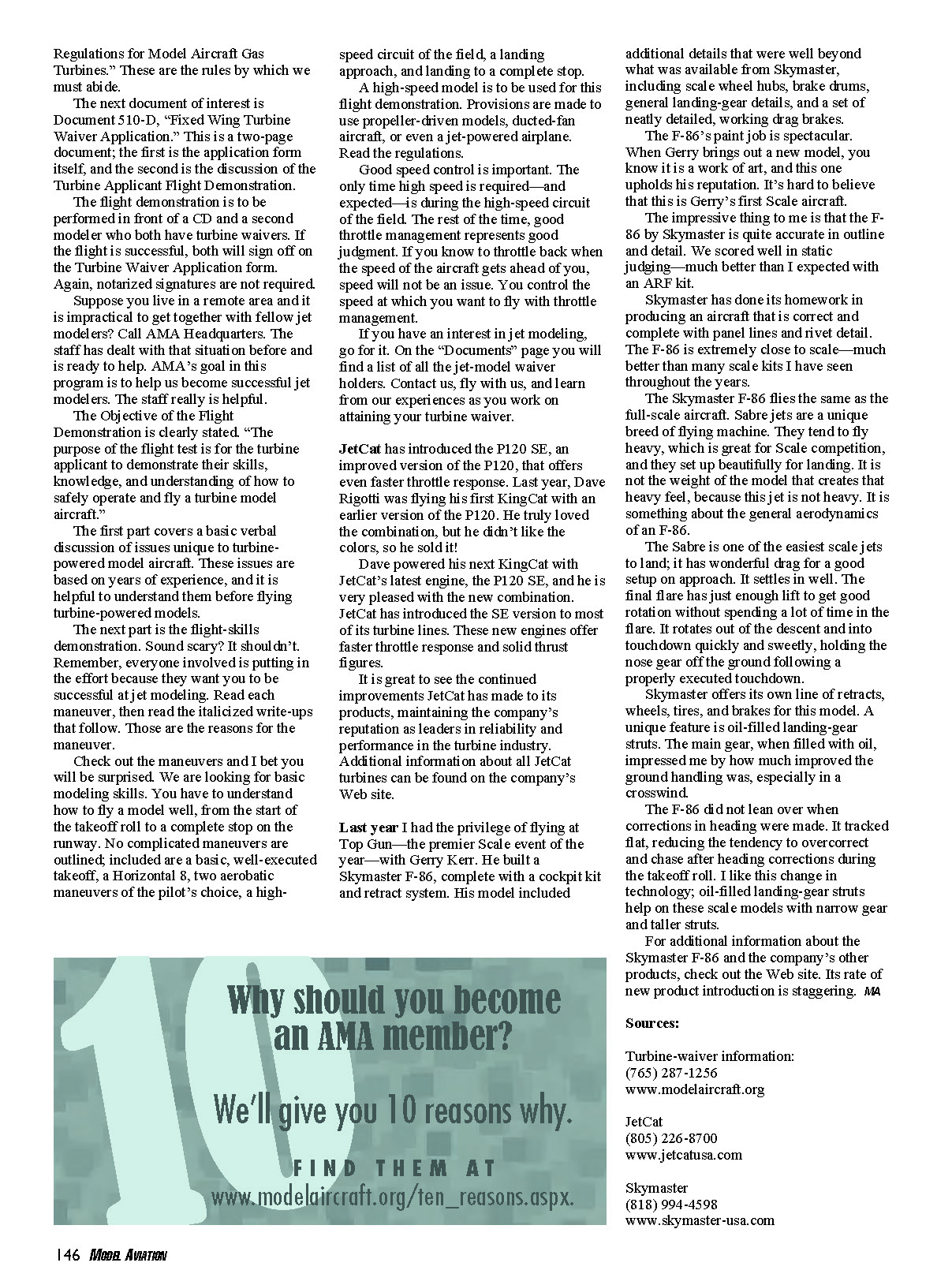
JetCat has introduced the P120 SE, an improved version of the P120, that offers even faster throttle response. Last year, Dave Rigotti was flying his first KingCat with an earlier version of the P120. He truly loved the combination, but he didn't like the colors, so he sold it!
Dave powered his next KingCat with JetCat's latest engine, the P120 SE, and he is very pleased with the new combination. JetCat has introduced the SE version to most of its turbine lines. These new engines offer faster throttle response and solid thrust figures.
It is great to see the continued improvements JetCat has made to its products, maintaining the company's reputation as leaders in reliability and performance in the turbine industry. Additional information about all JetCat turbines can be found on the company's Web site.
Scale event — Skymaster F-86 at Top Gun
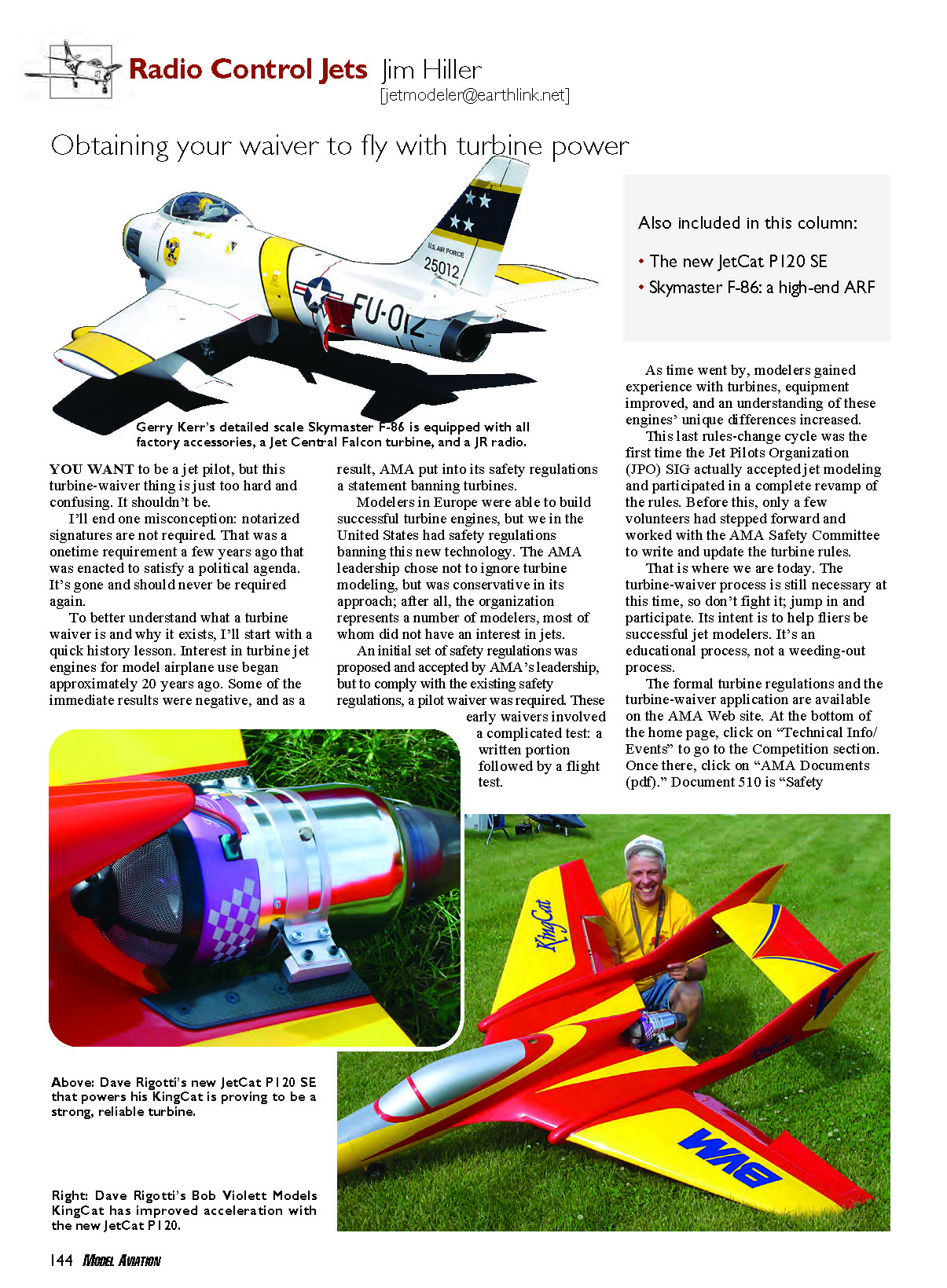
Last year I had the privilege of flying at Top Gun—the premier Scale event of the year—with Gerry Kerr. He built a Skymaster F-86, complete with a cockpit kit and retract system. His model included additional details that were well beyond what was available from Skymaster, including scale wheel hubs, brake drums, general landing-gear details, and a set of neatly detailed, working drag brakes.
The F-86's paint job is spectacular. When Gerry brings out a new model, you know it is a work of art, and this one upholds his reputation. It's hard to believe that this is Gerry's first Scale aircraft.
The impressive thing to me is that the F-86 by Skymaster is quite accurate in outline and detail. We scored well in static judging—much better than I expected with an ARF kit.
Skymaster has done its homework in producing an aircraft that is correct and complete with panel lines and rivet detail. The F-86 is extremely close to scale—much better than many scale kits I have seen throughout the years.
The Skymaster F-86 flies the same as the full-scale aircraft. Sabre jets are a unique breed of flying machine. They tend to fly heavy, which is great for Scale competition, and they set up beautifully for landing. It is not the weight of the model that creates that heavy feel, because this jet is not heavy. It is something about the general aerodynamics of an F-86.
The Sabre is one of the easiest scale jets to land; it has wonderful drag for a good setup on approach. It settles in well. The final flare has just enough lift to get good rotation without spending a lot of time in the flare. It rotates out of the descent and into touchdown quickly and sweetly, holding the nose gear off the ground following a properly executed touchdown.
Skymaster offers its own line of retracts, wheels, tires, and brakes for this model. A unique feature is oil-filled landing-gear struts. The main gear, when filled with oil, impressed me by how much improved the ground handling was, especially in a crosswind.
The F-86 did not lean over when corrections in heading were made. It tracked flat, reducing the tendency to overcorrect and chase after heading corrections during the takeoff roll. I like this change in technology; oil-filled landing-gear struts help on these scale models with narrow gear and taller struts.
For additional information about the Skymaster F-86 and the company's other products, check out the Web site. Its rate of new product introduction is staggering.
Sources
Turbine-waiver information:
- (765) 287-1256
- www.modelaircraft.org
JetCat:
- (805) 226-8700
- www.jetcatusa.com
Skymaster:
- (818) 994-4598
- www.skymaster-usa.com
Transcribed from original scans by AI. Minor OCR errors may remain.

