
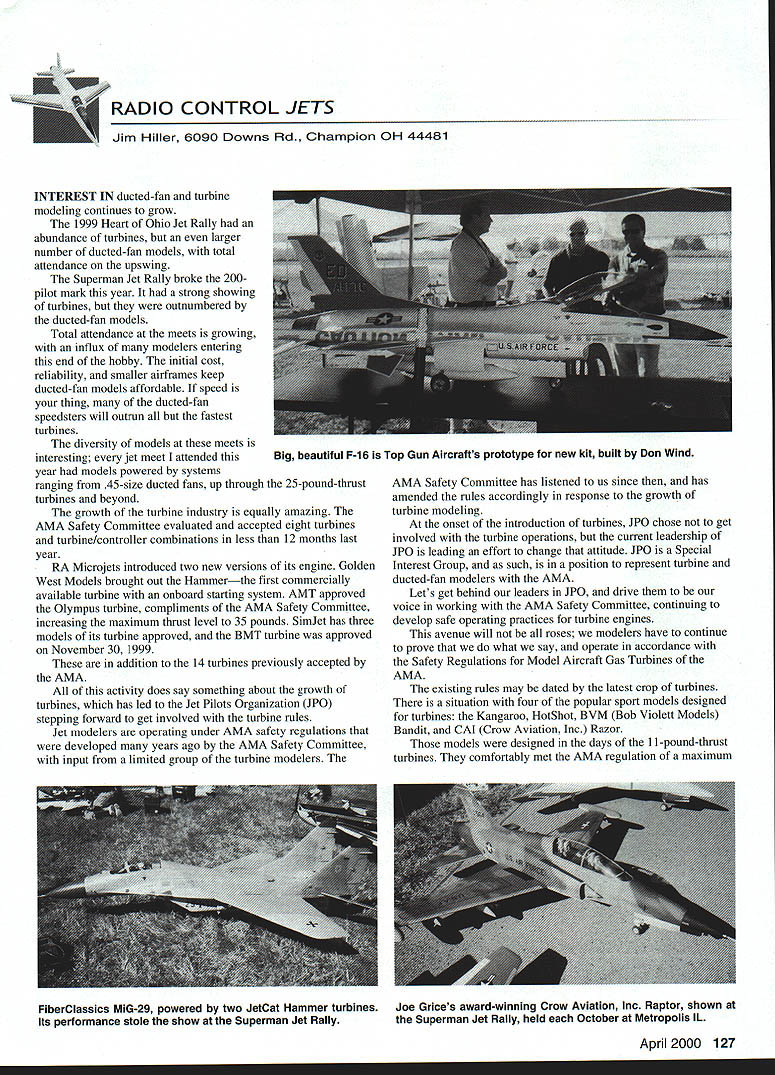
RC Jets
Jim Hiller, 6090 Downs Rd., Champion OH 44481
Interest and attendance
Interest in ducted-fan and turbine modeling continues to grow. The 1999 Heart of Ohio Jet Rally had an abundance of turbines, but an even larger number of ducted-fan models, with total attendance on the upswing.
The Superman Jet Rally broke the 200-pilot mark this year. It had a strong showing of turbines, but they were outnumbered by the ducted-fan models.
Total attendance at the meets is growing, with an influx of many modelers entering this end of the hobby. The initial cost, reliability, and smaller airframes keep ducted-fan models affordable. If speed is your thing, many of the ducted-fan speedsters will outrun all but the fastest turbines.
The diversity of models at these meets is interesting; every jet meet I attended this year had models powered by systems ranging from .45-size ducted fans up through the 25-pound-thrust turbines and beyond.
Turbine industry growth and approvals
The growth of the turbine industry is equally amazing. The AMA Safety Committee evaluated and accepted eight turbines and turbine/controller combinations in less than 12 months last year.
Notable developments and approvals include:
- RA Microjets introduced two new versions of its engine.
- Golden West Models brought out the Hammer—the first commercially available turbine with an onboard starting system.
- AMT approved the Olympus turbine, compliments of the AMA Safety Committee, increasing the maximum thrust level to 35 pounds.
- SimJet has three models of its turbine approved.
- The BMT turbine was approved on November 30, 1999.
These are in addition to the 14 turbines previously accepted by the AMA.
All of this activity highlights the growth of turbines and has led the Jet Pilots Organization (JPO) to step forward to get involved with turbine rules.
JPO and safety regulations
Jet modelers are operating under AMA safety regulations that were developed many years ago by the AMA Safety Committee, with input from a limited group of turbine modelers. The AMA Safety Committee has listened to us since then and has amended the rules accordingly in response to the growth of turbine modeling.
At the onset of the introduction of turbines, JPO chose not to get involved with turbine operations, but the current leadership of JPO is leading an effort to change that attitude. JPO is a Special Interest Group and, as such, is in a position to represent turbine and ducted-fan modelers with the AMA.
Let’s get behind our leaders in JPO and drive them to be our voice in working with the AMA Safety Committee, continuing to develop safe operating practices for turbine engines.
This avenue will not be all roses; we modelers have to continue to prove that we do what we say and operate in accordance with the Safety Regulations for Model Aircraft Gas Turbines of the AMA.
Thrust-to-weight rule and model concerns
The existing rules may be dated by the latest crop of turbines. There is a situation with four of the popular sport models designed for turbines: the Kangaroo, HotShot, BVM (Bob Violet Models) Bandit, and CAI (Crow Aviation, Inc.) Razor.
Those models were designed in the days of the 11-pound-thrust turbines. They comfortably meet the AMA regulation of a maximum of 0.9 pounds of thrust per pound of model empty weight.
Then the 15- to 17-pound-thrust turbines came out, and these models suddenly pushed the limits of this rule. These turbines are not really any heavier or larger—just more powerful.
Now some of these models could be built approaching the minimum empty weight of 19 pounds when equipped with a 17-pound-thrust turbine. I don't know any modelers who really tried to lighten a model to do this, but I'm sure it was possible.
The turbines submitted to the AMA for approval in the last few months are developments of the 15- to 17-pound-thrust turbines, capable of as much as 25 pounds of thrust with minimal size and weight gains over their predecessors.
These next-generation turbines could fit into these sport jets, but it would be quite a chore to build one at an empty weight of 28 pounds—the weight required to meet the 0.9-to-1 thrust-to-weight ratio limit.
Kit manufacturers may not even want their models flown at these weights, for structural reasons and for the excess airspeed that comes with the additional thrust.
The original intent of the 0.9-pounds-of-thrust-to-one-pound-of-model ratio was to limit maximum airspeed. You could argue that it is not an effective way to limit speed, but it is a measurable rule that can be enforced. I'm not a fan of this rule, but I don't have a better answer.
It's been proven that a model with greater than the 1:1 thrust-to-weight ratio can have a significantly lower maximum airspeed just by increasing drag with oversize air inlets. This combination offers awesome vertical push, but without the high airspeeds normally associated with such a thrust-to-weight ratio.
The problem comes with clean aircraft combined with the high speed of the jet exhaust. Measured jet speeds regularly exceed 200 mph, with maximum speed runs exceeding even the fastest of the ducted-fan speed models, and we aren't even trying to push jets to their maximum speed potentials.
This year, for the first time we could be facing a well-built, well-intentioned model that violates this rule just by putting together a proven airframe with a new-generation turbine. This model cannot be flown under the AMA Safety Regulations and hence cannot be flown at any AMA meeting, including jet meets.
As a modeler, you need to be aware of this potential.
Contest Directors will be facing this rule for the first time; let's support them. Don't build these combinations, and support the CDs when they are forced by an irresponsible modeler to enforce this rule.
Let's work through the Jet Pilots Organization to develop our AMA Safety Regulations for Model Aircraft Gas Turbines as technology continues to improve.
Contest director spotlight: Burt Eisenberg
Compliments to first-time Contest Director Burt Eisenberg, host of the 1999 Michigan Jet Rally on Grosse Ile Airport.
Burt is an active jet flier; he's flown at most major jet meets during the years. He decided that it was his turn to host an event, which is no minor undertaking. Any Contest Director will tell you of the numerous hours that he or she and the staff of volunteers put in to prepare for the meet, and the hours at the meet itself.
Burt put a slightly different twist on jet meets. He ran the event with half the proceeds going to the Ronald McDonald House and the other half going to a fund to erect a veterans' memorial at Grosse Ile Airport.
No entry fee was required; all funds raised were from parking, concessions, and other sources. Local businesses got behind the event with donations of money and products. There was coffee and doughnuts in the morning, lunch at the concession stand, and use of telephones from the local cellular telephone company for contest officials.
The cell phones were preprogrammed with the local emergency response numbers in case these services were required. Preparation for emergencies should not be taken lightly when holding a large spectator event, such as a model airplane meet.
Burt did a marvelous job. Many Midwest jet jocks are looking forward to this year's event, and Burt and friends are promising a bigger and better meet. See you there.
My winter project and observations from the Supermeet
I took delivery of a Crow Aviation Razor, along with a Golden West Hammer turbine, for my winter project.
As are many kits today, the Razor is a completely molded composite model—that's fuselage, wing, tail feathers, ailerons, flaps, and so on. This is my first of these new-generation kits, and it sure spoils you.
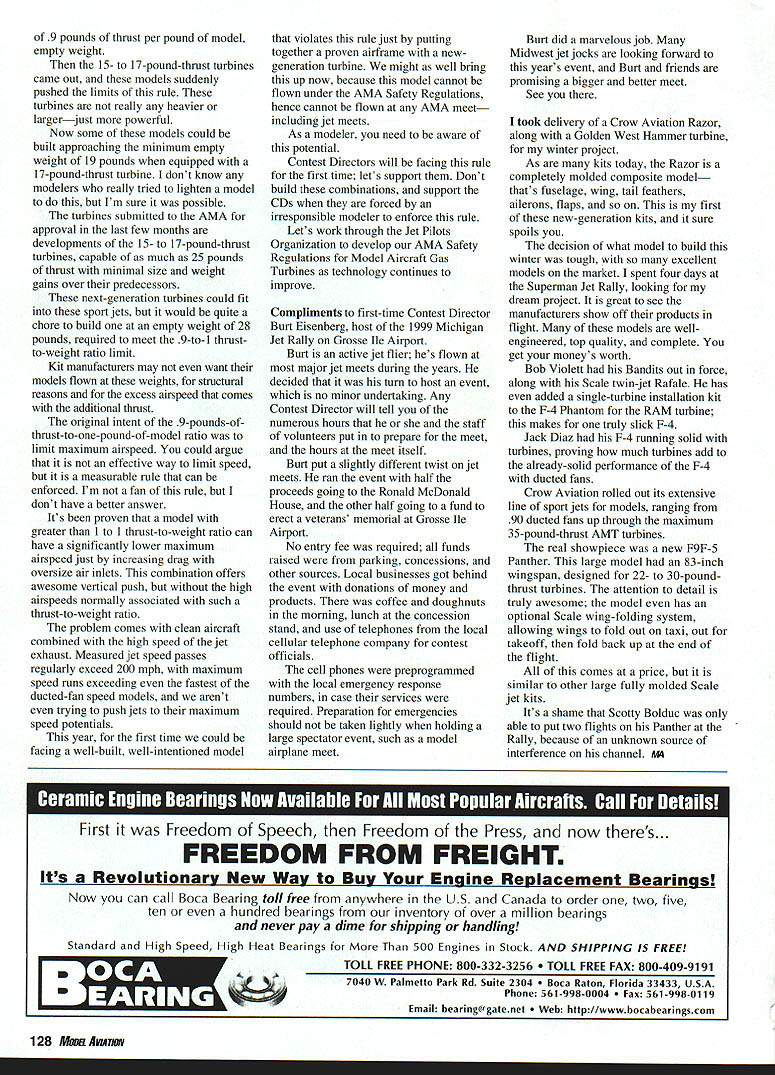
The decision of what model to build this winter was tough, with so many excellent models on the market. I spent four days at the Supermeet Jet Rally, looking for my dream project. It is great to see the manufacturers show off their products in flight. Many of these models are well-engineered, top quality, and complete. You get your money's worth.
Bob Violet had his Bandits out in force, along with his scale twin-jet Rafale. He has even added a single-turbine installation kit to the F-4 Phantom for the RAM turbine; this makes for one truly slick F-4.
Jack Diaz had his F-4 running solid with turbines, proving how much turbines add to the already-solid performance of the F-4 with ducted fans.
Crow Aviation rolled out its extensive line of sport jets for modelers, ranging from 90 ducted fans up through the maximum 35-pound-thrust AMT turbines.
The real showpiece was a new F9F-5 Panther. The large model had an 83-inch wingspan, designed for 22- to 30-pound-thrust turbines. The attention to detail is truly awesome; the model even has an optional scale wing-folding system, allowing wings to fold out on taxi, out for takeoff, then fold back up at the end of the flight.
All of this comes at a price, but it is similar to other large fully molded scale jet kits.
It's a shame that Scotty Bolduc was only able to put two flights on his Panther at the Rally because of an unknown source of interference on his channel.
MA
Transcribed from original scans by AI. Minor OCR errors may remain.

