

A tale of two turbines
Jim Hiller
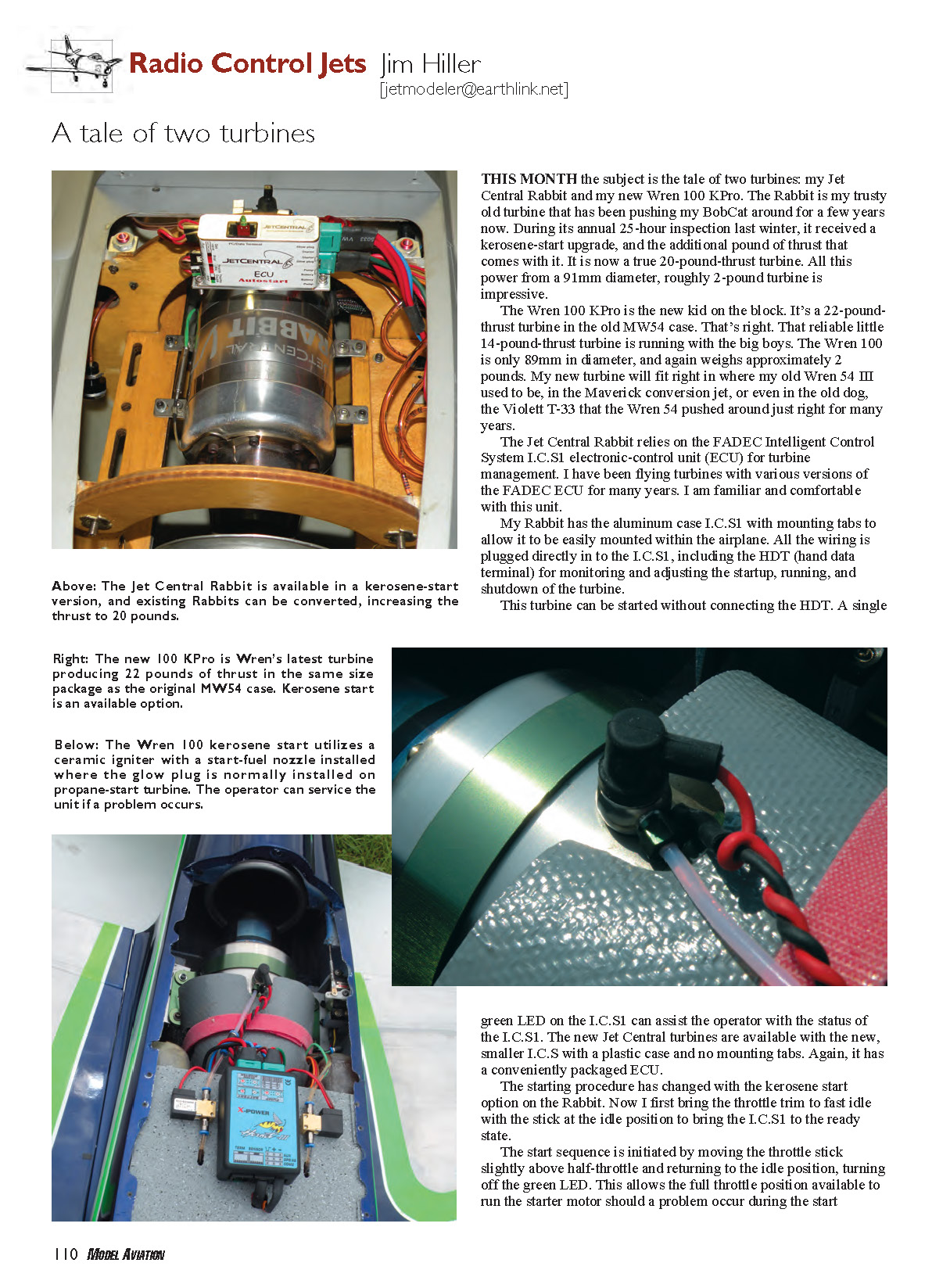
THIS MONTH the subject is the tale of two turbines: my Jet Central Rabbit and my new Wren 100 KPro. The Rabbit is my trusty old turbine that has been pushing my BobCat around for a few years now. During its annual 25-hour inspection last winter, it received a kerosene-start upgrade, and the additional pound of thrust that comes with it. It is now a true 20-pound-thrust turbine. All this power from a 91mm diameter, roughly 2-pound turbine is impressive.
The Wren 100 KPro is the new kid on the block. It's a 22-pound-thrust turbine in the old MW54 case. That's right. That reliable little 14-pound-thrust turbine is running with the big boys. The Wren 100 is only 89mm in diameter, and again weighs approximately 2 pounds. My new turbine will fit right in where my old Wren 54 III used to be, in the Maverick conversion jet, or even in the old dog, the Violett T-33 that the Wren 54 pushed around just right for many years.
The Jet Central Rabbit relies on the FADEC Intelligent Control System I.C.S1 electronic-control unit (ECU) for turbine management. I have been flying turbines with various versions of the FADEC ECU for many years. I am familiar and comfortable with this unit.
My Rabbit has the aluminum case I.C.S1 with mounting tabs to allow it to be easily mounted within the airplane. All the wiring is plugged directly in to the I.C.S1, including the HDT (hand data terminal) for monitoring and adjusting the startup, running, and shutdown of the turbine.
This turbine can be started without connecting the HDT. A single green LED on the I.C.S1 can assist the operator with the status of the I.C.S1. The new Jet Central turbines are available with the new, smaller I.C.S with a plastic case and no mounting tabs. Again, it has a conveniently packaged ECU.
The starting procedure has changed with the kerosene start option on the Rabbit. Now I first bring the throttle trim to fast idle with the stick at the idle position to bring the I.C.S1 to the ready state.
The start sequence is initiated by moving the throttle stick slightly above half-throttle and returning to the idle position, turning off the green LED. This allows the full throttle position available to run the starter motor should a problem occur during the start sequence. If a hot start occurs, the operator can move the idle trim to low, shutting down the turbine, and then run the throttle up to the full throttle position to run the starter motor. That’s a nice feature to help control a hot-start situation.
The KPro version of the Wren 100 features the ProJET Hornet III ECU for turbine control. This ECU promises plenty of upgrade options including a downlink transmitter and receiver unit with both a screen and audible alert options from the airplane, including options for airspeed and fuel status. I look forward to getting these options.
The ProJET Hornet is a large, plastic ECU. Again all wiring plugs into the ECU, but it requires more electronics to run. The turbine’s rpm and temperature probes plug into a termination block, and a stiff telephone-type cord plug extends from the termination block to the ECU.
Also plugging into the ECU is an I/O board, again with a telephone-type cord. This I/O board provides visual and audible indication of ECU operations, and provides a single button switch to prime the kerosene lines.
This I/O board is also the place to plug in the ground support unit (GSU) with another telephone-type cord. This is a lot of electronic stuff for such a small turbine, but the I/O board can be removed if desired once the kerosene lines are primed, because the GSU can be plugged directly into the ECU.
Once we get past the electronics, the plumbing of both these turbines is similar. A fuel pump draws fuel from the kerosene fuel tank. From the pump, a “Y” connection then divides kerosene to two fuel solenoids, one feeding the start injector, and one feeding the main fuel nozzles for turbine running. Both of these fuel lines must be primed; care must be taken not to pump kerosene in to the engine, only fill the lines up to the turbine.
One difference is that the Jet Central Rabbit uses 4mm diameter tubing from the fuel pump to the turbine while Wren continues to use 3mm diameter tubing. Both work well.
Now let’s talk numbers. These are two different turbines achieving their respective power at different rpms. Maximum thrust on the Rabbit is attained at 152,000 rpm and the Wren at 160,000 rpm. Idle thrust is rated at .8 pounds for the Rabbit, and the Wren is rated at .6 pounds of thrust.
My experience with previous Wren turbines is that they really run their idle speeds lower than most manufacturers, but both turbines’ idle thrusts are low enough that I doubt that on most applications it would make a difference. Each manufacturer rates fuel usage differently.
Enough about these turbines; let’s go fly them!
I put them up against each other by converting my BVM Maverick to first the Jet Central Rabbit, then to the Wren 100KPro—a head-to-head comparison at the field. The Rabbit required a new set of mounts to fit in where the Wren 54 had, but the size only required these new mounts to move the holes forward to increase the turbine-to-pipe spacing up to approximately 1 inch. I continued to use the same tailpipe.
The Maverick weighs in at slightly less than 16 pounds with the Rabbit installed, but I did change from the supplied 4300 mAh NiMH two-cell battery to a 3000 mAh NiMH two-cell battery for CG and space reasons. The Maverick only has 62 ounces of fuel capacity—slightly small for this type of power—but you live with what you have. No other setup changes were made, so let’s go fly this hot rod.
The Rabbit’s start procedure is simple: open the manual fuel valve, turn on all systems, move the throttle trim up to fast idle, and the GSU will show “Ready.” Initiate the start sequence by cycling the throttle approximately halfway. Pull it back to idle and the GSU should read “Burner On.”
It takes 8-10 seconds for the ceramic plug to warm up. The fuel pump will pulse and pump fuel to the start injector then the main fuel solenoid will open. Fuel pump power will continue to increase until idle rpm is achieved, and the turbine will be in the “Run” mode.
I set the timer at 5 minutes. That’s from start of takeoff roll until setup for landing. I had used 6 minutes with the little Wren 54, but started conservatively. My first flight was awesome! With this kind of power, the vertical lines went up forever, and full throttle in level flight was unnecessary. The throttle was so effective that I used power for real speed control.
Landing was straightforward. There was plenty of low enough idle thrust to not affect landing. I was surprised at this kind of power, yet no excess idle thrust affected the normal landing approach. Man, I like this!
I flew this Maverick-Rabbit combination for a few weeks. I found that I could use a 6-minute timer, land with plenty of fuel, and feel comfortable enough to land, turn around, takeoff, and shoot a second landing just for fun. This is an efficient turbine when it comes to fuel usage, but of course full throttle is not used for extended times in flight with such a small, lightweight aircraft.
Now it's the Wren 100 KPro’s turn to push the Maverick, so I pulled the little Rabbit. The Wren 100 fit on the new mounts. It required drilling new mounting holes with a different pattern. This time I set the turbine-to-tailpipe spacing at 1 1/8 inch per the Wren recommendation, which worked well.
Fitting the larger ECU and additional termination block did take some work. Size matters in a small airplane such as the Maverick, but everything fit. I did not install the I/O board, but I did use it to prime the fuel lines. I plug the GSU directly in to the ECU to monitor the start sequence. That saves space on a tight airplane. This time the supplied 2100 mAh two-cell LiPo fit right in matching the removed battery so there was no change in the CG and it was within ounces of the previous installation.
The supplied fuel lines and quick disconnect fittings were more than ample to set up the Wren 100 in the Maverick. Wren provides enough 3mm diameter tubing for a typical setup. Most turbines use 4mm diameter tubing, so my supply of 3mm tubing was in short supply.
One difference between the Jet Central Rabbit and the Wren 100 becomes immediately apparent. When the harness and fuel lines are hooked up and connected, the Rabbit has an internal ceramic igniter and start nozzle leaving the exterior diameter of the turbine housing clean. The only cuts required in the ductwork were to route cables and fuel lines.
The Wren 100 KPro has an external ceramic plug and start nozzle located where a glow plug on a typical propane-start turbine would be found, so a hole through the side of the turbine duct was required.
A hard plastic tube leads from the igniter/start nozzle to a coupling for the kerosene line connection because of the proximity to the turbine’s hot outer casing. The ceramic igniter and start nozzle are user-serviceable with instructions provided in the manual if it becomes necessary.
The manual provided with the Wren is informative and addresses many details of turbine operations, along with a good troubleshooting guide. The Wren’s kit-built turbine roots show in the maintenance information provided. You have access to many program options with information about how to use them to control your turbine start and running operations. That’s nice for an experienced turbine modeler; you can fine-tune the start sequence. I compliment Wren on this informative manual.
Let’s go fly this new turbine. The Maverick is again fueled with 62 ounces of kerosene. With the ProJET ECU set at fast idle trim, with the stick at idle, the ECU boots up with power on. Move the throttle to full and the unit goes to the standby state, then cycle the throttle within 2 seconds to idle, back to full throttle, and back to idle, and the start sequence begins.
The start sequence is similar to the Jet Central kerosene start, and just as smooth and quiet, however there is a difference. When the motor reaches the 45,000 rpm idle speed, the Wren will calibrate idle fuel pump, then run up to 85,000 rpm and calibrate at this speed, then finally cut back to idle and reach the run state.
Now it’s time to fly and compare the performance of the Wren vs. the Rabbit. The Wren is rated at 2 pounds greater thrust, and it produces a slightly faster level flight speed. Vertical push feels similar, especially when following a low-speed pass. With 16 pounds of airplane and 20-plus pounds of thrust, this aircraft isn’t going to slow down on the verticals. What a blast!
I fly the Wren in a similar manner as I did the Rabbit, having fun with the throttle stick and doing aerobatics that only this kind of power-to-weight ratio can provide.
I set the flight timer to 6 minutes, and was surprised that the Wren 100 KPro uses the same amount of fuel as the Rabbit for a typical flight. I love the fuel efficiency of this new generation of turbines! With only 62 ounces of fuel, once more the Maverick landed with plenty of fuel to power up and go around again. The Wren 100 will remain in the Maverick for the rest of the summer, so I look forward to putting some hours on this turbine and enjoying the kerosene start and incredible power of this generation of new small turbines.
The Jet Central Rabbit and the Wren 100 KPro are set for some heavy-duty flying. Each has unique features, and both perform as advertised. There is no shortage of power, they offer uneventful starts, and are able to push aircraft from my 16-pound Maverick all the way up to my 32-pound Vampire.
The 20- to 22-pound-thrust turbines are versatile in size, lightweight, powerful, fuel efficient, and great for a wide range of models that are large enough to be impressive, but not so large as to be difficult to transport and handle at the field.
See you at the field because it’s time to get back to flying.
Sources:
Wren Turbines [email protected] www.wrenturbines.co.uk
Jet Central www.jetcentralusa.com
Jet Pilots’ Organization www.jetpilots.org
Transcribed from original scans by AI. Minor OCR errors may remain.

