

Getting back into the swing of things
by Jim Hiller [email protected]
As I write this column, I am also preparing to test-fly three jets—a daunting task.
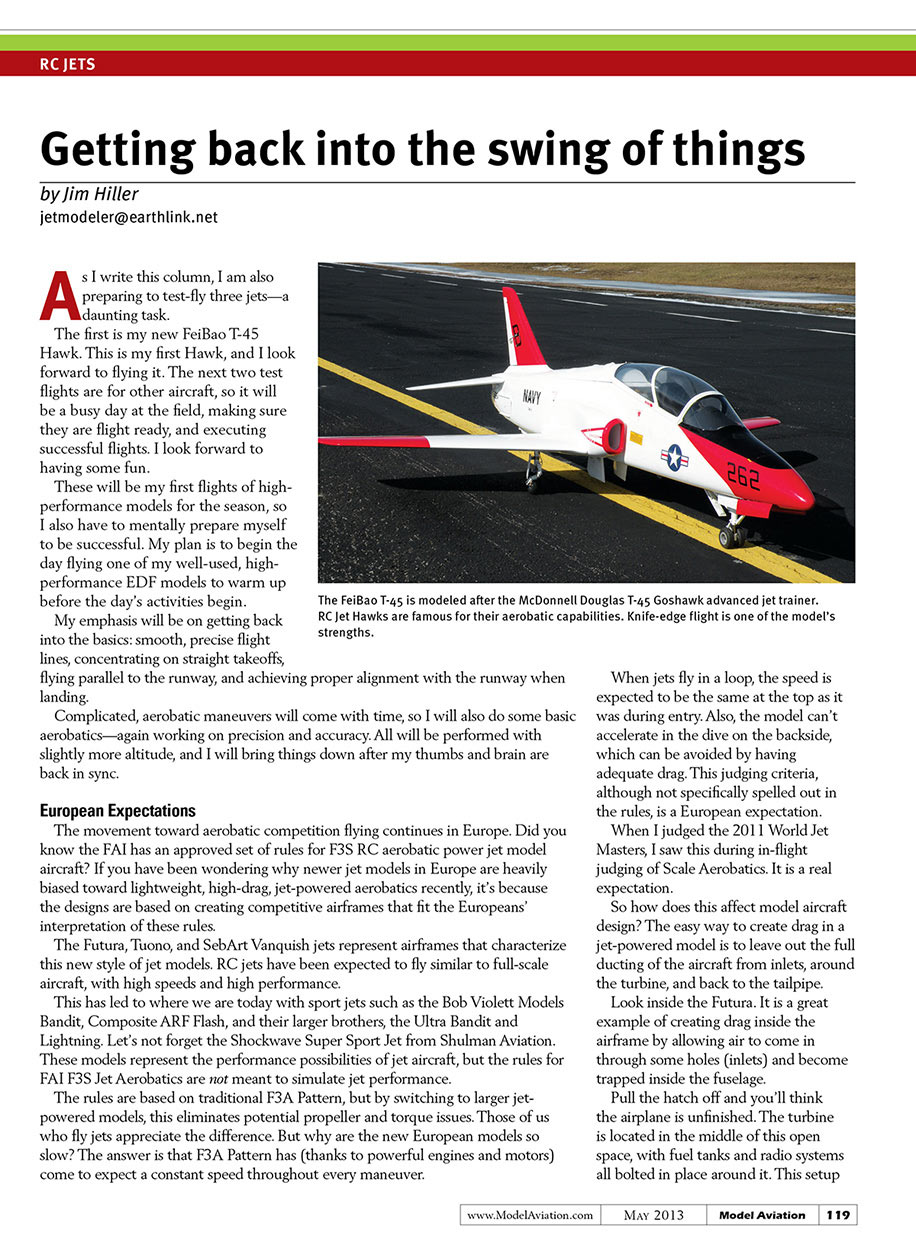
The first is my new FeiBao T-45 Hawk. This is my first Hawk, and I look forward to flying it. The next two test flights are for other aircraft, so it will be a busy day at the field, making sure they are flight ready, and executing successful flights. I look forward to having some fun.
These will be my first flights of high-performance models for the season, so I also have to mentally prepare myself to be successful. My plan is to begin the day flying one of my well-used, high-performance EDF models to warm up before the day’s activities begin.
My emphasis will be on getting back into the basics: smooth, precise flight lines, concentrating on straight takeoffs, flying parallel to the runway, and achieving proper alignment with the runway when landing.
Complicated, aerobatic maneuvers will come with time, so I will also do some basic aerobatics—again working on precision and accuracy. All will be performed with slightly more altitude, and I will bring things down after my thumbs and brain are back in sync.
European Expectations
The movement toward aerobatic competition flying continues in Europe. Did you know the FAI has an approved set of rules for F3S RC aerobatic power jet model aircraft? If you have been wondering why newer jet models in Europe are heavily biased toward lightweight, high-drag, jet-powered aerobatics recently, it’s because the designs are based on creating competitive airframes that fit the Europeans’ interpretation of these rules.
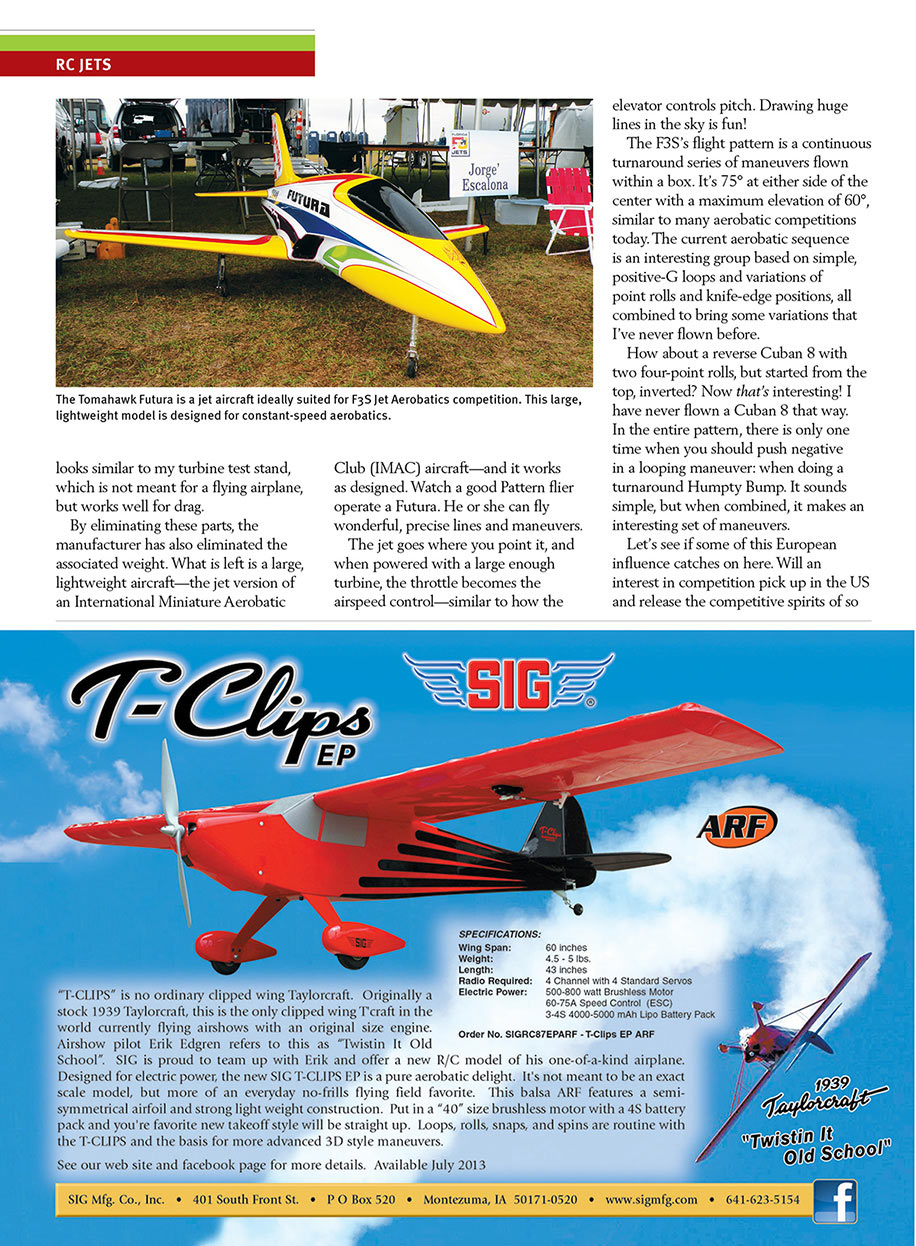
The Futura, Tuono, and SebArt Vanquish jets represent airframes that characterize this new style of jet models. RC jets have been expected to fly similar to full-scale aircraft, with high speeds and high performance.
This has led to where we are today with sport jets such as the Bob Violett Models Bandit, Composite ARF Flash, and their larger brothers, the Ultra Bandit and Lightning. Let’s not forget the Shockwave Super Sport Jet from Shulman Aviation. These models represent the performance possibilities of jet aircraft, but the rules for FAI F3S Jet Aerobatics are not meant to simulate jet performance.
The rules are based on traditional F3A Pattern, but by switching to larger jet-powered models, this eliminates potential propeller and torque issues. Those of us who fly jets appreciate the difference. But why are the new European models so slow? The answer is that F3A Pattern has (thanks to powerful engines and motors) come to expect a constant speed throughout every maneuver.
When jets fly in a loop, the speed is expected to be the same at the top as it was during entry. Also, the model can’t accelerate in the dive on the backside, which can be avoided by having adequate drag. This judging criteria, although not specifically spelled out in the rules, is a European expectation.
When I judged the 2011 World Jet Masters, I saw this during in-flight judging of Scale Aerobatics. It is a real expectation.
So how does this affect model aircraft design? The easy way to create drag in a jet-powered model is to leave out the full ducting of the aircraft from inlets, around the turbine, and back to the tailpipe.
Look inside the Futura. It is a great example of creating drag inside the airframe by allowing air to come in through some holes (inlets) and become trapped inside the fuselage.
Pull the hatch off and you’ll think the airplane is unfinished. The turbine is located in the middle of this open space, with fuel tanks and radio systems all bolted in place around it. This setup looks similar to my turbine test stand, which is not meant for a flying airplane, but works well for drag.
By eliminating these parts, the manufacturer has also eliminated the associated weight. What is left is a large, lightweight aircraft—the jet version of an International Miniature Aerobatic Club (IMAC) aircraft—and it works as designed. Watch a good Pattern flier operate a Futura. He or she can fly wonderful, precise lines and maneuvers.
The jet goes where you point it, and when powered with a large enough turbine, the throttle becomes the airspeed control—similar to how the elevator controls pitch. Drawing huge lines in the sky is fun!
The F3S’s flight pattern is a continuous turnaround series of maneuvers flown within a box. It’s 75° at either side of the center with a maximum elevation of 60°, similar to many aerobatic competitions today. The current aerobatic sequence is an interesting group based on simple, positive-G loops and variations of point rolls and knife-edge positions, all combined to bring some variations that I’ve never flown before.
How about a reverse Cuban 8 with two four-point rolls, but started from the top, inverted? Now that’s interesting! I have never flown a Cuban 8 that way. In the entire pattern, there is only one time when you should push negative in a looping maneuver: when doing a turnaround Humpty Bump. It sounds simple, but when combined, it makes an interesting set of maneuvers.
Let’s see if some of this European influence catches on here. Will an interest in competition pick up in the US and release the competitive spirits of so many Pattern fliers who are now flying jets for sport?
Okay, that’s all fun, but it isn’t jet flying as we know it. I think we need a Jet Aerobatics competition for jet performance for the real pilots.
A slow roll at 100 feet in altitude looks pretty, but you can drop 10 feet and who will notice? Put that slow roll at 10 feet in altitude and 180 will notice, let the airplane drop 10 feet, and everyone will notice.
Can a pilot keep his or her adrenaline in check or have the nerve to make those small corrections that are necessary with the ground so near? Now, that’s real piloting skill.
The difference between good and bad pilots is similar to comparing F3A competitions to a Huckfest. It will be interesting to see how F3S grows for jet competitions.
SOURCES:
Jet Pilots’ Organization www.jetpilots.org
IMAC www.mini-iac.com
Transcribed from original scans by AI. Minor OCR errors may remain.

