
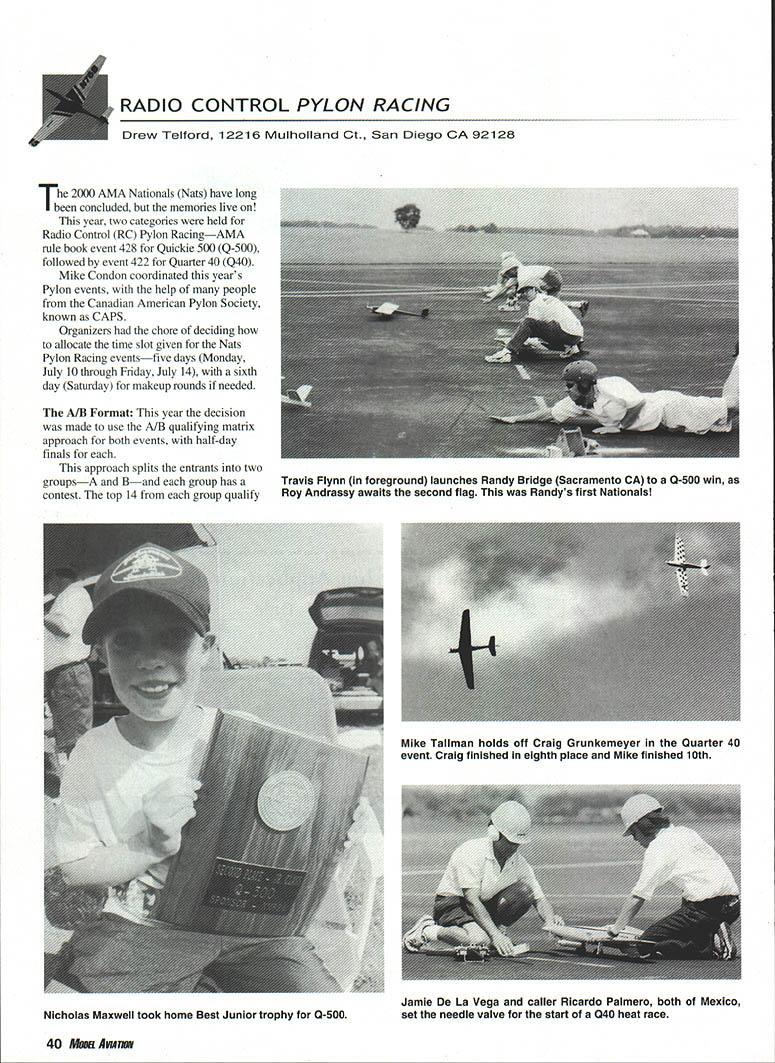
RC Pylon Racing
Drew Telford, 12216 Mulholland Ct., San Diego CA 92128
The 2000 AMA Nationals (Nats) have long been concluded, but the memories live on! This year, two categories were held for Radio Control (RC) Pylon Racing—AMA rule book event 428 for Quickie 500 (Q-500), followed by event 422 for Quarter 40 (Q40).
Mike Condon coordinated this year's Pylon events, with the help of many people from the Canadian American Pylon Society, known as CAPS.
Organizers had the chore of deciding how to allocate the time slot given for the Nats Pylon Racing events—five days (Monday, July 10 through Friday, July 14), with a sixth day (Saturday) for makeup rounds if needed.
The A/B Format This year the decision was made to use the A/B qualifying matrix approach for both events, with half-day finals for each.
This approach splits the entrants into two groups—A and B—and each group has a contest. The top 14 from each group qualify for the finals, for a 28-competitor race starting with a clean score sheet.
With 71 entries registered for Q-500 and 56 entries registered for Q40, this guarantees many rounds for qualifying, and a full five-round contest for each of the finals.
Although some competitors prefer the traditional "one big contest" setup, the A/B format allows contestants to get away from the flightline for a half-day during qualifying; they can do other things, rather than be there all of each day.
Off-Course Judging The off-course judging system was employed at this Nats. The approach was mandated earlier this year, as a measure to increase workers' safety and minimize potential injury by reducing the number of people out on the racecourse.
With this system, only the starter and assistant starter remain on the course with the four competitors and their assistants during each heat. Race officials judge the aircraft turns around the pylons from a safe distance, rather than from the base of each pylon.
There have been many discussions among racers about the pros and cons of this system, but the overnight transition to it has been reasonably smooth.
Race officials have repeatedly stated that they have a much better vantage point from which to see how the race is going and to more accurately determine which aircraft is where throughout a race.
Officials have also indicated that it is more enjoyable to do the job when they're sitting in a chair under a shade tent with coolers by their sides, which really helps offset the Muncie, IN summertime heat.
Prior to the Nats, several races across the country were run using different implementations of these off-course judging systems, with positive results.
A special thank you to those who hustled to design, build, and test these systems in such a short time; without them, we would not have been able to continue racing!
The judging system at the Nats was outstanding. It provided clear status information about laps and cuts for the racers, spectators, and race officials.
Q-500 Qualifying
The Q-500 pilots' meeting was held Monday morning at 7:00. The matrices for the A and B groups were posted, and heat cards were handed out.
There were very few first-time Nats entrants; most of the names were well-known to the field. Several entrants ran very fast heats, but a few mishaps occurred which curtailed some contestants' chances. The stage was set for some good racing. There were six rounds of qualifying.
Q-500 group A led off in the morning, followed by group B in the afternoon. The order was reversed Tuesday morning, with group B leading off and group A finishing in the afternoon.
There were a few delays caused by passing thunderstorms, but the racing was resumed each time with less than 30 minutes lost. There were roughly four pauses in action, including a lunch break.
The A group began with several very close races. In the last heat of round one, Randy Bridge of Sacramento, CA—a Nats newcomer—showed the field he was no novice; he posted the first "sub-10" time, going 1:09.77 for a win. Randy's mom, dad, and girlfriend Erin rooted him on to victory.
With many well-matched airplanes and several pilots with the same favorite racing groove, many collisions occurred; crashes ranged from minor wing-to-wing bumps to total disintegration.
There were no easy races; each point scored was fought for in earnest!
Gino Del Ponte—a Nats newcomer and Junior competitor from Aurora, CO—passed 11 fliers in the A group, achieving a best time of 1:19.00.
Group B racers followed suit, by starting out fast and furious. Nicholas Maxwell of Fort Wayne, IN, another Junior competitor, duked it out with the big boys. Nicholas achieved a best time of 1:39.10, and beat out five fliers!
Q-500 Finals
Wednesday morning, the stage was set for the top 14 racers from each group to compete in five runs for the trophies, and for the bragging rights of being a top Nationals-level competitor!
All of the excuses were used up by now, and the competitors had the "practice" rounds behind them, so they could pull out all the stops and go for it. A pilots' meeting was held, heat cards were passed out, and the throng immediately crowded around the matrix postings to figure out who had to race whom, and when.
Mother Nature was kind, and for the third day in a row, racing began under the watchful eyes of starter Bill Gallagher and assistant starter/Contest Director Pete Reed.
One of the more interesting aspects of Q-500 is the variety of airplanes—many designs meet the dimensional rules outlined in the AMA rule book, Competition Regulations.
Although there has been steady evolution in airframe design throughout the years, some competitors do quite well with veteran models. This proves that the event is living up to its original intent of being a competition of skill and piloting rather than aircraft design wizardry.
The Q-500 finals had matchups that only occur at the AMA Nats. Roy Andrassy, Jaime De La Vega, Michael Tallman, and Danny Kane went at it in round one, representing Canada, Mexico, Kansas, and Illinois respectively.
Michael Condon, Lyle Larson, Michael Tallman, and Darol Cady (Michigan, South Dakota, Kansas, and Washington state) were matched up in round two, as were Gary Freeman Sr., Mark Parker, Randy Bridge, and Joe Dodd (Florida, Texas, California, and Ohio).
There was a great deal of close racing, and sadly, a great deal of attrition in the heat of battle. There was also a great deal of enjoyment for the participants, which is what it's all about!
The winner of the "biggest smile in the world" award, along with first place and Fast Time, was Randy Bridge, flying his Vortex. He proved that you can win the Nationals the first time you attend!
After a brief photo session and a lunch break, the Q-500 airplanes were put away and the sleeker Q40 models came out (although many competitors had been test-running their engines and making the big decisions about which propellers to use).
Q40 Qualifying
Using the same A/B format as was used for Q-500, the 56 entrants were split into groups of 28. The A group was poised to race, and the B group got to take a break in the afternoon.
Racing was fast and furious, with many great matchups in the heats.
In the first heat, Brian Wilbur, a young Senior competitor from Longwood, FL, was pitted against Mike Heisel, Richard Oliver, and Dennis Crandall, all of Texas. They do their homework, and are always fast.
Tom Scott (Cincinnati, OH) and Lloyd Burnham (South Windsor, CT) were later, doing their best to fight off Roy Andrassy and Ed Smith of Canada, in a typical clash among the titans of Q40 Pylon.
Buried in the middle of the group was a name from many past AMA Nats Pylon events: David Latsha of Lemoyne, PA, who showed us all that a few years off the circuit doesn't take the fight out of the dog! Welcome back, Dave.
Racing was called for the day after five rounds.
The A group completed its last two rounds Thursday, then the B group went into action for a full seven rounds of furious racing.
Chago Panzardi (Dayton, OH), Mike Condon (Livonia, MI), Travis Flynn (North Hollywood, CA), and Lyle Larson (Piedmont, SD) put on a good demonstration of speed, as they fought it out for 10 laps.
Pete Reed of Ohio, Paul Beneiza of Georgia, Randy Bridge, and Jamie De La Vega met up in the third round, for some tight laps.
Q40 Finals
The top 14 from each qualifying group readied their gear for a clean start of the five final rounds.
Right away in heat one, Ed Smith went up against Richard Oliver, Terry Frazer (Ohio), and Dennis O'Brien (Florida). Ed took the win with a 1:18.00, edging out Richard's 1:18.10.
Mike Heisel, Jamie De La Vega, Mike Tallman, and Danny Kane met up, and finished in that order.
Tom Scott's 1:05.75 edged Randy Bridge's 1:06.51 to win his heat and set the Fast Time of the contest.
Going into the last round, Mike Heisel was the only one with a perfect score, and he was three points ahead. He needed a third-place finish or better to seal the victory, and he did it by taking second to Terry Frazer.
Many points were lost during the finals because of no-starts, collisions, cuts, etc. After the final tally, Randy Bridge took the flyoff win over Lyle Larson for second and third, and Jamie De La Vega took the flyoff win over Ed Smith for fourth and fifth.
Chago Panzardi was sixth, and Mike Condon was seventh.
Craig Grunkenmeyer, Mike Tallman, and I tied for eighth place, and we opted to settle by times. We finished eighth, ninth, and tenth.
Wrap-up A big thanks to Bill Gallagher for enduring the hot pavement on the starting line for five days, and to Chic White for serving as Q40 Contest Director. Thanks to Art Edsall for doing all the computer work, to all of those who worked the course, and to the CAPS for operating a smooth operation this year.
If you didn't make it to the Pylon Nats this year, come out next year and enjoy the fun. MA
Transcribed from original scans by AI. Minor OCR errors may remain.

