
RC Pylon Racing
Duane Gall 1267 S. Beeler Ct., Denver CO 80231 E-mail: [email protected]
IS ANYBODY out there? Last month I expounded on the fact that modelers seem to be leaving the official AMA racing events in droves. Many are racing, but few are racing the AMA rule-book events.
I identified six factors that must be wrestled and tamed before any sort of racing can break out of its usual "cult" status, attracting new participants to offset the steady trickle of dropouts.
- "Simple rules," meaning rules that have not been well thought-out or expressed, leaving loopholes that are easily exploited.
- Expense. The natural result of having to buy one loophole-exploiting gizmo after another to stay competitive.
- Excessive airspeed. The natural result of a steady bombardment by expensive, loophole-exploiting gizmos and continual refinements thereof. And the thing that scares newcomers away more than anything else.
- Noise.
- Fiddle factor. The amount of time you spend maintaining and adjusting all your expensive, loophole-exploiting gizmos.
- Specialization. The extent to which your expensive, loophole-exploiting gizmos are useless for anything except racing.
Last month's column featured photos of a cute little 1/2A (.049 cubic-inch [cu. in.]) model.
Historically, whenever anyone wanted to create a new racing formula that was simpler, cheaper, slower, quieter, and more user-friendly than the existing choices, he or she would simply take one of the existing choices and copy it on a smaller scale.
If you count full-scale aircraft and Radio Control (RC) models, there have been five major steps in this progression during the history of multi-aircraft, closed-course pylon racing:
- Full-scale Unlimited (Thompson Trophy, etc.) to full-scale Goodyear/Formula I — 1950s
- Full-scale Formula I to model Formula I (.40 cu. in.) — 1960s
- Formula I to Quarter Midget (.15 cu. in.) — 1970s
- Quarter Midget to 1/2A (.049 cu. in.) — 1980s
- 1/2A to mini-electrics — 1990s
Without exception, these smaller copies have started out as everything their designers intended. And almost without exception, the same factors that dogged the original predecessor have managed to jump the divide and infect each new, smaller formula in turn.
Recently, organizers of Speed 400 electric racing have had to split the class into two divisions: one for those who can manage to get their hands on the superior but discontinued "Yed" battery cells and one for those who can't.
Oh, and if your Speed 400 motor melts from the overload and has to be replaced between heats, you've got your setup tuned just right!
Why does this keep happening? Think about it; there will be a quiz next month.
Meanwhile, I'm pleased to pass along a successful story from Steve Terry of the Utah Valley Aeromodelers in Orem, UT, where .15 is still going strong. Official AMA rules for .15 (event 423) are online at www.modelaircraft.org/Comp1999Pylonsurgent.htm.
When I corresponded with you before, I was asking why .15 racing has never really taken off.
We deviate from the AMA rule book some, and this has made flying these little machines a lot easier here at 5,000 feet elevation. I'll highlight some of the changes:
- There is no minimum weight specified.
- Minimum wing area is 200 square inches.
- Any engine no larger than .051 cu. in.
- Two laps to start (heats are set and run by luck of the draw).
- One minute to start engine from the "start engines" signal to the drop of the flag.
- Pilots have up to the completion of the leader's fifth lap to get into the air.
- Two cuts per heat give the pilot a zero for that heat.
- Points are awarded as follows: 1st — 4 points, 2nd — 3 points, 3rd — 2 points, 4th — 1 point.
- Any commercial fuel with no more than 25% nitro (each pilot provides his/her own fuel).
Points are accumulated for the year (nine race days) and awards are given at our annual banquet.
In addition to the above items, we also sponsor a Duration Race. This is held once a year and no points are awarded to contribute to the annual totals. The race has rules similar to the pylon race, with a few alterations:
- Pilots are timed for the specific heat (for ranking).
- Race is 50 laps.
- Pilots may refuel as needed—usually two to three times.
- Pilots can restart as many times as needed.
- The pilot with the shortest elapsed time wins.
- Maximum five pylon cuts per pilot per heat; one additional lap penalty per cut.
- Have fun and don't fall down!
Fifty laps with these small airplanes require the pilots to take a good, long rest after the races. As you can imagine, the pilot can get a spinning!
Thanks for your time. I thought other readers might enjoy hearing about this.
Thanks, Steve.
(The accompanying photo didn't make it into print with all the jpegs, downloads, and digital-camera formats out there. M.A. has been scrambling to learn what works and what doesn't. If you have photos of local racing action you'd like to send, the plain old prints from the grocery store work fine, and probably always will.)
Volunteer workers
A perennial problem, especially at local meets where racing is still new or has been dormant for a while, is finding enough racecourse workers to put on a contest. A big meet, run by the book, requires a crew of 17. Many clubs don't have this many workers available on race day.
Another solution, which is perhaps more palatable from the contestant's standpoint, is to use the unofficial "one-cut, one-point" method and to go without flaggers at Pylon One.
Rather than the usual five workers at Pylon One—consisting of four flaggers (one for each aircraft in the heat) and a chief judge wearing a headset radio—it may be staffed by a single cut judge who also performs the duties normally assigned to the Pylon Two and Three cut judges.
Rather than watching each aircraft and signaling "you made the distance" on each lap by waving a flag or triggering a shutter, the judge simply watches for cuts and reports whether the aircraft has gone the distance to Pylon One.
After the heat, the cut judges from the three pylons tabulate the cuts recorded on each aircraft. A pilot who has cut once receives one point for the heat, regardless of the order of finish. A pilot who has cut two or more times receives zero points for the heat.
Under the "one cut, one point" system, it is possible for every pilot in the heat to receive one point. It is also possible for the slowest aircraft to win the heat if all the others cut.
For small clubs, using this system may make the difference between being able to put on a race and not being able to put on a race. Contestants who want to have fun, but not necessarily set a national record, will support it.
Using the "one cut, one point" system represents a variation on the official rules and should be announced in all precontest publicity whenever possible.
Airpark update
In the June issue I featured the efforts of some local heroes in my neck of the woods who managed to put together a "racing club" from scratch.
I put the words "racing club" in quotes because the club is not exclusively limited to racers, but includes beginners and sport fliers. Training is an integral part of the club's mission.
However, racing is not discouraged (as it is at many "sport" clubs); the runway and field layout were designed to accommodate pylons, judging stations, and all setback distances specified in the AMA rule book.
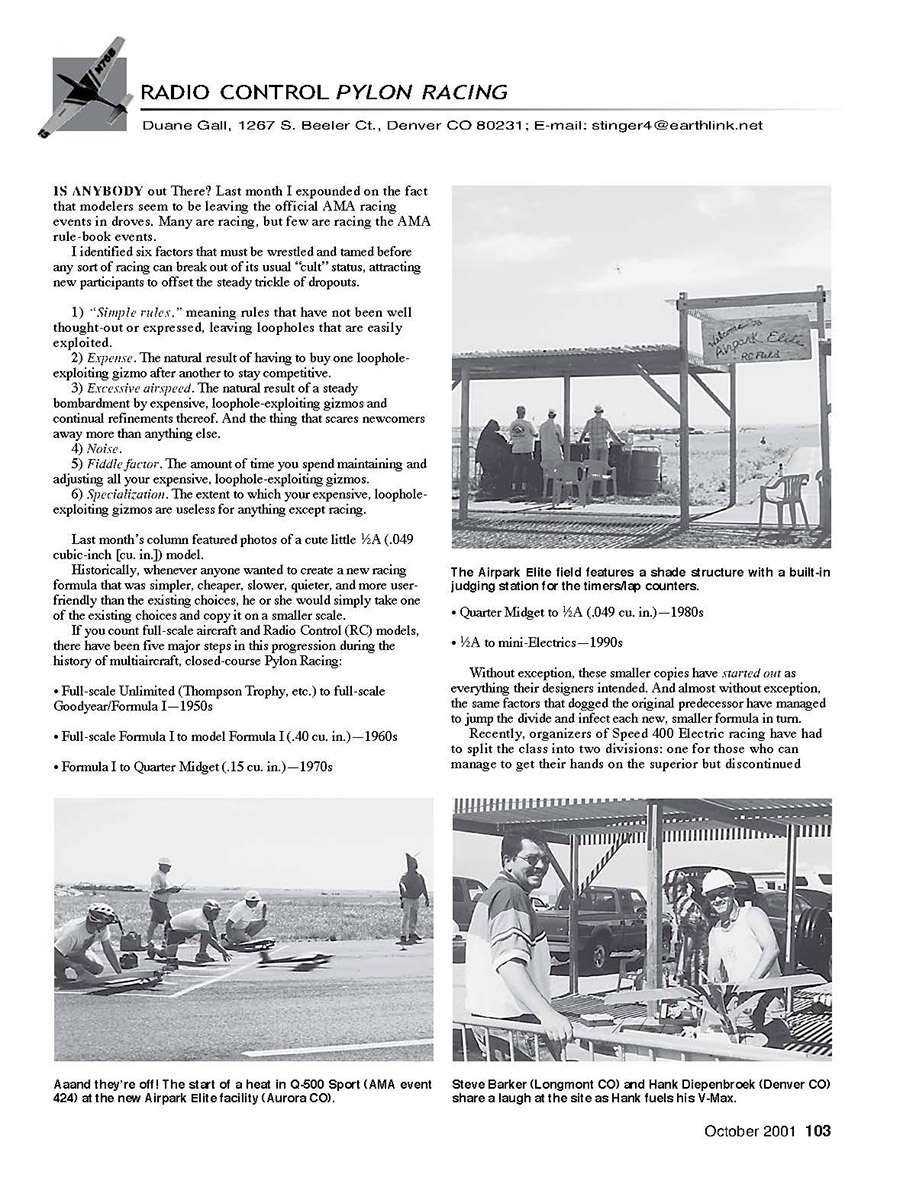
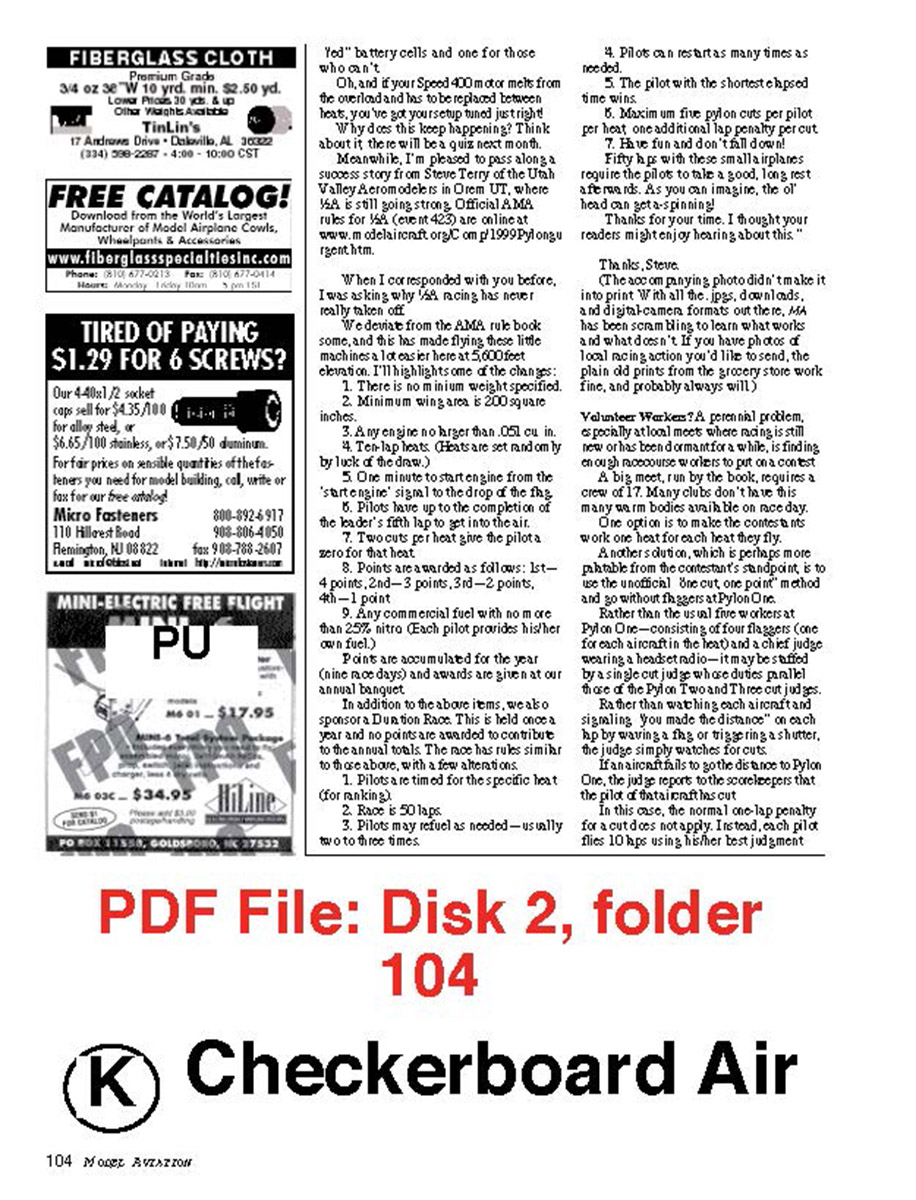
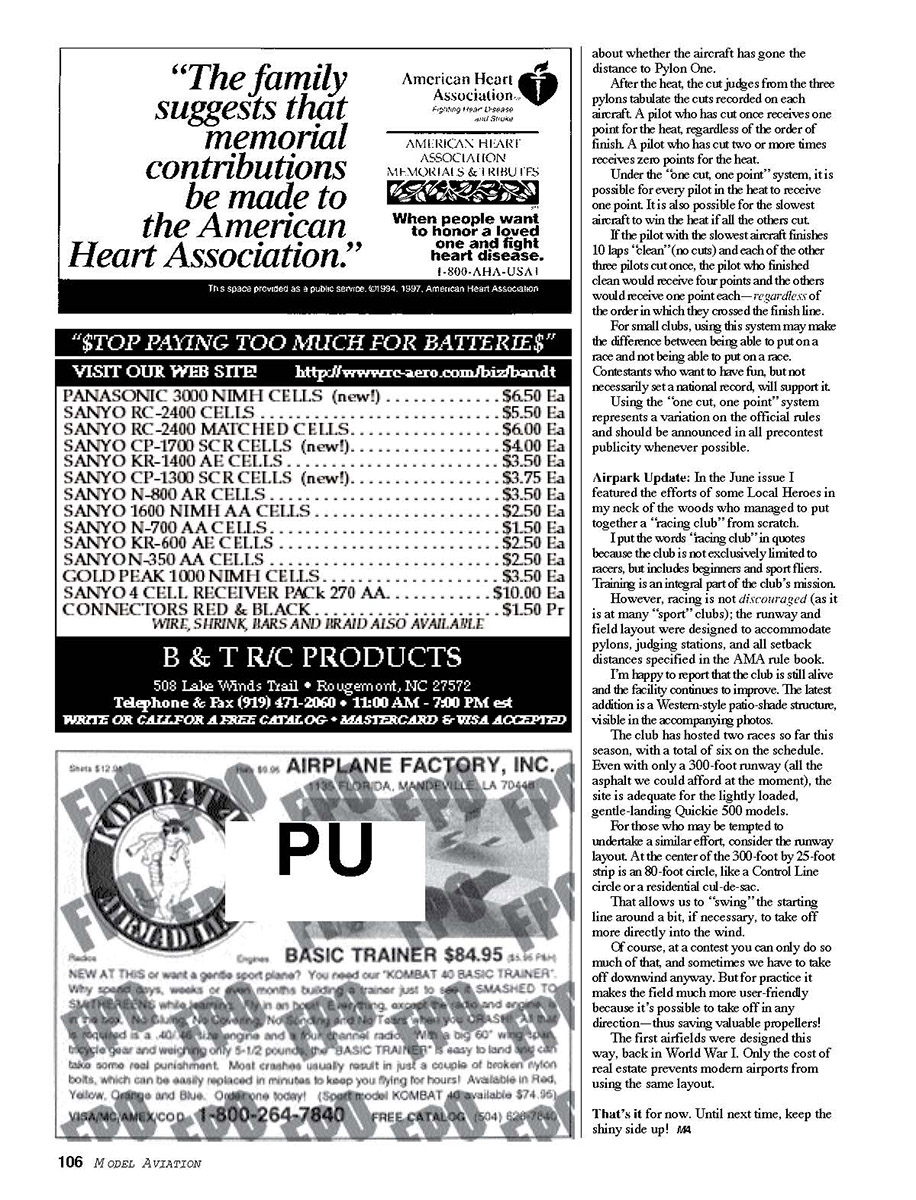
I'm happy to report that the club is still alive and the facility continues to improve. The latest addition is a Western-style patio-shade structure, visible in the accompanying photos.
The club has hosted two races so far this season, with a total of six on the schedule. Even with only a 300-foot runway (all the asphalt we could afford at the moment), the site is adequate for the lightly loaded, gentle-landing Quickie 500 models.
For those who may be tempted to undertake a similar effort, consider the runway layout. At the center of the 300-foot by 25-foot strip is an 80-foot circle, like a control-line circle or a residential cul-de-sac. That allows us to "swing" the starting line around a bit, if necessary, to take off more directly into the wind.
Of course, at a contest you can only do so much of that, and sometimes we have to take off downwind anyway. But for practice it makes the field much more user-friendly because it's possible to take off in any direction—thus saving valuable propellers!
The first airfields were designed this way, back in World War I. Only the cost of real estate prevents modern airports from using the same layout.
That's it for now. Until next time, keep the shiny side up! MA
Transcribed from original scans by AI. Minor OCR errors may remain.

