
RC Pylon Racing
Cliff Helford, 1512 S. Greenleaf Ct., Winter Springs FL 32708; e-mail: [email protected]
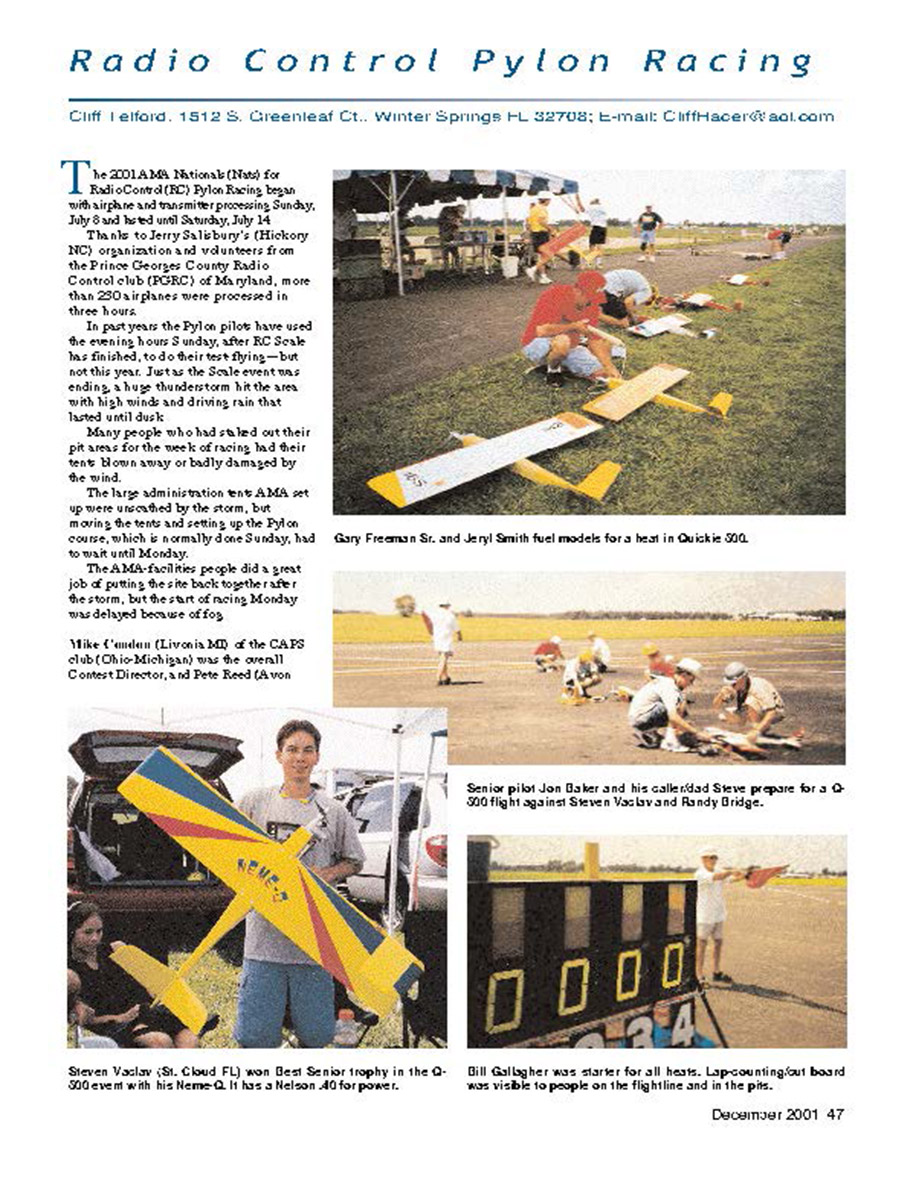
The 2001 AMA Nationals (Nats) for Radio Control (RC) Pylon Racing began with airplane and transmitter processing Sunday, July 8 and lasted until Saturday, July 14.
Thanks to Jerry Salisbury's (Hickory, NC) organization and volunteers from the Prince Georges County Radio Control Club (PGRC) of Maryland, more than 230 airplanes were processed in three hours.
In past years the Pylon pilots have used the evening hours Sunday, after RC Scale has finished, to do their test flying — but not this year. Just as the Scale event was ending a huge thunderstorm hit the area with high winds and driving rain that lasted until dusk.
Many people who had staked out their pit areas for the week of racing had their tents blown away or badly damaged by the wind.
The large administration tents AMA set up were uprooted by the storm, but moving the tents and setting up the Pylon course, which is normally done Sunday, had to wait until Monday.
The AMA facilities people did a great job of putting the site back together after the storm, but the start of racing Monday was delayed because of fog.
Mike Umdum (Livonia MI) of the CAFS club (Ohio-Michigan) was the overall Contest Director, and Pete Reed (Alvon CT) and Leroy Webb (South Beloit IL) were event directors for Quickie 500 (Q-500) and Quarter 40 (Q-40) events respectively.
Bill Gallagher (Mabank TX) was the starter for the sixth year. His tact and experience have earned the respect of the competitors and course workers.
Only two heats had to be reflown during the week. This was the second year the off-course judging system was used, so everyone was familiar with the new procedures.
The course equipment Fred Johanson and the CAPS designed and built worked flawlessly. The lap-counting cards and lights were visible in the pits 450 feet from the race course.
David Doyle (Coventry RI), assisted by Ingrid Webb, had the task of setting up the heats and tracking the results.
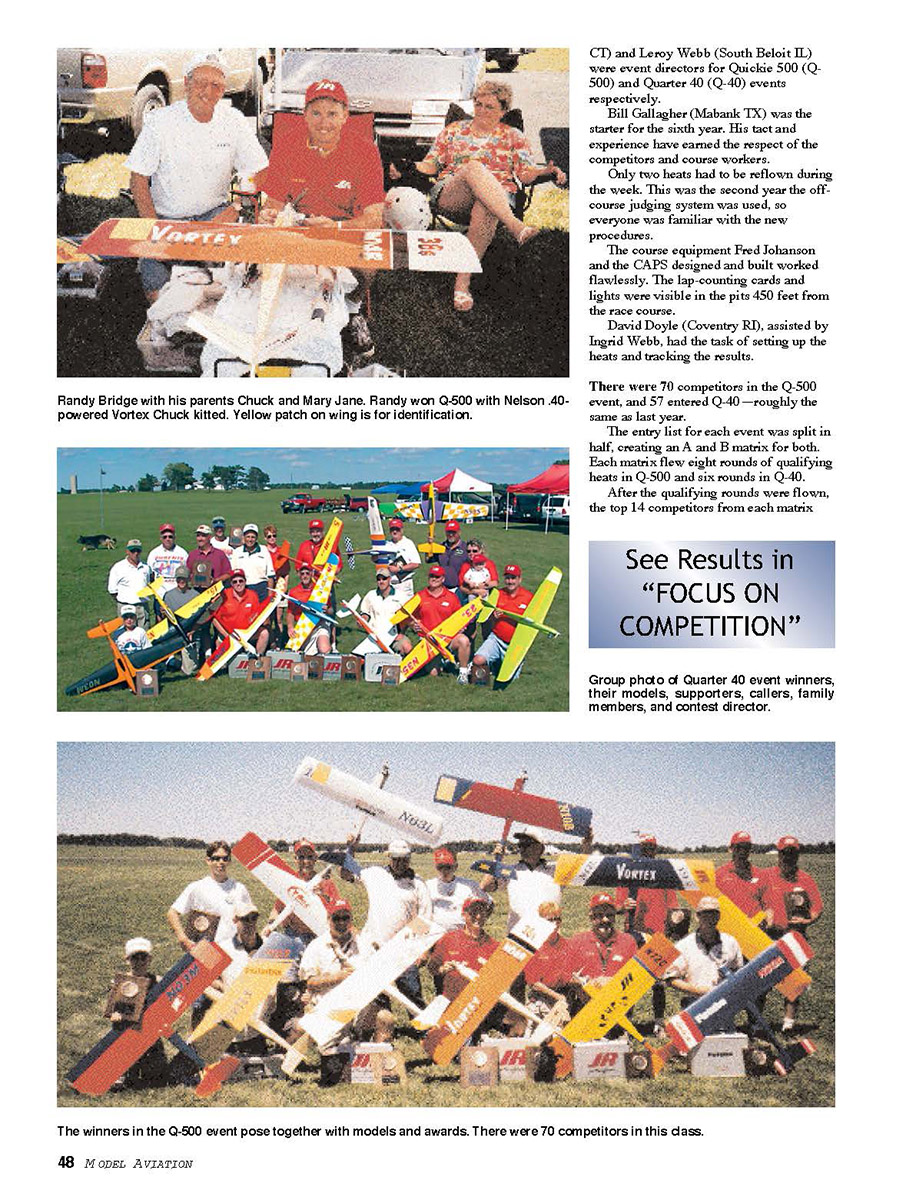
There were 70 competitors in the Q-500 event, and 57 entered Q-40—roughly the same as last year.
The entry list for each event was split in half, creating an A and B matrix for both. Each matrix flew eight rounds of qualifying heats in Q-500 and six rounds in Q-40.
After the qualifying rounds were flown, the top 14 competitors from each matrix went into a 28-pilot Finals of five more rounds to determine the winners.
This procedure yields a group of winners that is sometimes quite different from what a single matrix would yield, and it is more complicated to administer. The A/B-matrix system actually requires three different contests to be set up for each event.
Finishing in 14th place in the A or B matrix is just as good as finishing in first place. It earns a place in the Finals, and the contest begins anew. Twenty-eight people get to fly five more rounds with a chance of winning the event. All the others become spectators or go home.
Mike Condon took a poll of the fliers at the end of the awards ceremony, and it was decided that a single-matrix system will be used next year, as was done prior to 1996.
Monday: After the fog lifted in the morning, the CD held a pilots' meeting. He warned them not to fly over the pits or course workers and not to fly below the tops of Pylons Two and Three.
Before the advent of off-course judging, there were steel cages at the pylons to protect the cut judges. Since the judges are now off the course, there are no cages to hold up the pylons.
The pylons are made from four-inch PVC (polyvinyl chloride) pipe that stands 15 feet tall with a flag on top. The pylons are held up by ropes attached to concrete blocks on the ground, and flying into the ropes is just as calamitous as hitting the pylon.
Several pilots ignored the warning, and they hit the pylons or ropes and crashed.
Flying began with the A matrix for Q-500. Things started off with a bang; Ken Howell crashed in the first heat, and Tom Neff crashed in the second. Darrol Cady wrecked in the first heat of Round Two. Crashes by Rick Moreland, Steve Baker, and Michael Hammett ensued.
At the end of Round Four, only Lyle Larson had a perfect 16 points. Jim Allen, Randy Bridge, Travis Flynn, and Mike Helsel were tied for second with 15 points. Randy held the fast time at 1:08.18.
The A matrix was finished for the day at 11:30 a.m. and would not fly again until 11:30 a.m. Tuesday.
Flying began for the Q-500 B matrix after a short break for lunch. The crashes continued when Mike Tallman's airplane hit the supporting rope at Pylon Three in Round One. The pylon keeled over slowly, to the spectators' amusement.
Bob Brogdon and David Martin collided in Round Two.
In Round Three, Bob lost his second Vortex airplane when it hit Pylon Two, taking him out of the Q-500 event completely.
Mike Tallman eliminated himself from the contest in Round Four by hitting Pylon Three the second time.
Q-500 racing was finished for the day at the end of Round Four. Craig Grunkemeyer and Marcus Blanchard had perfect scores of 16 points. Fred Burgdorf and Gail Jacobson had 15 points.
Craig Grunkemeyer's 1:08.64 was fastest time in the B matrix.
Tuesday: A cold front passed through the area Monday night and brought cooler air and a 90° crosswind. The wind became stronger each day and was a significant factor Thursday and Friday; it caused several Q-40 airplanes to nose over on takeoff.
The B matrix of Q-500 flew first Tuesday, continuing with Round Five.
Randy Eiken's wing separated from the fuselage rounding Pylon One in Heat Four, and Mario Trevise's airplane flew through the falling wing in a spectacular midair collision. The Q-500 competition was over for both pilots.
At the end of Round Eight, only Marcus Blanchard had a perfect score of 32 points. Craig Grunkemeyer still held the fast time in the B matrix.
The pilots who advanced to the Q-500 Finals from the B matrix were, in order: Marcus Blanchard, Fred Burgdorf, Craig Grunkemeyer, Gail Jacobson, me, Terry Frazer, Paul Benezra, Mike Morris, David Martin, Mike Condon, David Doyle, Randy Eiken, Tom Scott, and Gary Freeman Jr.
After lunch, the Q-500 A matrix resumed flyoff for 10th place and the final trophy position.
No one had a perfect score at the end of the fifth round. Randy Bridge and Tom Scott were tied for first place. Randy had lost to Dub Jett, and Tom had lost to Travis Flynn.
Randy won the flyoff tiebreaker to take first place, repeating his Q-500 Nats win from last year. Tom Scott took second place.
The remaining trophy winners, in order, were Darrol Cady, third; Travis Flynn, fourth; Jim Allen, fifth; Craig Grunkemeyer, sixth; Lyle Larson, seventh; and Marcus Blanchard, eighth. Steven Vaclav earned his way into the trophy for Best --- was Best Junior.
Q-40 Finals: The pilots and callers
The pilots and callers seemed to tense up after the matrix for the Q-40 Finals was posted; there was hardly a heat flown in the Finals in which someone didn't cut inside the pylons and earn a zero.
The crosswind was blowing at a steady 15 mph with higher gusts, which altered the turn radius normally flown around the turn at Pylons Two and Three. Ten more airplanes were lost in five rounds because they crashed into the pylons or into other airplanes.
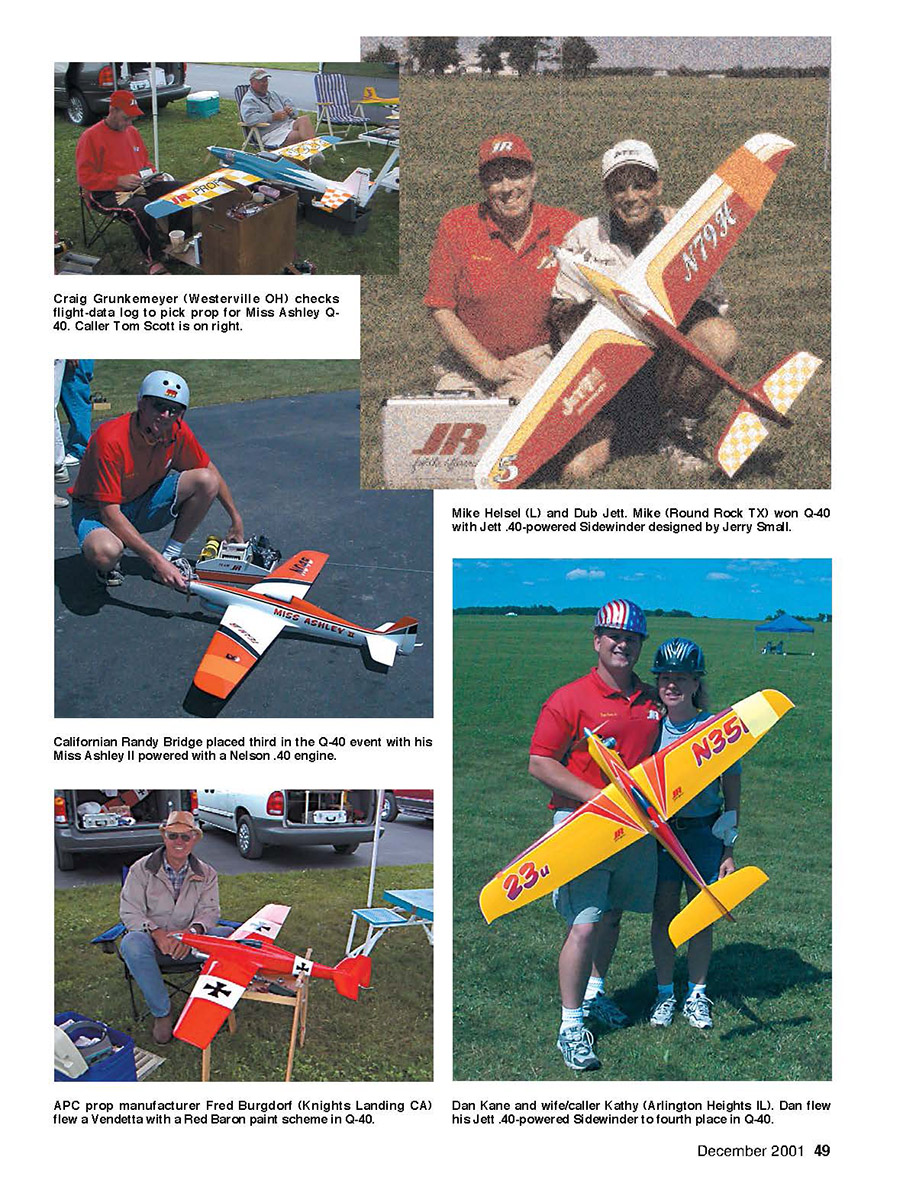
The most exciting race for the spectators was in Round One, when Randy Bridge, Mike Helsel, Dave Latsha, and Tom Scott went to the line. Mike and Randy finished first and second at the 2000 Nats, and Tom had won the Fast Time trophy.
The lead changed on every lap until the checkered flag dropped. When it was finished, Mike's 1:05.27 beat Randy by a scant .61 seconds. Dave posted his personal best time of 1:06.85, and Tom was fourth in the heat with a time of 1:07.1.
Wow! What a heat!
The outcome of the entire event was probably decided in that heat. Mike was never paired against Craig Grunkemeyer, and Grunk lost to a point when he posted a cut flying against Jerry Small.
Craig posted a 1:03.69 (fast time for the event) when he flew against Darrol Cady and Tim Lime in Round Five.
Mike continued to post good times against close competition to win the event with a perfect score of 20 points. Craig was second.
Randy Bridge lost another point in a heat when he cut, and he finished in third place. Dan Kane was fourth. Gary Freeman Sr. found himself in a four-way tie for fifth place with Tom Scott, Jerry Small, and Jeryl Smith.
In the five-round Finals it seemed that every time Gary went up against the faster fliers, the other guys cut or crashed.
Jeryl decided not to participate in the flyoff and accepted the eighth-place trophy.
Gary's good luck held in the flyoff when Tom Scott's airplane collided with Jerry Small's and crashed. Jerry cut, to give Gary the fifth-place trophy.
Darrol Cady claimed the ninth and final trophy.
Nicholas Maxwell was Best Junior and Jonathan Baker was Best Senior.
The National Miniature Pylon Racing Association (NMPRA) donated a new perpetual trophy to the person who had the best combined score in the Pylon events. Randy Bridge won the award for his first and third places. (He was High Point winner in 2000.)
PowerMaster donated all the fuel used in the Pylon events. Thanks!
Photo credits go to Kim Vaclav for the Q-500 pictures and to Jim Allen for the Q-40 pictures. MA
Transcribed from original scans by AI. Minor OCR errors may remain.

