
Meet NMPRA Champion Chuck Andraka
by Aaron "AJ" Seaholm
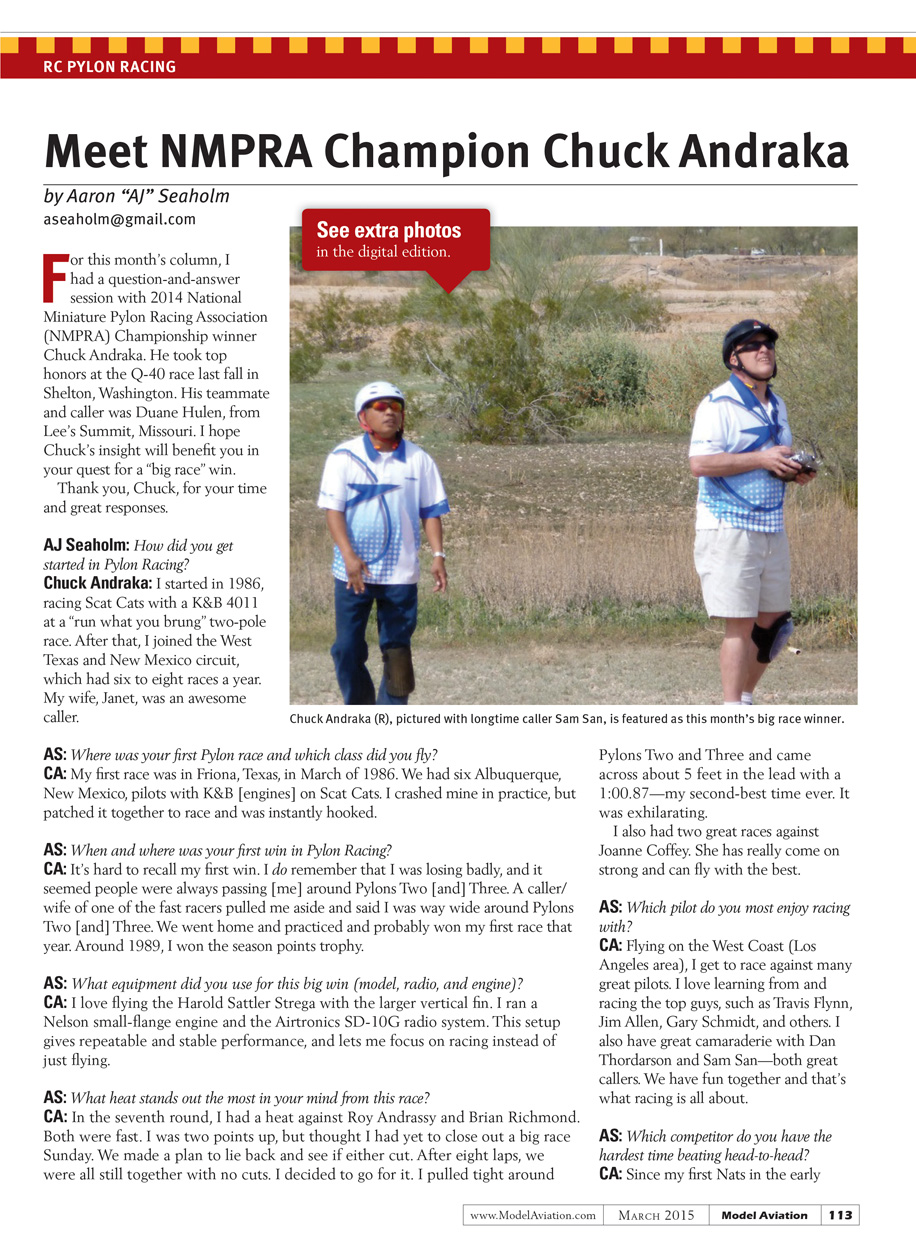
For this month's column, I had a question-and-answer session with 2014 National Miniature Pylon Racing Association (NMPRA) Championship winner Chuck Andraka. He took top honors at the Q-40 race last fall in Shelton, Washington. His teammate and caller was Duane Hulen, from Lee's Summit, Missouri. I hope Chuck's insight will benefit you in your quest for a "big race" win.
Thank you, Chuck, for your time and great responses.
AJ Seaholm: How did you get started in Pylon Racing? Chuck Andraka: I started in 1986, racing Scat Cats with a K&B 4011 at a "run what you brung" two-pole race. After that, I joined the West Texas and New Mexico circuit, which had six to eight races a year. My wife, Janet, was an awesome caller.
AJ Seaholm: Where was your first Pylon race and which class did you fly? Chuck Andraka: My first race was in Friona, Texas, in March of 1986. We had six Albuquerque pilots with K&B engines on Scat Cats. I crashed mine in practice, but patched it together to race and was instantly hooked.
AJ Seaholm: When and where was your first win in Pylon Racing? Chuck Andraka: It's hard to recall my first win. I do remember that I was losing badly, and it seemed people were always passing me around Pylons Two and Three. A caller—the wife of one of the fast racers—pulled me aside and said I was way wide around Pylons Two and Three. We went home and practiced and probably won my first race that year. Around 1989, I won the season points trophy.
AJ Seaholm: What equipment did you use for this big win (model, radio, and engine)? Chuck Andraka: I love flying the Harold Sattler Strega with the larger vertical fin. I ran a Nelson small-flange engine and the Airtronics SD-10G radio system. This setup gives repeatable and stable performance, and lets me focus on racing instead of just flying.
AJ Seaholm: What heat stands out the most in your mind from this race? Chuck Andraka: In the seventh round, I had a heat against Roy Andrassy and Brian Richmond. Both were fast. I was two points up, but thought I had yet to close out a big race Sunday. We made a plan to lie back and see if either cut. After eight laps, we were all still together with no cuts. I decided to go for it. I pulled two to three tight and came across about five feet in the lead with a 1:00.87—my second-best time ever. It was exhilarating.
I also had two great races against Joanne Coffey. She has really come on strong and can fly with the best.
AJ Seaholm: Which pilot do you most enjoy racing with? Chuck Andraka: Flying on the West Coast (Los Angeles area), I get to race against many great pilots. I love learning from and racing the top guys, such as Travis Flynn, Jim Allen, Gary Schmidt, and others. I also have great camaraderie with Dan Thordarson and Sam San—both great callers. We have fun together and that's what racing is all about.
AJ Seaholm: Which competitor do you have the hardest time beating head-to-head? Chuck Andraka: Since my first Nats, there have been many tough pilots. One competitor I have a lot of respect for is Darrol Cady—he's always a handful and a very strong racer.
AJ Seaholm: Can you share a memorable moment or funny story about yourself or others? Chuck Andraka: At a Nats 428 race, probably in the early 2000s, I needed to win the last qualifier round to make the finals and was up against Darrol Cady. My then 14-year-old son was doing a great job calling. We stayed just ahead of Darrol the whole race. The entire time I could hear Rhonda—Darrol's wife—yelling, "It's only Chuck!" I have a lot of respect for Darrol's racing skills, and I chuckle about that often.
AJ Seaholm: What is the one thing you would like to tell aspiring "big race" winners? Chuck Andraka: In order to win, you have to do everything perfect, and then get lucky. This means perfect preparation and practicing everything with critical observers. You need to practice the takeoff as if you were racing. Practice your turns with spotters and set the motor to race tune. Follow your procedure, whether racing or practicing.
As Sam tells me, "Attention to details." No one thing will win the race, but one thing can lose it. I also remember something you said in a column: you cannot win if you go to the line thinking you cannot beat every other pilot in the heat. Preparation and attitude are critical.
Fallen Racers
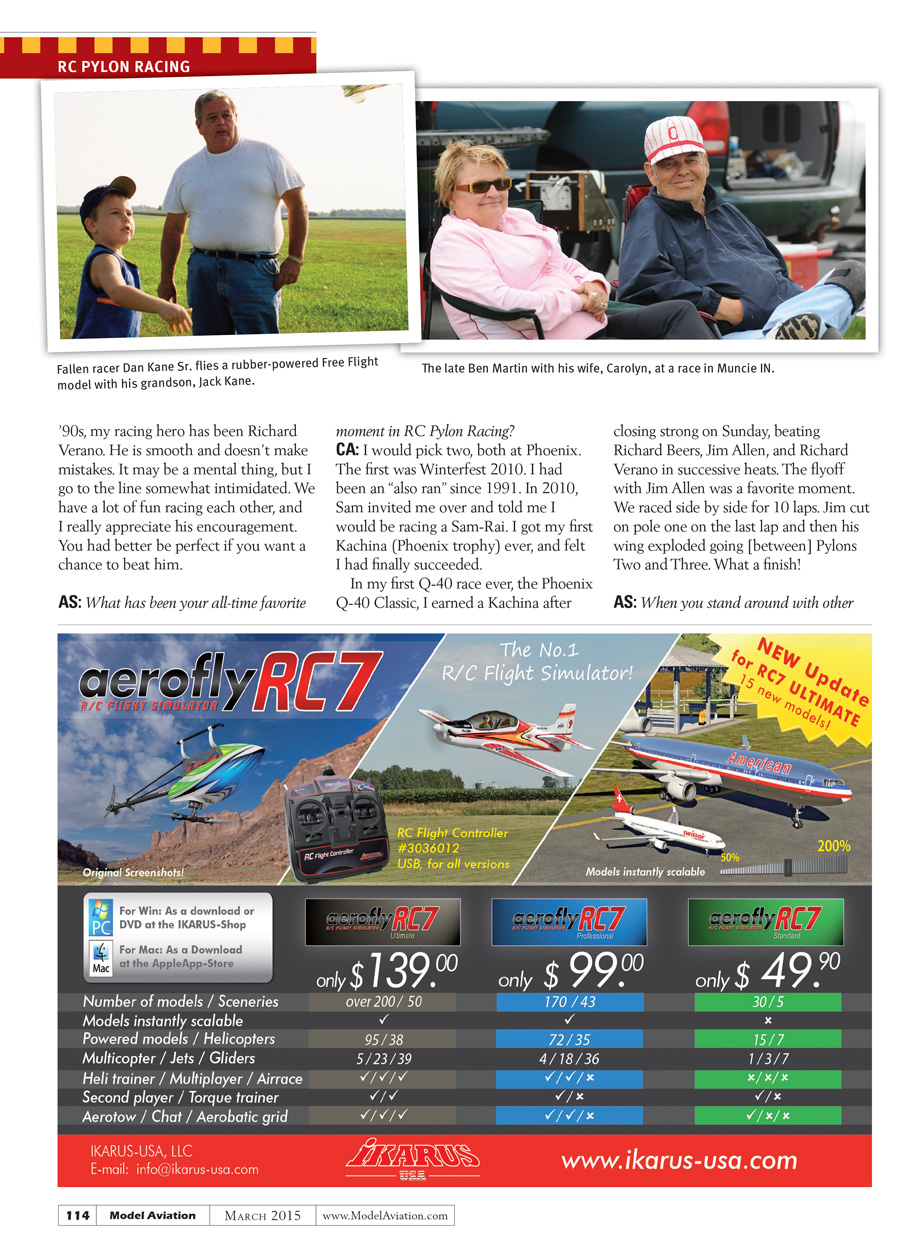
With a heavy heart, I would like to remember two racers whom our Pylon family lost in November 2014. The first is the father of Dan "DK" Kane Jr., one of the greatest racers and friends any of us have in this sport. Dan Kane Sr. passed away after a battle with cancer. My deepest condolences go to DK and his family.
I spoke with DK and we reminisced about his childhood memories of his father. One I would like to share relates to Dan Kane Sr.'s involvement with Top Flite Models and Carl Goldberg Models. According to DK, Top Flite had a building in Chicago with six to seven floors of modeling equipment. On the weekends, Dan Kane Sr. would do odd jobs and DK got to tag along. DK explored every corner of the shop. This great childhood exposure helped shape DK's passion for RC.
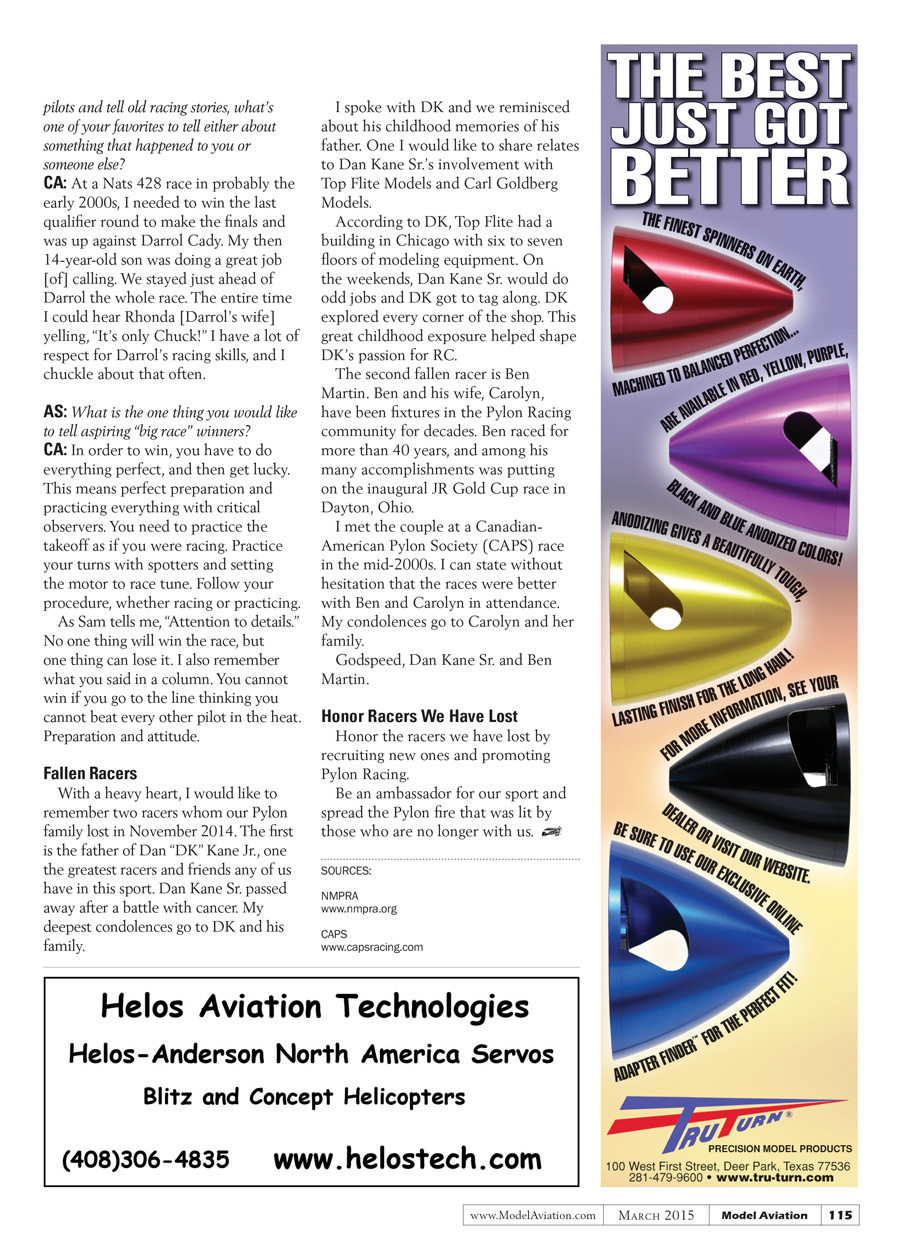
The second fallen racer is Ben Martin. Ben and his wife, Carolyn, have been fixtures in the Pylon Racing community for decades. Ben raced for more than 40 years, and among his many accomplishments was putting on the inaugural JR Gold Cup race in Dayton, Ohio.
I met the couple at a Canadian-American Pylon Society (CAPS) race in the mid-2000s. I can state without hesitation that the races were better with Ben and Carolyn in attendance. My condolences go to Carolyn and her family.
Godspeed, Dan Kane Sr. and Ben Martin.
Honor Racers We Have Lost
Honor the racers we have lost by recruiting new ones and promoting Pylon Racing. Be an ambassador for our sport and spread the Pylon fire that was lit by those who are no longer with us.
SOURCES
- NMPRA — www.nmpra.org
- CAPS — www.capsracing.com
Transcribed from original scans by AI. Minor OCR errors may remain.

