
RADIO CONTROL PYLON RACING
Duane Gall, 1267 S. Beeler Ct., Denver CO 80231; E-mail: [email protected]
HOW I SPENT my Summer Vacation: Labor Day weekend saw something new in the world of Quarter 40 (Q-40) racing: a major Q-40 contest other than the Nationals and the JR Gold Cup Series.
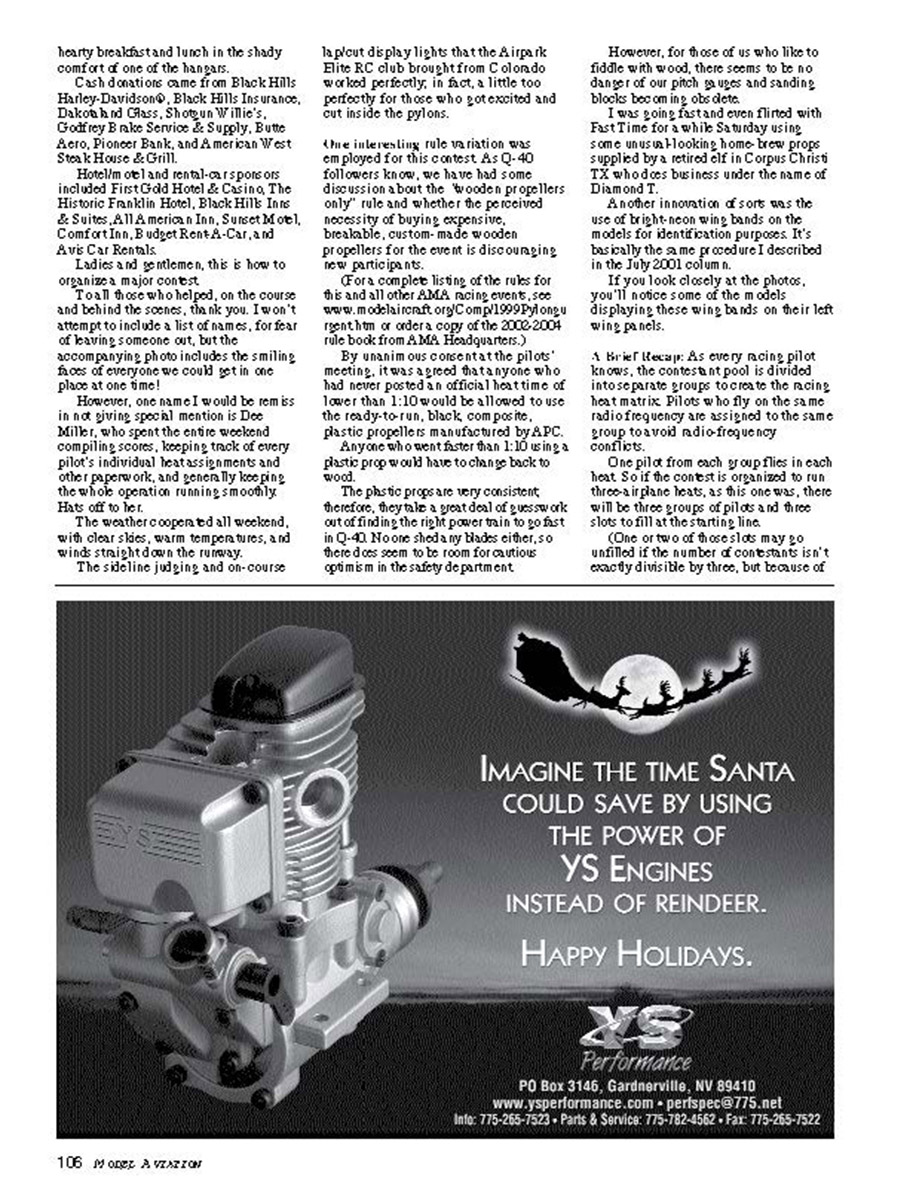
The inaugural Futaba Black Hills Pylon Classic brought pilots from as far away as Connecticut, California, and Canada to the humble but spectacularly equipped municipal airport at Belle Fourche, South Dakota.
Belle Fourche (pronounced "foosh," as in the sound of a mirror-smooth Dago Red whizzing by) is located at the northern edge of the beautiful Black Hills region, home to Mount Rushmore and Chief Crazy Horse national monuments and some of the best fishing anywhere.
It can't be beat for a combined model-aircraft expedition and family vacation.
There was also cash to be won. This was the richest purse in Radio Control (RC) racing history at more than $5,000, which, divided among the 18 entries, meant last place in the Monday "Dash for Cash" was worth $100.
Even your dumb-thumbed columnist went home with an extra 180 beans — not counting the money he donated to the slot machines in nearby Deadwood, that is.
Event organizers Lyle Larson and Ray Jarvis, with Contest Director Ted Bozanich, assembled a sponsor list of local businesses that read like the telephone book!
In addition to national sponsors Futaba Radio Control, PowerMaster Fuels, Landing Products (APC propellers), and Bob Smith Industries, local sponsors included Scott Peterson Motors, which provided a gleaming red truck and trailer to shuttle the pilots and callers from the pits to the starting line.
The local chapter of the Civil Air Patrol was on hand all three days to serve up a hearty breakfast and lunch in the shady comfort of one of the hangars.
Cash donations came from Black Hills Harley-Davidson, Black Hills Insurance, Dakotah Glass, Show 'n Willie's, Godfrey Brake Service & Supply, Butte Aero, Pioneer Bank, and American West Steak House & Grill.
Hotel/motel and rental-car sponsors included First Gold Hotel & Casino, The Historic Franklin Hotel, Black Hills Inn & Suites, All American Inn, Super 8 Motel, Comfort Inn, Budget Rent-A-Car, and Avis Car Rentals.
Ladies and gentlemen, this is how to organize a major contest.
To all those who helped, on the course and behind the scenes, thank you. I won't attempt to include a list of names, for fear of leaving someone out, but the accompanying photo includes the smiling faces of everyone who could get in one place at one time!
However, one name I would be remiss in not giving special mention is Dee Miller, who spent the entire weekend compiling scores, keeping track of every pilot's individual heat assignments and other paperwork, and generally keeping the whole operation running smoothly. Hats off to her.
The weather cooperated all weekend, with clear skies, warm temperatures, and winds straight down the runway.
The sideline judging and on-course lap-cut display lights that the Airpark Elite RC club brought from Colorado worked perfectly; in fact, a little too perfectly for those who got excited and cut inside the pylons.
One interesting rule variation was employed for this contest. In Q-40 followers know, we have had some discussion about the "wooden propellers only" rule and whether the perceived necessity of buying expensive, breakable, custom-made wooden propellers for the event is discouraging new participants.
(For a complete listing of the rules for this and all other AMA racing events, see www.modelaircraft.org/Comp1999r... or get in touch or order a copy of the 2002-2004 rule book from AMA Headquarters.)
By unanimous consent at the pilots' meeting, it was agreed that anyone who had never posted an official heat time of lower than 1:10 would be allowed to use the ready-to-run, black, composite, plastic propellers manufactured by APC. Anyone who went faster than 1:10 using a plastic prop would have to change back to wood.
The plastic props are very consistent; therefore, they take a great deal of guesswork out of finding the right power train to go fast in Q-40. No one shed any blades either, so there does seem to be room for cautious optimism in the safety department.
However, for those of us who like to fiddle with wood, there seems to be no danger of our pitch gauges and sanding blocks becoming obsolete.
I was going fast and even flirted with Fast Time for a while Saturday using some untried looking home-brew props supplied by a retired elf in Corpus Christi, TX who does business under the name of Diamond D.
Another innovation of sorts was the use of bright neon wing bands on the models for identification purposes. It's basically the same procedure I described in the July 2001 column.
If you look closely at the photos, you'll notice some of the models displaying the same wing bands on their left wing panels.
A brief Recap:
As every racing pilot knows, the contest pool is divided into separate groups to create the racing heat matrix. Pilots who fly on the same radio frequency are assigned to the same group to avoid radio-frequency conflicts.
One pilot from each group flies in each heat. So if the contest is organized to run three-airplane heats, as this one was, there will be three groups of pilots and three slots to fill at the starting line.
(One or two of those slots may go unfilled if the number of contestants isn't exactly divisible by three, but because of the raffle-type format, these empty slots are filled with backup pilots so the heats run full.)
This contest was run under AMA sanction and the scale of organization shown bodes well for the future of RC pylon racing. The winners carried home trophies and the satisfaction of having flown at one of the premier events in the country.
If you have any questions about pylon racing or would like to get involved, contact your local AMA club or visit the AMA web site for rules and event listings. Hardly anyone crashed! Apologies to the two or three pilots I just referred to as "hardly anyone" — it's tough to lose a prized model — but sometimes racing gets a bump up for its supposedly high attrition rate.
That's not true! It's exciting, yes, but definitely not a crash-'n'-burn fest. Chalk this up to the combination of well-built, uniformly built models, vigorous preflight inspections, and capable, responsible pilots.
The Dash for Cash on the third day (Monday) pitted pilots with similar best times against each other in groups of three. These were designated as group A ("A Main"), group B ("B Main"), etc. The grouping sorted all the way down the roster, giving even those who had problems in the two days of regular racing a chance to get it together and redeem themselves before heading for home.
And thanks to the generous support of the sponsors mentioned before, everyone got a little walking-around money to take home with them.
The contest finale was the A Main match-up among Lyle Larson, Darrol Cady, and Fred Burdorf for the top purse of $700, the one that came down to the wire, in one of the most exciting heats of racing I have ever witnessed.
The takeoff was a scramble because Lyle, who had to borrow a caller at the last minute, learned that neither of them had turned on the airborne radio.
Lyle ran up behind the airplane to hit the switch then only had time to take a couple steps back before the starting time expired and the race was on!
Darrol jumped out to an early lead of roughly one-third of a lap, and with all three pilots turning right on the pins, it looked as though Darrol had it sewed up.
But there's always a human peel out there somewhere. As Lyle nibbled away at Darrol's lead, Darrol remained under pressure to turn as tight as possible to stay ahead.
Fred cut early, so he played it safe, hanging back a little and hoping one of the other two would cut as they duked it out.
But they both passed him eventually, still clean, meaning that even if one of them cut and had to make an extra lap, Fred would still be in third.
Darrol finally cut on the ninth or 10th lap, and so did Lyle. Less than six seconds later, they flashed across the finish line to complete the 100-lap. Darrol was ahead by a couple of airplane lengths.
Normally this would have ended the match, but Lyle protested what had been confirmed until an eye‑blink later, when the cut indicators on the starting line display panel lit up for both pilots.
Lyle stayed down hard on the course while Darrol lost focus momentarily, and at the finish line after the 11th lap — the penalty lap for both pilots — it was Lyle by a nose!
Lyle's official 11-lap time was 1:14.87 and Darrol's was 1:15.26, or less than one-third of a second between the two. Fred checked in 2.5 seconds later at 1:17.82.
These would be respectable 11-lap times even at scale level, but Belle Fourche is at 3,200 feet elevation. That's why approximately a three- or four-second handicap, so these fellows definitely qualify as a fast crowd.
The final placings for the official two-day contest (not including the Dash for Cash) were as follows:
- Lyle Larson 1:06.32
- Fred Burdorf 1:07.69
- Tim Lime 1:08.75
- Mike Tallman 1:10.54
- Darrol Cady 1:10.82
- Duane Call 1:11.24
- Mike Misi 1:13.18
- Ed Smith 1:13.20
- Phil Laidlaw 1:13.55
- Hal Carmody 1:13.78
- Pat Calhoun 1:13.84
- Mike Spray 1:14.87
- Mike Barker 1:14.87
- Dave Doyle 1:14.87
- Don Clancy 1:14.97
- Howie Wayne 1:21.17
- Brian Neff 1:23.96
- Dean McBournie N/T
Transcribed from original scans by AI. Minor OCR errors may remain.

