
RC Pylon Racing
IT'S MIDWINTER: time to catch up on news from the flying season and get in the mood to rummage around in the workshop. Take heart! The sun will return!
Thanks to those of you who send me local race reports. Because of the lead time required for magazine publication, it takes months for them to be seen here, and I know that can be a disincentive.
For up-to-the-minute news, nothing beats the National Miniature Pylon Racing Association (NMPRA) newsletter. Visit www.nmpra.net for details, or contact NMPRA secretary/treasurer Randy Bridge at 603 Ironwood Way, Sacramento CA 95831; Tel.: (916) 424-1803.
The first race report is from Glen Wierschke of Byron IL. Glen has been running contests, encouraging beginners, and sending me race reports for as long as I can remember. All three endeavors are much appreciated, so thank you, Glen!
This contest took place September 16, 2001 and was hosted by the Rock Valley Flyers of Rockford IL. An even dozen pilots competed. The event was expert Quickie 500 (Q-500), AMA event 428. (For complete rules, call AMA at (765) 287-1256, ext. 212, and ask for a copy of the 2002-2004 Competition Regulations.)
Everyone was so busy that no one had time to take pictures. How often has this happened? But the final standings follow.
Glen provided only first initials and last names, apparently assuming that as someone who has been around forever, I would know everybody's first name from personal acquaintance!
Nice try, Glen, but I've learned not to trust my own recollection in such cases because, like as not, it's the contestant's dad I know personally! The last name may be the same, but the first name is some smart-alecky kid who comes out of nowhere to wax my tail, and then it's, "Oh, you must be So-and-So's son. Do me a favor and get him out here, because I know I can beat him!'
So the list contains initials unless I'm darn sure. It is Jerry Bednarik, Terry Frazer, D. Norman, Glen Wierschke, M. Parker, D. Steinmetz, Paul Sieden, Dan Kane (eighth place, plus fast time of 1:08.95), J. Nikodem, Mike DeNeve, Leroy Webb, and Tom DeGroodt.
Defeat the Heat:
In sunny Phoenix, AZ, winter is flying season because summertime is too darn hot. I received the following race report from Paul Herman about one of the early-season contests in October 2001.
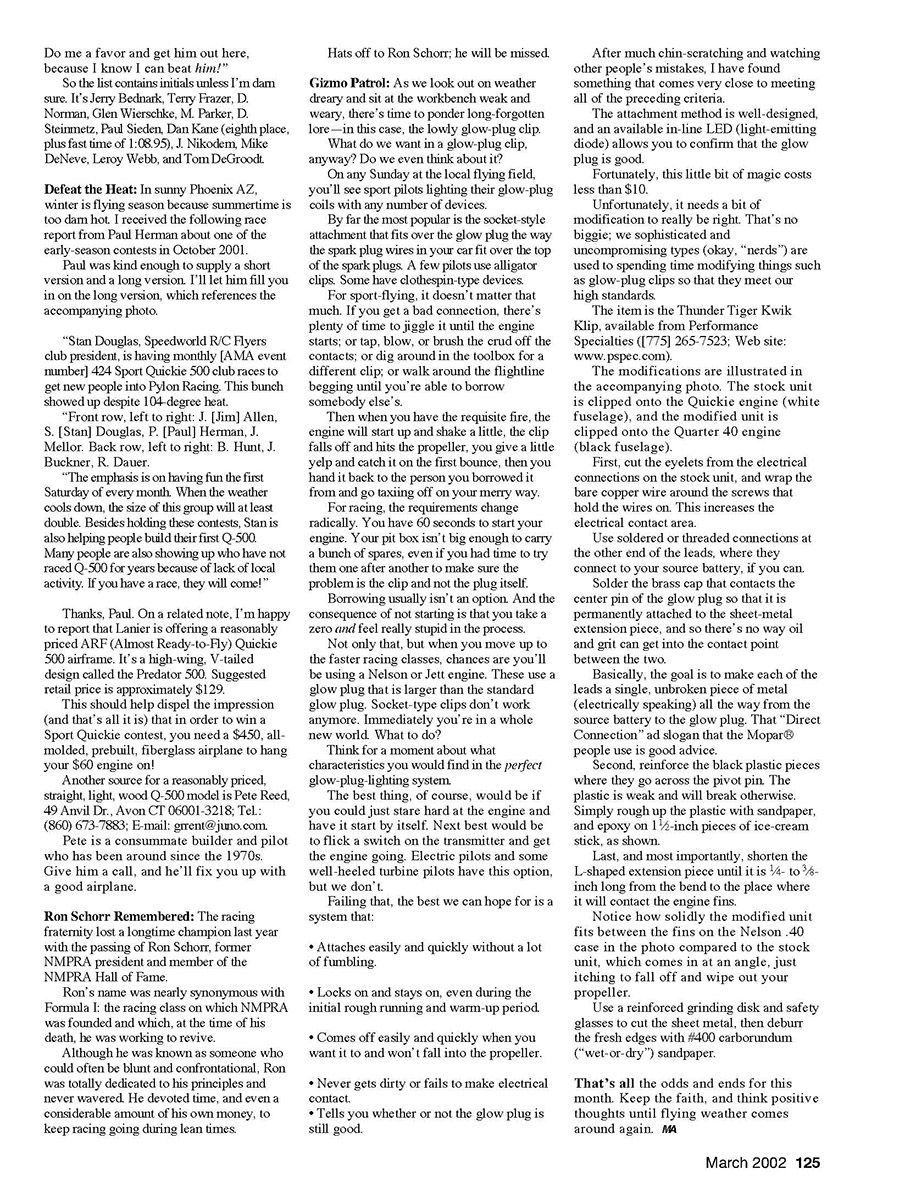
Paul was kind enough to supply a short version and a long version. I'll let him fill you in on the long version, which references the accompanying photo.
"Stan Douglas, Speedworld R/C Flyers club president, is having monthly (AMA event number) 424 Sport Quickie 500 club races to get new people into Pylon Racing. This bunch showed up despite 104-degree heat.
"Front row, left to right: J. [Jim] Allen, S. [Stan] Douglas, P. [Paul] Herman, J. Mellor. Back row, left to right: B. Hunt, J. Buckner, R. Dauer.
"The emphasis is on having fun the first Saturday of every month. When the weather cools down, the size of this group will at least double. Besides holding these contests, Stan is also helping people build their first Q-500. Many people are also showing up who have not raced Q-500 for years because of lack of local activity. If you have a race, they will come!"
Thanks, Paul. On a related note, I'm happy to report that Lanier is offering a reasonably priced ARF (Almost Ready-to-Fly) Quickie 500 airframe. It's a high-wing, V-tailed design called the Predator 500. Suggested retail price is approximately $129.
This should help dispel the impression (and that's all it is) that in order to win a Sport Quickie contest, you need a $4,500, all-molded, prebuilt, fiberglass airplane to hang your $60 engine on!
Another source for a reasonably priced, straight, lightweight Q-500 model is Pete Reed, 49 Anvil Dr., Avon CT 06001-3218; Tel.: (860) 673-7883; E-mail: [email protected]. Pete is a consummate builder and pilot who has been around since the 1970s. Give him a call, and he'll fix you up with a good airplane.
Ron Schorr Remembered:
The racing fraternity lost a longtime champion last year with the passing of Ron Schorr, former NMPRA president and member of the NMPRA Hall of Fame.
Ron's name was nearly synonymous with Formula 1; the racing class on which NMPRA was founded and which, at the time of his death, he was working to revive.
Although he was known as someone who could often be blunt and confrontational, Ron was totally dedicated to his principles and never wavered. He devoted time, and even a considerable amount of his own money, to keep racing going during lean times.
Hats off to Ron Schorr; he will be missed.
Gizmo Patrol:
As we look out on weather dreary and sit at the workbench weak and weary, there's time to ponder long-forgotten lore — in this case, the lowly glow-plug clip. What do we want in a glow-plug clip, anyway? Do we even think about it?
On any Sunday at the local flying field, you'll see sport pilots lighting their glow-plugs with any number of devices.
By far the most popular is the socket-style attachment that fits over the glow plug the way the spark plug wires in your car fit over the top of the spark plugs. A few pilots use alligator clips. Some have clothespin-type devices.
For sport-flying, it doesn't matter that much. If you get a bad connection, there's plenty of time to jiggle it until the engine starts; or tap, blow, or brush the crud off the contacts; or dig around in the toolbox for a different clip; or walk around the flightline begging until you're able to borrow somebody else's.
When you have the requisite fire, the engine will start up and shake a little, the clip falls off and hits the propeller, you give a little yelp and catch it on the first bounce, then you hand it back to the person you borrowed it from and go taxiing off on your merry way.
For racing, the requirements change radically. You have 60 seconds to start your engine. Your pit box isn't big enough to carry a bunch of spares, even if you had time to try them one after another to make sure the problem is the clip and not the plug itself.
Borrowing usually isn't an option. And the consequence of not starting is that you take a zero and feel really stupid in the process.
Not only that, but when you move up to the faster racing classes, chances are you'll be using a Nelson or Jett engine. These use a glow plug that is larger than the standard glow plug. Socket-type clips don't work anymore. Immediately you're in a whole new world! What to do?
Think for a moment about what characteristics you would find in the perfect glow-plug-lighting system.
The best thing, of course, would be if you could just stare hard at the engine and have it start by itself. Next best would be to flick a switch on the transmitter and get the engine going. Electric pilots and some well-heeled turbine pilots have this option, but we don't.
Failing that, the best we can hope for is a system that:
- Attaches easily and quickly without a lot of fumbling.
- Locks on and stays on, even during the initial rough running and warm-up period.
- Comes off easily and quickly when you want it to and won't fall into the propeller.
- Never gets dirty or fails to make electrical contact.
- Tells you whether or not the glow plug is still good.
After much chin-scratching and watching other people's mistakes, I have found something that comes very close to meeting all of the preceding criteria.
The attachment method is well-designed, and an available in-line LED (light-emitting diode) allows you to confirm that the glow plug is good.
Fortunately, this little bit of magic costs less than $10.
Unfortunately, it needs a bit of modification to really be right. That's no biggie; we sophisticated and uncompromising types (okay, "nerds") are used to spending time modifying things such as glow-plug clips so that they meet our high standards.
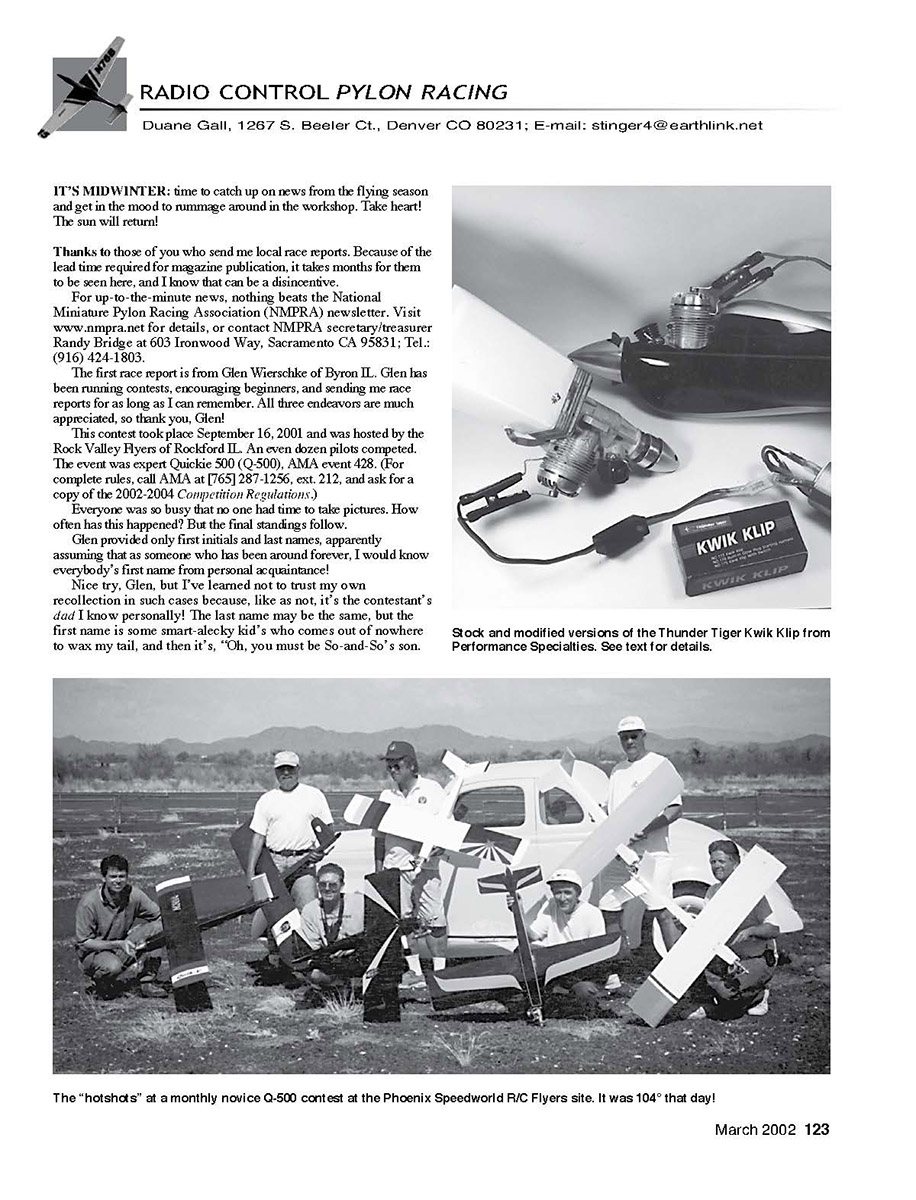
The item is the Thunder Tiger Kwik Klip, available from Performance Specialties (775) 265-7523; Web site: www.pspec.com.
The modifications are illustrated in the accompanying photo. The stock unit is clipped onto the Quickie engine (white fuselage), and the modified unit is clipped onto the Quarter 40 engine (black fuselage).
First, cut the eyeslets from the electrical connections on the stock unit, and wrap the bare copper wire around the screws that hold the wires on. This increases the electrical contact area.
Use soldered or threaded connections at the other end of the leads, where they connect to your source battery, if you can.
Solder the brass cap that contacts the center pin of the glow plug so that it is permanently attached to the sheet-metal extension piece, and so there's no way oil and grit can get into the contact point between the two.
Basically, the goal is to make each of the leads a single, unbroken piece of metal (electrically speaking) all the way from the source battery to the glow plug. That "Direct Connection" ad slogan that the Mopar® people use is good advice.
Second, reinforce the black plastic pieces where they go across the pivot pin. The plastic is weak and will break otherwise. Simply rough up the plastic with sandpaper, and epoxy on 1½-inch pieces of ice-cream stick, as shown.
Last, and most importantly, shorten the L-shaped extension piece until it is 1/4- to 3/8-inch long from the bend to the place where it will contact the engine.
Notice how solidly the modified unit fits between the fins on the Nelson .40 case in the photo compared to the stock unit, which comes in at an angle, just itching to fall off and wipe out your propeller.
Use a reinforced grinding disk and safety glasses to cut the sheet metal, then deburr the fresh edges with #400 carborundum ("wet-or-dry") sandpaper.
That's all the odds and ends for this month. Keep the faith, and think positive thoughts until flying weather comes around again. MA
Transcribed from original scans by AI. Minor OCR errors may remain.

