
RADIO CONTROL PYLON RACING
Duane Gall, 1267 S. Beeler Ct., Denver CO 80231; E-mail: [email protected]
TRAVELIN' MAN: Racing means contests, and contests mean travel. Until that happy day when Radio Control (RC) Pylon is as popular as golf, the only way most of us can get our fill of racing is to drive or fly to some exotic clime where the decor at Applebee's looks different somehow, and the locals speak with a strange dialect using words such as "eh" or "y'all." So grab your wallet, and let's hit the road!
The first thing you will need is usually the last thing most people think of: a good sunshade. When you run out to the local field to sport-fly or test your racing airplane for a couple hours, you're fine without shade, but at an out-of-town contest you'll be spending the entire day out in the open.
Sunburn and dehydration are hazardous to your health. More importantly, they can cause you to crash! "Brain fade" after lunchtime on a hot day accounts for more broken airplanes than you might think.
Sunshades come in two basic flavors: the strong, semipermanent kind, such as the E-Z Up® brand, and the lightweight, less substantial dining canopy or picnic-shelter kind. The former are well worth the extra investment if you plan to do a lot of traveling but are out of the question unless you have a large van or truck in which to carry them.
The latter are cheap, expendable, and will fit in a small car when disassembled, but they take longer to set up and usually depend on guy ropes and stakes. If the pit area is on asphalt or concrete, you won't be able to use these.
Another consideration when selecting a sunshade is whether it will handle wind and rain. Some have flat roofs that allow water to puddle up in the middle until someone notices and pushes the middle up, giving a "soaker" to any people or models that happen to be near the edge when the water pours off, or no one notices until it's too late.
Others are made from a porous material that allows the wind through, avoiding the excitement of a dust devil pirouette but rendering them useless as a rain shelter.
If your only concern, rainwise, is keeping your airplane and radio dry, consider the combination of a lightweight, porous sunshade for you and a child-size tent for the airplane and pit box. Kids' tents can be purchased for as little as $10.
Of equal importance to what goes above you and your gear is what goes underneath. Anyone who has heard his or her name called for the next heat while frantically searching in the grass for that one-of-a-kind metric muffler bolt understands how valuable an old piece of carpet can be.
Most cars come with floor mats, and some SUVs have removable rubber mats in the rear compartment. Place these on the ground wherever you plan to do any airplane maintenance. A low-slung beach chair or camping chair will bring you down to eye level with the airplane and make for a shorter reach if you do happen to drop any parts.
Next on the list is a cooler for your drinks. This is important not only for pilot hydration but also as an emergency hold-down for your sunshade. Bring 50 feet of extra rope to connect one handle of your cooler to the upwind corner of the sunshade. In case of wind, the cooler will act as an anchor.
In case of flood, you can cling to the cooler for flotation while the sunshade trail behind as a sea anchor, limiting your drift and making you more visible to rescue aircraft (I'm thinking of our friends in Texas here).
Speaking of drinks, they should be high in water content and low in sugar, corn syrup, saccharin, and other pollutants. Caffeine is an option, depending on your own particular needs. Alcohol is a total no-no until the contest is over. And notice that I wrote "contest"—not "day." Those who protest a string of wins on Saturday and defeat by the same opponent on Sunday should analyze why.
Multicultural issues: In many ways the RC pylon contest circuit is a culture of its own. Racing pilots tend to stay at the same hotels, return year after year to the same contests, and pass along their collected wisdom and war stories to the younger or new arrivals. The fact has implications for the way we conduct ourselves among newcomers and the outside world.
First of all, we ought to be civil to each other. Loan a guy a wrench even if you don't like him much. Both of you spent way more than you should have to get there, and the next time it might be you who needs an assist. If you have a race toolset, let it be on the racecourse.
Second, one ought to be good ambassadors. Most people have no idea about what we do or how cool it is. We have an equal chance of coming across as goofs or geeks. Taking a moment to explain to a spectator how the transmitter works makes you a god. Starting up an engine in the hotel parking lot might make you a geek.
And third, remember that the family comes first. Most racing pilots are males who have well-deserved reputations for enjoying food and accommodations that make women and children recoil in horror. (Well, maybe just women; the children by now have adopted Bart Simpson as their patron saint, so they're not easily grossed out.) If you're bringing the wife or girlfriend along, upgrade to the hotel with the pool. Then she has the option of hanging out there instead of sweltering in the field all day, watching your glorious victory and the subsequent fight that much more likely to support you in achieving more glorious victories later.
Passing on "pylon culture" to newcomers is probably the greatest benefit of being involved in the sport. There is no substitute for just watching the old masters do their thing. If a picture is worth a thousand words, you can get more than a year's worth of these in only magazine columns from one afternoon in the pits, or an evening in the hotel, at any major contest such as the Nationals.
The package deal: Traveling by airline presents special challenges. Recent changes in security procedures mean more delays and more scrutiny of baggage, in addition to the problems we modelers have always had such as how to protect our gear during transit and how to avoid exorbitant oversize-baggage charges.
The transmitter is the thing most likely to raise the eyebrows of airline personnel. It should be packed separately in its own case. Be prepared to take it out, open up the back, and demonstrate that it works. Don't count on taking it as carry-on.
All major radio manufacturers sell aluminum transmitter cases for this purpose, but they can be pricey. A less expensive alternative is a picnic plastic case, available from sporting-goods stores. You will need to custom-cut the foam-pipe liner to fit your transmitter.
Another "red flag" item is the engine. The best bet is to take the engine out of the airframe and pack it separately. Again, be prepared to unwrap, disassemble, and demonstrate that it is in some sort of weapon. Obviously it's a good idea to arrive at the airport with plenty of time to spare.
Fuel and fuel cans are a non-issue. Fortunately, since the demise of the old Formula I event, the rule books now require the hosting clubs to supply the fuel, so there's no reason to bring your own. As for the fuel tank in the airplane, it's my duty to inform you that the airlines consider even an empty, used fuel tank a hazard because the alcohol fumes inside could technically ignite if there were a fire in the hold. Just to be safe, bring a new tank in its original package and repack the airplane when you get there. Most of us do it; replace our fuel tanks often enough anyway.
Because of all these complications, many contestants try to ship their gear or the airframe to someone they know in their destination city, fly with just what they can carry in the airplane and assemble things the day before the contest. Even if you do that, there is still the problem of how to pack the airplane safely into a box that won't redline your travel budget.
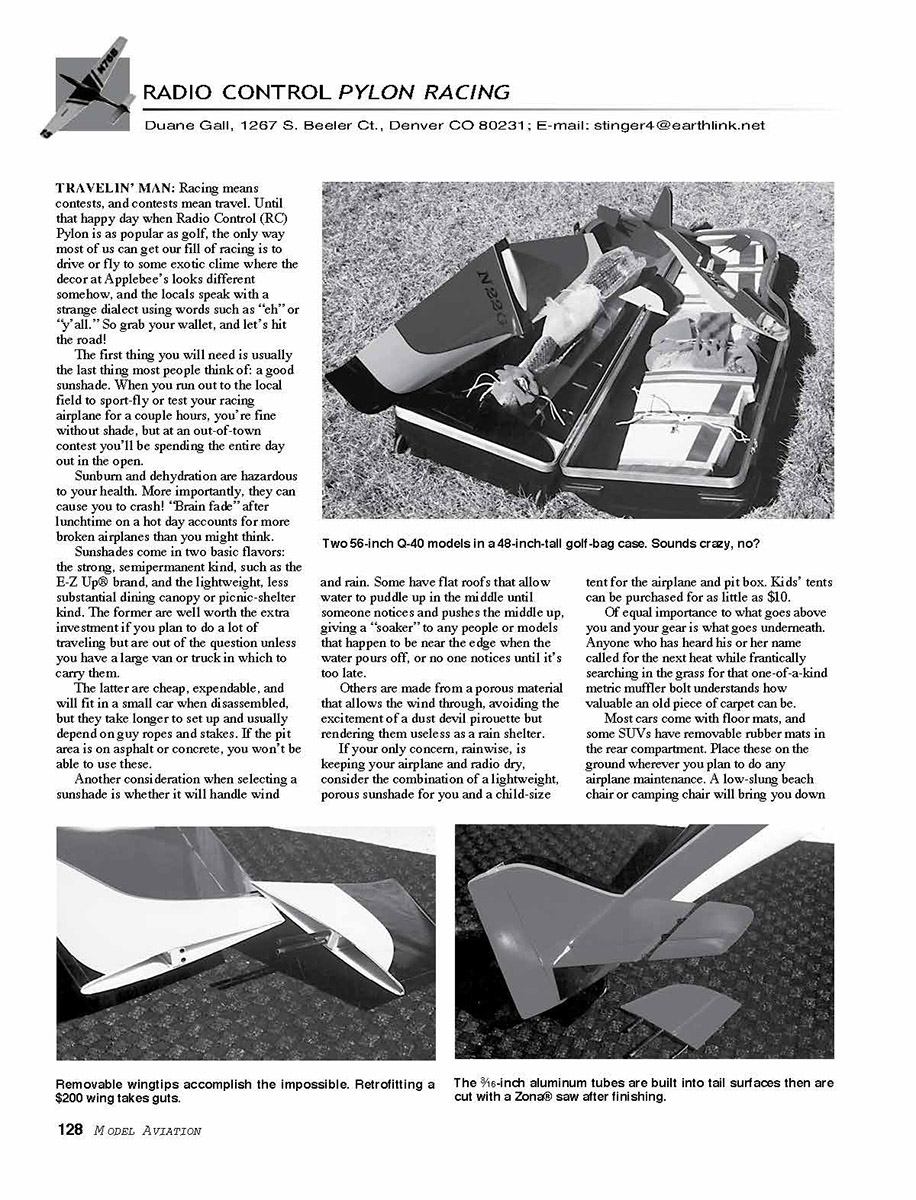
I'll close this month's column with my solution to the problem, illustrated in the photos. I managed to fit two 55-inch-span Quarter 4 (Q4 AMA event 422) aircraft into an extra-large golf-bag case. I chose the golf-bag case because although it is technically oversize, it has such a wide following that airlines typically waive the oversize-baggage fee for this type of cargo.
The case walls are made from a tough plastic that is roughly 5/8-inch thick. I hang the aircraft components from those walls using homemade twist ties consisting of 18-gauge insulated copper wire from Radio Shack. Each anchor point consists of a pair of 3/32-inch holes, approximately an inch apart, drilled in the case walls. The wire is threaded through the holes from the inside out, then again.
Each fuselage is locked into a cradle that is cut from blue Styrofoam and stuck to the inside of the case using silicone adhesive. I wrap each fuselage in bubble wrap, then place it in the cradle and secure it with two wire ties.
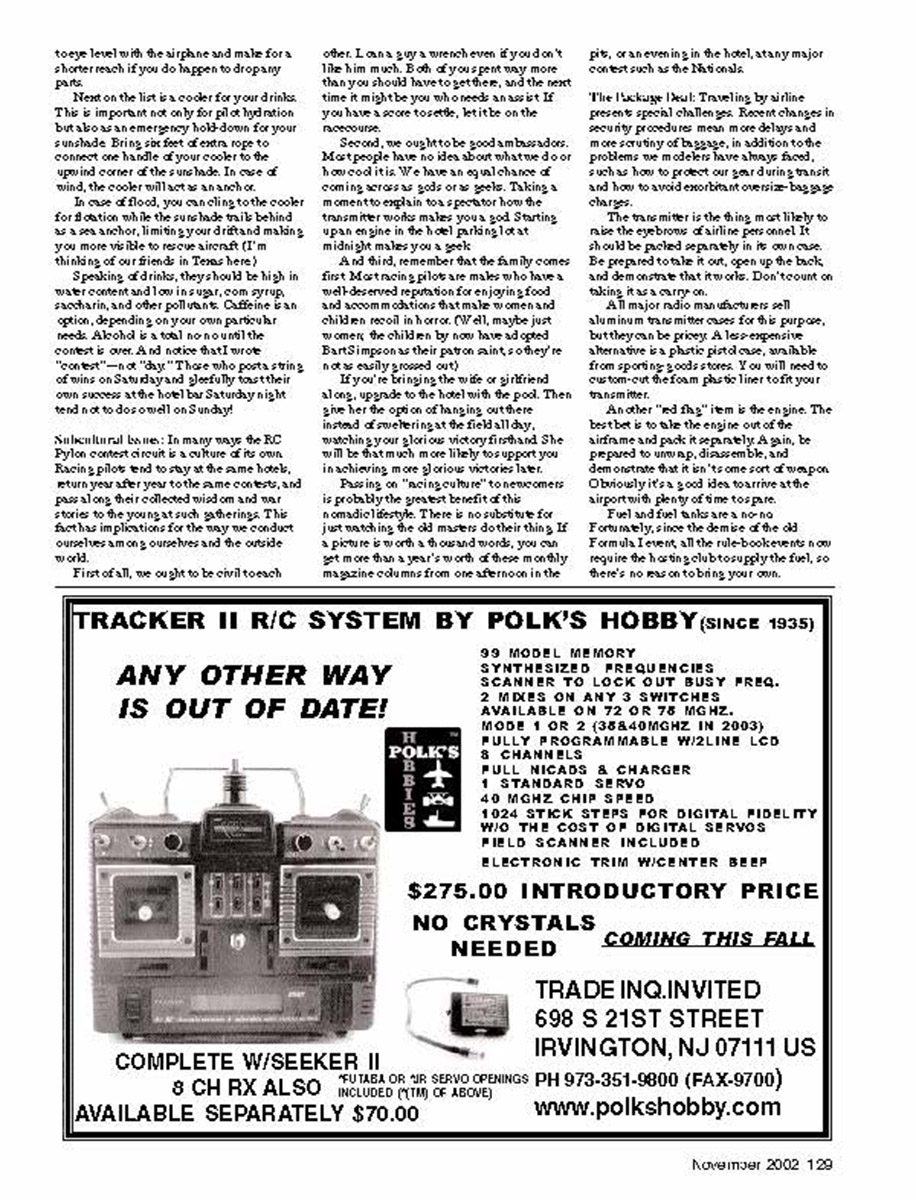
To allow the 55-inch wings to fit inside the 48-inch-long case, I made the wing tips removable. An accompanying photo shows the basic setup: two 1/4-inch outside-diameter (OD), 1/8-inch inside-diameter (ID) aluminum tubes, each six inches long, at the top and bottom of the spar, cut at the parting line and rejoined with matching six-inch-long, 1/8-inch OD carbon-fiber tubes.
The parting line is six or seven inches inboard of the tip and an inch or so outboard of the aileron. To hold the tip on and keep it aligned, I use one strip of vinyl tape running from the trailing edge (TE) around the leading edge and back to the TE. Since the flight loads are minimal at this distance from the center, this lightweight method provides adequate strength with no observable flexing in the turns.
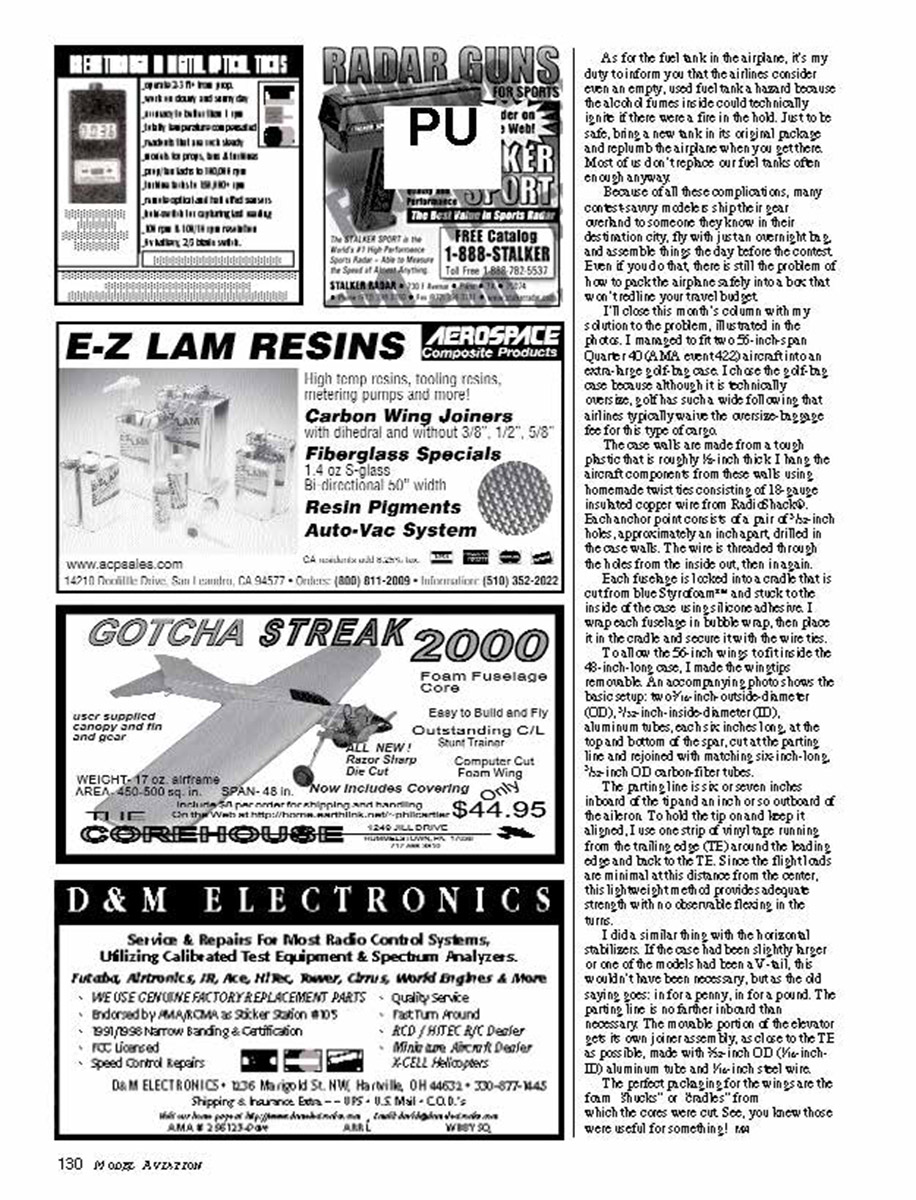
I did a similar thing with the horizontal stabilizers. If the case had been slightly bigger or one of the models had been a V-tail, this wouldn't have been necessary, but as the old saying goes, "in for a penny, in for a pound." The parting line is no farther inboard than necessary. The removable portion of the elevator gets its own joiner assembly, as close to the TE as possible, made with 1/8-inch OD (1/16-inch ID) aluminum tube and 1/8-inch carbon-fiber wire.
The perfect sizes for the wing-spar and tailboom "shocks" or "cradles" from which the cores were cut are — you knew those would be useful for something!
Transcribed from original scans by AI. Minor OCR errors may remain.

