
RC Pylon Racing
Cliff Telford. 1512 S. Greenleaf Ct., Winter Springs FL 32708; E-mail: [email protected]
PARTICIPATION IN THE Radio Control (RC) Pylon Racing events at this year's AMA Nationals (Nats) enjoyed more flying time than usual. In the past few years the Nats flying schedule has been so tight that there has been little opportunity for the racing pilots to practice at the site where the competition events have been held. This year the RC Scale contest finished earlier, and this unusual circumstance allowed the racing pilots three days to practice.
This had not happened since the Nats made the permanent move to Muncie, and it proved to be a blessing for racers from Canada, Texas, and the West Coast, who could adjust the engines and their equipment to the Indiana weather conditions in July.
All pilots who arrived early were grateful for the bonus time in the air and the chance to socialize for a few extra days. By the time the official model processing began at 2 p.m. Sunday, July 14, most people were prepared for the races to begin on Monday. The Pylon events ended on Saturday.
National Miniature Pylon Racing Association (NMPRA) President Darrol Cady supervised the processing procedure, and he was assisted by members of the Prince Georges County Radio Control Club (PGRC) of Maryland. More than 260 airplanes and 100 transmitters were checked and measured in less than two hours.
Most competitors are using custom-built kits prefabricated from fiberglass and carbon fiber, so scrutiny must be given only to a model that is an original design or has had some major alteration to the kit.
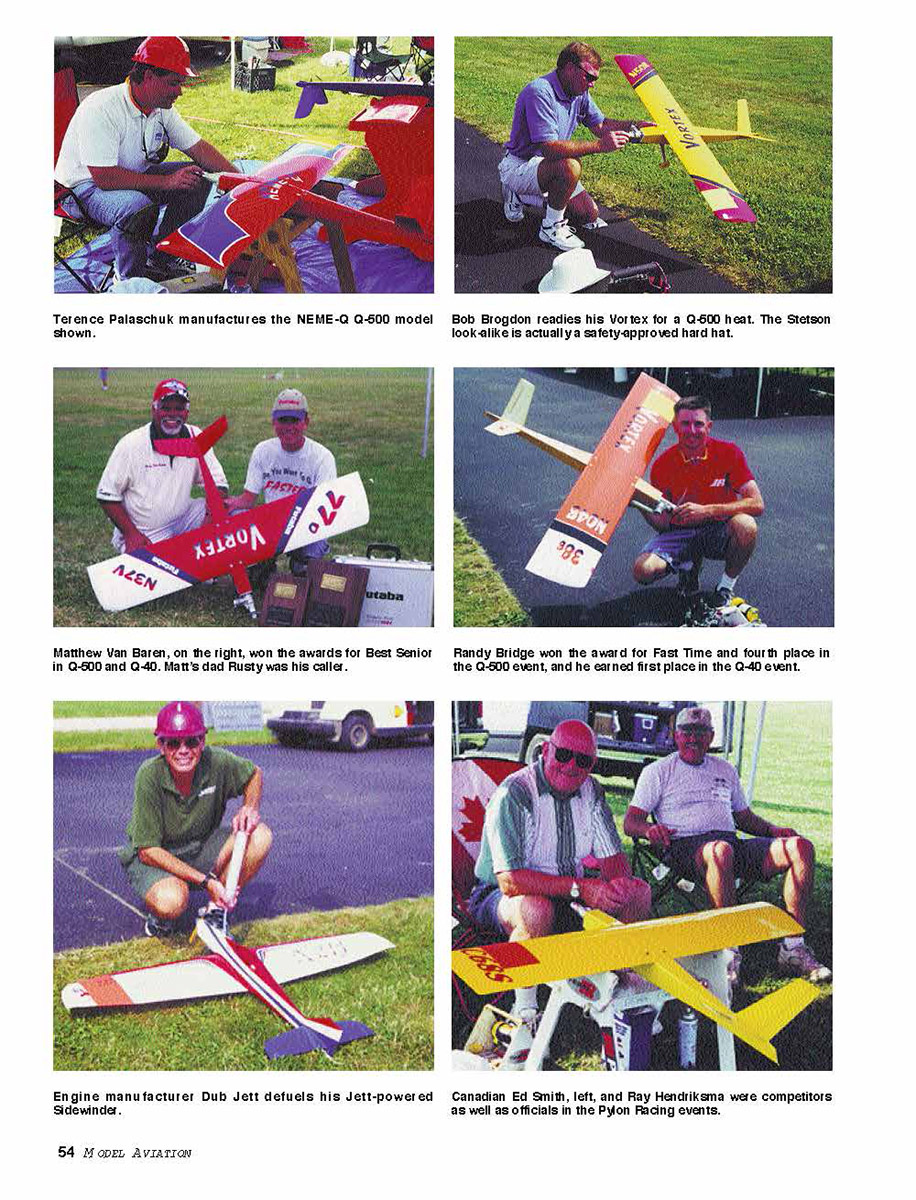
The majority of the models processed for the Quickie 500 (Q-500) event were the high-wing V-tail type pioneered by Jim Allen as far back as 1987. Evolutionary changes in construction technique, composite materials, and airfoil design have resulted in beautifully made kits, such as the Vortex kitted by Chuck Bridge and the NEME-Q produced in Canada by Terence Palaschuk. These models dominated the Q-500 entries in 2002.
The Quarter 40 (Q-40) entries were more diverse. Rusty Van Buren's Miss Ashley kit was the most popular. Several people entered the Sidewinder kitted by Jerry Small or Lyle Larson's Dago Red or Vendetta. AMA rules require that all Q-40 models be approved by the RC Racing Contest Board, so there are seldom surprises at processing time.
Contest Director (CD) Mike Condon and the CAPS club (Ohio-Michigan) were again asked by AMA to manage the Pylon Racing competition and they did a great job. The events flown were AMA 428 (Q-500) and AMA 422 (Q-40).
Each event was split into an A and B matrix, each of which required a starter and an assistant. Those positions were filled by pilot volunteers Mike Elden (West Virginia), Pete Reed (New Hampshire), Rick Moreland (Maryland), Chic White (Virginia), Ed Smith (Canada), Ray Hendriksma (Michigan), and Dennis Cranfill (Texas). The top 14 pilots from each qualifying matrix advanced to the 28-pilot final for each event.
Dan Stegall (North Carolina) built new pylons for AMA, and they worked well. In 2001 the pylons were secured to the pavement with ropes attached near the tops of the 15-foot poles. Pilots who flew too low and too close snagged the ropes a few times and crashed. Dan's pylons needed no ropes, and there were fewer pylon strikes in 2002.
Q-500 A Matrix: The Q-500 competition began Monday morning. Mike Condon held a meeting with the pilots to discuss the rule interpretations and overflow restrictions. A demo flight proved that the course equipment and workers were ready, then the first heat was launched at approximately 8:30 a.m.
In Round One the airplanes didn't seem to be going very fast. At the end of the round Terry Frazer had the fast time with a 1:10.00, which held through Round Three. Jason Duda's airplane was the first to hit one of the new pylons. The pylon stood and the model crashed.
In Round Three Brian Neff's model took a piece off the top of Pylon Three and crashed, then Mike Eden's airplane hit the same pylon. The pylons keeled over slowly, as if to surrender, to the delight of the spectators. Dan Stegall and the course workers repaired the pylon with only a short delay.
When flying resumed the pilots began to get the weather and propellers sorted out, and the times began to creep down. At the end of Round Four, only Ed Coker had a perfect score and he held fast time at 1:08.99. Only five pilots had times below 1:10.00. Round Four was the last one run Monday; the last three were flown Tuesday afternoon.
In Round Five Ed Coker set the fastest time in the A Matrix at 1:08.62, but he cut twice in Round Six and ruined his perfect score. By Round Seven, no one had a perfect score.
The top 14 pilots from the A Matrix to advance to the finals were Ed Coker, Terry Frazer, Mario Travieso, Matthew Van Buren, Gary Freeman Jr., Jaime De La Vega, Stu McAfee, Mark Parker, Bill Vargas, Randy Bridge, Travis Flynn, Mike Weaver, Lloyd Brunham, and Roy Andrassy. A 20 out of a possible 28 points entitled the 14th-place pilot to enter the finals.
The Q-500 B Matrix began flying Monday afternoon. The airplanes seemed a little slow, as the A Matrix models had been in the morning. Mike Hufsel had the fastest time in Round One at 1:11.21. In Round Two the times dropped by two seconds, and Marcus Blanchard, Mike Condon, and Vern Smith posted times of 1:09.00+ in winning their heats.
By the end of Round Four, and the end of competition on the first day, Marcus Blanchard held first place in the B Matrix with a perfect score of 20 points and held fast time at 1:08.99.
In Round Five Tuesday morning Marcus improved the fast time to 1:08.06, but he lost his perfect score in Round Seven when he cut a pylon flying against Jon Baker and Vern Smith and took third place in the heat.
At the end of seven rounds, the following B Matrix pilots advanced to the final: Marcus Blanchard, Mike Helsek, Mike Condon, Gino Del Ponte, Mike Devore, Richard Beers, Chuck Anderson, Dennis O’Brien, David Norman, Chuck Andraka, Bob Brogdon, “Red” Cranfill, Dub Jett and Darrol Cady. The last three were in a five-way tie with 20 points each. Jon Baker and Steve Baker also had 20 points, but they did not qualify when the tie was broken by best times.
The Q-500 final was held Wednesday morning. Dub Jett’s NEME-O and David Norman’s Vortex collided in the first heat. Dub’s airplane survived to win the heat, but Norman’s crashed to collect a zero.
Randy Bridge decided to change engines and try a different propeller from the 8.6 x 8.75 APC he had used in qualifying. It was a bold move. The newer Nelson engine and APC 8.8 x 9.25 produced the fastest time in the event; he easily won his first-round heat at 1:06.74.
In Round Two Marcus Blanchard, Randy Bridge, Ed Coker, and Mike Helsek won their heats to remain perfect and tied for first place. In Round Three Marcus and Randy lost to Bill Vargas when the frontrunners cut. Marcus runs third in the heat for his only loss in the Q-500 final. Ed’s 1:07.28 lost to Marcus’s 1:07.10 in Round Five. Mike Helsek finished fourth in his heat in Round Five, for his only loss in the final. In Round Six Ed lost to Randy. Terry Frazer, and Dennis O’Brien when he was the only one to cut in a tight race.
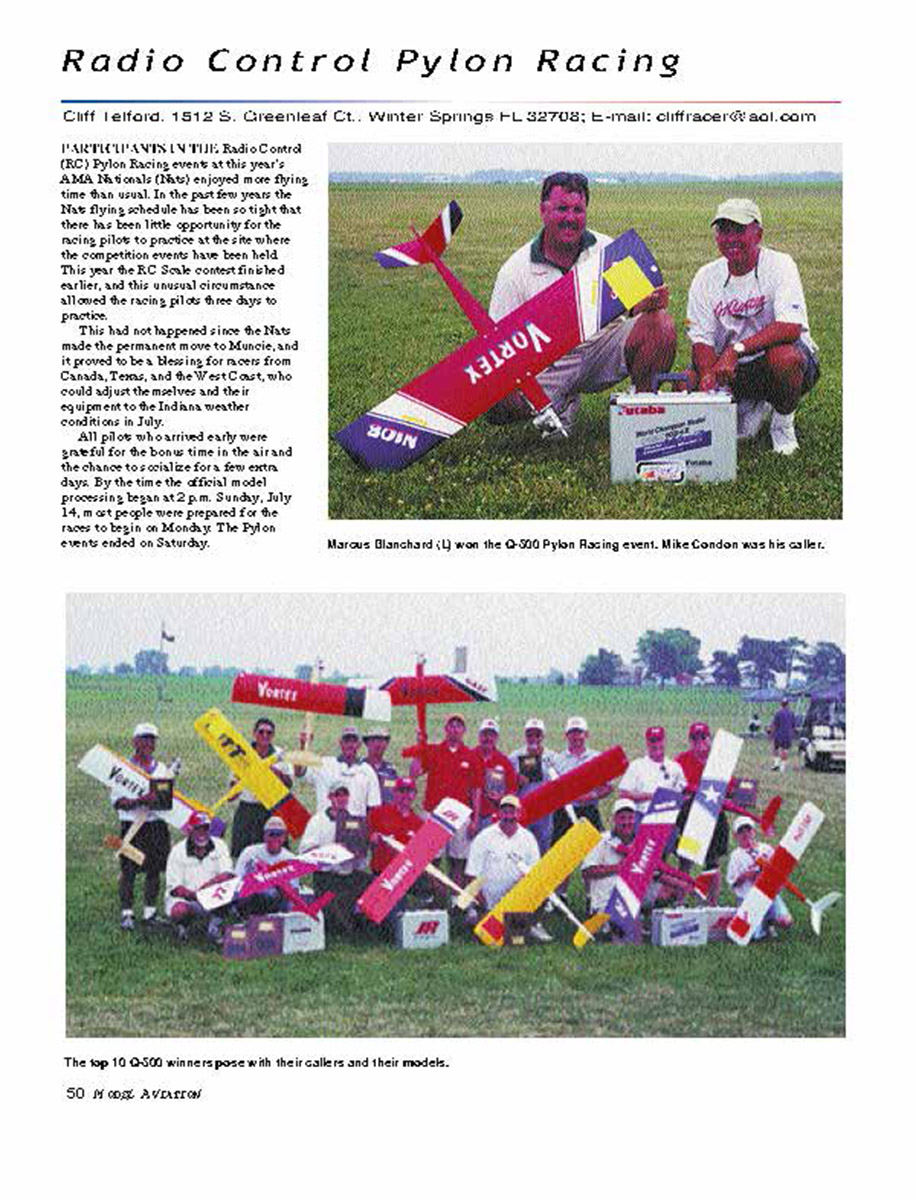
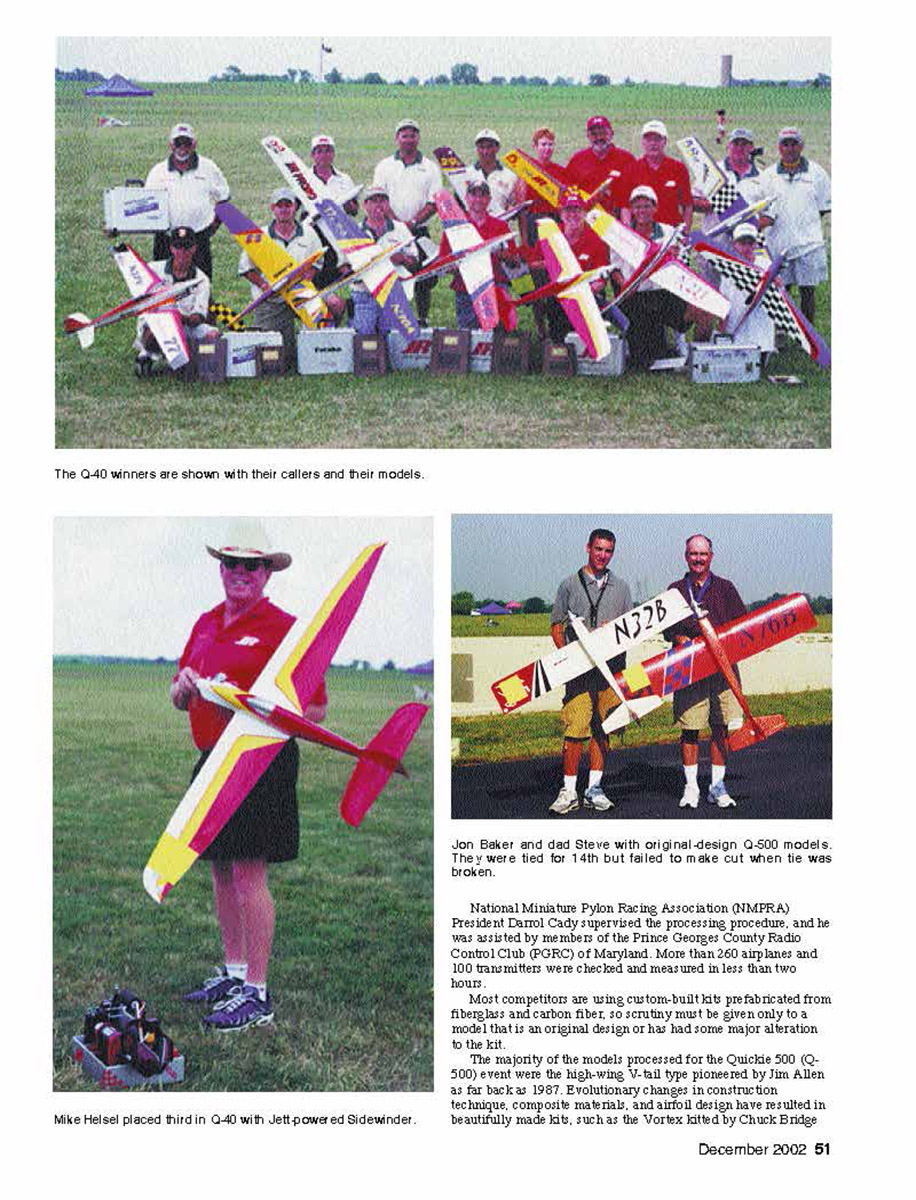
At the end of the sixth round Marcus Blanchard won Q-500. Terry Frazer, Mike Helsek, and Randy Bridge were second, third, and fourth after a flyoff to break the tie. Matthew Van Baren won the flyoff against Dub Jett to take fifth place and the award for Best Senior. Ed Coker, Gary Freeman Jr., and Mark Parker finished seventh, eighth, and ninth after a flyoff tiebreaker. Bill Vargas claimed the 10th-place plaque. Nickie Maxwell won the Best Junior award.
Q-M/A Matrix flying began after the Q-500 final was three rounds in. In Round One Tom Scott turned in the fastest time with his new Poindexter designed by Dan Kane and Bruce DeChantel. (Dan was in Europe participating in the Fédération Aéronautique Internationale (FAI) World Championships for Electric Pylon Racing.) Mike Helsek, who won the Q-40 event in 2001, dropped a point to Shane De La Vega in a tight race in which both pilots recorded times of 1:07.00+.
In Round Two Mike finished third in a heat where three pilots turned 1:06.00+. Jim Allen’s 1:05.52 in that heat was the fastest time of the day. In Round Three Tom Scott hit his new Poindexter in midair collision with David Martin’s Miss Ashley. Mike moved out Terry Frazer to win that heat.
In Round Four Tom Scott brought out the second new Poindexter and posted a 1:06.91. Racing ended for the day at 4:30 p.m., with Jim Allen, Matt Van Baren, Gary Schmidt, Rusty Van Baren, and Gino Del Ponte tied for first place, only one point down.
Round Five began at 8 a.m. Thursday. Dennis Cranfill was scheduled to fly in the first heat of the day, but he missed his wake-up call and failed to show. He had already received a zero in Round Three for a double cut on a red if heat. Frustrated and in danger of not making the cut, he decided to save his airplane for another day and withdrew from the competition. He volunteered to be the starter for the Q-40 final and did a commendable job.
Gino Del Ponte, one of the three Senior fliers in the contest, suffered a “no start” in the round that would ultimately keep him from qualifying for the final. In Rounds Six and Seven, there were several heats with only two or three airplanes because of no-shows. The leaders flew conservatively and were content to take second place knowing that only a zero could prevent them from qualifying.
The tightest races were between pilots who needed all the points they could get to make the list of 14 qualifiers. Those who made the list were Rusty Van Baren, Jim Allen, Terry Frazer, Matt Van Baren, Jaime De La Vega, Lee Unger, Mike Helsek, Mike Wever, Tom Scott, Gary Schmidt, Dub Jett, Terrence Pishak, Hank Kaufmann, and Richard Beers. Gino Del Ponte had the same number of points (20) as Richard Beers, but had a slower time and did not make the cut.
Run and One for the Q-40 B Matrix began at 10:45 a.m. Thursday. The heaviest breeze was a factor as it slowed the airplanes on the legs from Pylon Three to Pylon One. This caused many cuts at Pylon One.
The times recorded were relatively slow in Round One except for Fred Bygford’s 1:07.13, Travis Flynn’s 1:07.93, and Roy Andress’ 1:08.26. No scores were under 1:10.00. In Round Two Ray lowered the fastest time to 1:05.07 in a tight race with Lloyd Burnham (1:06.91). Ray scored another 1:05.00+ for the best time in Round Three.
In Round Four Randy Bridge found the right propeller and posted a 1:06.08. At the end of Round Four Ray Andress and Travis Flynn had the only perfect scores. Ray cut a pylon and placed fourth in his Round Five heat to drop three points. Two heats later Travis cut and dropped one point. By the end of Round Five, no one had a perfect score. Thursday’s flying ended at 5:30 p.m.
Round Six on Friday morning passed uneventfully as Rick Morehead and Chic White’s team of score workers continued to run through the matrix at an average of five minutes per heat.
At the end of Round Seven, Travis Flynn had lowered the fast time to 1:05.24 and shared first place with Fred Burgdorf and Stu McAfee, just one point short of being perfect.
Kyle Larson was fourth; Lloyd Burnham was fifth; Randy Bridge and Bill Johnson were sixth and seventh; Jon Baker, the only Senior flier in the B Matrix, was eighth; Roy Andrassy was ninth; Marcus Blanchard was 10th; Mark Parker was 11th; Ed Smith was 12th; and Darrol Cady was 13th. Mike Tallman claimed the 14th and final spot with 16 points. Mike Masi, Ray Hendriks, and Bob Brogdon also had 16 points, but Mike Tallman had the fastest time at 1:09.33.
The Q-40 final began at 11 a.m. Friday after a break for the course workers. Dennis Crandall and Pete Reed handled starter duties. The skies were starting to get cloudy, and a cold front was predicted to pass through the area during the day. Roughly two hours into the final, it got very dark and the pylon course was surrounded on three sides by rain showers approximately a mile away.
The International Miniature Aerobatic Club (IMAC) event was in progress a mile to the south. When the big airplanes sometimes approached the pylon area because of the crosswind, we were informed that the rain had shut down the IMAC event for a while and everyone had to run for cover. At the Pylon Racing site the tent over the cut judges for Pylon Two blew over, but the rainstorms missed the site completely.
Whether it was the tension generated by the weather, the anxiety of the callers, or just competition jitters, no one can say, but it seemed that everyone had saved some cuts for the final event.
In Round One Fred Burgdorf double cut while racing Gary Schmidt, Tom Scott, and Mike West. Everyone in the heat had at least one cut. Terry Flanagan cut in a very tight race against Randy Bridge (1:05.07), Rusty Van Baren (1:05.31), and Lloyd Burnham (1:07.81).
In Round Two Fred cut out again in a heat in which everyone had at least one cut. Marcus Blanchard also cut out, and Dub Jett won the heat with a time of 1:12.54 for 11 laps.
Travis Flynn began Round Three by dropping the fast time to 1:04.88 in a race with Jaime De La Vega (1:05.45), Ray Andrassy on his beat with a time of 1:06.89. In the most exciting heat of the day, Rusty Van Baren (1:06.13) beat Mark Parker (1:06.15), Jon Baker (1:06.20), and Terrence Palaschuk (1:11.00).
At the end of Round Three only Randy Bridge and Mike Hessel had perfect scores. Mike lost a point in Round Four when his 1:06.56 was not fast enough to beat Rusty Van Baren’s 1:06.07. Tom Scott lost his second P-20 cut in a midair collision at Pylon One with Matt Van Baren’s Miss Ashley II. Tom could fly no more in the event. Travis Flynn’s 1:04.99 eked out a win against Gary Schmidt’s 1:05.04.
In Round Five Jim Allen’s 1:05.09 paced out Randy Bridge’s 1:06.06 for Randy’s only loss in the final. Mike Hessel’s 1:06.17 squeaked by Marcus Blanchard’s 1:05.24 to stay in a tie with Randy for first place. Jim was only two points down to hold onto third place. Round Six would determine the winner.
In the first heat of Round Six, Jim Allen won with a 1:06.74. In the second heat Randy Bridge and Mike Hessel faced Jaime De La Vega and Ray Andrassy to determine the winner. All four pilots had posted times of 1:05.00 during the contest.
When it was over, Randy had been pushed to a new fast time for the contest of 1:04.73 for first place. Jaime was second at 1:05.19. Mike had a cut to finish third in the heat and Ray cut to finish fourth.
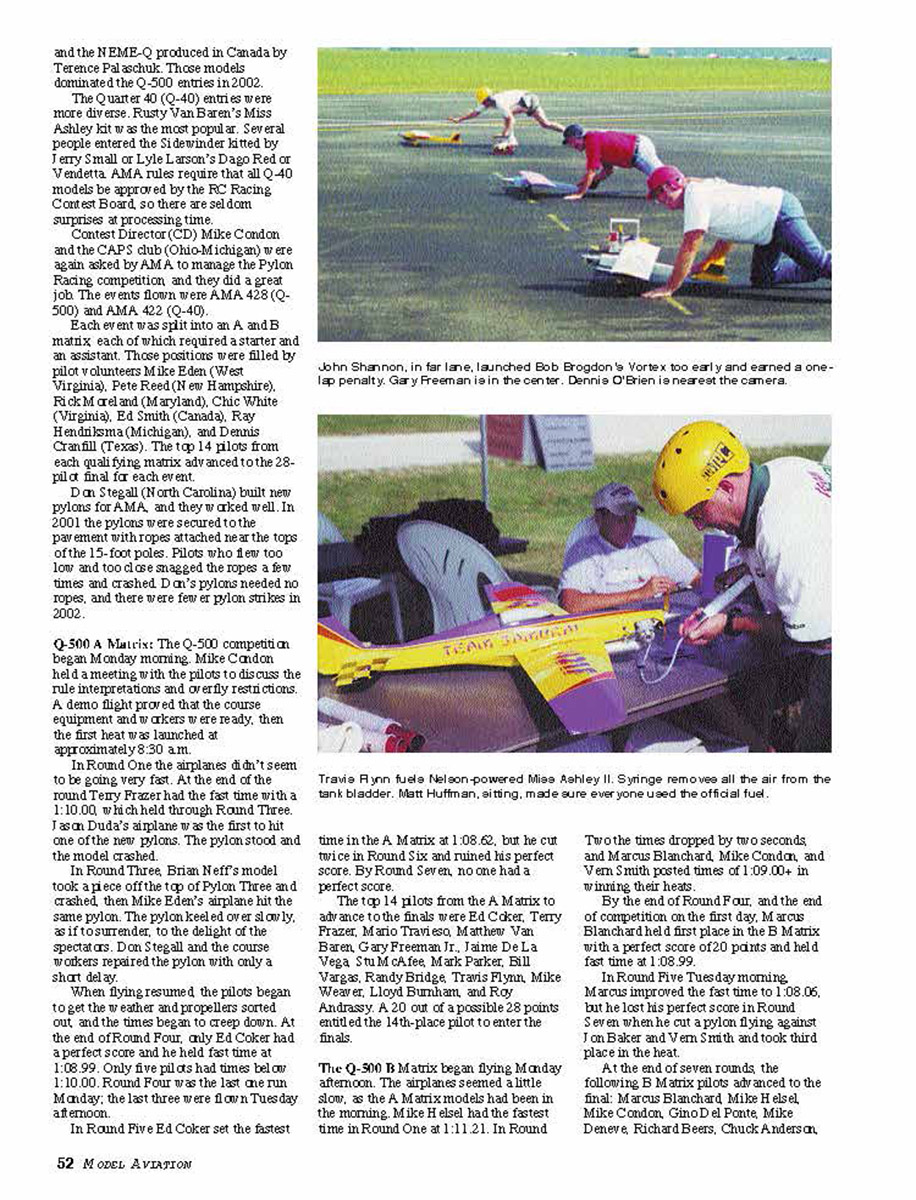
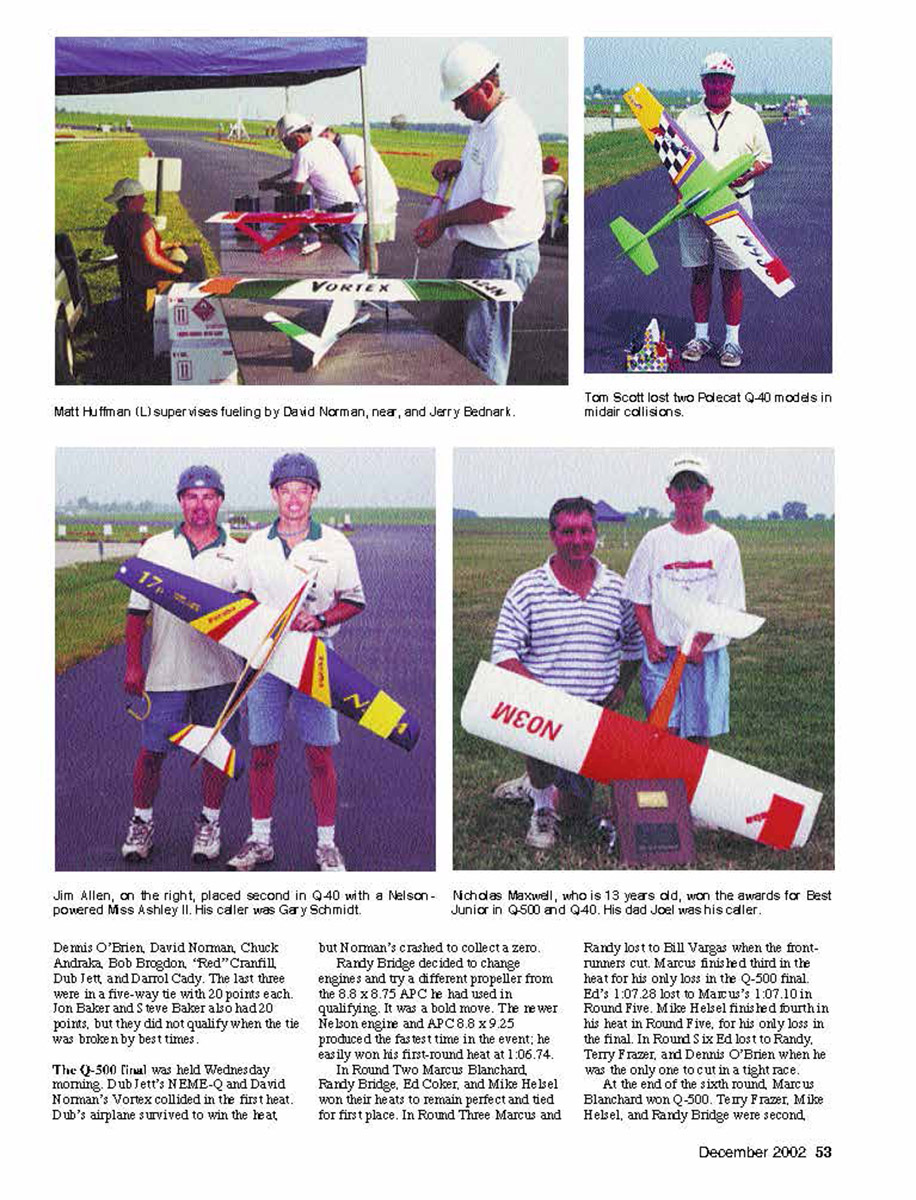
The final results were Randy Bridge, first and fast time for the contest; Jim Allen, second; Mike Hessel, third; Travis Flynn, fourth after a flyoff with Dub Jett, who finished fifth. Lloyd Burnham, Jaime De La Vega, and Darrol Cady were sixth, seventh, and eighth after a flyoff. Stu McAfee was ninth.
There was also a flyoff between Jon Baker and Matt Van Baren to break the tie for Best Senior. Both pilots cut Pylon Three on the 10th lap. Jon pulled up after crossing the finish line, and therefore did not finish the race. Matt flew 11 laps to earn the win. Nicholas Maxwell won the award for Best Junior.
Randy Bridge won the CAPS perpetual trophy for highest combined score in the pylon events for the third consecutive time.
Before the Nats started, CAPS president and Pylon CD Mike Condon agreed to hold an unofficial race for FAI F3D. F3D was not expected to make up weather delays. F3D is the international event for pylon racing, and AMA sends a team abroad every other year to represent our country. The problem is that the F3D pilots are a small group, and there are very few events held for them to practice under contest conditions.
Teams from the USA dominated the event for many years. More recently the competition has improved immensely, and the lack of experience shown by the AMA/US Team has caused them to make many costly mistakes. Under FAI rules, the pilots are flying against the clock—not head to head as in AMA racing. Pilots must fly fast consistently to win. Only practice in a contest environment will expose all of the potential errors that must be corrected.
By the time you see this report, a team will have been selected to represent the USA next year. Thanks to Mike Condon and the CAPS members who stayed an extra day to hold the event.
There were 14 entrants in F3D, and five rounds were flown. FAI rules allow a pilot’s worst score to be thrown out after four rounds. Therefore, the total of the best four flights was used to score this event.
After the five rounds were flown, Matt Van Baren’s total time bested Tom Scott’s by 2.5 seconds for the win. Gino Del Ponte was third. Matt’s best time of 0:58.98 was good enough for an AMA record in the Senior class. It was a pleasant surprise to see that the younger fliers are showing an interest in the international event.
Thanks to PowerMaster for furnishing the fuel for all of the pylon events at the 2002 AMA Nats.
Transcribed from original scans by AI. Minor OCR errors may remain.

