
RC Pylon Racing
Aaron "AJ" Seaholm [[email protected]]
AMA Nats preview
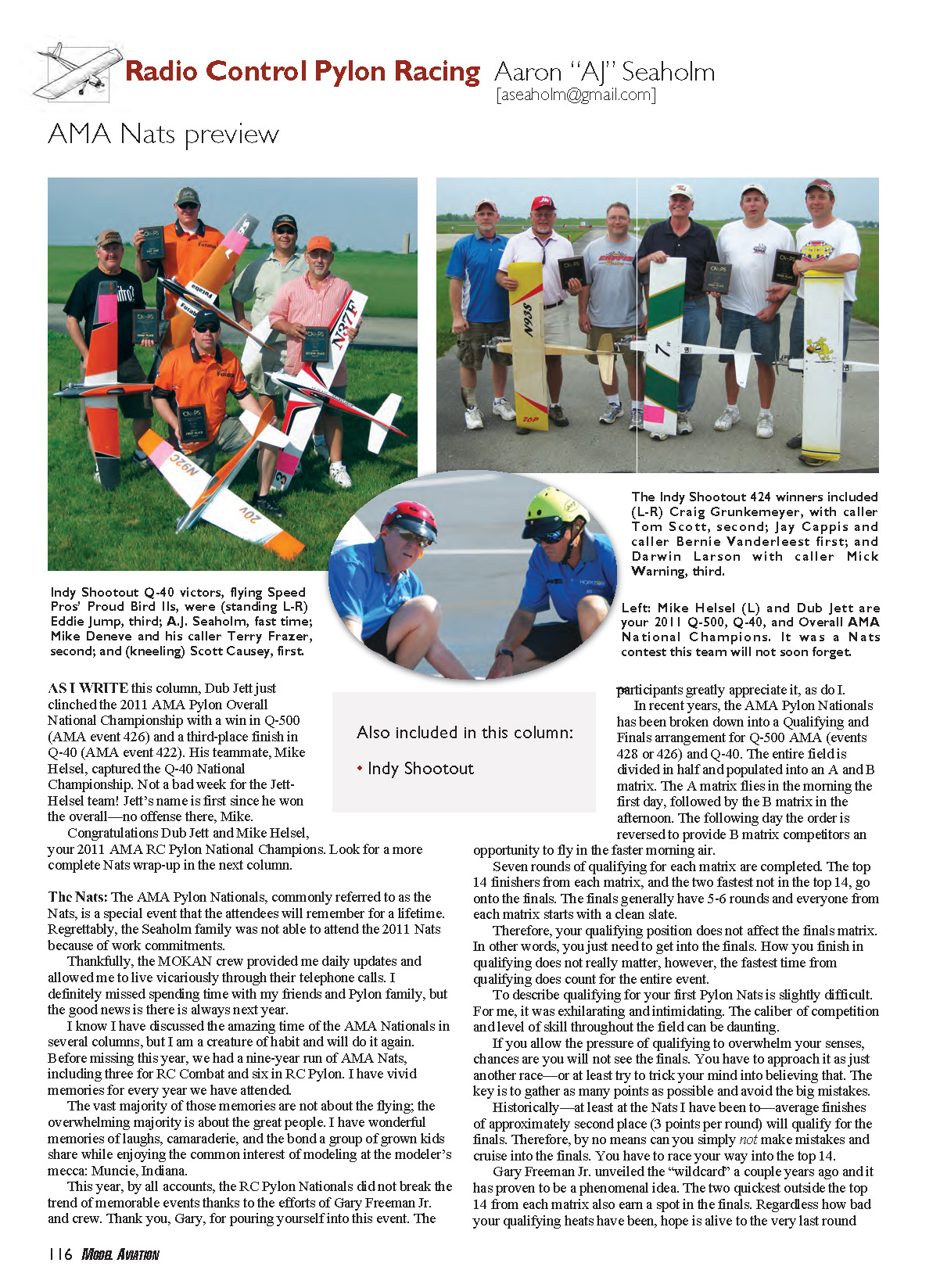
AS I WRITE this column, Dub Jett just clinched the 2011 AMA Pylon Overall National Championship with a win in Q-500 (AMA event 426) and a third-place finish in Q-40 (AMA event 422). His teammate, Mike Helsel, captured the Q-40 National Championship. Not a bad week for the Jett-Helsel team! Jett’s name is first since he won the overall—no offense there, Mike.
Congratulations Dub Jett and Mike Helsel, your 2011 AMA RC Pylon National Champions. Look for a more complete Nats wrap-up in the next column.
The Nats: The AMA Pylon Nationals, commonly referred to as the Nats, is a special event that the attendees will remember for a lifetime. Regrettably, the Seaholm family was not able to attend the 2011 Nats because of work commitments.
Thankfully, the MOKAN crew provided me daily updates and allowed me to live vicariously through their telephone calls. I definitely missed spending time with my friends and Pylon family, but the good news is there is always next year.
I know I have discussed the amazing time of the AMA Nationals in several columns, but I am a creature of habit and will do it again. Before missing this year, we had a nine-year run of AMA Nats, including three for RC Combat and six in RC Pylon. I have vivid memories for every year we have attended.
The vast majority of those memories are not about the flying; the overwhelming majority is about the great people. I have wonderful memories of laughs, camaraderie, and the bond a group of grown kids share while enjoying the common interest of modeling at the modeler’s mecca: Muncie, Indiana.
This year, by all accounts, the RC Pylon Nationals did not break the trend of memorable events thanks to the efforts of Gary Freeman Jr. and crew. Thank you, Gary, for pouring yourself into this event. The participants greatly appreciate it, as do I.
In recent years, the AMA Pylon Nationals has been broken down into a Qualifying and Finals arrangement for Q-500 AMA (events 428 or 426) and Q-40. The entire field is divided in half and populated into an A and B matrix. The A matrix flies in the morning the first day, followed by the B matrix in the afternoon. The following day the order is reversed to provide B matrix competitors an opportunity to fly in the faster morning air.
Seven rounds of qualifying for each matrix are completed. The top 14 finishers from each matrix, and the two fastest not in the top 14, go onto the finals. The finals generally have 5-6 rounds and everyone from each matrix starts with a clean slate.
Therefore, your qualifying position does not affect the finals matrix. In other words, you just need to get into the finals. How you finish in qualifying does not really matter, however, the fastest time from qualifying does count for the entire event.
To describe qualifying for your first Pylon Nats is slightly difficult. For me, it was exhilarating and intimidating. The caliber of competition and level of skill throughout the field can be daunting.
If you allow the pressure of qualifying to overwhelm your senses, chances are you will not see the finals. You have to approach it as just another race—or at least try to trick your mind into believing that. The key is to gather as many points as possible and avoid the big mistakes.
Historically—at least at the Nats I have been to—average finishes of approximately second place (3 points per round) will qualify for the finals. Therefore, by no means can you simply not make mistakes and cruise into the finals. You have to race your way into the top 14.
Gary Freeman Jr. unveiled the "wildcard" a couple years ago and it has proven to be a phenomenal idea. The two quickest outside the top 14 from each matrix also earn a spot in the finals. Regardless how bad your qualifying heats have been, hope is alive to the very last round.
Indy Shootout in Muncie: Scott Causey and I were able to attend the Indy Shootout hosted in Muncie May 21 and 22. I want to thank Scott for the frequent flier ticket and coaxing me into attending this race. I also want to thank Lonnie Finch for hauling my airplanes back and forth.
Darwin Larson and Rick Vogelsang took on the challenging role as co-CDs. Darwin and Rick delivered a well run, fun race to the entrants.
On Saturday, 18 hardened Q-500 pilots signed up. At the end of the day, smooth-flying, WIPRO mover and shaker, and heck of a nice guy, Bernie Vanderleest, stood atop the field to take home the win. Well done, Bernie.
Tom Scott has been supporting the CAPS and WIPRO 424 races for quite some time. Tom is an experienced racer with two Q-40 National Championships on his wall. I want to commend Tom for supporting 424 through his continued participation and congratulate him on his second-place and Fast Time awards.
Mick Warning took the final podium spot in 424 Q-500 on Saturday. The Warning brothers always bring a lot of humor and fun to these events, not to mention they are tough on the course.
Next up are the results of Q-500 (event 426), the newest Q-500 official AMA event. There has been a great deal of discussion related to the new 426 Q-500 and the perennial 428 Q-500 event.
The goal of 426 was to reduce the speed and cost of the top-level Q-500 racing class. Dub Jett offers the Sport Jett Q-500 for $250, minus the back plate. Current 426 Q-500 speeds are in the 140-150 mph range, making for some very fun action on the AMA Short Course: 2.0 miles for 10 laps. This speed range is nicely centered between the 110 mph 424 Q-500 class and the 190 mph 422 Q-500 class. This allows a nice speed progression for developing racers.
Now I am going to step over the landmine 426 vs. 428 debates and simply say this: fly what turns your crank. I personally have been getting a lot of racing satisfaction from 426.
The Indy Shootout was the fourth time I have flown the 426 Class on the Short Course and I have no complaints; in fact, I enjoy it a great deal. I purchased a new Sport Jett engine prior to this race and broke it in on Friday before the event. The power plant ran easily all day Saturday on my glassed ready-to-cover Great Planes Viper.
There were 18 entries for the Saturday 426 race. Thanks to Scott’s exceptional calling, the $100 Viper airframe allowed me to capture second place behind victor Tom Scott. Mike Tallman from Wichita, Kansas, was a close third place.
Craig “Bionic Pilot” Grunkemeyer turned a 1:02.76 to capture Fast Time, which is smoking-fast. The next closest time was posted by my teammate Scott Causey at a 1:04.90.
Sunday dawned with the course reset to the AMA Long Course: 2.5 miles for 10 laps. Event 424 Q-500 and Q-40 were on the agenda for Sunday and the action did not disappoint.
When the dust settled, after five rounds of 424 heats flown by 17 pilots, Mick Warning had earned enough points to capture the win. A model of Q-500 consistency, this race had Tom Scott again taking second place. Event co-CD, Darwin Larson, finished in third place.
My main man, Kansas City’s own Duane Hulen, took Fast Time on Sunday with a 1:30.48. That is an exceptionally good long-course time.
The Q-40 event came down to Terry Frazer and Scott Causey. Both appeared to have brought their A games to this event. Through four rounds, neither had lost a race and entered a head-to-head Heat 5 race against one another. Basically, it was a last round fly-off for it all. Great. I hope Scott’s caller does not mess it up—that is, I, of course.
Causey was able to nip Frazer in the final round, I did not screw up, and Scott took the victory with a clean Heat 5 score and 1:04.09 fast time. Terry Frazer and caller Mike Deneve finished second, only one point back, with a best time 1:05.60. Third place came down to a fly-off between MOKAN pilot Eddie Jump and CAPS pilot Mike Eden. Eddie was able to hold off a late charge by Mike and clinch third place. Well done, Eddie.
Thanks again to Scott’s rock-steady calling, I was able to capture Fast Time for the event with a 1:03.95, a mere .14 seconds faster than my teammate. I am sure he would state that is because he is handicapped with a less capable caller than I. Hard to argue there. Thanks, Scott.
That is all for now. Have fun, race hard! AJ
Sources:
- NMPRA
- Jett Engineering
(713) 680-8113 www.jettengineering.com
- CAPS
- WIPRO
- Great Planes
(217) 398-8970 www.greatplanes.com
Transcribed from original scans by AI. Minor OCR errors may remain.

