
RADIO CONTROL PYLON RACING
Duane Gall, <REDACTED>; E-mail: <REDACTED>
Moment of Silence
Put down that starter and let's remember Les Haddad, proprietor of the Hobby Stop and Hobby Stop West in Toledo, Ohio, who passed away in February.
Les was one of the greatest friends racing ever had, sponsoring the annual two-day Toledo Silver Cup contest for Quarter Midget 26 years in a row—first with .15s, then with .40s after the rule change.
And Les didn't just put his shop's name on the contest flyers—he furnished beautiful silver trophies at his own expense, and saw to it that every contestant and worker went home with something from the Hobby Stop.
Les never forgot a face or the name that went with that face. After I'd been away at college and came back to fly in the Silver Cup, Les greeted me as if we'd both been at the field the day before. I was just a pesky kid; he had no particular reason to remember me, but he did.
Wayne Yeager gave perhaps the best eulogy when he said, "Les was a good friend who ran an old-fashioned hobby shop, where people could come in and talk about airplanes."
Thanks for all the good times, Les. Our hats are off to you.
Where to Get Stuff
By far the most frequently asked question in my world is "Where can I get a Quickie 500 kit?" Used to be you could walk into any hobby shop, walk out with a Scat Cat or Dodger, and you'd be set. Nowadays, racing gear is harder to find.
Fortunately, there are also more sources.
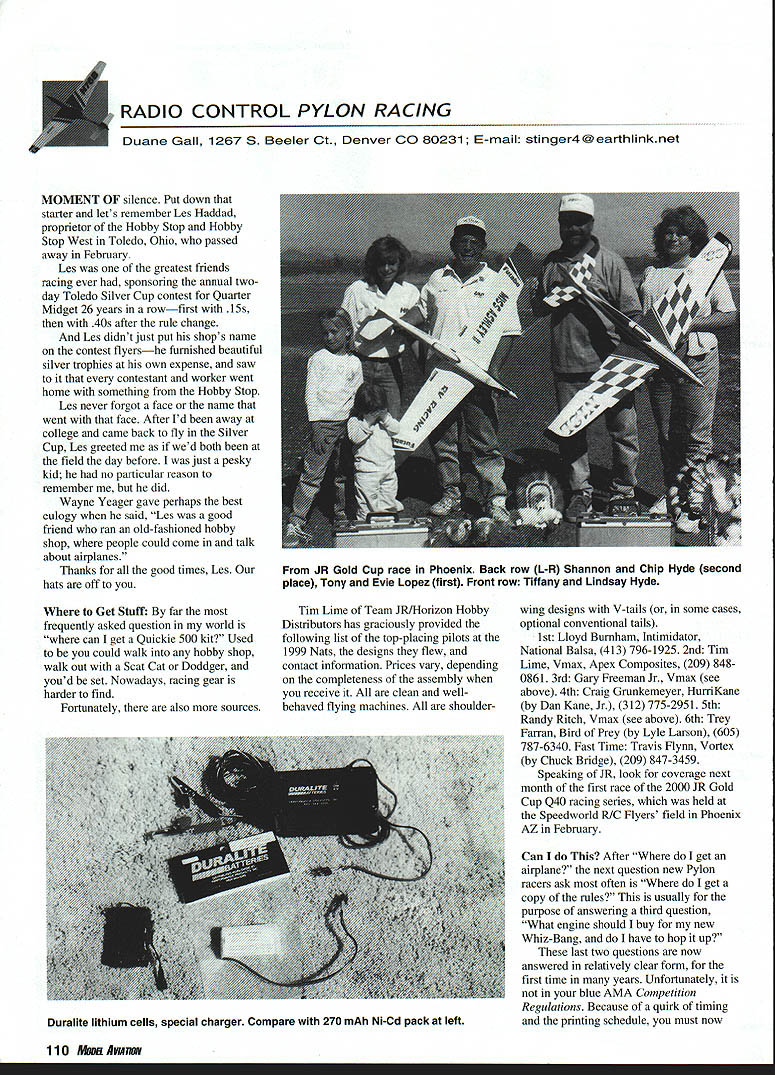
Tim Lime of Team JR/Horizon Hobby Distributors has graciously provided the following list of the top-placing pilots at the 1999 Nats, the designs they flew, and contact information. Prices vary, depending on the completeness of the assembly when you receive it. All are clean and well-behaved flying machines. All are shoulder-wing designs with V-tails (or, in some cases, optional conventional tails).
- 1st: Lloyd Burnham, Intimidator, National Balsa, <REDACTED>.
- 2nd: Tim Lime, Vmax, Apex Composites, <REDACTED>.
- 3rd: Gary Freeman Jr., Vmax (see above).
- 4th: Craig Grunkmeyer, HurriKane (by Dan Kane, Jr.), <REDACTED>.
- 5th: Randy Ritch, Vmax (see above).
- 6th: Trey Farran, Bird of Prey (by Lyle Larson), <REDACTED>.
- Fast Time: Travis Flynn, Vortex (by Chuck Bridge), <REDACTED>.
Speaking of JR, look for coverage next month of the first race of the 2000 JR Gold Cup Q40 racing series, which was held at the Speedworld R/C Flyers' field in Phoenix AZ in February.
Can I Do This?
After "Where do I get an airplane?" the next question new Pylon racers ask most often is "Where do I get a copy of the rules?" This is usually for the purpose of answering a third question, "What engine should I buy for my new Whiz-Bang, and do I have to hop it up?"
These last two questions are now answered in relatively clear form, for the first time in many years. Unfortunately, it is not in your blue AMA Competition Regulations. Because of a quirk of timing and the printing schedule, you must now contact AMA Headquarters or visit the Competition pages of AMA's Web site: http://www.modelaircraft.org/Comp/Competition.htm (follow the link from this page). What you will find there is a complete rewrite of the Pylon section of the rule book. There are not many substantive changes, but the subject matter is now easier to find and is accompanied by an index.
One of the few substantive changes, but one that is very significant, is in the entry-level class, Sport Quickie (event 424). There you will find a generic rule formula, plus three suggested methods of engine limitation. I encourage any clubs that have not already set in their sanction applications for races to be held this year to specify which (if any) of these optional methods they plan to use—on the sanction application and in all precontest publicity.
Another change is within the definition of a "stock" engine. (Yes, we finally have a definition of this and of other key terms.)
For years there has been low-level angst over what sort of modification was allowed to the carburetor or muffler of a sport engine so it would hold together at racing rpm, and still remain "stock." The rewritten rules attempt to settle this question once and for all by laying out, in black and white, the things you can do to keep a sport engine together for racing. Check it out—it's almost a how-to.
For racing in the sport class you will probably end up with the Thunder Tiger Pro .40 or the SuperTiger GS .40. Each retails for right around $100—the price limit in most areas that use the "price limit" or "claiming rule" methods of limiting cost—and each will turn the standard 9 x 6 APC propeller at close to the 16,500 rpm limit specified in the basic rule, without much extra attention.
Replacement of the rear bearing is recommended on the Thunder Tiger. This is legal. See the March 1999 column for a how-to on preparing the Thunder Tiger for long life and best performance.
The SuperTiger GS .40 is a better choice if you don't want to tinker at all, but the tradeoff is, to keep costs down, the manufacturer uses an old-style ringed piston and steel sleeve. This means you have to break the engine in slow and easy. Bench-running is highly recommended.
Assuming you have a six-ounce tank, run at least four tankfuls through the engine on the ground. Use mild sport fuel (5% to 15% nitro, with extra castor oil if possible) and a 7 x 6 or 8 x 4 propeller.
Yes, that is a small prop. Do not fly with it. Its only purpose is to simulate the cool, "unloaded" conditions of actual flying.
Check to make sure the idle needle (which looks like a brass, flat-head slotted screw) is out far enough that it sits flush with the end of the carburetor barrel. Open the throttle to full bore. Open the main needle valve seven or eight turns. Prime the engine with a couple of drops of fuel and "bump" it with an electric starter until it fires up.
With the glow plug clip still attached, back out the needle until the mixture is so rich that the engine will barely keep running. You will see black goo coming out the exhaust; this is oil mixed with tiny particles of steel from the ring and sleeve as the parts wear to fit each other perfectly. The cylinder head and fins should be cool enough that you can comfortably touch them with your fingers.
Let it grind this way for a full tank. Refill the tank and start it up again. This time, lean out the mixture enough that the engine will run without the battery attached. Remove the battery and let it grind some more. The black goo should be tapering off to light brown by now.
On the third and fourth tankfuls, begin gently "thermal cycling" the engine by pinching the muffler pressure line (or, if you don't have the muffler tapped for pressure, by capping the air intake line from the fuel tank with your finger) until you hear the rpm coming up to a strong, steady note. Hold for a few seconds, then release the line to flush and cool the engine with fuel. Wait half a minute or so, then do it again. You can get more aggressive, as time goes on, but resist the urge to hear it scream. It will scream plenty later on if you do this part right.
Finally, wipe all that brown goo off the airplane, put on your 9 x 6 flying prop, and go play. Keep it burbling rich for at least the next half-gallon. Beware, it may not idle very well, so plan your landings accordingly.
Gizmo Patrol
I will close this month with a mere revolution: the Duralite lithium batteries. These are available from a variety of sources, but I got mine from Darrel Cady, <REDACTED>.
How much of RC culture in the last 30 years has been devoted to the care and feeding of Ni-Cd batteries? You can forget most of it now. The Duralites have a long shelf-life between charges; have three times the power density of Ni-Cds; and apparently have no problems with "memory." In layman's terms, that means you can top them off on a Tuesday, then fly all the next weekend without worry. The only thing you are not allowed to do is run them down completely; this will ruin them.
What about weight? A six-volt, 800 mAh pack weighs less than 1.5 ounces and fits in less space than whatever you are racing with now. With the help of these, I "made weight" with my last two racing models and (if you know how I build, that is saying something).
Since I've just given you Mr. Cady's address, you should also know that he will repair broken bolts from Nelson or Jett mufflers for $10, plus $6 shipping. This is a delicate process involving a mixture of acids that you don't want to fool with, believe me. But I just got mine back and it's as good as new. Not only that, it's clean!
MA
Transcribed from original scans by AI. Minor OCR errors may remain.

