
RADIO CONTROL SCALE
Stan Alexander, 3709 Valley Ridge Dr., Nashville TN 37211; E-mail: [email protected]
THIS MONTH I am going to look at one way anyone can enjoy scale aeromodeling: competition.
Some modelers don't want to compete, and others have been left with a bad taste from a local contest. But if you begin with the right attitude and accept competition as a learning, sharing experience, you'll enjoy it.
Scale competition is a social event you can enjoy if you aren't so solemn about it. Some modelers take competitive events so seriously, they don't realize they aren't doing what they came out to do in the first place: have fun.
For this column I am going to assume you haven't competed in a scale contest, so you might want to try competition in Fun Scale® or Sportsman class.
You don't even have to build your scale model in Fun Scale®. You can purchase a scale ARF (Almost Ready to Fly) model from a hobby shop or you can buy a scale model that was assembled there.
Static competition counts for only five points; you either have documentation and get the points, or you don't have documentation and don't get the points. One photo or plastic-model box art of the aircraft you enter will suffice.
However, the model does have to be scale. You can't go to the contest with a Swizzle Stick or a Kadet Senior and expect to compete.
A good ARF for scale is the Hangar 9 PT-19 or one of the World War II heavy-metal fighters from Hobbico. You could also use an aerobatic aircraft, such as the Sig CAP 231 EX; this kit even comes with the pilot strapped into the cockpit.
Although Fun Scale® is a beginner's class, at regional or national events it can be divided into Novice class and Expert class. This allows modelers who no longer qualify as beginners to fly more flights, in front of judges, which should help improve their scores in the other classes available to them. The Mint Julep and the AMA Scale Nationals do this, with positive results.
A New Competitor's Question
Todd, a new radio control scale competitor, sent me the following e-mail:
"I have a CAP 232 and am just starting to fly in competition. This summer is when I plan to actually fly in my first contest. I would be entered in the Sportsman category I think.
"Anyway, the model itself has to be scale but what about its color scheme? I have seen in Model Aviation and other magazines that they would all have the same pattern and most of the time have different colors for those patterns. Does it have to be a scale color scheme, just a scale pattern (with whatever colors you like), or can the plane be covered in any way that you want it?
"Like I said this will be my first summer for trying any competition and would hate to have to go and start ripping covering off because of a requirement that you would have to have."
Sportsman is more involved; you do have to build your scale model.
Any modeler who has built several scale models will tell you to obtain your documentation first! I can't stress this enough.
Collect the photos, three-views, and other documentation you might want to add to your booklet. Keep your booklet.
RC Scale
If you have any questions, contact your district Scale representative, Scale Board Chairman Dave Platt, or myself.
Few modelers and nonmodelers realize that to compete in an AMA Scale event, you only have to complete nine maneuvers. That's right—nine.
Let's pick a "caller" and make out a "call sheet"—a flight list of maneuvers—for practice.
To practice your total flight plan, you use the call sheet whenever you fly. You can use this flight plan with almost any sport model, if you don't want to risk your contest airplane at the local field.
At the contest, your caller uses the call sheet on the flightline to let you know what is to be flown next. Some modelers have family members or very good friends act as their callers, and others ask fellow contestants.
This is the friendly hobby of scale aeromodelling; competitors help each other, and it's normal—even at national championships. Sometimes you will see several generations of modelers helping each other at the same time.
It's a good idea to have two call sheets and two flight plans (just don't get them mixed up)—one for wind conditions and one for calm weather, which you never have at a contest, right?
The required maneuvers in an AMA Scale contest are straight out of the rule book, which is available from AMA for $2.50 or free with your membership, in case you didn't ask for your copy.
The following flight plan would be for an aerobatic aircraft, such as a CAP 231 or an Extra 300. Mandatory maneuvers have asterisks behind them.
Aerobatic
- Takeoff*
- Figure Eight*
- Fly-Past*
- Aileron Roll
- Immelmann Turn
- Split S
- Snap Roll Inside
- 3-Turn Spin
- Landing*
- Realism in Flight*
Non-Aerobatic
- Takeoff*
- Figure Eight*
- Fly-Past*
- Overshoot
- Straight Flight Out
- Procedure Turn
- Straight Flight Back
- Chandelle
- Landing*
- Realism in Flight*
There are many combinations you could put together from the maneuvers in the rule book.
What Is Aerobatic?
What is considered aerobatic and what is considered non-aerobatic? That's a can of worms!
- A Piper J-3 Cub isn't usually considered aerobatic.
- A clipped-wing Cub is aerobatic or limited aerobatic.
- Bombers and transports usually aren't aerobatic.
- Purpose-built aircraft such as the Laser 200, CAP 232, and Extra 300 are aerobatic.
- Fighters and most dive-bombers are also aerobatic.
When aircraft equipped with larger engines have their normal characteristics changed, that can affect the classification one way or the other.
The list is probably endless.
Then there are other thoughts, such as "how about recreational aerobatics?" I didn't coin this term; I believe Pete Bowers of Fly Baby fame did. Pete's article in the Spring/Summer 1967 Air Progress Homebuilt Aircraft explained, "Just What is Aerobatic?"
That question is similar to "how high is up?" Each airplane is aerobatic, to some degree.
Pick one of these flight routines; practice it at your local field, with a buddy calling for you. Complete the routine without playing around in the sky between maneuvers, and you might practice landings even more than the aerobatic or other maneuvers.
Use the whole flight pattern and take time to set up your maneuvers on the backside of the runway; unless it's a Touch-and-Go, an Overshoot, or any other maneuver in which the runway is used.
Above all, read the rule book.
This is one of the most common mistakes many judges see. A pilot thinks he knows how to perform a maneuver someone told him about, such as the Touch-and-Go, but he hasn't read the rule book.
So he goes to the flightline with his score sheet filled out incorrectly, and he has the Touch-and-Go listed as one maneuver—it counts as two maneuvers.
At most local contests, the knowledgeable judge will help the contestant by telling him to delete the following maneuver, unless he has listed landing next! This may also be the case at many national events.
Ask an expert at the field during the scale contest what you can do to improve. It's not like some other competitive areas in the hobby; most pilots will be happy to help you, if they aren't working on their own models or getting ready for their next flights.
The contest circuit is sort of like an extended family; you just have reunions a couple times a year.
Close-up Examples
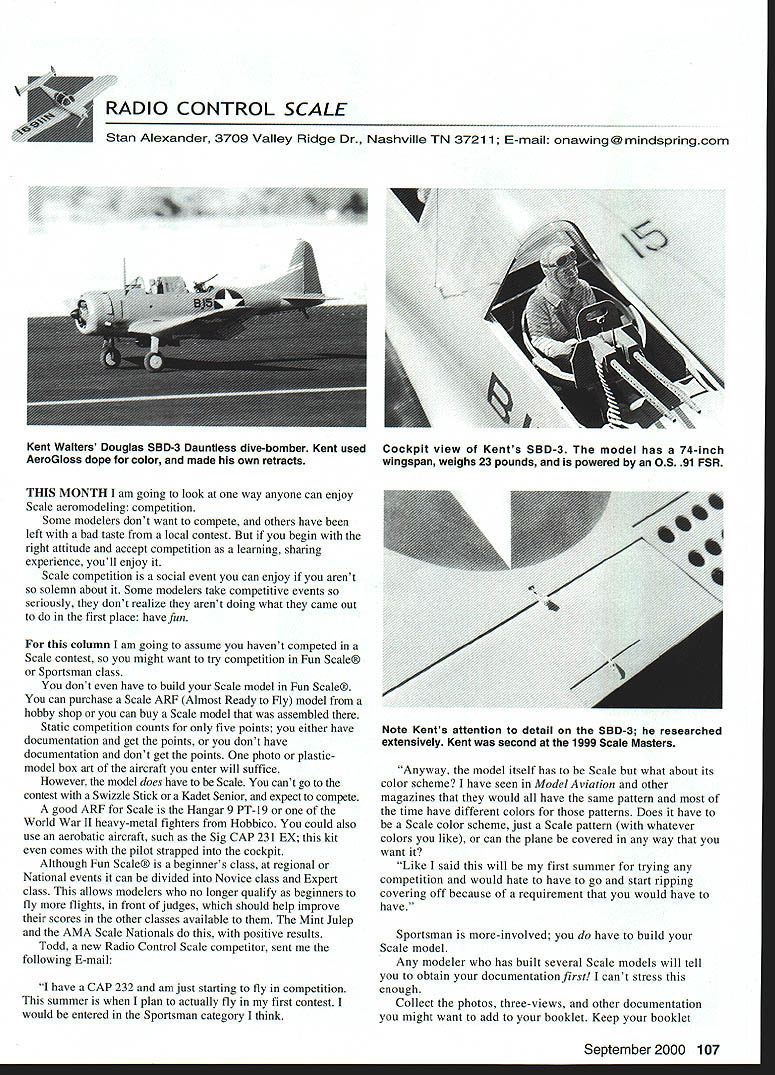
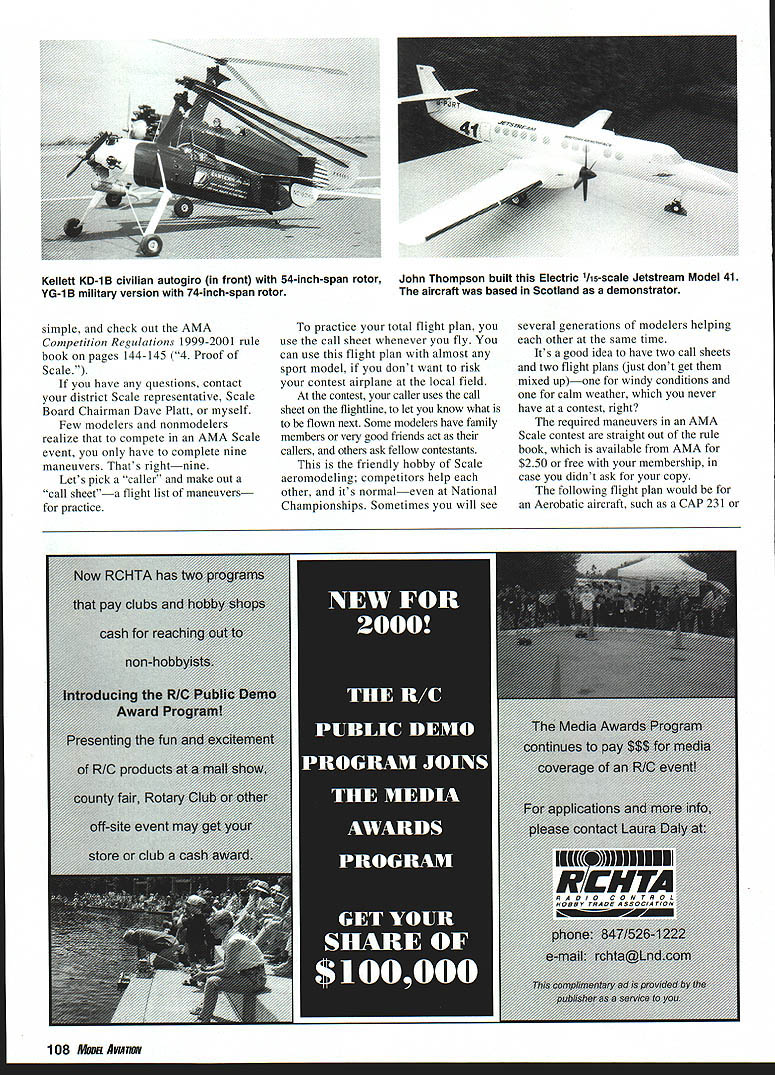
This month I have included photos of one of several Douglas SBD Dauntless dive-bombers seen in competition during the last couple of years.
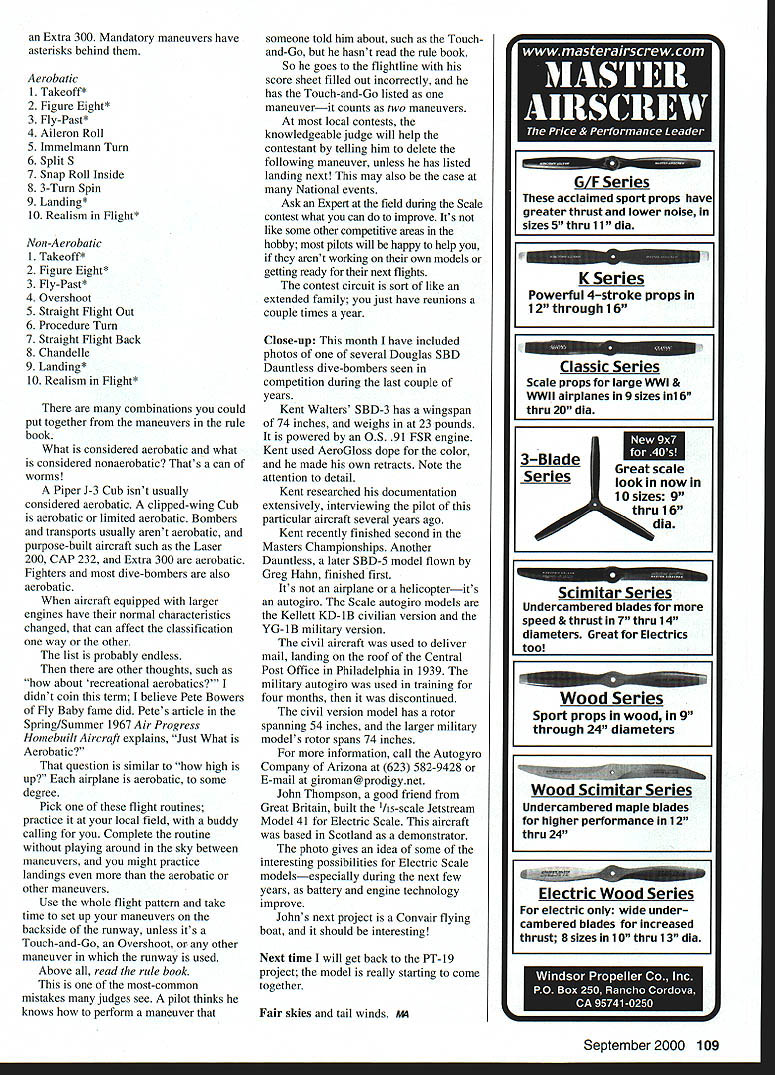
- Kent Walters' SBD-3 has a wingspan of 74 inches and weighs in at 23 pounds. It is powered by an O.S. .91 FSR engine. Kent used AeroGloss dope for the color, and he made his own retracts. Note the attention to detail.
- Kent researched his documentation extensively, interviewing the pilot of this particular aircraft several years ago. Kent recently finished second in the Masters Championships. Another Dauntless, a later SBD-5 model flown by Greg Hahn, finished first.
It's not an airplane or a helicopter—it's an autogiro. The scale autogiro models are the Kellett KD-1B civilian version and the YG-1B military version.
- The civil aircraft was used to deliver mail, landing on the roof of the Central Post Office in Philadelphia in 1939.
- The military autogiro was used in training for four months, then it was discontinued.
- The civil version model has a rotor spanning 54 inches, and the larger military model's rotor spans 74 inches.
For more information, call the Autogyro Company of Arizona at (623) 582-9428 or e-mail [email protected].
John Thompson, a good friend from Great Britain, built the 1/5-scale Jetstream Model 41 for Electric Scale. This aircraft was based in Scotland as a demonstrator. The photo gives an idea of some of the interesting possibilities for electric scale models—especially during the next few years, as battery and engine technology improve.
John's next project is a Convair flying boat, and it should be interesting!
Next time I will get back to the PT-19 project; the model is really starting to come together.
Fair skies and tail winds. MA
Transcribed from original scans by AI. Minor OCR errors may remain.

