
RADIO CONTROL SCALE
Stan Alexander, 3709 Valley Ridge Dr., Nashville TN 37211; E-mail: [email protected]
WITH THE UPCOMING celebration of 100 years of sustained, controlled, powered flight, several celebrations are in the late stages of planning at this time.
The Rocky Mountain section of the American Institute of Aeronautics & Astronautics (AIAA) is asking for proposals for construction of a flying Radio Control (RC) Scale replica of the 1903 Wright Flyer.
The winning proposal sent to AIAA by December 17, 2001 will receive as much as $500 to subsidize the purchase of equipment and building supplies, as well as publicity and assistance in obtaining local television coverage of a flight on December 17, 2003.
The winning proposal must be ready for flight by July 17, 2003. The model can be powered by electric motors or gas engines. The designs must meet all AMA safety requirements.
For more information about this ambitious project, please contact Vic Whitehead — at (303) 841-0654 or [email protected] — or Pete McQuade at (719) 522-1239 or [email protected].
There are many areas in which modelers can participate in RC Scale. The preceding project and the one in the September issue are just two of the different areas where Scale modeling can take you.
You can also attend local, regional, or national contests or fly-ins. Some of these events offer all competition, and some are held without competition. The fly-ins and contests are very well-attended and are run by the AMA Contest Directors and club volunteers across the country.
RC Scale modeling has different levels of competition. The new AMA Competition Regulations will be coming out at the end of this year for 2002-2004. This is a good place to start if you're looking into Scale competition on any level, and it includes Control Line (CL) and Free Flight (FF) Scale.
One rule booklet is free with your membership renewal or new membership. Call or send an E-mail to the AMA Membership Department.
You can learn more about AMA competition, US Scale Masters Championships, and FAI Scale competition on the National Association of Scale Aeromodelers (NASA) Web site at www.scaleareo.com/amascale.htm. The site has links to the Scale Masters Web page and to the FAI Web page.
What is FAI anyway? It's a mystery to many modelers out there, and it shouldn't be.
It is the Fédération Aéronautique Internationale: the governing body of all international competition involving anything that flies—including balloons, full-scale sailplanes, aerobatic aircraft, and rockets—and all international aeromodelling contests.
International Scale competition is overseen by the International Modeling Committee (CIAM). The CIAM governs many competitions, most of which are similar to what we fly in the US according to the AMA Competition Regulations.
Of these categories, we are interested in the ones under the designation of F4; it covers F4B (CL Scale) and F4C (RC Scale), which is what I'll discuss this time. Check Bill Boss's "Control Line Scale" column for more information about F4B.
I call FAI Scale "Museum Scale" because the documentation requirements are more involved and the weight limit is different from what we are used to in Sport Scale or Scale Masters competition. They are as follows.
- Scale Drawings: A competitor will need an accurate three (or more)-view drawing of the full-scale airplane with a minimum span of 250mm (10 inches) up to a maximum span of 500mm (20 inches), and be sure to submit them in triplicate. (This also lessens the time the judges will look at your model).
- Proof of Color: You can establish this from color photos or accepted published descriptions if accompanied by color chips that are published or certified by a competent authority. Examples of this are samples of original paint, accepted published color drawings, or "Profile"-type publications.
- Photo Documentation: You need at least three photos or printed reproductions of the prototype, including at least one of the subject being modeled. That is the "minimum needed to compete"; having 10–12 photos of the modeled aircraft is even better, although many times that many are not available.
- Aircraft Speed: The subject's cruising or maximum speed must be included in the documentation and repeated on all flight score sheets. Using the maximum speed gives you a little more leeway if you tend to fly fast.
- Competitor's Declaration: Contestants must list all components of the model that he or she didn't make. Parts such as wheels, hinges, propellers, etc. must be documented.
Scratch-built models constructed from scale drawings and three-views or planbuilt models seem to achieve better results in static judging. Fiberglass-fuselage kits and balsa kits don't seem to fare well. Using many preformed parts will not increase your score in the static area.
Choosing a subject aircraft can be a great deal of fun. Most of the recent World Championship winners have been World War I-era models, although the winner at the last World Championships could easily have been a Grumman F7F Tigercat.
The majority of the top-10 aircraft, and the majority of the models entered, were from the WW I era, and most of the European contestants like that type of aircraft. When choosing an airplane to model, you have to really like it.
It's a good idea to have a ton of material on the subject for building notes, documentation, and your presentation for the static judges.
It also helps in static judging if the prototype has lots of surface detail; you can show your expertise in duplicating full-scale kits and pieces on the model.
One major change that will affect participation in the US is the weight limit, which is currently set at 12 kg, or 26.4 pounds. There has been a growing movement in Europe and in the US to raise this number.
During the annual meeting this past March, the weight limit was raised to 15 kg (33.33 pounds) for F4C. However, the rule won't be in effect until January 1, 2005, which gives everyone who is building time to get ready; three years isn't too much time for a good F4 model.
For international competition, you have to consider the transportation costs. It can cost a team anywhere from $0 to $800 to transport a model to and from a contest.
Writing the article for Top Gun 2001 in the September issue, it was interesting to learn that the average weight of the models present was 29.6 pounds.
F4C flight competition features the basic Scale flight routine we use in the US, with a few differences. The Takeoff, Straight Flight, and Figure Eight are standard. In F4C you add the 360° Descending Circle. The approach and landing are combined into one maneuver.
Models fly 10 maneuvers, which is one more than in AMA RC Scale and the same as in Top Gun and the US Scale Masters. Also judged are engine sound, the model's speed, smoothness of flight, and size of the maneuvers.
Only one mechanical option is allowed per flight, such as parachute, retractor demonstration, flap demonstration, or drooping of bombs or fuel tanks. Multiple engines is the only option you can use (such as making a pass with one engine throttled back to idle) with which you can add one of the other mechanical options listed in the book.
Some of the best flight-maneuver diagrams are in this section of the FAI rules and regulations. These illustrations will help you in your sport flying, or your competition flying. Models are allowed 14 minutes for flight if they are aerobatic. They can use as many as 17 minutes if they are nonaerobatic. If you compete with a multicontact model, you gain one minute for each additional engine.
Unlike Scale contests in the US, one model is flown at a time. A team of five flight judges — all from different countries — evaluate each flight. Each entry gets three flights, and awards are given to individuals and teams; sometimes more than 30 countries are represented.
At the beginning of any F4 Scale World Championship is a parade, a national-flag-raising ceremony, and presentations similar to those at the Olympics. Most teams of three competitors and their managers have some sort of "team uniform," and the awards are Gold, Silver, and Bronze Medals — as in the Olympics.
If you would like to represent the US at the next Scale World Championship, order the FAI rules and regulations from the AMA Competition Department and start building that "Museum Scale" model airplane. Some of you already have very competitive models for the current weight limit.
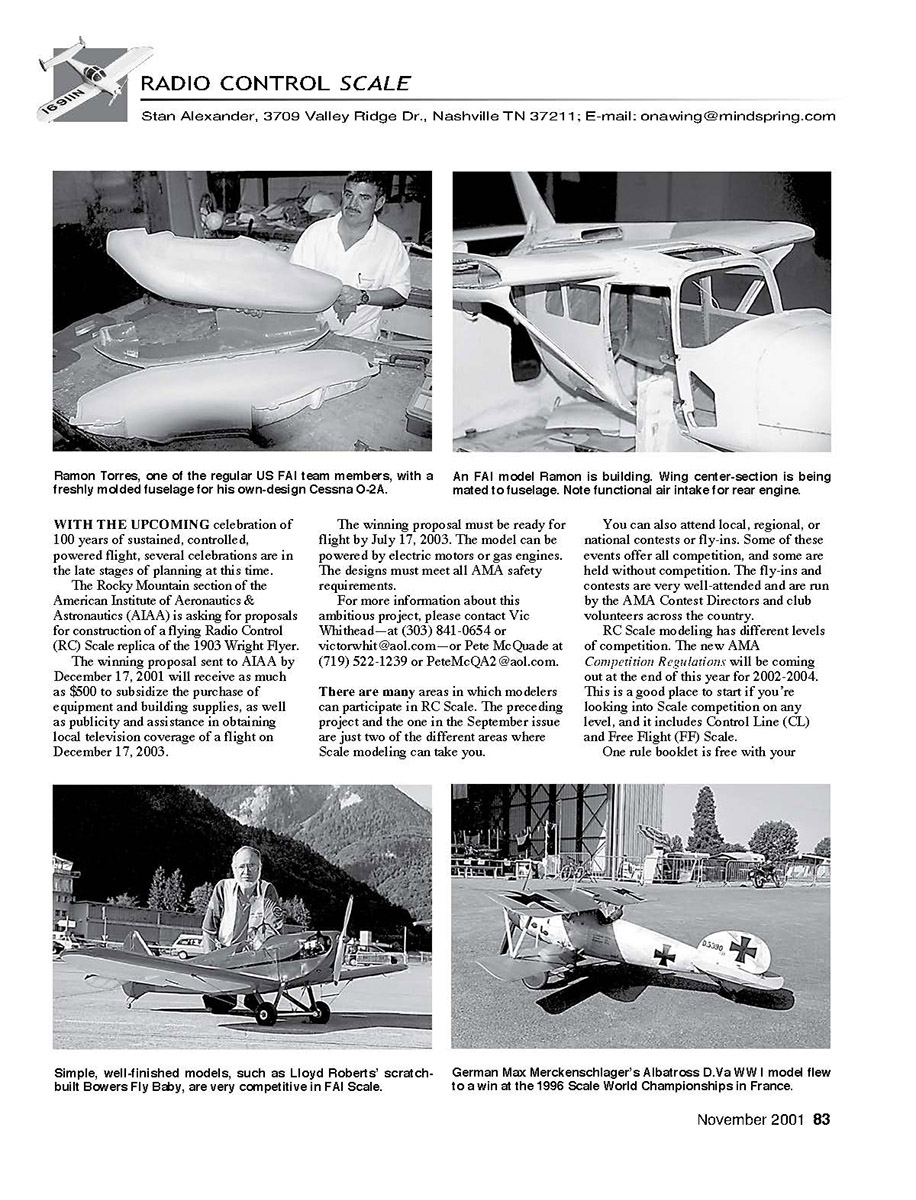
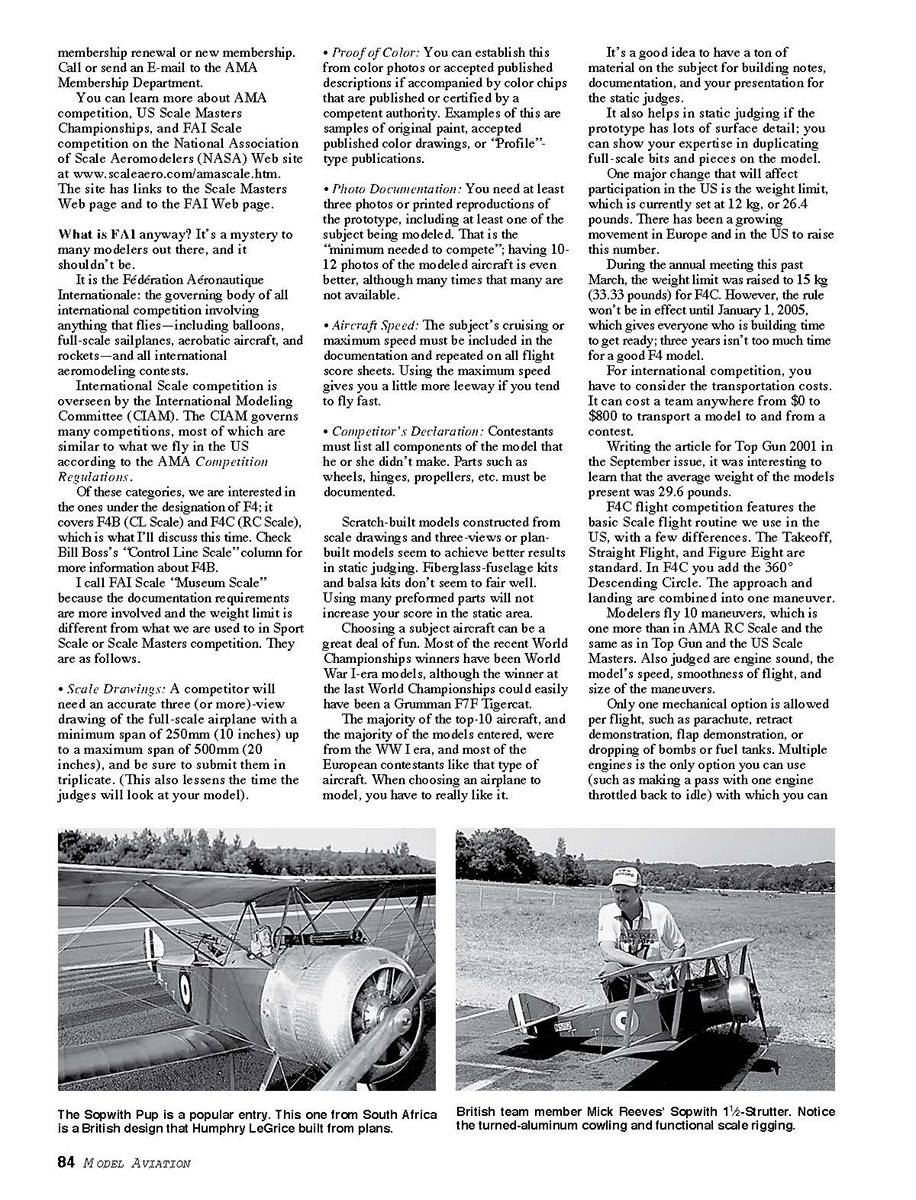
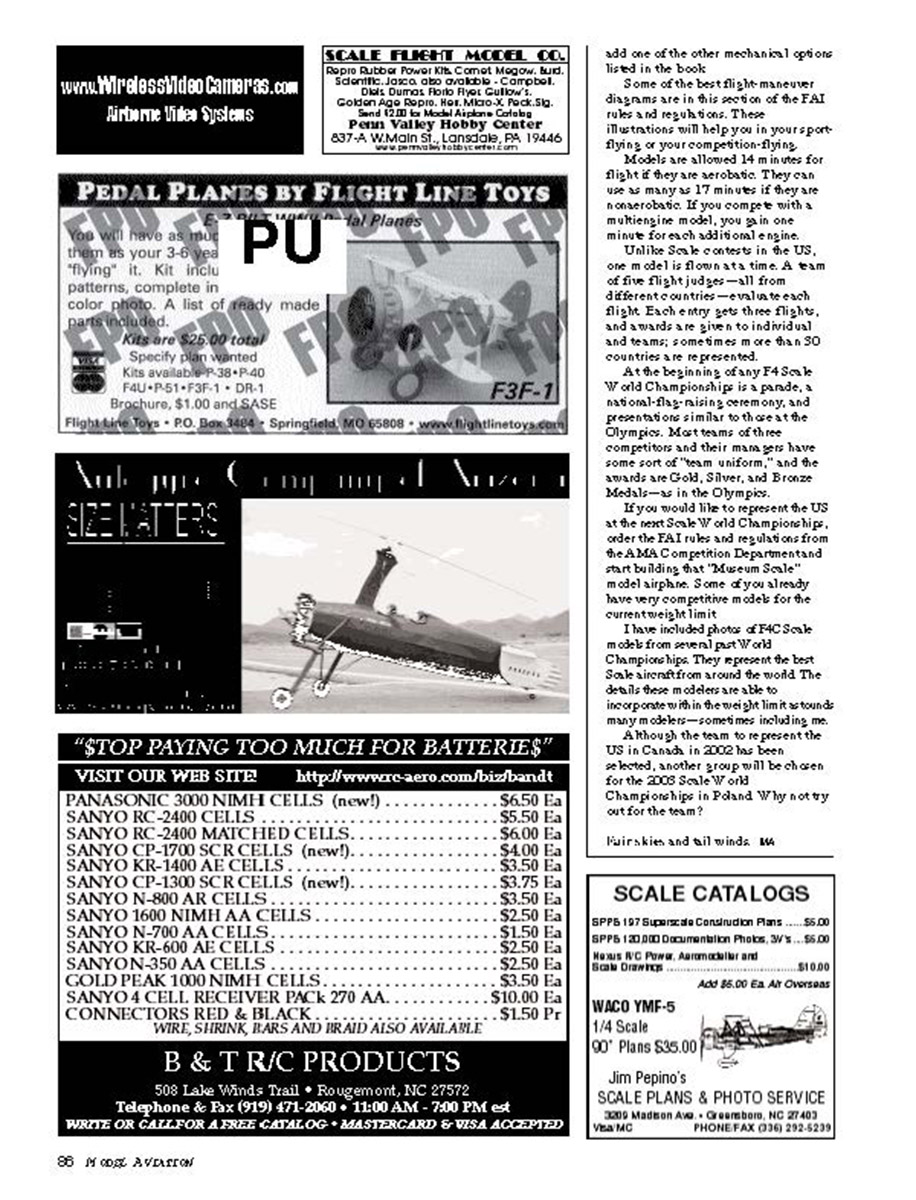
I have included photos of F4C Scale models from several past World Championships. They represent the best Scale aircraft from around the world. The details these modelers are able to incorporate within the weight limit astound many modelers — sometimes including me.
Although the team to represent the US in Canada in 2002 has been selected, another group will be chosen for the 2005 Scale World Championship in Poland. Why not try out for the team?
Fair skies and tail winds. MA
Transcribed from original scans by AI. Minor OCR errors may remain.

