
RC Scale - 2012/06
RC Scale Nationals
Don't assume you'll pick up points with a simple "thank you"; don't you feel better when someone is nice to you?
After the flight, decompress with your caller back at your tent and see where you can improve, or how you might want to change your flight plan. If one of your five optional maneuvers isn't working, substitute that maneuver in the next round. Don't forget to change your call sheets to match!
That's a basic rundown of the Nats. There typically are two rounds of flying on Saturday, and two more on Sunday. Your lowest-scoring round is thrown out, and the others are averaged and added to your static score to give your final placing.
Don't forget to buy tickets for yourself and your caller for the banquet, which is normally held Saturday evening.
What to Bring
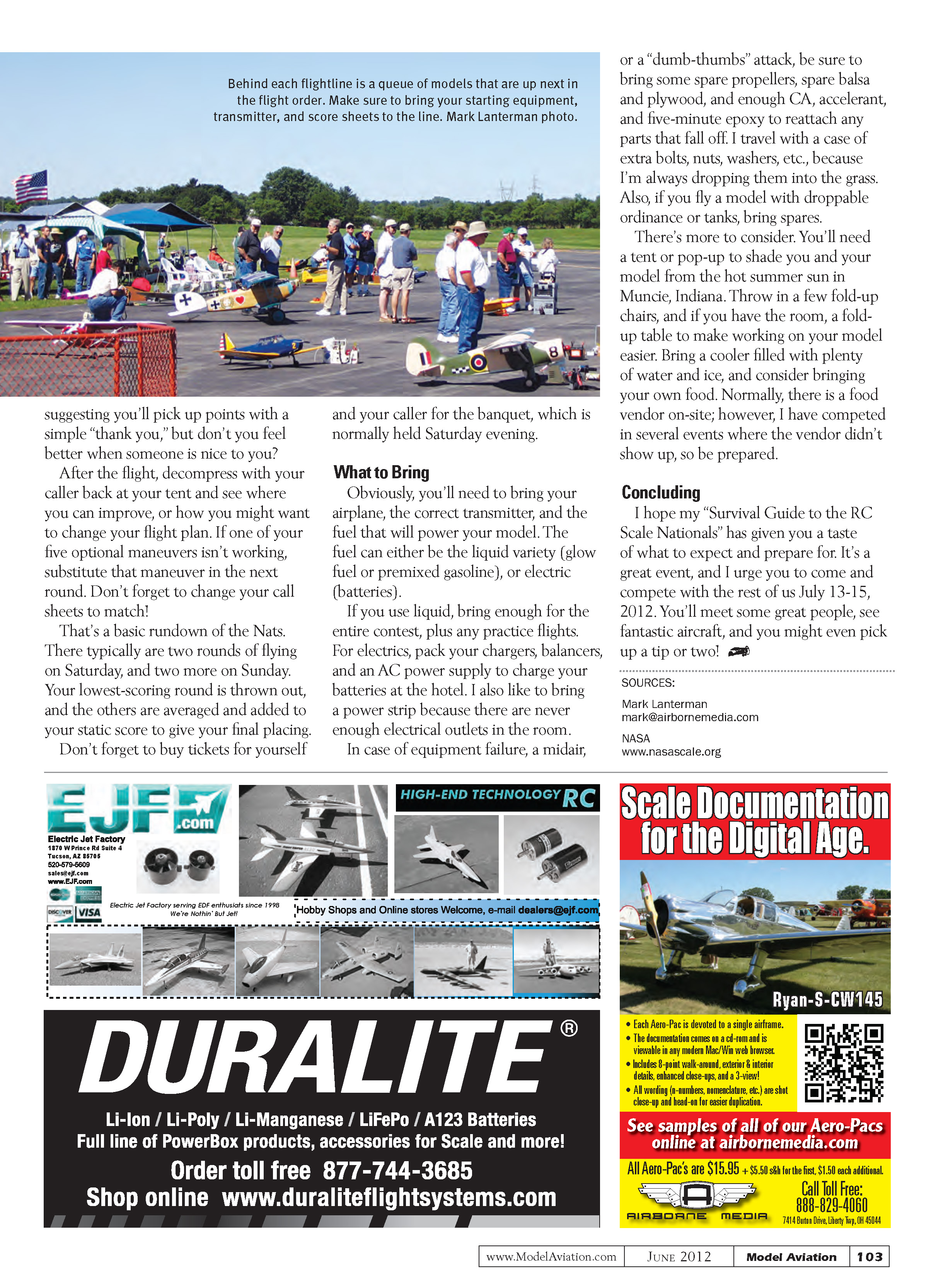
Obviously, you'll need to bring your airplane, the correct transmitter, and the fuel that will power your model. The fuel can either be the liquid variety (glow fuel or premixed gasoline), or electric (batteries).
If you use liquid, bring enough for the entire contest, plus any practice flights. For electrics, pack your chargers, balancers, and an AC power supply to charge your batteries at the hotel. I also like to bring a power strip because there are never enough electrical outlets in the room.
In case of equipment failure, a midair, or a "dumb-thumbs" attack, be sure to bring:
- Spare propellers
- Spare balsa and plywood
- Enough CA, accelerator, and five-minute epoxy to reattach any parts that fall off
- A case of extra bolts, nuts, washers, etc.
- Spare droppable ordnance or tanks (if your model uses them)
You'll also need shelter and comfort items:
- A tent or pop-up to shade you and your model from the hot summer sun (Muncie, Indiana)
- A few fold-up chairs
- A fold-up table (if you have the room)
- A cooler filled with plenty of water and ice
- Food (there is normally a food vendor on-site, but vendors sometimes don't show up)
Concluding
I hope my "Survival Guide to the RC Scale Nationals" has given you a taste of what to expect and prepare for. It's a great event, and I urge you to come and compete with the rest of us July 13–15, 2012. You'll meet some great people, see fantastic aircraft, and you might even pick up a tip or two!
SOURCES
- Mark Lanterman — [email protected]
- NASA — www.nasascale.org
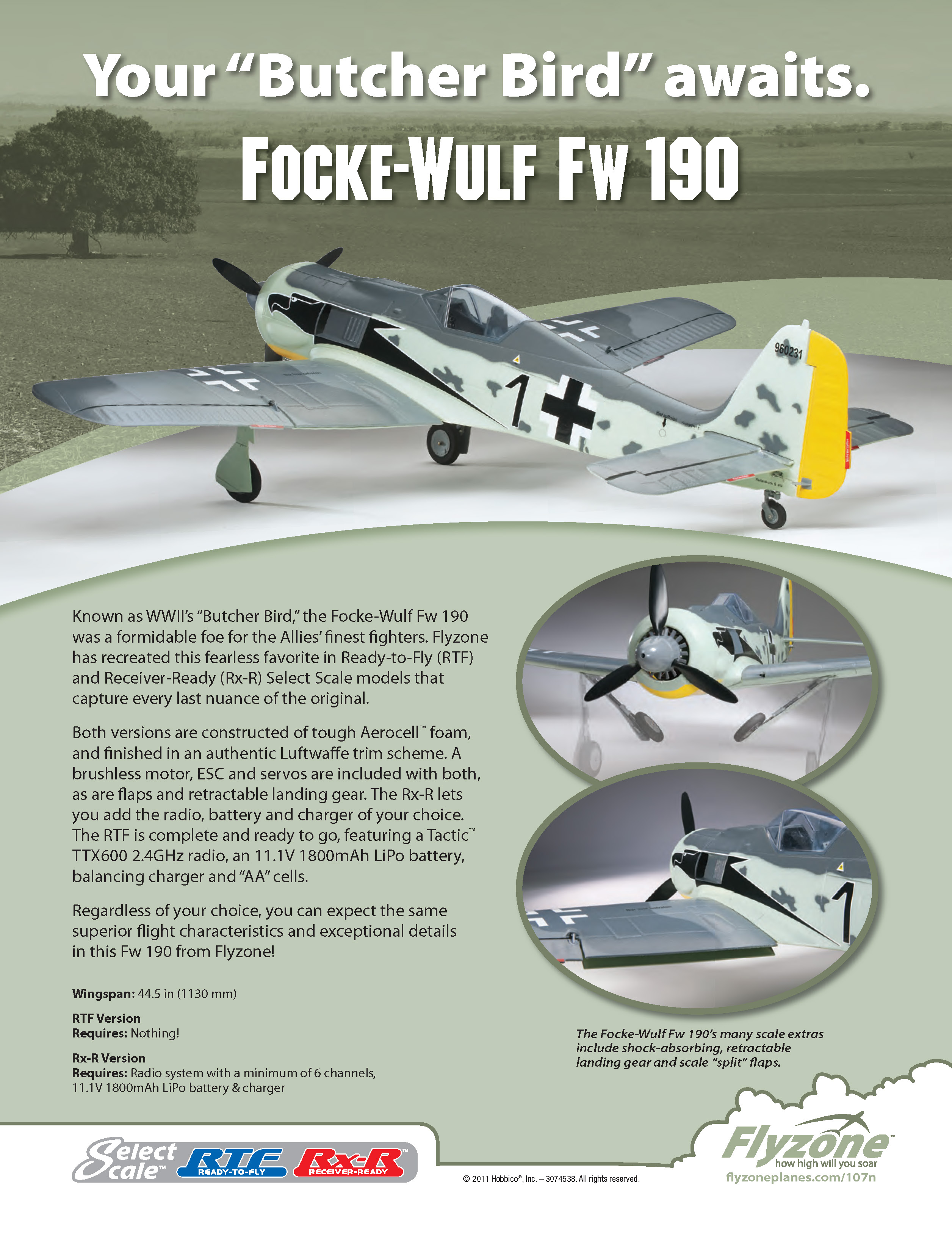
No primary article text appears on this scanned page — the page contains an advertisement for the Flyzone Focke‑Wulf Fw 190.
Walt Moucha’s Hanriot HD-1
by Sal Calvagna [email protected]
Welcome back to the "RC Giants" column. Summer is upon us and I hope your winter projects have been successfully completed. Now is the time to enjoy the fruits of our labor. Grab a friend and head out to a local flying event. I'm sure you'll have a great time!
In this month's column, I have a few new products and a couple of members' RC Giants to share.
Walt Moucha
Prolific designer Walt Moucha, from Fort Pierce, Florida, is at it again with another creation: the Hanriot HD-1. The 1/3-scale model has a 110-inch top wingspan, a 95-inch bottom wingspan, and a 17-inch chord.
Both wings are built in two pieces and plug in for fast field assembly. Cowl diameter is 12 inches. All framed up, the model weighs 15 pounds, with an all-up weight of roughly 27 to 29 pounds.
Walt is hoping to preview the model at this year's Joe Nall and will offer a laser-cut short kit including all ribs and formers. For additional information, contact Walt at the telephone number or email address listed in "Sources."
Unlike the well-known Sopwith, Fokker, and Nieuport lines of aircraft flown during World War I, the Hanriot HD-1 fighter remains obscure, although it was successful and highly regarded by the pilots who flew it.
The HD-1 was never adopted for use by the air forces of the country that produced it. France passed over the Hanriot for the Nieuport and the Spad VII, which became the standard of the French Air Force by the time it appeared. France did allow Hanriot to sell the aircraft to the US, Belgium, and Italy. More than 800 were manufactured in Italy under license.
Although it was not widely accepted initially, the HD-1 was slightly faster than the Nieuport with a considerably higher ceiling. It also had a stronger structure than the Nieuport, which was known for its weak sesquiplane configuration.
More than 1,200 were produced during the war, and Belgium continued to use them through 1926.
Glenn Torrance Models
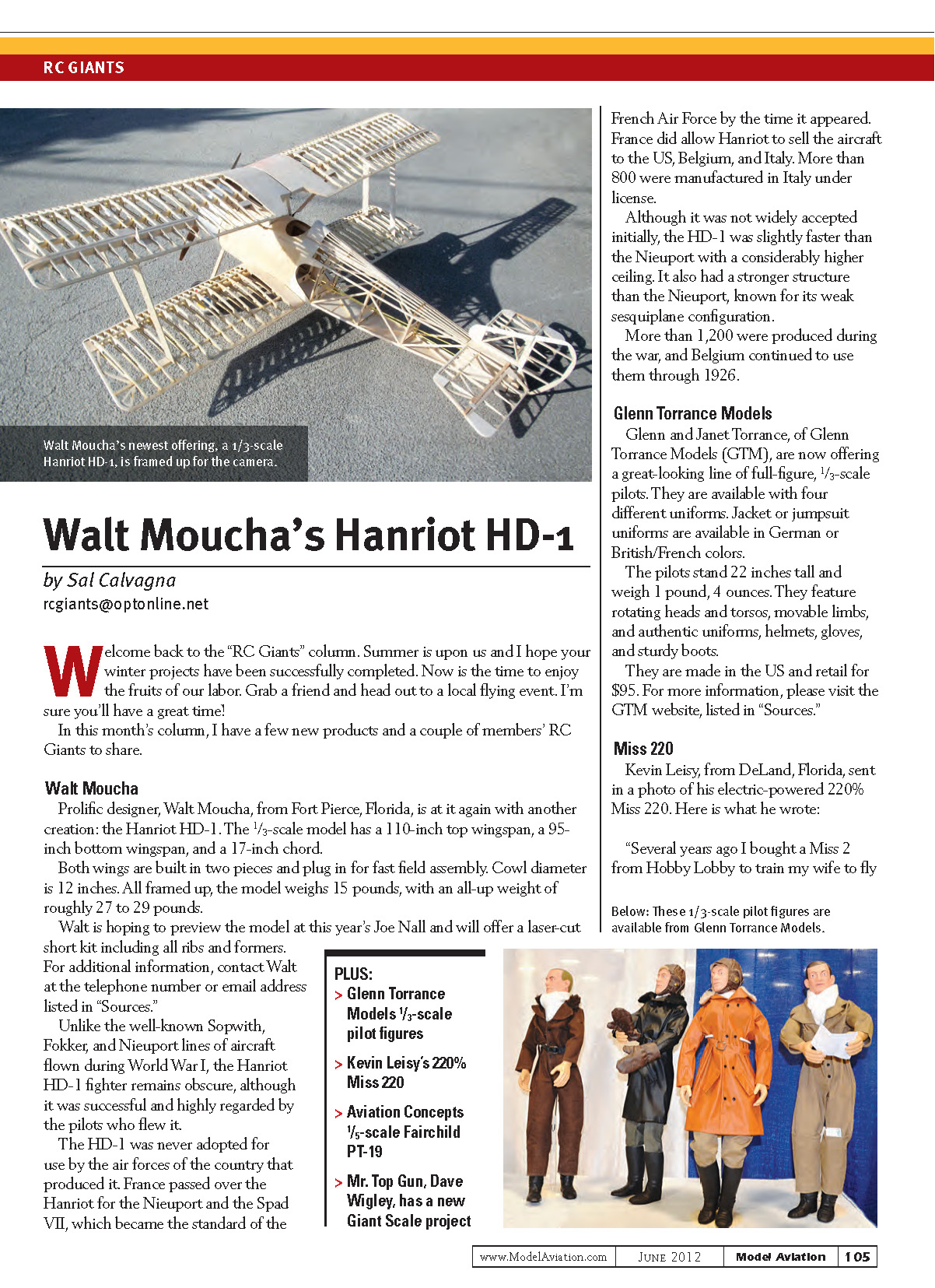
Glenn and Janet Torrance, of Glenn Torrance Models (GTM), are now offering a great-looking line of full-figure, 1/3-scale pilots. They are available with four different uniforms. Jacket or jumpsuit uniforms are available in German or British/French colors.
The pilots stand 22 inches tall and weigh 1 pound, 4 ounces. They feature rotating heads and torsos, movable limbs, and authentic uniforms, helmets, gloves, and sturdy boots.
They are made in the US and retail for $95. For more information, please visit the GTM website, listed in "Sources."
Miss 220
Kevin Leisy, from DeLand, Florida, sent in a photo of his electric-powered 220% Miss 220. Here is what he wrote:
"Several years ago I bought a Miss 2 from Hobby Lobby to train my wife to fly."
Transcribed from original scans by AI. Minor OCR errors may remain.

