
RC Scale
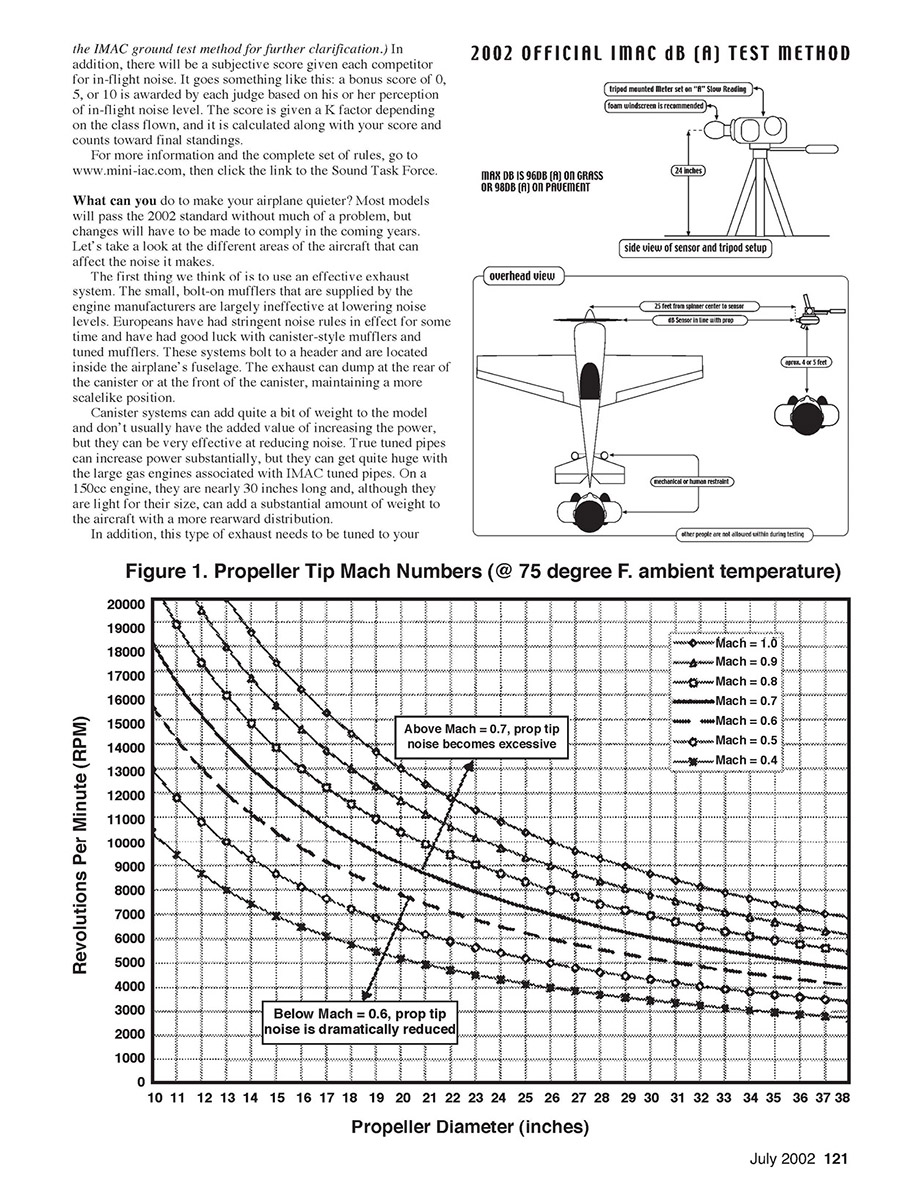
(The IMAC ground test method for further clarification.) In addition, there will be a subjective score given each competitor for in-flight noise. It goes something like this: a bonus score of 0, 5, or 10 is awarded by each judge based on his or her perception of in-flight noise level. The score is given a K factor depending on the class flown, and it is calculated along with your score and counts toward final standings.
For more information and the complete set of rules, go to www.mini-imac.com, then click the link to the Sound Task Force.
What can you do to make your airplane quieter? Most models will pass the 2002 standard without much of a problem, but changes will have to be made to comply in the coming years. Let’s take a look at the different areas of the aircraft that can affect the noise it makes.
The first thing we think of is to use an effective exhaust system. The small, bolt-on mufflers that are supplied by the engine manufacturers are largely ineffective at lowering noise levels. Europeans have had stringent noise rules in effect for some time and have had good luck with canister-style mufflers and tuned mufflers. These systems bolt to a header and are located inside the airplane’s fuselage. The exhaust can dump at the rear of the canister or at the front of the canister, maintaining a more scale-like position.
Canister systems can add quite a bit of weight to the model and don’t usually have the added value of increasing the power, but they can be very effective at reducing noise. True tuned pipes can increase power substantially, but they can get quite huge with the large gas engines associated with IMAC tuned pipes. On a 150cc engine, they are nearly 30 inches long and, although they are light for their size, can add a substantial amount of weight to the aircraft with a more rearward distribution.
In addition, this type of exhaust needs to be tuned to your engine, and the tuning process can be somewhat daunting to the uninitiated.
When properly set up, the result could be a very quiet aircraft with increased performance and improved weight distribution. Desert Aircraft, 3W, and RC Showcase (ZDZ engines) sell quiet exhaust systems that have been effective in Europe for years.
Some say that the propeller is the largest contributor to the noise equation. The STF has found that prop tip speeds higher than .7 Mach create a lot of airborne noise. A propeller change is easy and effective. When looking at prop for noise considerations, utilize a higher propeller loading to us reducing the prop-tip speed.
For the best results, use a good stiff competition prop. A three-blade propeller seems to reduce in-flight noise substantially and is becoming a popular choice for some of the larger airplanes. It places a higher load on the engine and reduces the diameter, effectively reducing the tip speed. A three-blade prop is not magic; a too lightly-loaded three-blade prop may be louder than the correctly loaded two-blade.
As with most things, to get you must give. A three-blade prop is less efficient than a two-blade and will produce somewhat less thrust. Throttle management may be just as effective in reducing in-air noise. The question is, does a three-blade or high-load prop help reduce loaded (restrained on the ground) full-throttle noise levels where the measurement is taken?
The initial research shows that it does help slightly on the ground, but the prop alone is not enough to pass the standards with some of the 150cc engines. The real benefit is during horizontal full-throttle passes. Some throttle management at this point just makes everything even quieter.
Another area to look at is resonance and airframe noise created by the vibration from the engine. The vibration covers framework acts as an amplifier and adds to the overall loudness of your aircraft.
Again, the European community has long been using soft mounts to dampen vibration. And again, we're looking at a double-edged sword. The mounting systems are large, cumbersome, and heavy. Many allow the engine to swing wildly at idle and can fail to keep the thrustline true during maneuvers. The constant movement can also wreak havoc on exhaust systems that have a large mass bolted to a small area; they tend to break at the mount.
Soft-mounting may void warranties on specific engines and mufflers, so check with the manufacturer before you try it. Some soft-mount systems even allow your engine to sag or droop in time if it's just setting there. Unlike a Pattern model, there is no good way to support a nose ring on a large-scale twin gas engine. And, as with any soft-mounted engine, efficiency is reduced.
On the other hand, a soft mount will reduce vibration levels. This is better for your airframe and all of its components, particularly servos and electronic equipment, and can reduce noise output by decreasing the strength of the pulses through your airframe. Spreading the load with a larger footprint the firewall and dampening the rotating pulses are key to an effective soft-mount system.
For the 2002/2003 season, the recommended standards set by the STF and the DMAC board will be voluntary and may or may not be enforced at your local contest. To ease the burden on pilots to meet the standards, the effort to reduce noise in DMAC will be a multiyear process with slow but deliberate steps. The standards, enforced by an AMA URP (Urgent Rules Proposal), may be a bit tougher in 2003, and we'll have a final set of standards in 2004 that will be implemented through the AMA rules process.
Future numbers have yet to be determined, but the STF is working hard to make the right decisions on standards that will be responsible, attainable, and effective.
Special thanks to Wally Pitts, chairman of the DMAC STF, for his contribution to this column.
Transcribed from original scans by AI. Minor OCR errors may remain.

