
RADIO CONTROL SCALE
Stan Alexander, 3709 Valley Ridge Dr., Nashville TN 37211; E-mail: [email protected]
IN TRYING TO promote Scale competition worldwide, FAI Scale has rules and regulations that cover RC, CL, and FF events. These are the Olympics of Scale competition. In the US we usually fly Stand-Off Scale or Sport Scale classes.
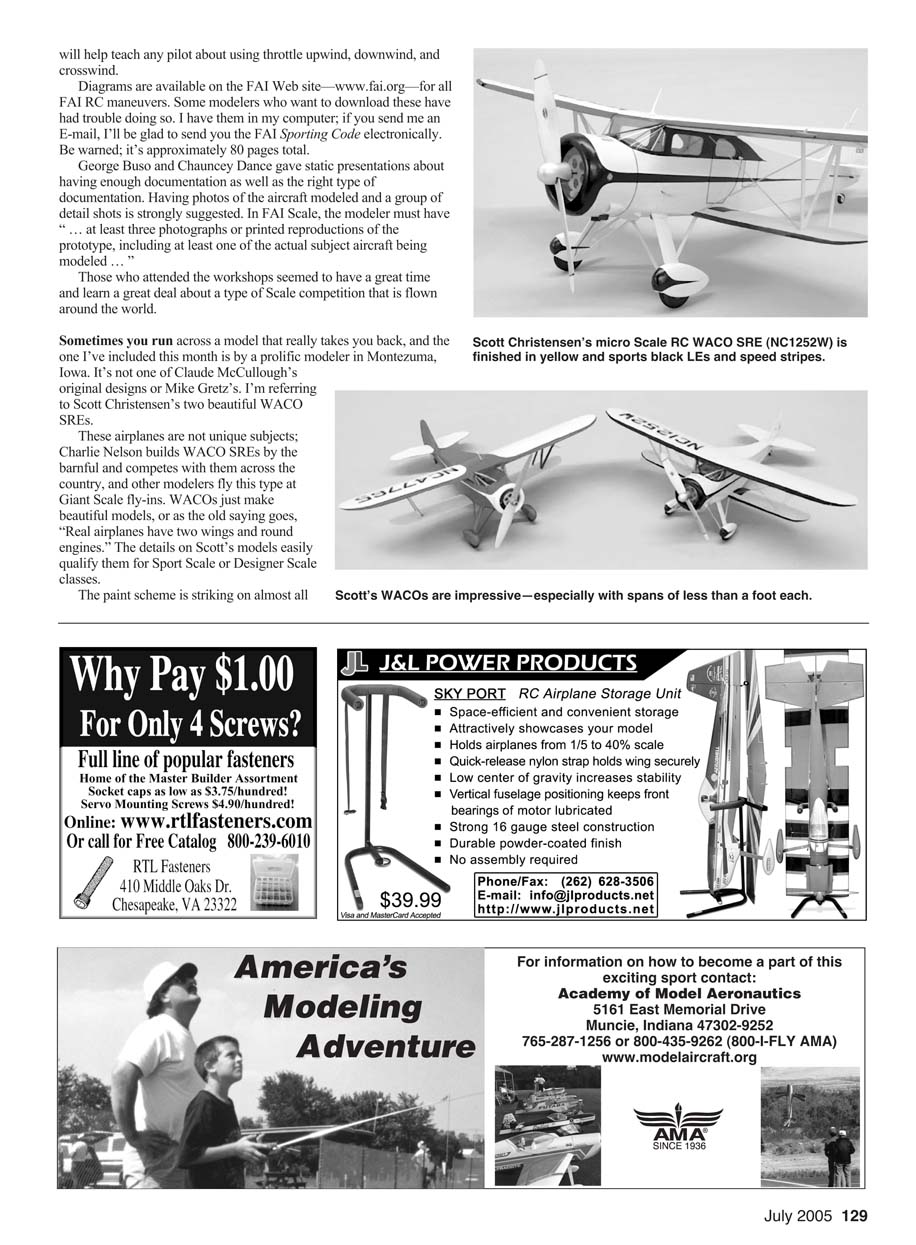
In an effort to encourage more modelers to try these events, 2006 Scale team manager Lloyd Roberts, George Buso, Chauncey Dance, Richard Schneider, Kent Walters, and several other modelers and people who are interested in the Olympics of Scale competition came together at the inaugural NASA FAI Scale Workshop east and west.
Held at the SpeedWorld R/C Flyers’ field in Wittman, Arizona, in March and at the Metrolina Control Line Society’s field in Huntersville, North Carolina, in April, a variety of modelers came out to contribute.
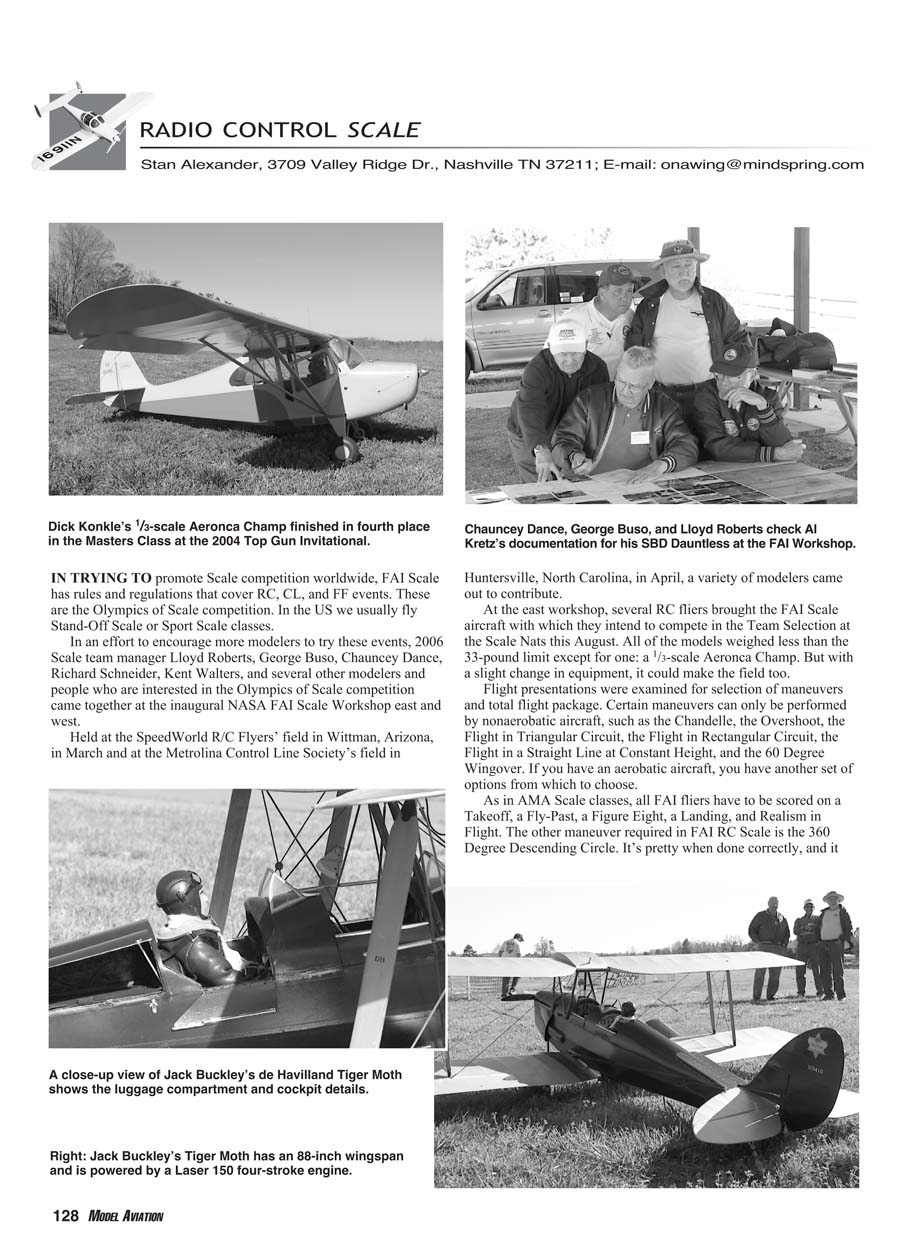
At the east workshop, several RC fliers brought the FAI Scale aircraft with which they intend to compete in the Team Selection at the Scale Nats this August. All of the models weighed less than the 33-pound limit except for one: a 1/3-scale Aeronca Champ. But with a slight change in equipment, it could make the field too.
Flight presentations were examined for selection of maneuvers and total flight package. Certain maneuvers can only be performed by nonaerobatic aircraft, such as the Chandelle, the Overshoot, the Flight in Triangular Circuit, the Flight in Rectangular Circuit, the Flight in a Straight Line at Constant Height, and the 60 Degree Wingover. If you have an aerobatic aircraft, you have another set of options from which to choose.
As in AMA Scale classes, all FAI fliers have to be scored on a Takeoff, a Fly-Past, a Figure Eight, a Landing, and Realism in Flight. The other maneuver required in FAI RC Scale is the 360 Degree Descending Circle. It’s pretty when done correctly, and it will help teach any pilot about using throttle upwind, downwind, and crosswind.
Diagrams are available on the FAI Web site—www.fai.org—for all FAI RC maneuvers. Some modelers who want to download these have had trouble doing so. I have them in my computer; if you send me an E-mail, I'll be glad to send you the FAI Sporting Code electronically. Be warned; it's approximately 80 pages total.
George Buso and Chauncey Dance gave static presentations about having enough documentation as well as the right type of documentation. Having photos of the aircraft modeled and a group of detail shots is strongly suggested. In FAI Scale, the modeler must have "… at least three photographs or printed reproductions of the prototype, including at least one of the actual subject aircraft being modeled …"
Those who attended the workshops seemed to have a great time and learn a great deal about a type of Scale competition that is flown around the world.
Sometimes you run across a model that really takes you back, and the one I've included this month is by a prolific modeler in Montezuma, Iowa. It's not one of Claude McCullough's original designs or Mike Gretz's. I'm referring to Scott Christensen's two beautiful WACO SREs.
These airplanes are not unique subjects; Charlie Nelson builds WACO SREs by the barnful and competes with them across the country, and other modelers fly this type at Giant Scale fly‑ins. WACOs just make beautiful models, or as the old saying goes, "Real airplanes have two wings and round engines." The details on Scott's models easily qualify them for Sport Scale or Designer Scale classes.
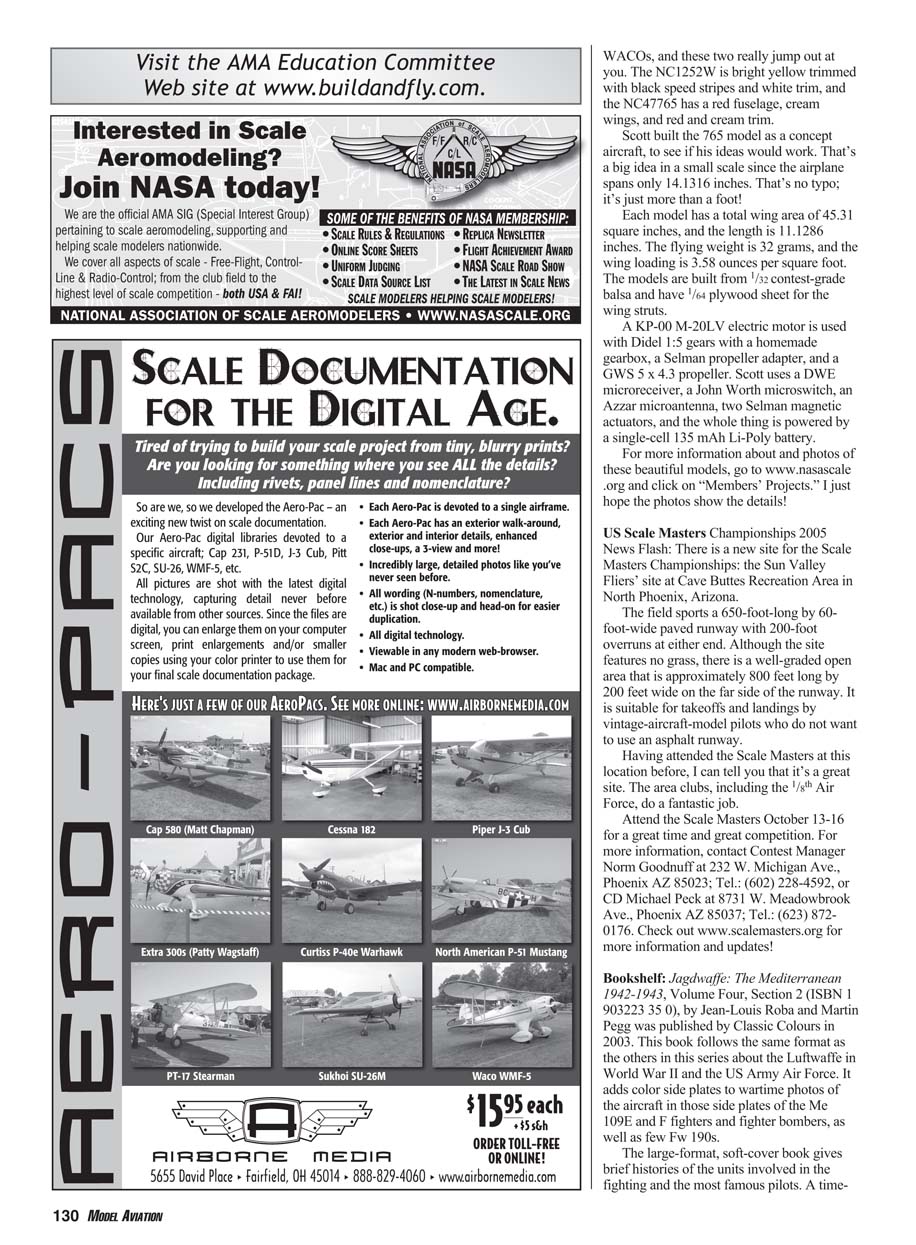
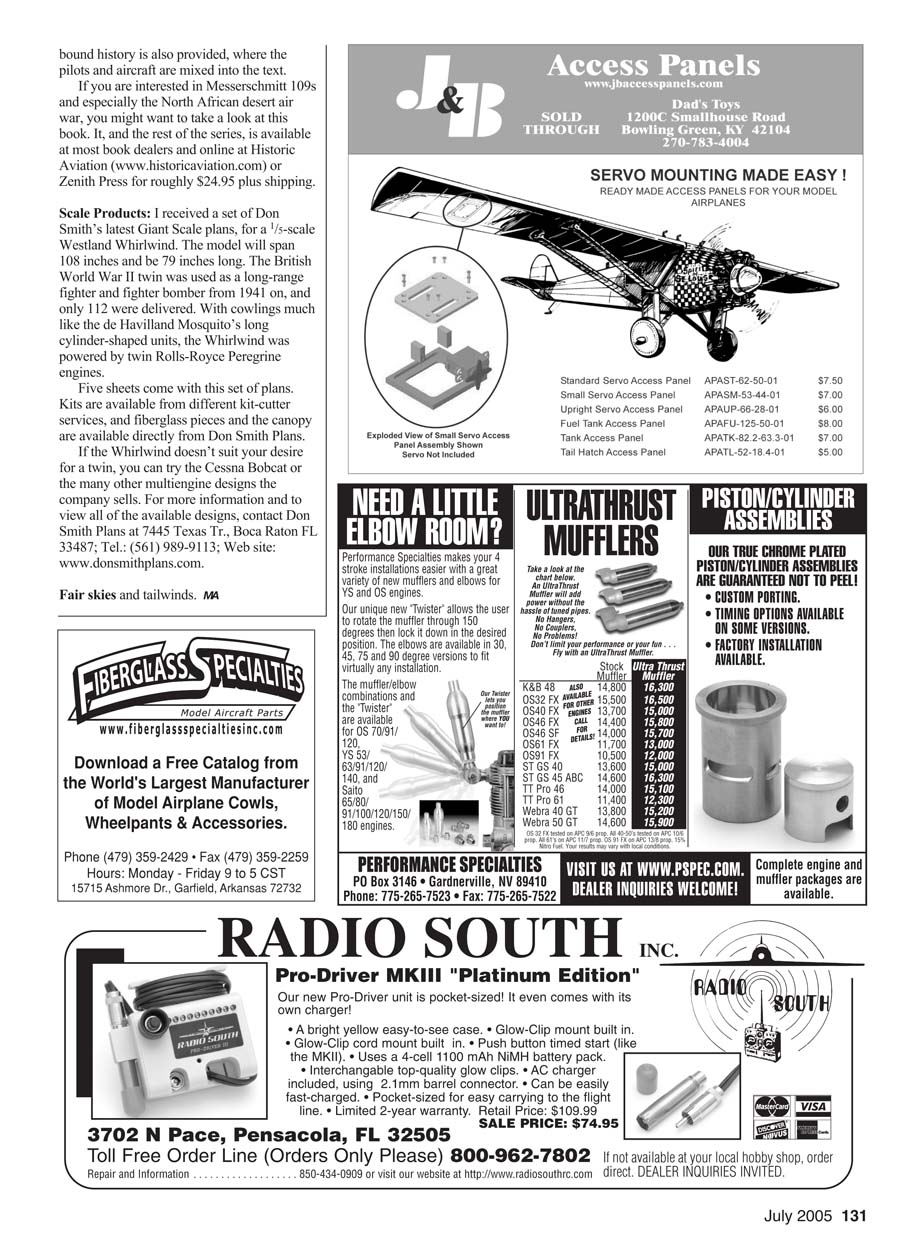
The paint scheme is striking on almost all of Scott's models. WACOs, and these two really jump out at you. The NC1252W is bright yellow trimmed with black speed stripes and white trim, and the NC47765 has a red fuselage, cream wings, and red and cream trim.
Scott built the 765 model as a concept aircraft, to see if his ideas would work. That's a big idea in a small scale since the airplane spans only 14.1316 inches. That's no typo; it's just more than a foot!
Each model has a total wing area of 45.31 square inches, and the length is 11.1286 inches. The flying weight is 32 grams, and the wing loading is 3.58 ounces per square foot. The models are built from 1/32-inch post-grade balsa and have 1/64 plywood sheet for the wing struts.
A KP-00 M-20LV electric motor is used with Dided 1:5 gears with a homemade gearbox, a Selman propeller adapter, and a GWS 5 × 4.3 propeller. Scott uses a DWE microreceiver, a John Worth microswitch, an Azzar microantenna, two Selman magnetic actuators, and the whole thing is powered by a single-cell 135 mAh Li-Poly battery.
For more information and photos of these beautiful models, go to www.nasascale.org and click on "Members' Projects." I just hope the photos show the details! A bound history is also provided, where the pilots and aircraft are mixed into the text.
If you are interested in Messerschmitt 109s and especially the North African desert air war, you might want to take a look at that book. It, and the rest of the series, is available at most book dealers and online at Historic Aviation (www.historicaviation.com) or Zenith Press for roughly $24.95 plus shipping.
Scale Products:
I received a set of Don Smith's latest Giant Scale plans, for a 1/5-scale Westland Whirlwind. The model will span 108 inches and be 79 inches long. The British World War II twin was used as a long-range fighter and fighter bomber from 1941 on, and only 112 were delivered. With cowlings much like the de Havilland Mosquito's long cylinder-shaped units, the Whirlwind was powered by twin Rolls-Royce Peregrine engines.
Five sheets come with this set of plans. Kits are available from different kit-cutter services, and fiberglass pieces and the canopy are available directly from Don Smith Plans.
If the Whirlwind doesn't suit your desire for a twin, you can try the Cessna Bobcat or the many other multiengine designs the company sells. For more information and to view all of the available designs, contact Don Smith Plans at 7445 Texas Tr., Boca Raton FL 33487; Tel.: (561) 989-9113; Web site: www.donsmithplans.com.
Fair skies and tailwinds. MA
Transcribed from original scans by AI. Minor OCR errors may remain.

