
RADIO CONTROL SCALE
Stan Alexander, 3709 Valley Ridge Dr., Nashville TN 37211; E-mail: [email protected]
LAST MONTH I wrote about maneuvers for Scale models. The best guide for flight maneuvers is the FAI Sporting Code. Whether you are a serious competitor or a novice Scale modeler who wants to improve your flight performance, the Sporting Code is a good guide to keep handy.
Following are the best descriptions of most Scale maneuvers. Although not all of them are listed and the distances and heights are slightly different from what we normally see in AMA Sport Scale or Scale Masters, it's still a good visual reference. I've included the diagrams, so you can either copy them or cut them out to keep with you.
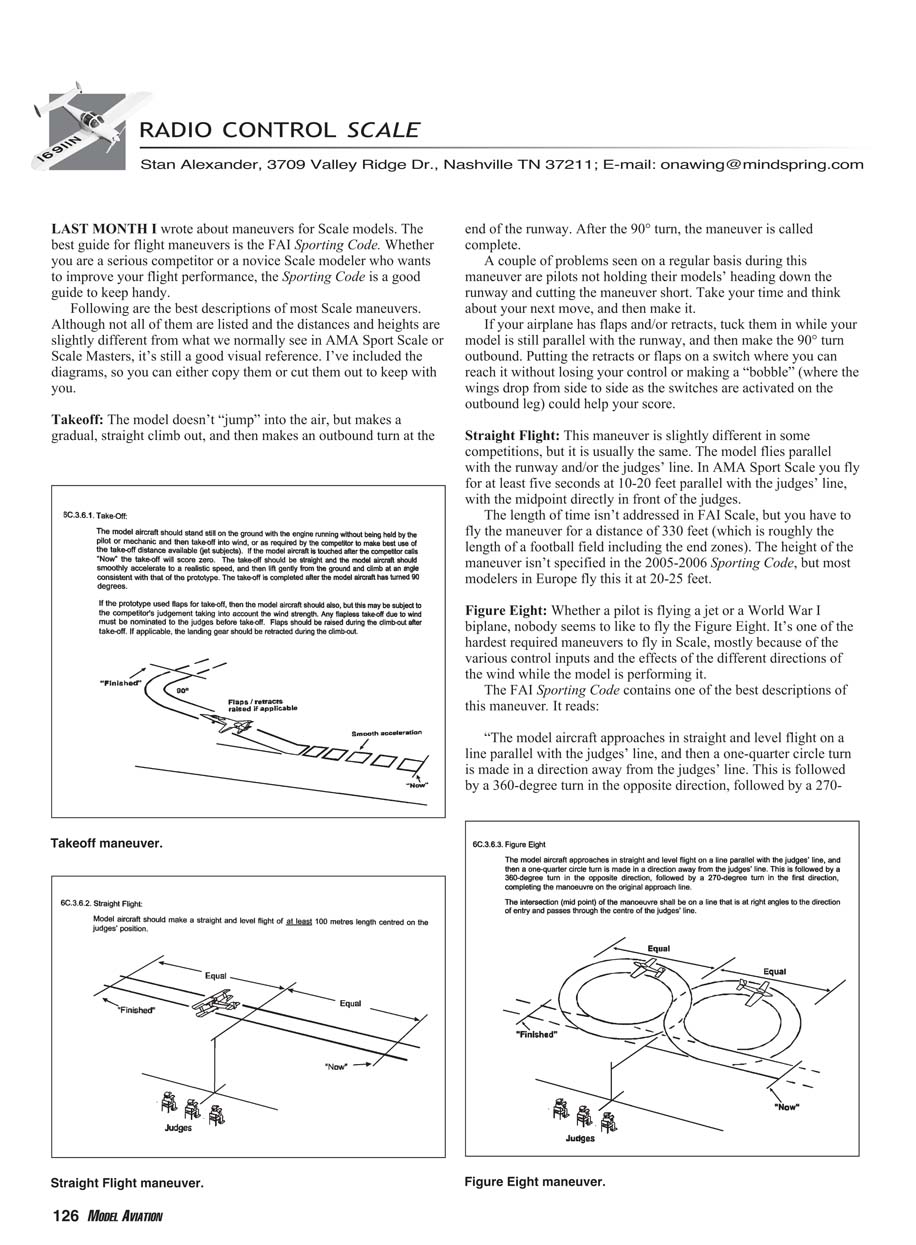
Takeoff
Takeoff: The model doesn't "jump" into the air, but makes a gradual, straight climb out, and then makes an outbound turn at the end of the runway. After the 90° turn, the maneuver is called complete.
A couple of problems seen on a regular basis during this maneuver are pilots not holding their models' heading down the runway and cutting the maneuver short. Take your time and think about your next move, and then make it.
If your airplane has flaps and/or retracts, tuck them in while your model is still parallel with the runway, and then make the 90° turn outbound. Putting the retracts or flaps on a switch where you can reach it without losing your control or making a "bobble" (where the wings drop from side to side as the switches are activated on the outbound leg) could help your score.
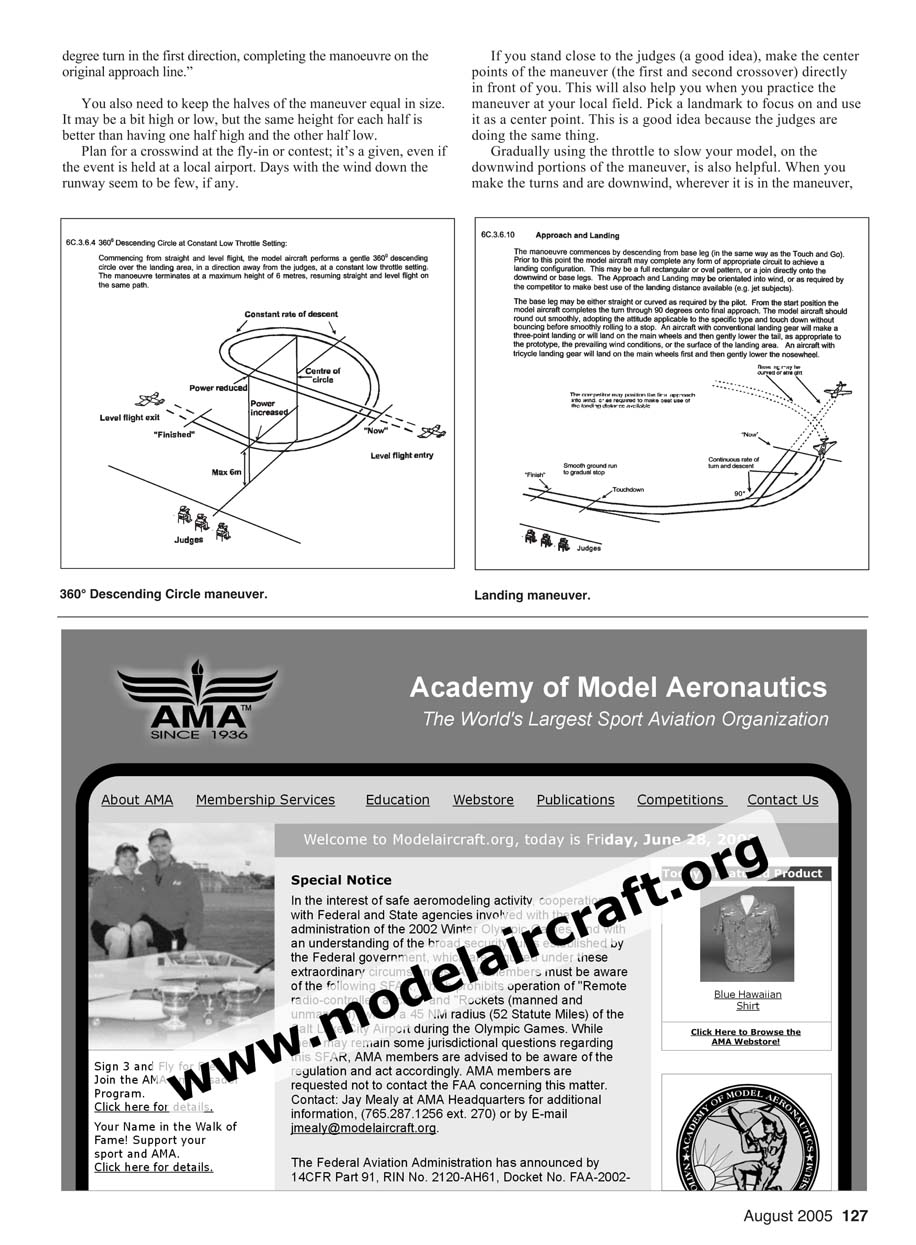
Straight Flight
Straight Flight: This maneuver is slightly different in some competitions, but it is usually the same. The model flies parallel with the runway and/or the judges' line. In AMA Sport Scale you fly for at least five seconds at 10-20 feet parallel with the judges' line, with the midpoint directly in front of the judges.
The length of time isn't addressed in FAI Scale, but you have to fly the maneuver for a distance of 330 feet (which is roughly the length of a football field including the end zones). The height of the maneuver isn't specified in the 2005-2006 Sporting Code, but most modelers in Europe fly this at 20-25 feet.
Figure Eight
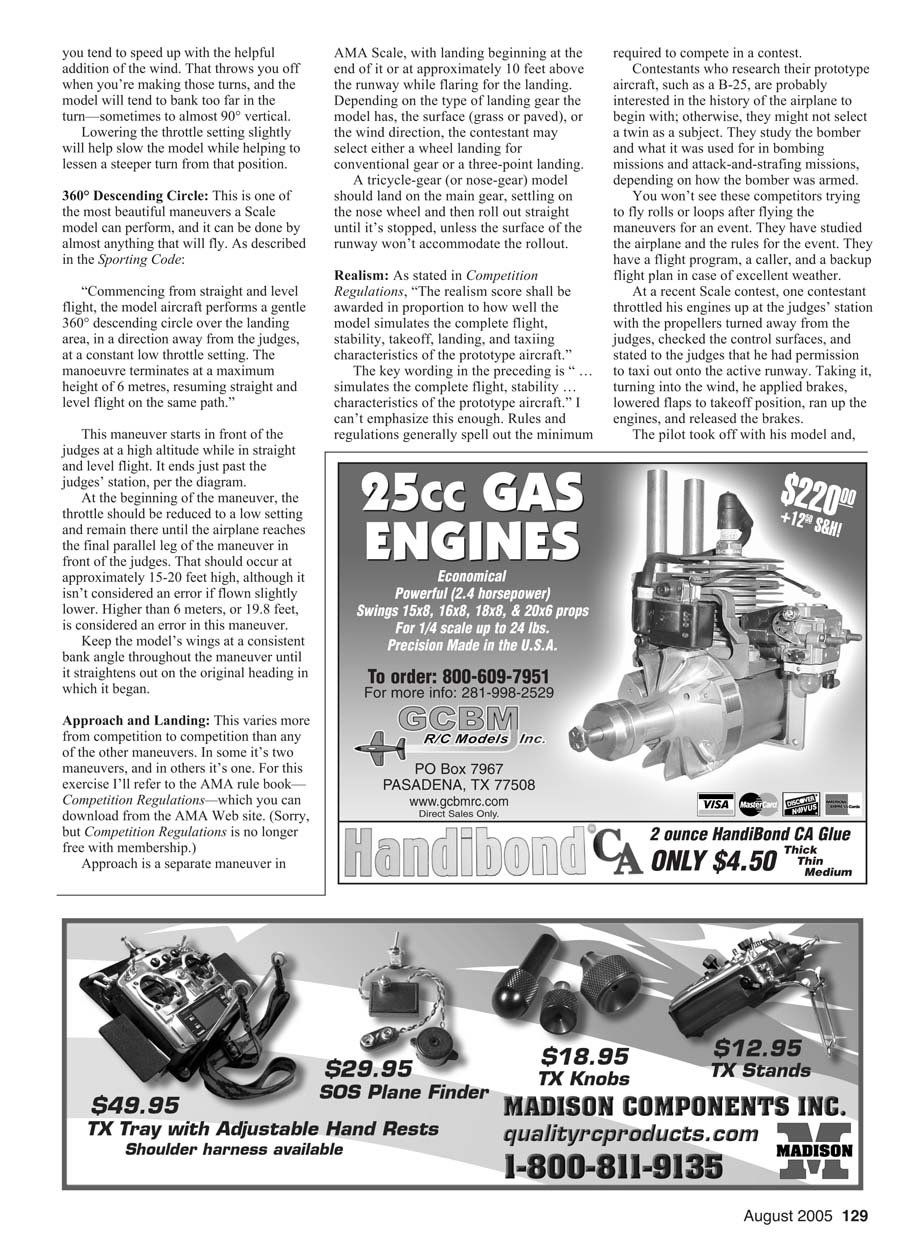
Figure Eight: Whether a pilot is flying a jet or a World War I biplane, nobody seems to like to fly the Figure Eight. It's one of the hardest required maneuvers to fly in Scale, mostly because of the various control inputs and the effects of the different directions of the wind while the model is performing it.
The FAI Sporting Code contains one of the best descriptions of this maneuver. It reads:
"The model aircraft approaches in straight and level flight on a line parallel with the judges' line, and then a one-quarter circle turn is made in a direction away from the judges' line. This is followed by a 360-degree turn in the opposite direction, followed by a 270-
Takeoff maneuver.
Straight Flight maneuver.
Figure Eight maneuver.
You also need to keep the halves of the maneuver equal in size. It may be a bit high or low, but the same height for each half is better than having one half high and the other half low.
Plan for a crosswind at the fly-in or contest; it's a given, even if the event is held at a local airport. Days with the wind down the runway seem to be few, if any.
If you stand close to the judges (a good idea), make the center points of the maneuver (the first and second crossover) directly in front of you. This will also help you when you practice the maneuver at your local field. Pick a landmark to focus on and use it as a center point. This is a good idea because the judges are doing the same thing.
Gradually using the throttle to slow your model, on the downwind portions of the maneuver, is also helpful. When you make the turns and are downwind, wherever it is in the maneuver, you tend to speed up with the helpful addition of the wind. That throws you off when you're making those turns, and the model will tend to bank too far in the turn—sometimes to almost 90° vertical.
Lowering the throttle setting slightly will help slow the model while helping to lessen a steeper turn from that position.
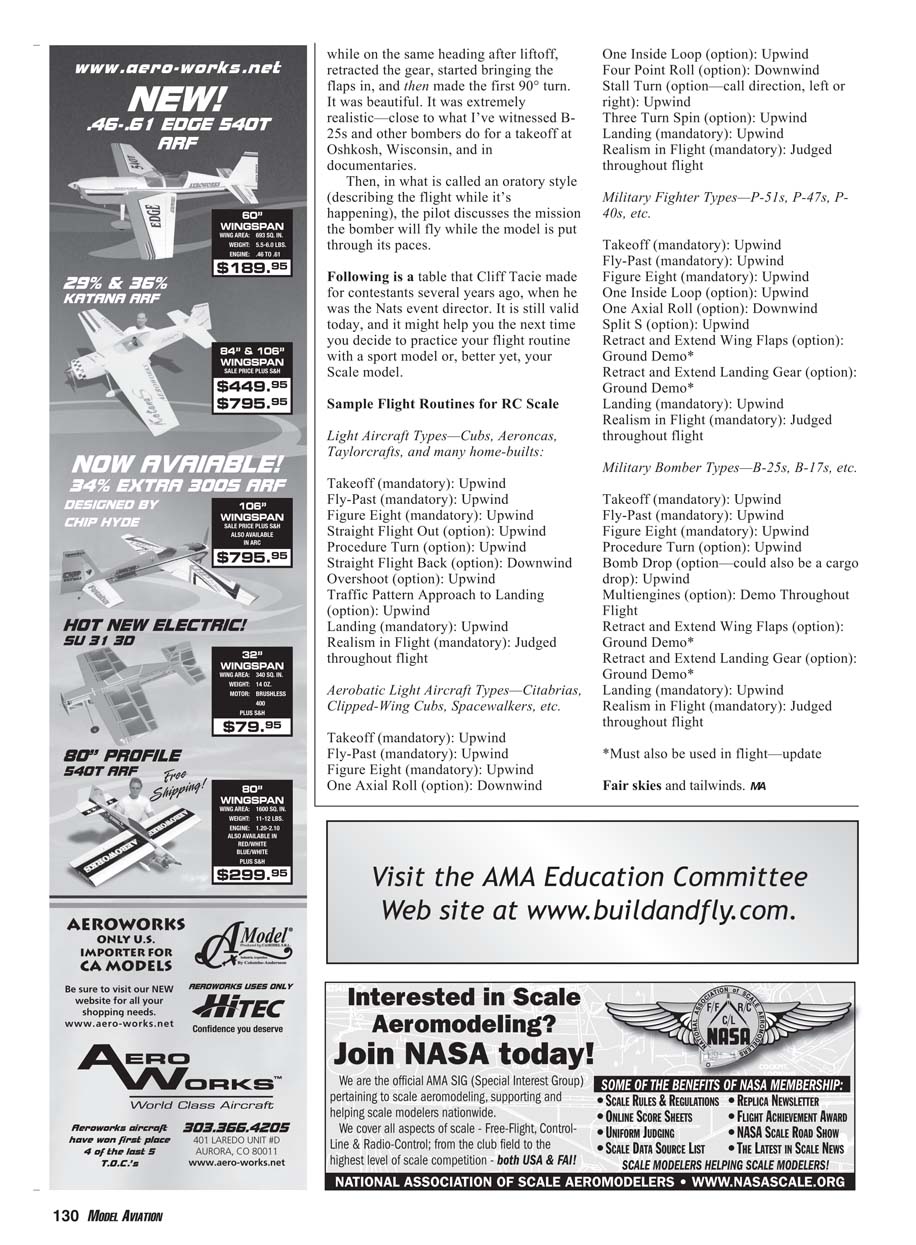
360° Descending Circle
360° Descending Circle: This is one of the most beautiful maneuvers a Scale model can perform, and it can be done by almost anything that will fly. As described in the Sporting Code:
"Commencing from straight and level flight, the model aircraft performs a gentle 360° descending circle over the landing area, in a direction away from the judges, at a constant low throttle setting. The manoeuvre terminates at a maximum height of 6 metres, resuming straight and level flight on the same path."
This maneuver starts in front of the judges at a high altitude while in straight and level flight. It ends just past the judges' station, per the diagram.
At the beginning of the maneuver, the throttle should be reduced to a low setting and remain there until the airplane reaches the final parallel leg of the maneuver in front of the judges. That should occur at approximately 15-20 feet high, although it isn't considered an error if flown slightly lower. Higher than 6 metres, or 19.8 feet, is considered an error in this maneuver.
Keep the model's wings at a consistent bank angle throughout the maneuver until it straightens out on the original heading in which it began.
Approach and Landing
Approach and Landing: This varies more from competition to competition than any of the other maneuvers. In some it's two maneuvers, and in others it's one. For this exercise I'll refer to the AMA rule book—Competition Regulations—which you can download from the AMA Web site. (Sorry, but Competition Regulations is no longer free with membership.)
Approach is a separate maneuver in AMA Scale, with landing beginning at the end of it or at approximately 10 feet above the runway while flaring for the landing. Depending on the type of landing gear the model has, the surface (grass or paved), or the wind direction, the contestant may select either a wheel landing for conventional gear or a three-point landing.
A tricycle-gear (or nose-gear) model should land on the main gear, settling on the nose wheel and then roll out straight until it's stopped, unless the surface of the runway won't accommodate the rollout.
Realism
Realism: As stated in Competition Regulations, "The realism score shall be awarded in proportion to how well the model simulates the complete flight, stability, takeoff, landing, and taxiing characteristics of the prototype aircraft."
The key wording in the preceding is "… simulates the complete flight, stability … characteristics of the prototype aircraft." I can't emphasize this enough. Rules and regulations generally spell out the minimum required to compete in a contest.
Contestants who research their prototype aircraft, such as a B-25, are probably interested in the history of the airplane to begin with; otherwise, they might not select a twin as a subject. They study the bomber and what it was used for in bombing missions and attack-and-strafing missions, depending on how the bomber was armed.
You won't see these competitors trying to fly rolls or loops after flying the maneuvers for an event. They have studied the airplane and the rules for the event. They have a flight program, a caller, and a backup flight plan in case of excellent weather.
At a recent Scale contest, one contestant throttled his engines up at the judges' station with the propellers turned away from the judges, checked the control surfaces, and stated to the judges that he had permission to taxi out onto the active runway. Taking it, turning into the wind, he applied brakes, lowered flaps to takeoff position, ran up the engines, and released the brakes.
The pilot took off with his model and, while on the same heading after liftoff, retracted the gear, started bringing the flaps in, and then made the first 90° turn. It was beautiful. It was extremely realistic—close to what I’ve witnessed B-25s and other bombers do for a takeoff at Oshkosh, Wisconsin, and in documentaries.
Then, in what is called an oratory style (describing the flight while it’s happening), the pilot discusses the mission the bomber will fly while the model is put through its paces.
Following is a table that Cliff Tacie made for contestants several years ago, when he was the Nats event director. It is still valid today, and it might help you the next time you decide to practice your flight routine with a sport model or, better yet, your Scale model.
Sample Flight Routines for RC Scale
- Light Aircraft Types—Cubs, Aeroncas, Taylorcrafts, and many home-builts:
- Takeoff (mandatory): Upwind
- Fly-Past (mandatory): Upwind
- Figure Eight (mandatory): Upwind
- Straight Flight Out (option): Upwind
- Procedure Turn (option): Upwind
- Straight Flight Back (option): Downwind
- Overshoot (option): Upwind
- Traffic Pattern Approach to Landing (option): Upwind
- Landing (mandatory): Upwind
- Realism in Flight (mandatory): Judged throughout flight
- Aerobatic Light Aircraft Types—Citabrias, Clipped-Wing Cubs, Spacewalkers, etc.
- Takeoff (mandatory): Upwind
- Fly-Past (mandatory): Upwind
- Figure Eight (mandatory): Upwind
- One Axial Roll (option): Downwind
- One Inside Loop (option): Upwind
- Four Point Roll (option): Downwind
- Stall Turn (option—call direction, left or right): Upwind
- Three Turn Spin (option): Upwind
- Landing (mandatory): Upwind
- Military Fighter Types—P-51s, P-47s, P-40s, etc.
- Takeoff (mandatory): Upwind
- Fly-Past (mandatory): Upwind
- Figure Eight (mandatory): Upwind
- One Inside Loop (option): Upwind
- One Axial Roll (option): Downwind
- Split S (option): Upwind
- Retract and Extend Wing Flaps (option): Ground Demo*
- Retract and Extend Landing Gear (option): Ground Demo*
- Landing (mandatory): Upwind
- Military Bomber Types—B-25s, B-17s, etc.
- Takeoff (mandatory): Upwind
- Fly-Past (mandatory): Upwind
- Figure Eight (mandatory): Upwind
- Procedure Turn (option): Upwind
- Bomb Drop (option—could also be a cargo drop): Upwind
- Multiengines (option): Demo Throughout Flight
- Landing (mandatory): Upwind
*Must also be used in flight—update
Fair skies and tailwinds. MA
Transcribed from original scans by AI. Minor OCR errors may remain.

