
RC Scale
Stan Alexander [[email protected]]
Diversity is the spice of life in RC Scale
It's just after the Memorial Day holiday as I write this. Contest season has just begun in earnest. What never ceases to amaze many modelers about Scale competition is the diversity of subjects you see at any given competition.
The Piper J-3 Cubs, the warbirds, and the increasing number of turbines are present at all national Scale events. Ducted-fan models are almost nonexistent these days; I can't remember seeing one in the last few years.
It's the other aircraft that really interest many modelers. These include odd or different warbirds, such as the Nakajima Ki-27 "Nate," which was flown in the Japanese Army Air Force beginning in 1936. There are P-47s and many other warbirds at almost every event, so why not surprise the judges or your friends with something out of the ordinary, even at a Scale fly-in? The growing number of ARFs makes this easier.
At Top Gun this year there were a few unusual aircraft. It's not everyday you see a Lockheed F-104 Starfighter at a contest—with a turbine or otherwise. Jerry Keller scratch-built his new F-104 and powered it with an AMT AT-400 turbine. The full-scale aircraft was capable of speeds in excess of 1,400 mph.
Jerry constructed the fiberglass plug for the model, the intricate landing gear, and all of its other parts. He might agree that being an aerospace engineer doesn't hurt when you're building such a subject.
At 55 inches, the F-104 had a small wingspan compared to other models at the contest, and it weighed 32 pounds. Expert pilot Tommy Wood flew the jet in Team Scale and they finished in 11th place.
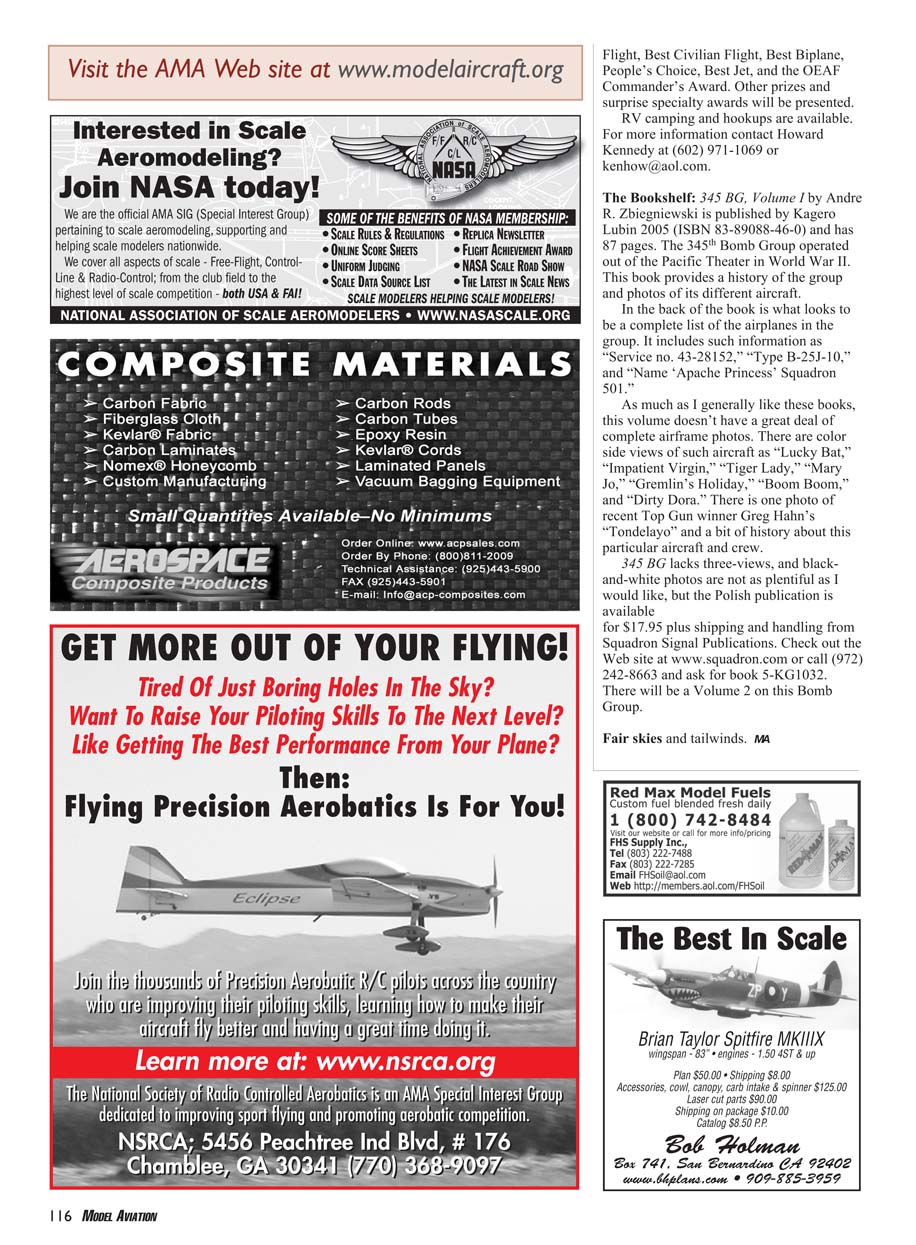
Pat McCurry has been to several Top Guns and he has his own modeling company; check it out at www.flypcm.com. This year he brought a new version of the Dornier Do 335 Pfeil: an unusual push-pull fighter that had a maximum speed of 474 mph. There were several different versions of the full-scale aircraft.
Pat's model spanned 85 inches and weighed 37 pounds. He had both engines running for flight operation, as did the scale aircraft, with Mok 1.40s. Pat scratch-built the landing gear. The model is now available as a kit and can be seen on the Web site.
Miles airplanes were unique wooden civil designs in England before and during World War II. The British built many aircraft using plywood, and Miles Aircraft used plywood-covered wings much like those on our PT-19 trainers.
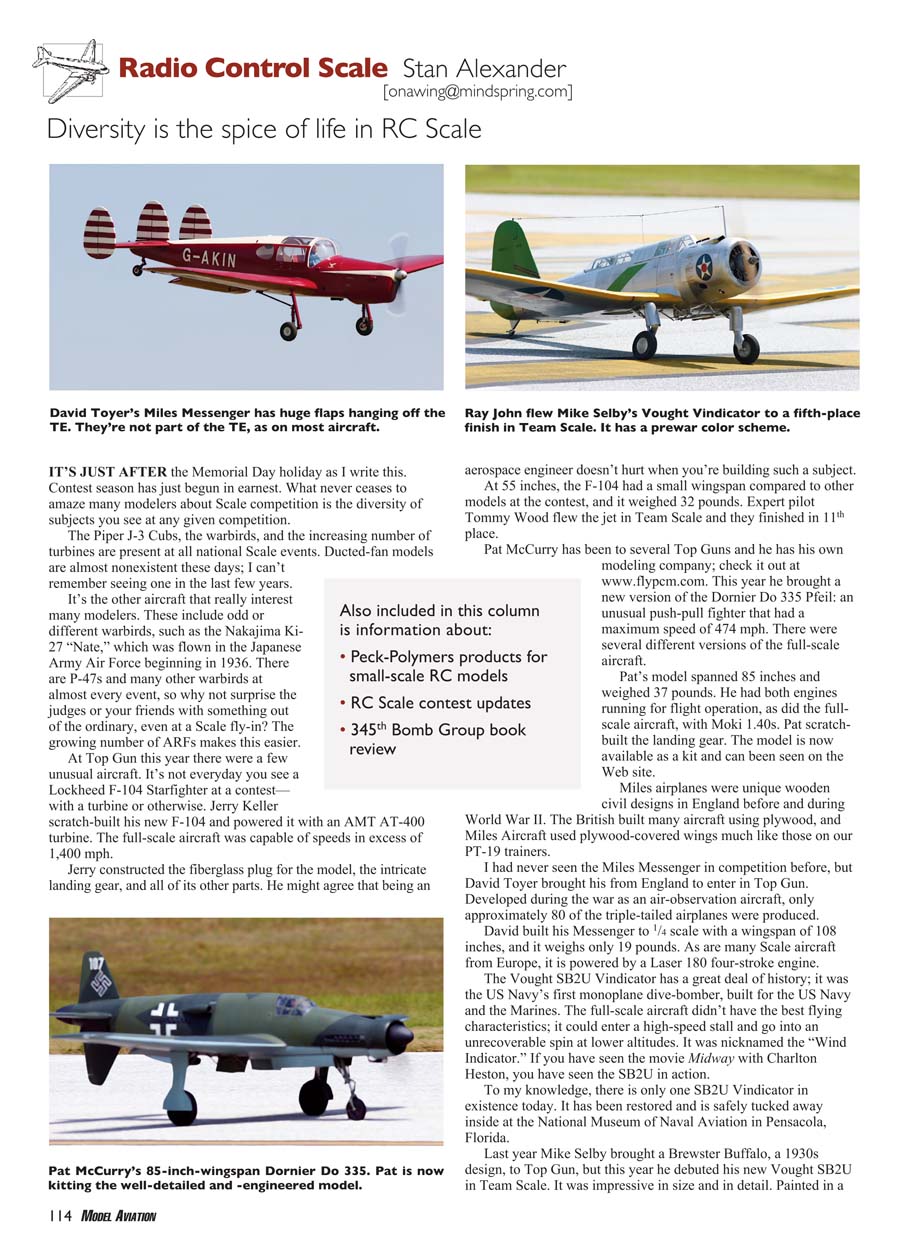
I had never seen the Miles Messenger in competition before, but David Toyer brought his from England to enter in Top Gun. Developed during the war as an air-observation aircraft, only approximately 80 of the triple-tailed airplanes were produced.
David built his Messenger to 1/4 scale with a wingspan of 108 inches, and it weighs only 19 pounds. As are many Scale aircraft from Europe, it is powered by a Laser 180 four-stroke engine.
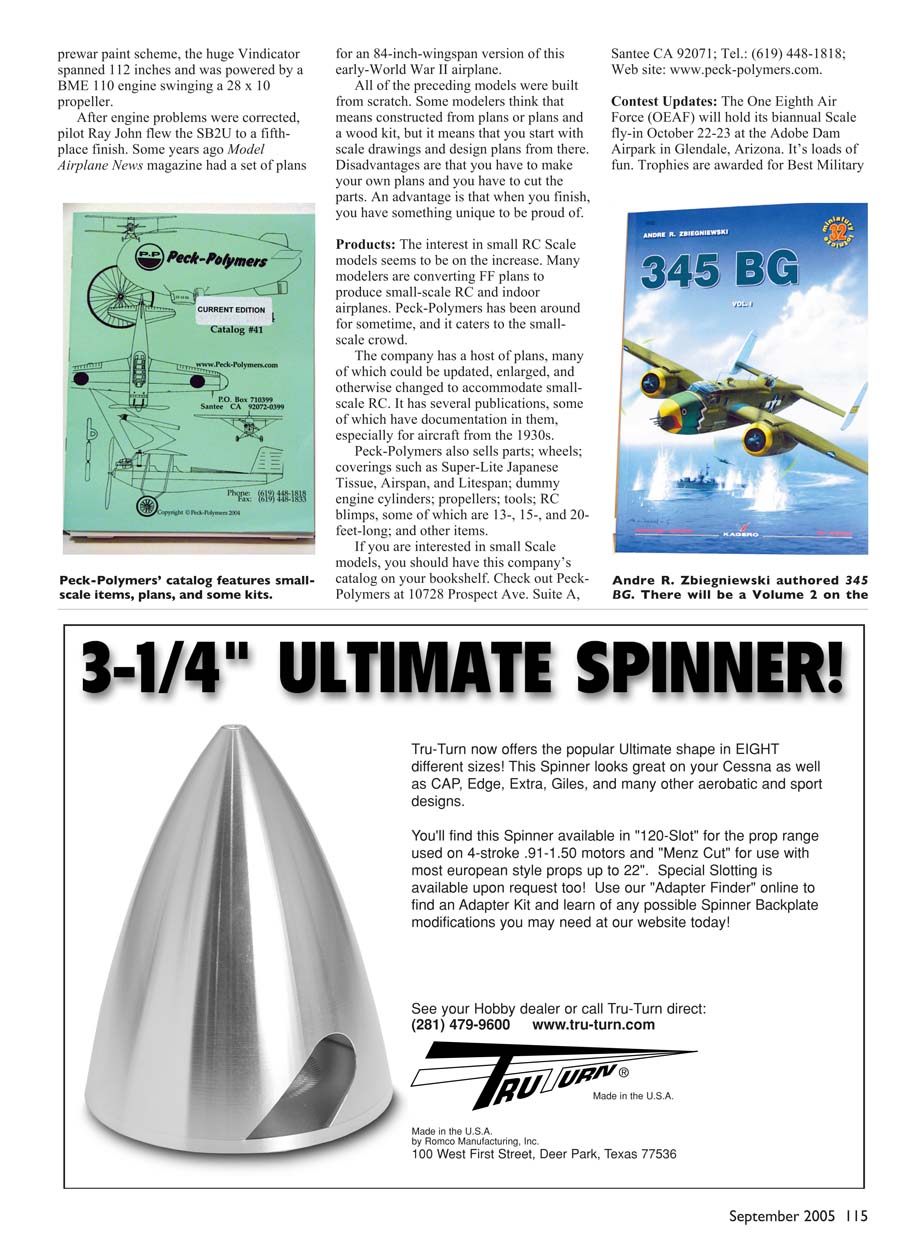
The Vought SB2U Vindicator has a great deal of history; it was the US Navy's first monoplane dive-bomber, built for the US Navy and the Marines. The full-scale aircraft didn't have the best flying characteristics; it could enter a high-speed stall and go into an unrecoverable spin at lower altitudes. It was nicknamed the "Wind Indicator." If you have seen the movie Midway with Charlton Heston, you have seen the SB2U in action.
To my knowledge, there is only one SB2U Vindicator in existence today. It has been restored and is safely tucked away inside at the National Museum of Naval Aviation in Pensacola, Florida.
Last year Mike Selby brought a Brewster Buffalo, a 1930s design, to Top Gun, but this year he debuted his new Vought SB2U in Team Scale. It was impressive in size and in detail. Painted in a prewar color scheme, the model finished fifth in Team Scale. Expert pilot Ray John often flies the plane for Mike.
Also included in this column is information about:
- Peck-Polymers products for small-scale RC models
- RC Scale contest updates
- 345th Bomb Group book review
for an 84-inch-wingspan version of this early-World War II airplane.
All of the preceding models were built from scratch. Some modelers think that means constructed from plans or plans and a wood kit, but it means that you start with scale drawings and design plans from there. Disadvantages are that you have to make your own plans and you have to cut the parts. An advantage is that when you finish, you have something unique to be proud of.
Products:
The interest in small RC Scale models seems to be on the increase. Many modelers are converting FF plans to produce small-scale RC and indoor airplanes. Peck-Polymers has been around for some time, and it caters to the small-scale crowd.
The company has a host of plans, many of which could be updated, enlarged, and otherwise changed to accommodate small-scale RC. It has several publications, some of which have documentation in them, especially for aircraft from the 1930s.
Peck-Polymers also sells parts; wheels; coverings such as Super-Lite Japanese Tissue, Airspan, and Litespan; dummy engine cylinders; propellers; tools; RC blimps, some of which are 13-, 15-, and 20-feet-long; and other items.
If you are interested in small Scale models, you should have this company's catalog on your bookshelf. Check out Peck-Polymers at 10728 Prospect Ave. Suite A, Santee CA 92071; Tel.: (619) 448-1818; Web site: www.peck-polymers.com.
Contest Updates:
The One Eighth Air Force (OEAF) will hold its biannual Scale fly-in October 22-23 at the Adobe Dam Airpark in Glendale, Arizona. It's loads of fun. Trophies are awarded for Best Military Flight, Best Civilian Flight, Best Biplane, People's Choice, Best Jet, and the OEAF Commander's Award. Other prizes and surprise specialty awards will be presented. RV camping and hookups are available. For more information contact Howard Kennedy at (602) 971-1069 or [email protected].
The Bookshelf:
345 BG, Volume 1 by Andre R. Zbigniewski is published by Kagero Lubin 2005 (ISBN 83-89088-46-0) and has 87 pages. The 345th Bomb Group operated out of the Pacific Theater in World War II. This book provides a history of the group and photos of its different aircraft.
In the back of the book is what looks to be a complete list of the airplanes in the group. It includes such information as "Service no. 43-28152," "Type B-25J-10," and "Name 'Apocalypse Princess' Squadron 501."
As much as I generally like these books, this volume doesn't have a great deal of complete airframe photos. There are color side views of such aircraft as "Lucky Bat," "Impatient Virgin," "Tiger Lady," "Mary Jo," "Gremlin's Holiday," "Boom Boom," and "Dirty Dora." There is one photo of recent Top Gun winner Greg Hahn's "Tondelayo" and a bit of history about this particular aircraft and crew.
345 BG lacks three-views, and black-and-white photos are not as plentiful as I would like, but the Polish publication is available for $17.95 plus shipping and handling from Squadron Signal Publications. Check out the Web site at www.squadron.com or call (972) 242-8663 and ask for book S-KG1032. There will be a Volume 2 on this Bomb Group.
Fair skies and tailwinds. MA
Transcribed from original scans by AI. Minor OCR errors may remain.

