
RC Scale
Stan Alexander
Stan does make mistakes—but not this time!
Also included in this column:
- Fairchild airplane documentation
OCTOBER 30, 1938, much of the East Coast of the United States came under attack from invaders from Mars—at least if you were one of those at the time who believed everything you heard on the radio! Another medium has taken the radio's spot in this modern age: the Internet.
Many people believe that if it's on the Internet, it's chiseled in stone and true. That is not so! Much of the information's accuracy depends on the Web site and those who contribute to it.
I make mistakes, as does any person. I've made many throughout the years, some of which have pertained to airplanes.
When I look for aircraft to document, I have a tried-and-true method of taking photos. If you are using a 35mm camera, first
Just because you take 40-60 photos doesn't mean you have to use all of them in the documentation pack. This is a critical piece of knowledge, especially if you haven't added all the details yet.
A member criticized me about the Fairchild aircraft I showed in the January and June RC Scale columns, stating that I had misidentified the Fairchild 24. Uh, not this time!
My little library is for my own use, but I have approximately 200 photo packs for different full-scale aircraft I've photographed throughout the years. They are cataloged and filed in a drawer, and most of the pictures were taken before the digital age (at least for me!).
There is a mix of civil airplanes, 1930s racers (some reproductions), Golden Age aircraft (generally known as those from between the world wars), World War II fighters, transports, and more. Most of the photos were taken at different museums or at EAA AirVenture, which used to be the EAA Fly-In.
As do many, I like a wide variety of aircraft. These include military airplanes—mostly dive-bombers or early or pre-World War II fighters—and jets. The interests seem to vary, and that is one of the main reasons I believe many modelers are attracted to Scale modeling, some for all their lives. This month I'll write about Fairchild aircraft and documenting them.
Fairchild was once a huge company that built many different aircraft during World War II and later. There is probably at least one
RC Scale
Stan Alexander
book about each aircraft type that tries to cover everything that particular manufacturer built or is building. For Fairchild aircraft, I use Fairchild Aircraft 1926-1987 by Kent A. Mitchell. I would love to talk with him sometime about this company and its civil and military aircraft designs.
The reader I previously referred to claimed that I had misidentified an aircraft in the January issue as a Fairchild 24K (registration CF-BWW), when it is actually a 24R, and a model in the June issue, about which the builder sent me the information.
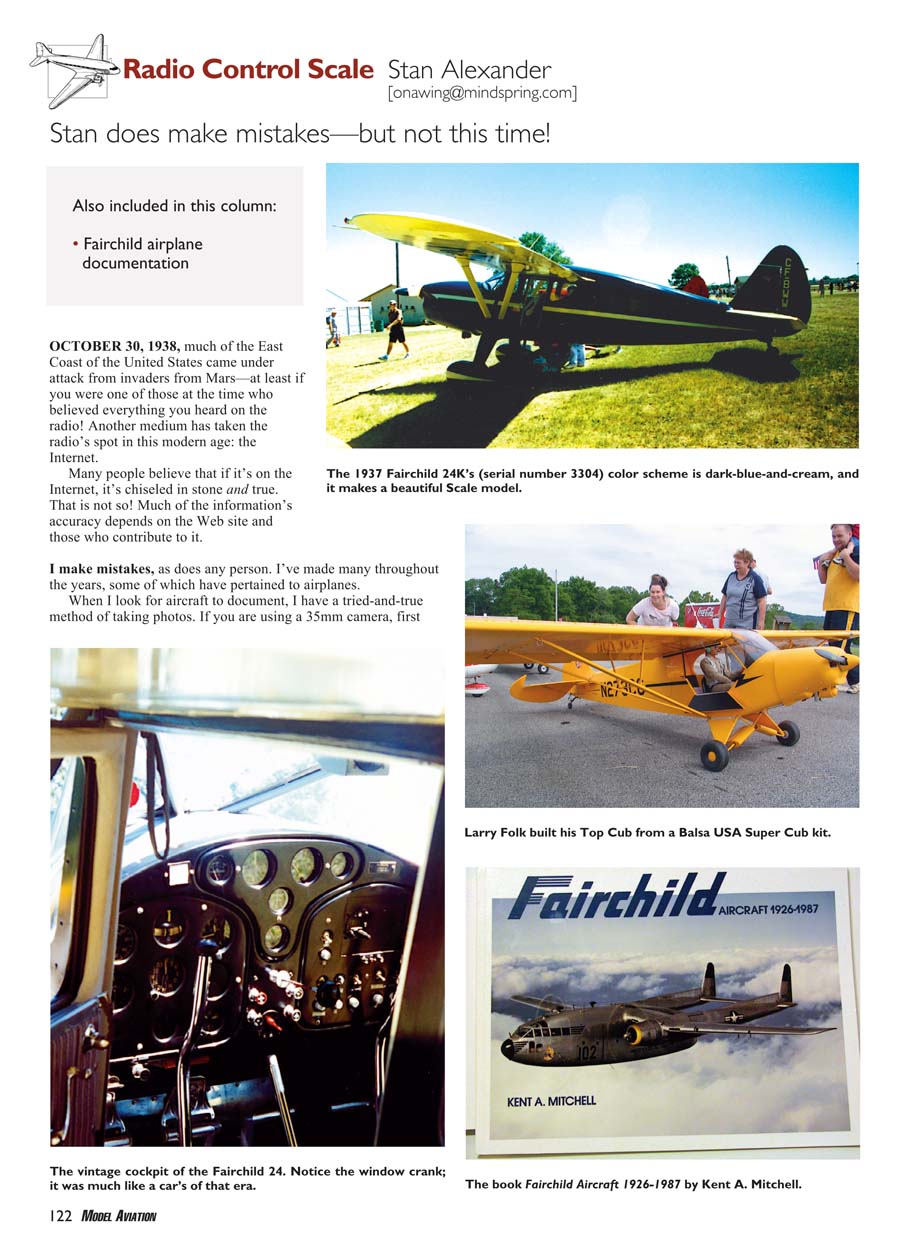
The writer pointed out that the two types are so similar you would have to see the inspection plate on the aircraft to identify them. That’s what I usually look at, and this particular aircraft is a K (serial number 3304). At the time (1997) it was powered by a Ranger 175-horsepower engine mounted inverted, as all in-line versions of this aircraft were. I also had the owner’s name and address and the airplane’s weight, wingspan, landing speed, and other information.
To make certain I was not leading anyone astray with the information, I checked my book. On page 79 under “Production: Model 24C8-C8F/24G-K/24W9-W46” it states that Model 24K was produced with the Ranger 6-410-B engines with C numbers 3300-3326, 3350-3358, three to the US Army Air Forces as UC-61E, two to the US Coast Guard as J2K2, and this concluded the model K’s production run.
So that makes the one photograph the fifth airframe produced of the model run. My comment that this was a more common Fairchild aircraft had to do with the fact that the Model 24 was widely produced before, during, and after World War II. I could have stated that more clearly. There were 1,983 Model 24s produced between 1931 and 1947. So be careful with just a “quick Internet check.”
As were many other civil aircraft of that era, some Model 24s started out as civilian and then were pressed into military service later. Others, such as the DC-3, were converted from civilian and produced specifically for the military.
This is why it’s good to identify the aircraft before you start snapping away with your camera. You might be surprised to learn that it’s not what you think it is. Many aircraft have the general look of a Piper J-3 Cub or the Piper Super Cub, but other companies produce the same “type” of airframes under different names. About the only way to tell the difference is to look at the inspection plate with the builder’s information on it.
Just finding Fairchild aircraft can be a real snipe hunt sometimes, at least when you’re looking for a model other than the common PT-19-series aircraft. The Virginia Aviation Museum has a couple Fairchilds from the Golden Age of Aviation, one of which is a 1928 Fairchild FC-2W2—a high-wing, radial-engine transport, of which only 31 were built. This “Stars and Stripes” version is on loan from the Smithsonian Institution. It would make a beautiful Scale model.
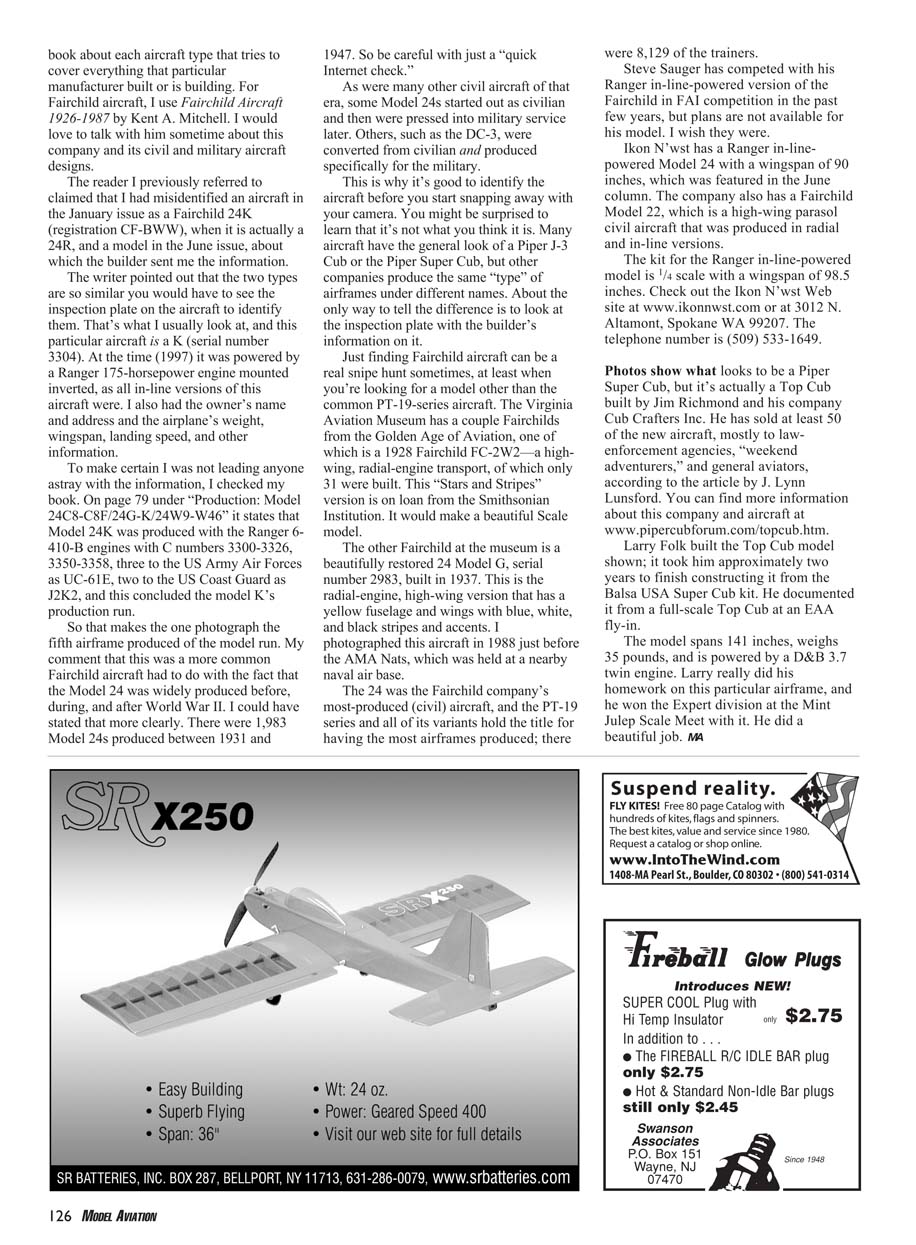
The other Fairchild at the museum is a beautifully restored 24 Model G, serial number 2983, built in 1937. This is the radial-engine, high-wing version that has a yellow fuselage and wings with blue, white, and black stripes and accents. I photographed this aircraft in 1988 just before the AMA Nats, which was held at a nearby naval air base.
The 24 was the Fairchild company’s most-produced (civil) aircraft, and the PT-19 series and all of its variants hold the title for having the most airframes produced; there were 8,129 of the trainers.
Steve Sauger has competed with his Ranger in-line-powered version of the Fairchild in FAI competition in the past few years, but plans are not available for his model. I wish they were.
Ikon N’west has a Ranger in-line–powered Model 24 with a wingspan of 90 inches, which was featured in the June column. The company also has a Fairchild Model 22, which is a high-wing parasol civil aircraft that was produced in radial and in-line versions.
The kit for the Ranger in-line–powered model is 1/4 scale with a wingspan of 98.5 inches. Check out the Ikon N’west Web site at www.ikonwst.com or at 3012 N. Altamont, Spokane WA 99207. The telephone number is (509) 533-1649.
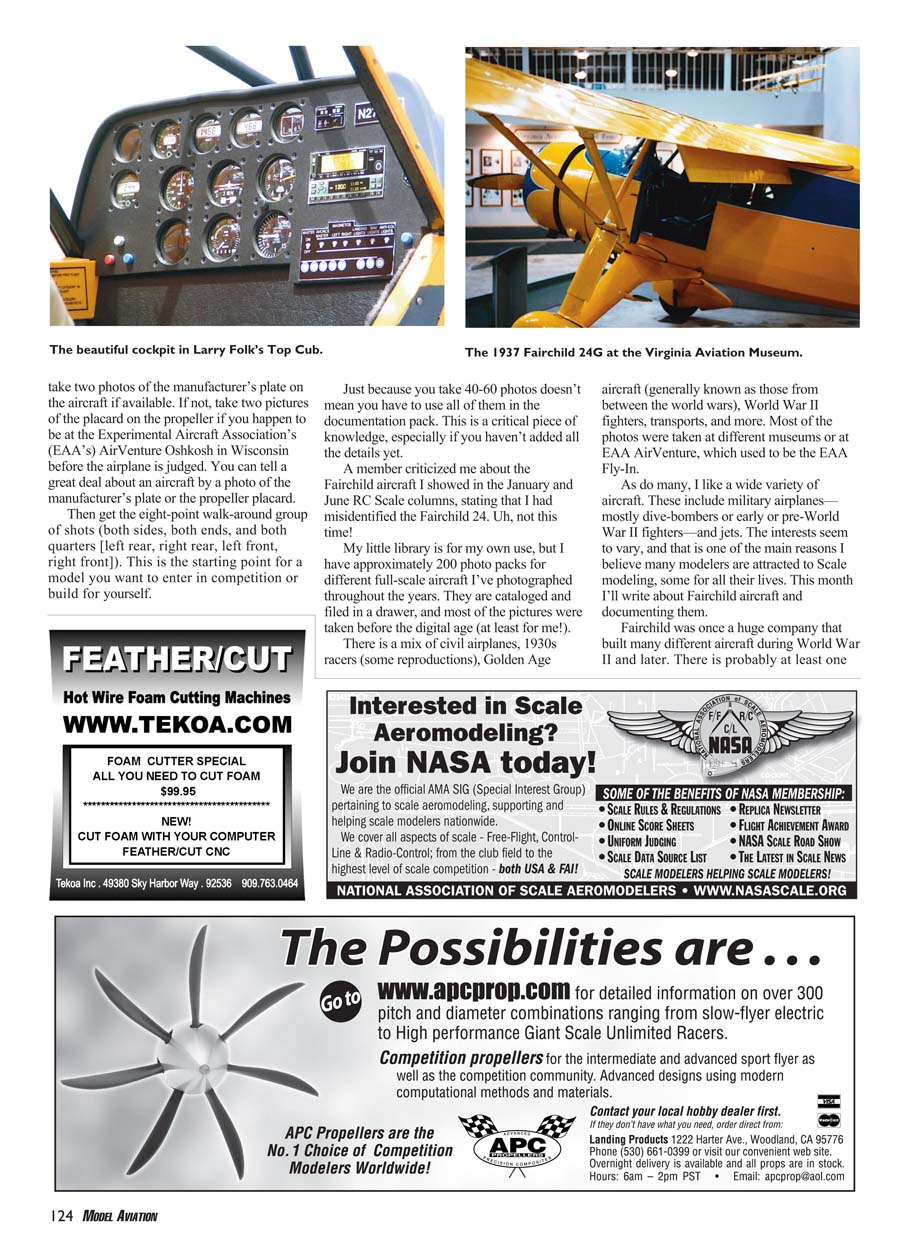
Photos show what looks to be a Piper Super Cub, but it’s actually a Top Cub built by Jim Richmond and his company Cub Crafters Inc. He has sold at least 50 of the new aircraft, mostly to law-enforcement agencies, “weekend adventurers,” and general aviators, according to the article by J. Lynn Lunsford. You can read more information about this company and aircraft at www.pipercubforum.com.
Larry Folk built the Top Cub model shown; it took him approximately two years to finish constructing it from the Balsa USA Super Cub kit. He documented it from a full-scale Top Cub at an EAA fly-in.
The model spans 141 inches, weighs 35 pounds, and is powered by a D&B 3.7 twin engine. Larry really did his homework on this particular airframe, and he won the Expert division at the Mint Julep Scale Meet with it. He did a beautiful job. MA
Transcribed from original scans by AI. Minor OCR errors may remain.

