
Radio Control Scale
Stan Alexander ([email protected])
Choosing a power supply for Scale models
CHOOSING YOUR power supply is one of the most—if not the most—personal decisions you'll make with your new scale model. Radio systems are generally by JR, Futaba, Hitec, or Airtronics. Some have different features and the programming can be different, but they operate in a similar manner.
A good friend was having a hard time running his .40- to .60-size two-stroke alcohol engines. He lost some airplanes and was going to have to rebuild others. As we talked about the reasons why these airplanes crashed, I realized he had several inexpensive or knock-off engines in his scale models. I suggested that he take them all and make a boat anchor.
There are few engine brands that I will put into a scale model. One I use frequently is an O.S. two- or four-stroke engine, and I've had good luck with Saitos. It's not because of the power or the pretty colors of the crankcase or the chrome. It's because of their reliability.
With some engines you have to change the idle or the high-end needle valve adjustment before each flight. My time and the airplane are more valuable than that. On mine, once the adjustments are set, I'm done. I don't have to do anything else to it for the rest of the summer if I stay at the local field. Changing elevation when traveling to fields in other states can affect all engines to some degree.
There are other reliable engines available. When most of us find one that works well, we stick with it. Let us know what works for you and share your experiences.
On the gas side of the equation, most brands are reliable. This is why so many scale modelers use gas engines such as ZDZ, Zenoah, and Fuji, as well as the more expensive Seidel radial engines. You don't have to clean the model after each flight because gas engines don't leave a trail of oily residue.
Electric power is a different ballgame. Electrics are good power sources for small aircraft as well as the larger ones, especially multiengine models. Electric power may be an alternative for your scale model, but if you like to fly several times per day, be sure to check the time frame for recharging flight packs.
Pietenpol Update
Construction has stalled on the Pietenpol this summer. I've had some home maintenance issues that have kept my attention for several weeks at a time, but I'm back in the shop and getting back to the fun of building!
I have received several emails asking about the plans for the Pietenpol. I'm using AMA Plans Service plan number 28345—Gene Wallock Kits 84.5-inch span aircraft, originally from the John Pond Old-Time Plan Service catalog. If you call the Plans Service and ask for these plans, please mention this column!
The spruce longerons for the fuselage didn't work as I had planned. One cracked as they were being pulled together at the rear, so I cut them out of the fuselage forward section and used medium balsa instead.
The tail wheel in the landing gear will be a CB Associates 1/4-scale unit. There are several from which to choose, but the main gear shown on the plans is all wire.
Around Scale
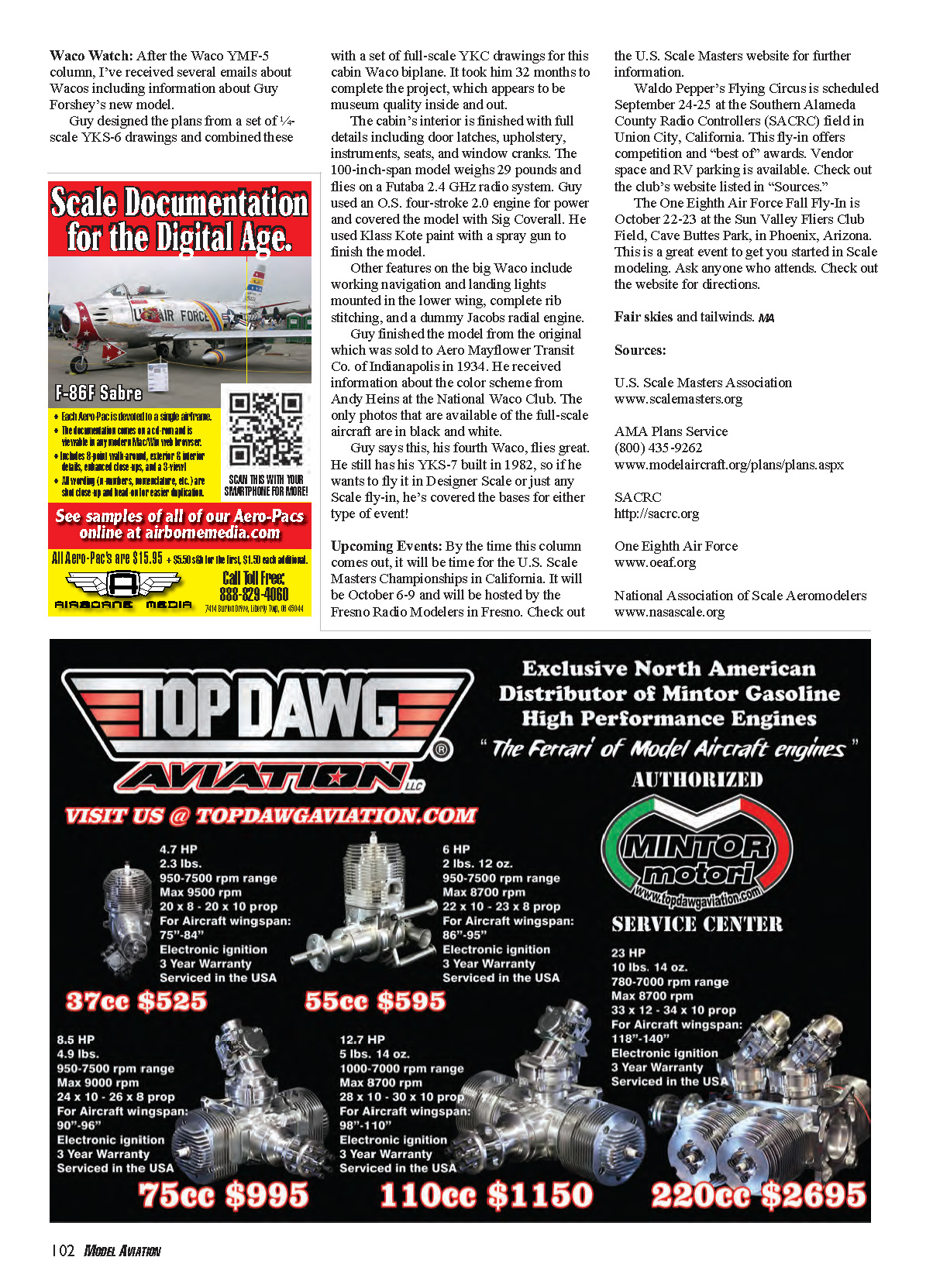
A few months ago I reported on one of the Waco YMF-5 models seen at the One Eighth Air Force Fly-In last year. Great Planes has come out with a great-looking Waco YMF-5 with a 72-inch wingspan, which makes it available for International Miniature Aircraft Association (IMAA) events as well as Fun Scale classes across the country.
It uses an engine in the popular 1.2 four-cycle size range. It allows you to fly a good-size model, but it's manageable at most airfields. I'm sure it wasn't lost on the manufacturer that the 1.2 FS engine is one that many have.
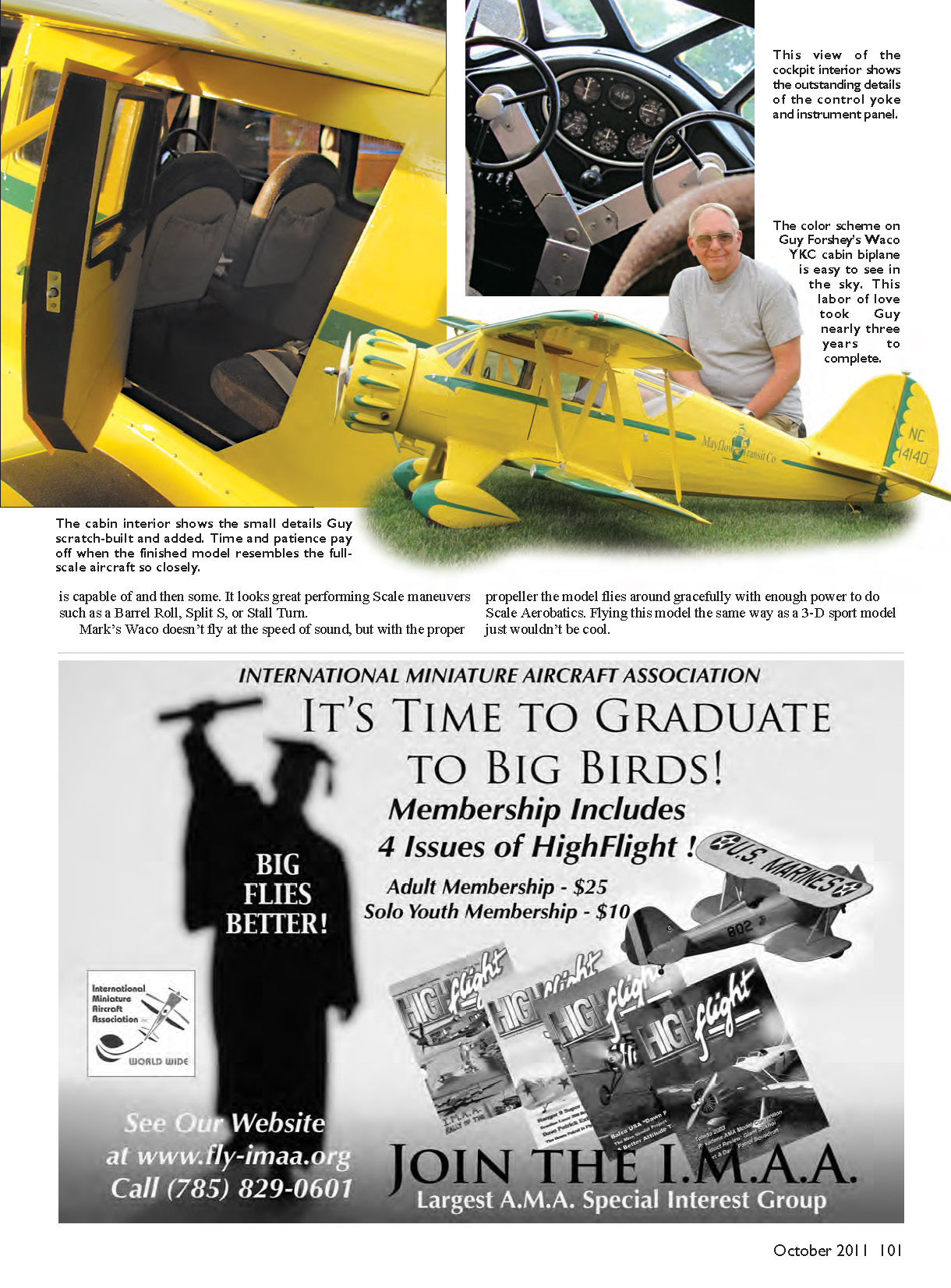
Mark Lanterman's 72-inch-span Great Planes ARF Waco YMF-5 was seen at the 2011 Mint Julep Scale Meet at Falls of Rough State Park in Kentucky. Although the weather was hairy at times, Mark's Waco flew great.
Mark's highly detailed model is covered with MonoKote. He selected an O.S. .95 two-stroke engine and there is plenty of power for the model to do anything the full-scale Waco would do. It is capable of and then some. It looks great performing Scale maneuvers, such as a Barrel Roll, Split S, or Stall Turn.
Mark's Waco doesn't fly at the speed of sound, but with the proper propeller the model flies around gracefully with enough power to do Scale Aerobatics. Flying this model the same way as a 3-D sport model just wouldn't be cool.
RC Scale
Stan Alexander
with a set of full-scale YKC drawings for this cabin Waco biplane. It took him 32 months to complete the project, which appears to be museum quality inside and out.
The cabin's interior is finished with full details including door latches, upholstery, instruments, seats, and window cranks. The 100-inch-span model weighs 29 pounds and flies on a Futaba 2.4 GHz radio system. Guy used an O.S. four-stroke 2.0 engine for power and covered the model with Sig Coverall. He used Klass Kote paint with a spray gun to finish the model.
Other features on the big Waco include working navigation and landing lights mounted in the lower wing, complete rib stitching, and a dummy Jacobs radial engine.
Guy finished the model from the original which was sold to Aero Mayflower Transit Co. of Indianapolis in 1934. He received information about the color scheme from Andy Heins at the National Waco Club. The only photos that are available of the full-scale aircraft are in black and white.
Guy says this, his fourth Waco, flies great. He still has his YKS-7 built in 1982, so if he wants to fly it in Designer Scale or just any Scale fly-in, he's covered the bases for either type of event!
Upcoming Events
By the time this column comes out, it will be time for the U.S. Scale Masters Championships in California. It will be October 6-9 and will be hosted by the Fresno Radio Modelers in Fresno. Check out the U.S. Scale Masters website for further information.
Waldo Pepper's Flying Circus is scheduled September 24-25 at the Southern Alameda County Radio Controllers (SACRC) field in Union City, California. This fly-in offers competition and "best of" awards. Vendor space and RV parking is available. Check out the club's website listed in "Sources."
The One Eighth Air Force Fall Fly-In is October 22-23 at the Sun Valley Fliers Club Field, Cave Buttes Park, in Phoenix, Arizona. This is a great event to get you started in Scale modeling. Ask anyone who attends. Check out the website for directions.
Fair skies and tailwinds. MA
Sources
- U.S. Scale Masters Association
- AMA Plans Service
(800) 435-9262 www.modelaircraft.org/plans/plans.aspx
- SACRC
- One Eighth Air Force
- National Association of Scale Aeromodelers
Transcribed from original scans by AI. Minor OCR errors may remain.

