
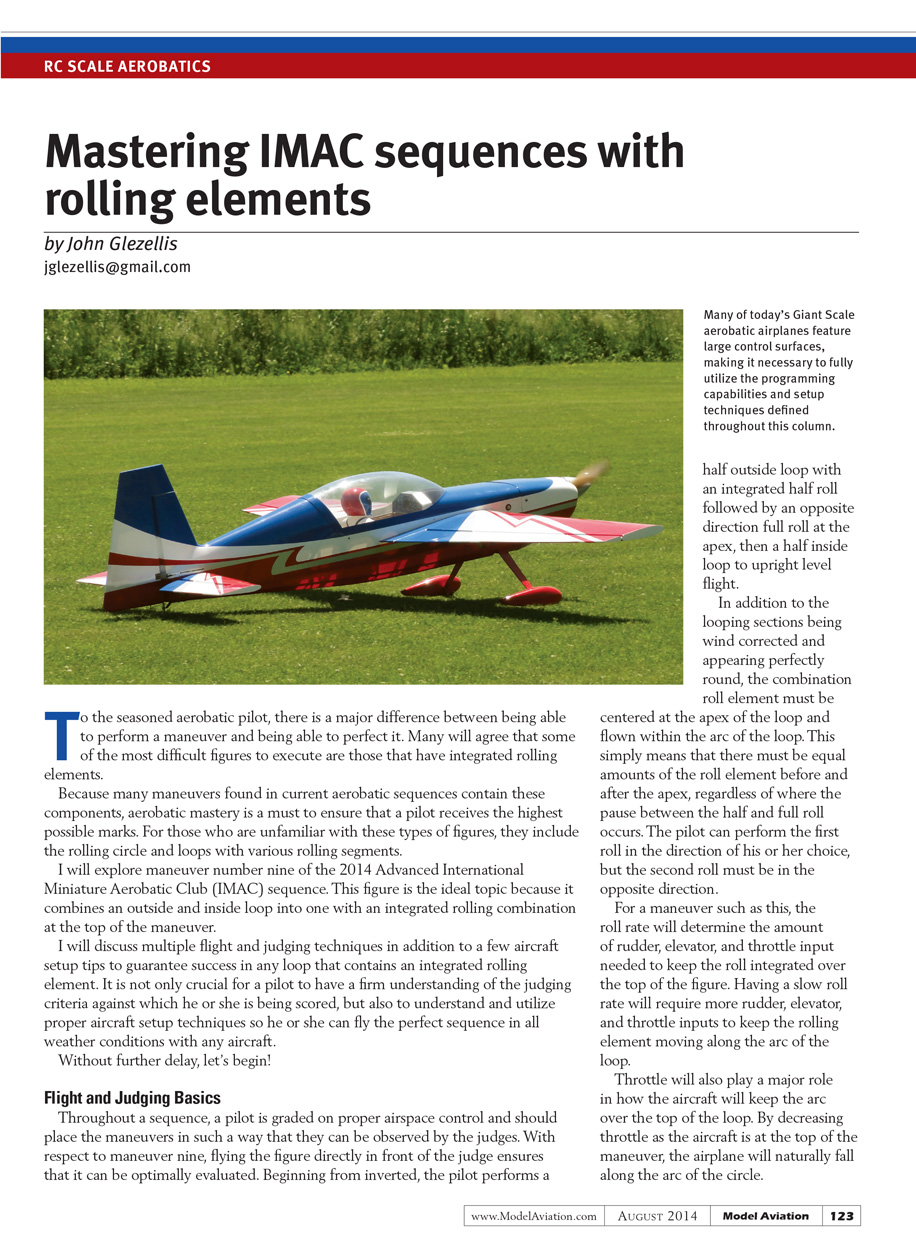
Mastering IMAC sequences with rolling elements
by John Glezellis [email protected]
To the seasoned aerobatic pilot, there is a major difference between being able to perform a maneuver and being able to perfect it. Many will agree that some of the most difficult figures to execute are those that have integrated rolling elements.
Because many maneuvers in current aerobatic sequences contain these components, aerobatic mastery is a must to ensure a pilot receives the highest possible marks. For those unfamiliar with these types of figures, they include rolling circles and loops with various rolling segments.
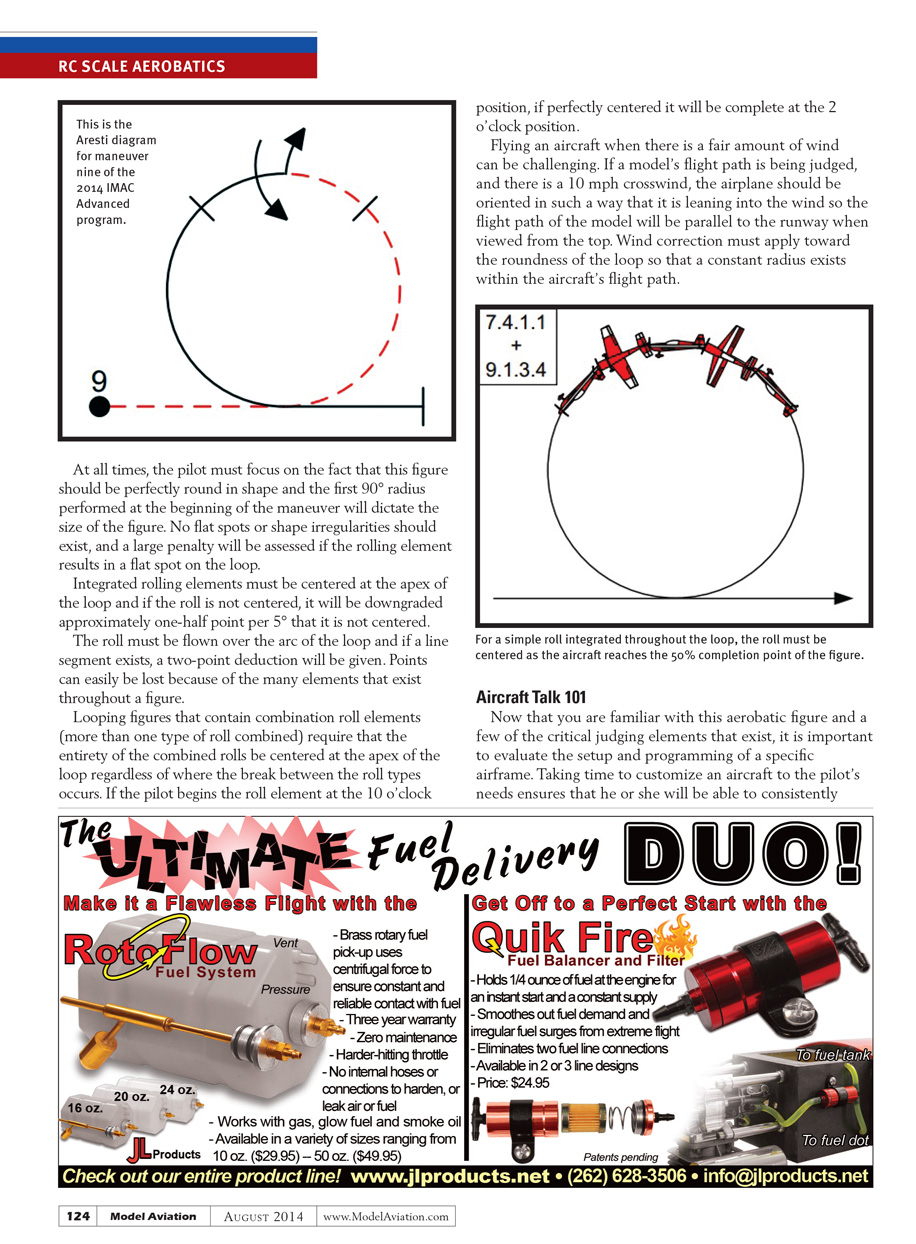
I will explore maneuver number nine of the 2014 Advanced International Miniature Aerobatic Club (IMAC) sequence. This figure is an ideal topic because it combines an outside and inside loop into one with an integrated rolling combination at the top of the maneuver.
I will discuss multiple flight and judging techniques in addition to a few aircraft setup tips to guarantee success in any loop that contains an integrated rolling element. It is crucial for a pilot to have a firm understanding of the judging criteria against which he or she is scored, and to understand and utilize proper aircraft setup techniques so the perfect sequence can be flown in all weather conditions with any aircraft.
Without further delay, let's begin!
Flight and Judging Basics
Throughout a sequence, a pilot is graded on proper airspace control and should place maneuvers so they can be observed by the judges. With respect to maneuver nine, flying the figure directly in front of the judge ensures it can be optimally evaluated. Beginning from inverted, the pilot performs a half outside loop with an integrated half roll, followed by an opposite-direction full roll at the apex, then a half inside loop back to upright, level flight.
In addition to the looping sections being wind-corrected and appearing perfectly round, the combination roll element must be centered at the apex of the loop and flown within the arc of the loop. This means there must be equal amounts of the roll element before and after the apex, regardless of where the pause between the half and full roll occurs. The pilot can perform the first roll in the direction of his or her choice, but the second roll must be in the opposite direction.
For a maneuver such as this, the roll rate will determine the amount of rudder, elevator, and throttle input needed to keep the roll integrated over the top of the figure. A slow roll rate requires more rudder, elevator, and throttle inputs to keep the rolling element moving along the arc of the loop.
Throttle also plays a major role in how the aircraft keeps the arc over the top of the loop. By decreasing throttle as the aircraft reaches the top of the maneuver, the airplane will naturally fall along the arc of the circle.
At all times, the pilot must focus on the fact that this figure must be perfectly round in shape. The first 90° radius performed at the beginning of the maneuver will dictate the size of the figure. No flat spots or shape irregularities should exist; a large penalty will be assessed if the rolling element results in a flat spot on the loop.
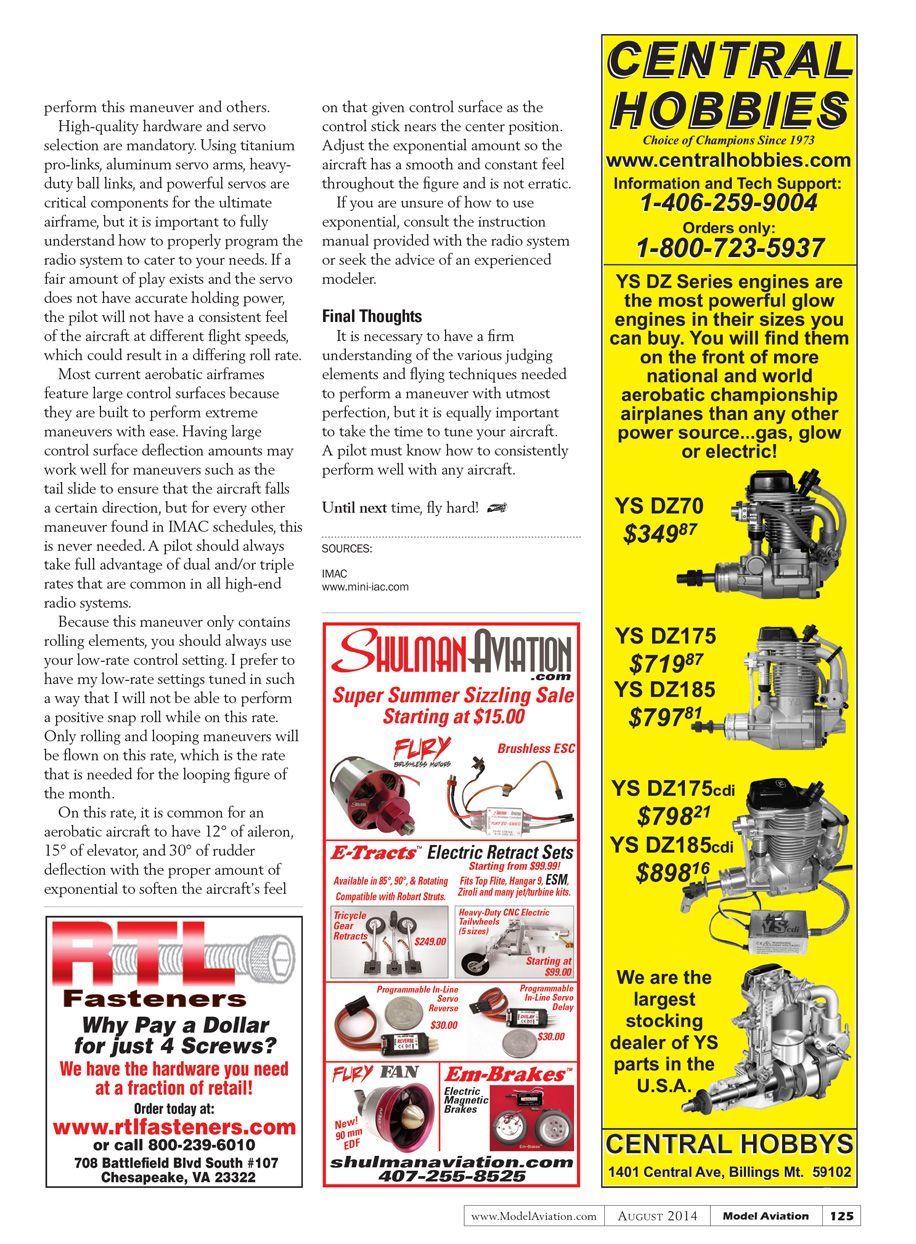
Integrated rolling elements must be centered at the apex of the loop. If the roll is not centered, it will be downgraded approximately one-half point per 5° that it is off-center. The roll must be flown over the arc of the loop; if a line segment exists, a two-point deduction will be given. Points can easily be lost because of the many elements that exist throughout a figure. Looping figures that contain combination roll elements (more than one type of roll combined) require that the entirety of the combined rolls be centered at the apex of the loop regardless of where the break between roll types occurs. If the pilot begins the roll element at the 10 o'clock position, a perfectly centered roll will be complete at the 2 o'clock position.
Flying an aircraft in a fair amount of wind can be challenging. If the model's flight path is being judged and there is a 10 mph crosswind, the airplane should be oriented so it is leaning into the wind, making the flight path of the model parallel to the runway when viewed from above. Wind correction must preserve the roundness of the loop so that a constant radius exists within the aircraft's flight path.
Aircraft Talk 101
Now that you are familiar with this aerobatic figure and some of the critical judging elements, it is important to evaluate the setup and programming of a specific airframe. Taking time to customize an aircraft to the pilot's needs ensures consistent, accurate rolls. Most model aircraft have a roll rate that is much too fast for integrated rolling elements. Typically, the roll rate should be near 360° per second; however, this will vary depending on the maneuver size and the type of aircraft.
Slowing down roll rate is not difficult if the aircraft has a pitch/rate switch or a high/low rate switch for the ailerons. Reduce the aileron throw to get a slower roll rate. If the airplane is equipped with flaperons, adjust the mixing to get more differential if needed, and reduce mixing in the low rate to perform this maneuver and others.
High-quality hardware and good servo selection are mandatory. Using titanium pro-links, aluminum servo arms, heavy-duty ball links, and powerful servos are critical components for the ultimate airframe, but it is important to fully understand how to properly program the radio system to cater to your needs. If a fair amount of play exists and the servo does not have accurate holding power, the pilot will not have a consistent feel of the aircraft at different flight speeds, which could result in a varying roll rate.
Most current aerobatic airframes feature large control surfaces because they are built to perform extreme maneuvers with ease. Having large control-surface deflections may work well for maneuvers such as the tail slide, but for most IMAC schedule maneuvers this is not needed. A pilot should always take full advantage of dual and/or triple rates that are common in all high-end radio systems.
Because this maneuver only contains rolling elements, you should always use your low-rate control setting. I prefer my low-rate settings to be tuned so I cannot perform a positive snap roll on that rate. Only rolling and looping maneuvers will be flown on this rate, which is the setting needed for the looping figure of the month.
On this low rate, it is common for an aerobatic aircraft to have approximately 12° of aileron, 15° of elevator, and 30° of rudder deflection with the proper amount of exponential to soften the aircraft’s feel as the control stick nears center. Adjust the exponential so the aircraft has a smooth and constant feel throughout the figure and is not erratic.
If you are unsure how to use exponential, consult the instruction manual provided with your radio system or seek the advice of an experienced modeler.
Final Thoughts
It is necessary to have a firm understanding of the various judging elements and flying techniques needed to perform a maneuver with utmost perfection, but it is equally important to take the time to tune your aircraft. A pilot must know how to consistently perform well with any aircraft.
Until next time, fly hard!
Sources
- IMAC
- www.mini-iac.com
Transcribed from original scans by AI. Minor OCR errors may remain.

