
Radio Control Scale Aerobatics
Ed Alt, 7 Parkview Rd., Randolph NJ 07869
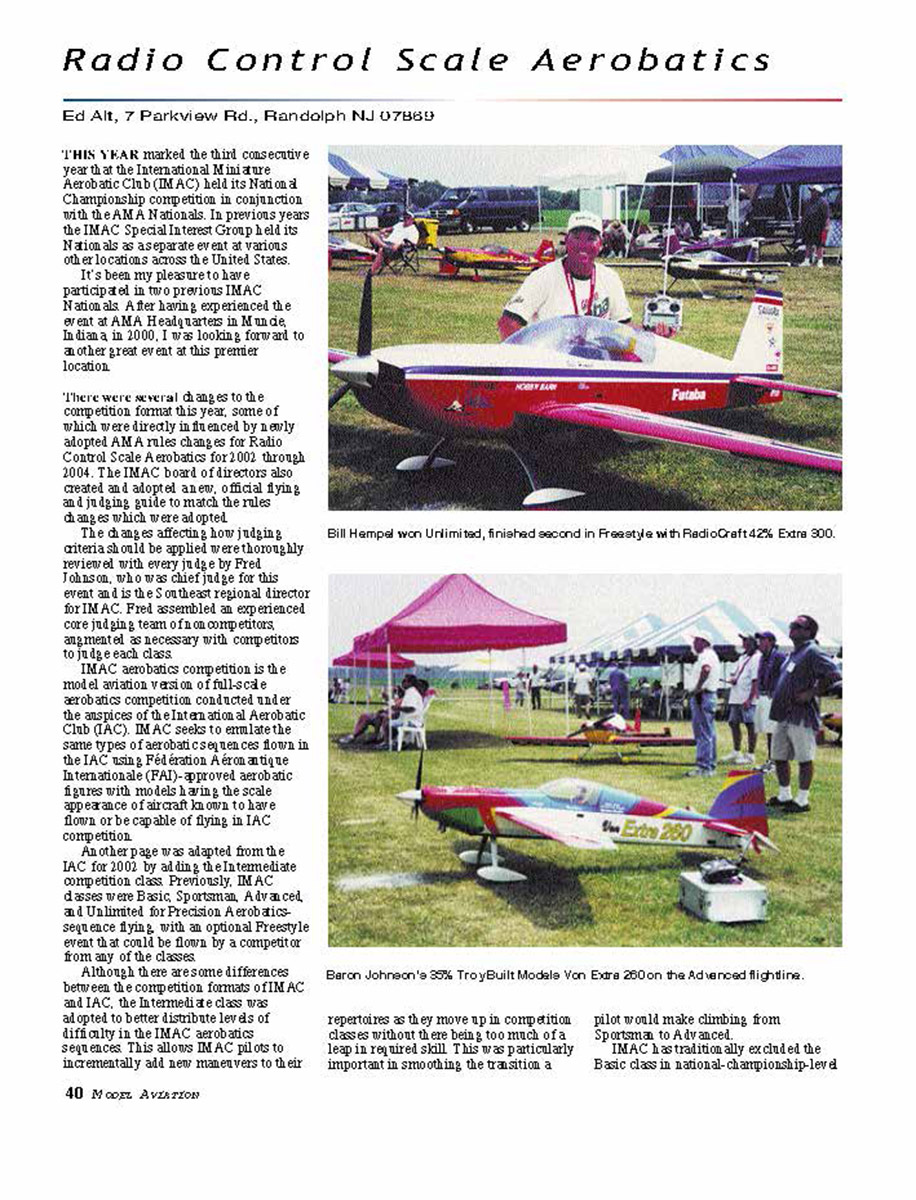
THIS YEAR marked the third consecutive year that the International Miniature Aerobatic Club (IMAC) held its National Championship competition in conjunction with the AMA Nationals. In previous years the IMAC Special Interest Group held its Nationals as a separate event at various other locations across the United States.
It's been my pleasure to have participated in two previous IMAC Nationals. After having experienced the event at AMA Headquarters in Muncie, Indiana in 2000, I was looking forward to another great event at this premier location.
There were several changes to the competition format this year, some of which were directly influenced by newly adopted AMA rules changes for Radio Control Scale Aerobatics for 2002 through 2004. The IMAC board of directors also created and adopted a new, official flying and judging guide to match the rules changes which were adopted.
The changes affecting how judging criteria should be applied were thoroughly reviewed with every judge by Fred Johnson, who was chief judge for this event and is the Southeast regional director for IMAC. Fred assembled an experienced core judging team of IMAC competitors, augmented as necessary with competitors to judge each class.
IMAC aerobatics competition is the model aviation version of full-scale aerobatics competition conducted under the auspices of the International Aerobatic Club (IAC). IMAC seeks to emulate the same types of aerobatic sequences flown in the IAC using Federation Aeronautique Internationale (FAI)-approved aerobatic figures with models having the scale appearance of aircraft known to have flown or be capable of flying in IAC competition.
Another page was adapted from the IAC for 2002 by adding the Intermediate competition class. Previously, IMAC classes were Basic, Sportsman, Advanced and Unlimited for Precision Aerobatics; sequence flying with an optional Freestyle event that could be flown by a competitor from any of the classes.
Although there are some differences between the competition formats of IMAC and IAC, the Intermediate class was adopted to better distribute levels of difficulty in IMAC aerobatics sequences. This allows IMAC pilots to incrementally add new maneuvers to their repertoires as they move up in competition classes without there being too much of a leap in required skill. This was particularly important in smoothing the transition a pilot would make climbing from Sportsman to Advanced.
IMAC has traditionally excluded the Basic class in national-championship-level competition, as it did this year. However, with the addition of Intermediate between Sportsman and Advanced, now there is a better leveling of expected skills to fly sequences designed for each class. Because of this, most seem to agree that the situation has improved for aspiring Scale Aerobatics competitors to test their skills at the right level on a national scale.
Another significant change for 2002 was the adoption of the rules contained in an Urgent Rules Proposal (URP) to AMA, even before AMA officially ruled on them. The rules changes in the URP were followed at this year's event as a properly advertised deviation from the official rules. This was done in response to the feedback from site coordinators from AMA in 2001 to assure that the 2002 event would not generate noise complaints.
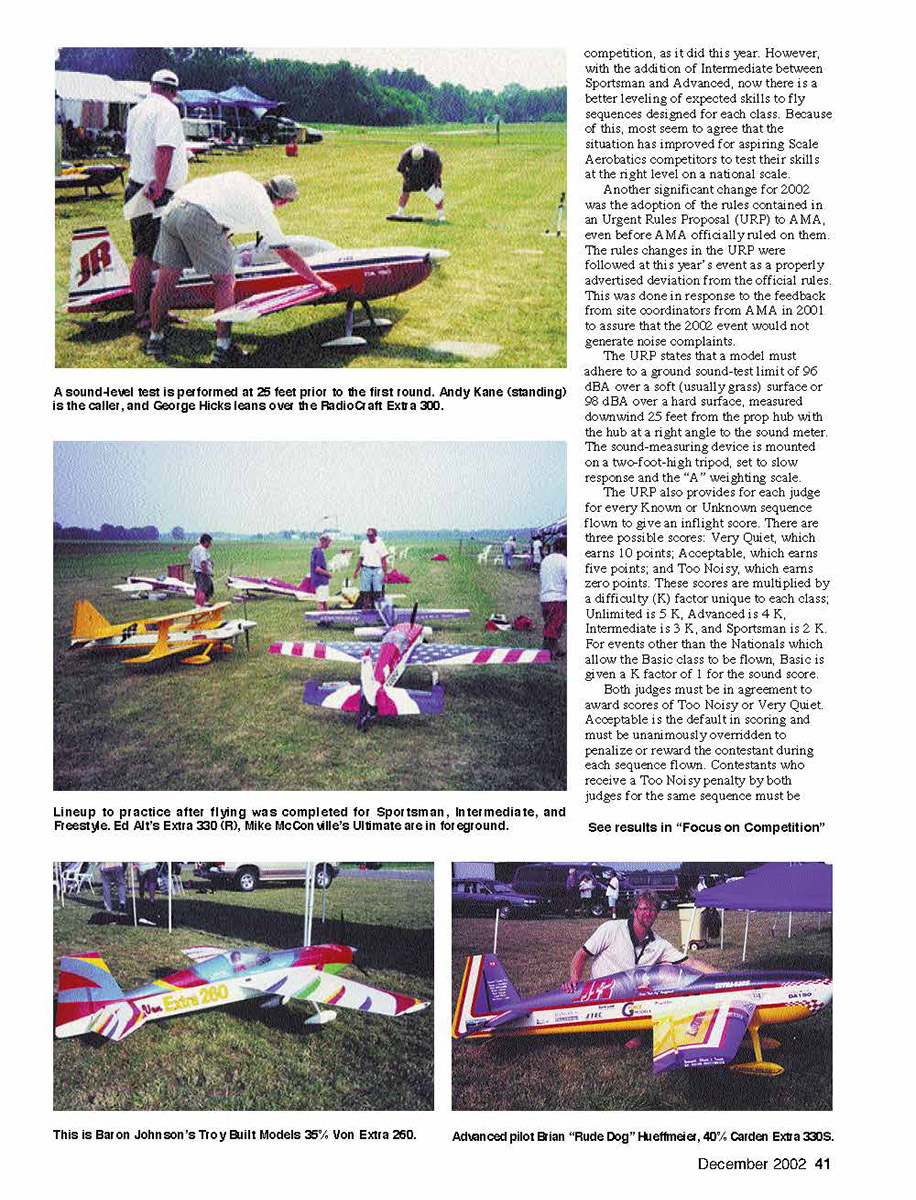
The URP states that a model must adhere to a ground sound-test limit of 96 dBA over a soft (usually grass) surface or 98 dBA over a hard surface, measured downwind 25 feet from the prop hub with the hub at a right angle to the sound meter. The sound-measuring device is mounted on a two-foot-high tripod, set to slow response and the "A" weighting scale.
The URP also provides for each judge for every Known or Unknown sequence flown to give an inflight score. There are three possible scores: Very Quiet, which earns 10 points; Acceptable, which earns five points; and Too Noisy, which earns zero points. These scores are multiplied by a difficulty (K) factor unique to each class; Unlimited is 5 K, Advanced is 4 K, Intermediate is 3 K, and Sportsman is 2 K. For events other than the Nationals which allow the Basic class to be flown, Basic is given a K factor of 1 for the sound score.
Both judges must be in agreement to award scores of Too Noisy or Very Quiet. Acceptable is the default in scoring and must be unanimously overridden to penalize or reward the contestant during each sequence flown. Contestants who receive a Too Noisy penalty by both judges for the same sequence must be disqualified.
See results in "Focus on Competition" notified by the contest director before the next round is flown. If a second Too Noisy penalty is assessed, the contestant is disqualified from further competition at that contest.
The IMAC Sound Task Force (STF) created and submitted this URP early in 2002. The STF was formed in May 2001 to proactively study the unique noise problem when operating larger gasoline-powered model airplanes.
Following the 2001 IMAC Nationals, the wisdom of chartering the STF came into sharper focus than ever. The sound footprint of some of the models flown at the time was well publicized in last year's event coverage. Subsequent to this year's AMA/IMAC Nationals, AMA approved the STF URP, and it becomes effective for all IMAC competition from now on.
STF members patiently researched and implemented what now appears to be a workable set of sound guidelines. This required analysis of the primary sound energy sources in larger gas models, the appropriate means to measure them, and the development of meaningful dB limits.
Establishing the right dB limits for typical large IMAC-style models was not as simple as establishing arbitrary ground-test
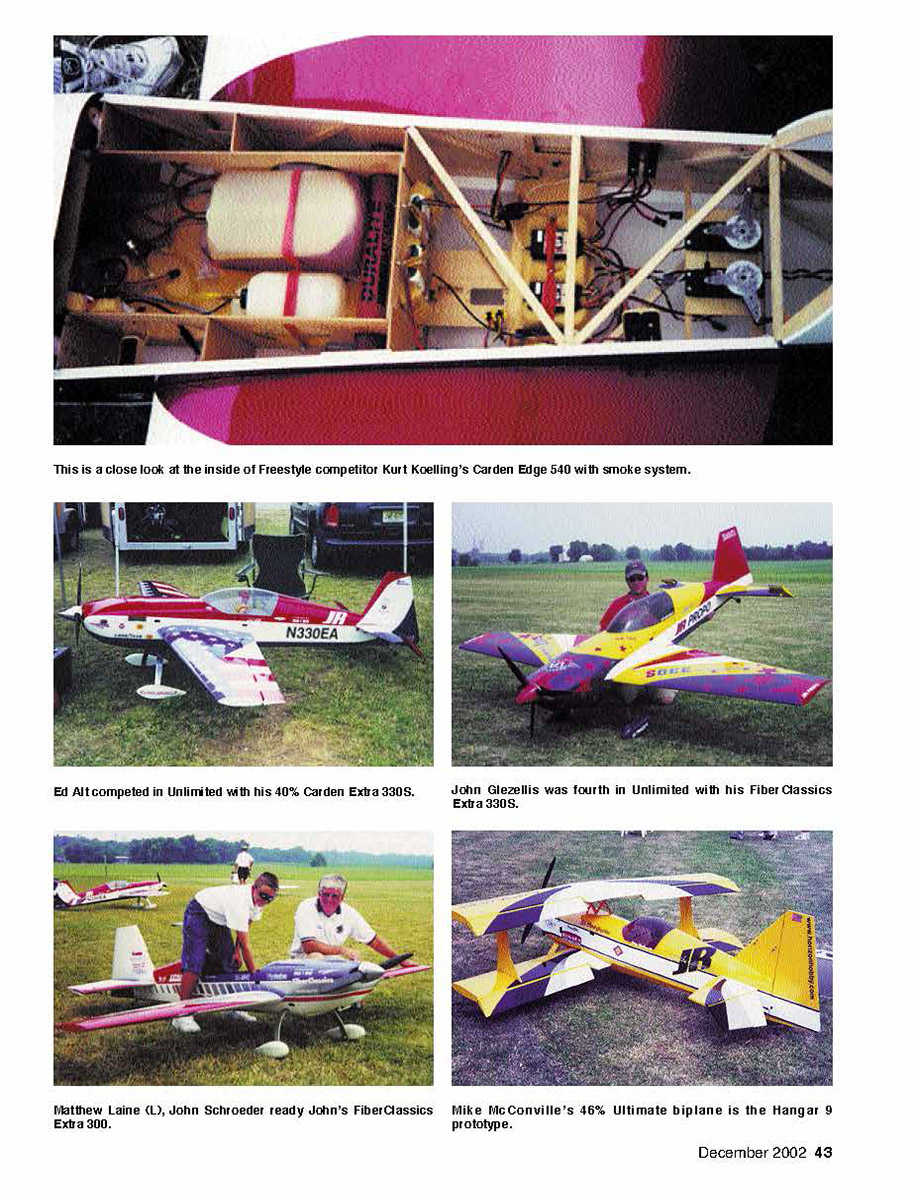
This is a close look at the inside of Freestyle competitor Kurt Koelling's Carden Edge 540 with smoke system.
Ed Alt competed in Unlimited with his 40% Carden Extra 330S.
John Glezellis was fourth in Unlimited with his FiberClassics Extra 330S.
Matthew Laine (L), John Schroeder ready John's FiberClassics Extra 300.
Mike McConville's 46% Ultimate biplane is the Hangar 9 prototype. competition was slated, which was open to all four classes from Sportsman through Unlimited.
The awards presentation for Sportsman, Intermediate, and Freestyle was set to end the day Wednesday, after which Advanced and Unlimited sequence preliminary rounds would begin Thursday morning.
For those who are unfamiliar with IMAC-style competition, the Unknown sequences are full aerobatic sequences, never before seen by the contestants. These are written in Aresti and usually have accompanying text descriptions to help aid in the understanding of the figures to be flown. Technically, though, all that really has to be provided to the contestant is the Aresti diagram, which is all that I can remember seeing for my Unknowns in Unlimited.
Unknowns are given to the pilots at the end of a day of competition and are flown first thing the following day, for just one sequence. No practice flying is permitted, whether with a model or simulator. However, it is permitted (and customary) to practice with a handheld stick airplane. Sometimes a knife and fork crossed over on a steak or container is substituted for a stick airplane. I pity the poor waitress for the table of customers!
Normally, for Known-round flights two sequences are flown per flight. However, the thinking in IMAC is that if you repeat the Unknown sequence even once during the same flight, it becomes a "Known" sequence.
Speaking from experience, it may technically become a Known sequence at that point, but it is certainly not a "Very Well Known" sequence. Thus each contestant plainly has one shot at really making a move if on the fly a well-executed Unknown, since the chances are relatively high that your fellow contestants may not execute as well as they might with the Known sequences.
The high attendance expected and planned for did not materialize for 2002. The most marked decrease was in the Sportsman class, with only eight pilots competing compared to 27 in 2001. The lower class expectations for a high turnout for the first year of the Intermediate class, but those numbers were also less than expected with only six.
Undaunted by this turn of events and with the help of a willing team of judges, flightline helpers, and scorers, contest director (CD) and newly appointed IMAC Secretary Steve Evans did a terrific job of turning lemons into lemonade. He had a simple answer to the dilemma: everyone flew a lot and had lots of fun.
I arrived in Muncie early Tuesday afternoon (July 16), and Sportsman and Intermediate were well under way. After less than two full days of flying, when I glanced at the results posted on the scoring board it looked like two contests had been run.
Including one sequence of preliminary-round Unknowns Tuesday and one sequence of final-round Unknowns Wednesday, a total of 22 rounds each in Sportsman and Intermediate had been flown during the 2½ days of competition.
Since Unknowns are designed to play an important role in the way winners are determined in IMAC competition and to avoid dilution of their scores in the final outcome, Steve decided to weight the relatively small number of Unknown sequences as one-third of the total score in spite of the high number of Known sequences flown. Seven of each competitor's lowest-scoring Known sequences were thrown out because of the high total number flown.
Ultimately, the two Unknown sequences counted for one-third of the total points, and 13 Known sequences counted for the remaining two-thirds of the points.
The competitors' response to Steve's solution seemed to be unanimous approval. Pilots were going out for gas runs in the middle of the competition, especially for those competitors who were lending their models to others who had equipment issues.
Everywhere you looked, there were airplanes and transmitters on charge to keep pace with the demands placed on their battery systems from the frequent flights. None of this unusual activity slowed the flow of the competition, and pilots seemed to have enjoyed themselves.
As the Sportsman and Intermediate competitions were reaching their conclusions Wednesday morning, several Advanced and Unlimited competitors were arriving who planned on competing in the Freestyle event later that afternoon.
There were 10 pilots competing for top honors as IMAC Freestyle National Champion, and they provided an excellent show of creative and well-choreographed flying. There were two competitors from the Sportsman ranks, two from Advanced, and six from the Unlimited class.
Prior to the Freestyle flying getting underway, Chief Judge Fred Johnson gathered all the contestants and his panel of Freestyle judges to explain a choice in judging criteria that the pilots would vote on. Only a unanimous decision would allow the deviation from the standard IMAC Freestyle judging criteria, which are Originality, Versatility, Harmony and Rhythm, and Execution. Fred proposed that the criteria used in this year's XFC competition be applied instead.
Judging Freestyle is subjective in nature to begin with and is designed to provide a relatively ranking of competitors based largely on impression versus the exact criteria, which are applied for precision sequence flying.
The XFC criteria permit (but do not require) the judge to be influenced somewhat by the level of appreciation the crowd shows after each performance. This was perhaps the single area I could point to that did nothing to decrease the subjective nature of Freestyle judging with the XFC criteria, but it is an interesting twist. As one of the judges, I don't think I allowed the crowd-appreciation factor to influence my scoring to any great extent, if at all.
The advantage of the XFC criteria seems to be in three main areas. First, it allows somewhat greater emphasis on fully exercising the model's limits by more clearly defining what the judge is entitled to expect from the performance. You read that right! The judges are allowed to have expectations based on their knowledge of what these models should be capable of doing at the extreme limits of their performance envelopes.
Second, the judge is supposed to expect the model to display a wide range of performance. It should not be all high-alpha or "3-D" flying, nor should it be all precision, sequence-style flying.
Third, there seems to be a better-defined set of criteria for judging how well a model's flight is choreographed to the music. It clearly stated that a well-choreographed sequence ought to flow and complement the music, just as the music should complement the model's actions. There should be tempo, volume, and pitch changes to match what the airplane is doing as it demonstrates precision when precision is to be expected, controlled and well-timed actions in extreme stalled flight conditions, and so forth.
It's an interesting and seemingly improved way to judge Freestyle. After hearing Fred's detailed explanation of the XFC Freestyle judging criteria, all 10 competitors voted to use it.
Following the single round of Freestyle, Wednesday ended with the awards ceremony to crown the 2002 IMAC National Champions for Sportsman, Intermediate, and Freestyle. In Sportsman, Paul Martin (Huber Heights OH) took top honors, Mark Garza (San Antonio TX) received the second-place award, and Joe Utasi (Cincinnati OH) received a third-place plaque.
Michael Marcellin (Tucson AZ) was named the 2002 IMAC National Champion in the Intermediate class. Second place went to Jeremy McKenna (Mesa AZ), and third place was awarded to Travis Higgins (Amarillo TX). All of the fliers in both classes demonstrated solid flying.
In Freestyle, Baron Johnson (Ocala FL) flew a very well-choreographed sequence that really seemed to please the crowd as it demonstrated his aircraft's full range of performance, with well-timed movements and pace to match the music. Many agreed afterward that the choreography gave Baron the edge over Bill Hempel's (Tucson AZ) performance, which was also outstanding.
Bill put in perhaps the most dramatic and exciting flight of the Freestyle event, demonstrating precision, the aircraft's full range of performance, and good elements of surprise. The choreography was also well done. But Baron finished on top in the end, and Bill was right behind in second place.
Michael Schauer (Fort Collins CO) received the third-place plaque for a well-flown performance.
The highest and lowest scores the panel of judges gave for each of the six judging criteria were thrown out to avoid undue influence from the "Wow Factor" or from any one judge's possible disinterest in a competitor's performance style.
Thursday morning Advanced and Unlimited flying got under way after Fred Johnson gave judges and pilots a thorough briefing regarding the rules and how precision sequence judging would be done.
CD Steve Evans went through field rules and placed considerable emphasis on observing the boundaries of the aerobatic box. The site chosen for Scale Aerobatics is not really restrictive if the aerobatic-box limits are properly observed, but old habits tend to die hard.
Overall, the Advanced and Unlimited pilots did a good job of staying within the boundaries of the roads surrounding the site; there were only a few transgressions that the CD needed to discuss with those pilots. Steve also relayed feedback from AMA site officials, which indicated that they were quite pleased with how much improvement in noise reduction and reduced overall footprint of the larger models had been made from the previous two years.
With 10 contestants in Advanced and 15 in Unlimited, there was a sufficient number to run the remainder of the event with a more normal number of Known sequences. Thursday, Advanced and Unlimited flew eight sequences each. Friday started with one sequence of Unknowns for each class, which were challenging to say the least. Following that, four more sequences of Knowns were flown.
Ending the day Friday, the Unlimited finalists were announced. Steve said that since there were only 10 contestants in Advanced, he would increase the number allowed in the finals from eight to 10. He also increased the Unlimited finalist count from eight to 10 as well, which seemed to work out fine as the flying unfolded Saturday.
As one who didn't quite make the cut in Unlimited, I was asked to fly the judges' demo flight for the Unlimited Unknowns on Saturday morning, and Unlimited contestant Mike Schauer performed the Advanced Unknowns to warm up the judges. I can safely say that I would not have moved any higher in the standings based on my execution of that final-round routine, but it was a lot of fun to fly it for the judges anyway.
It's truly a pleasure to watch the top fliers put in such solid performances in the Unknowns when it does count, which is exactly what happened. were announced at that day's awards ceremony, are under review by the AMA Contest Committee at the time of this writing. Subsequent to the event ending, a scoring error was discovered which may result in a different outcome than I'm reporting. The unofficial results are that Kurt Koelling (Columbus OH) is the IMAC National Champion. Baron Johnson was awarded second place, and David E. Moser (Lake Worth FL) finished third.
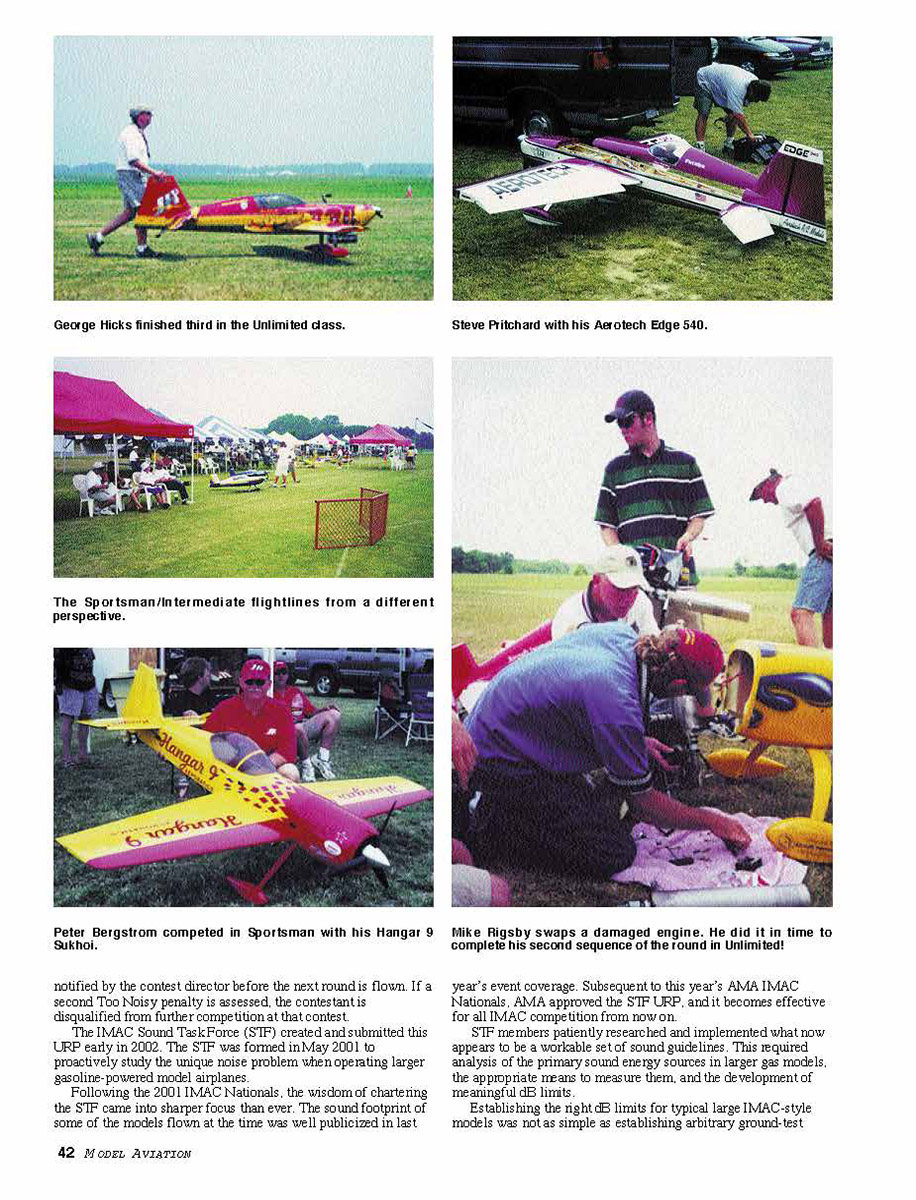
Bill Hempel won the Unlimited class. Mike McConville (Champaign IL) finished second flying a prototype 46% Hangar 9 Ultimate biplane, and George Hicks (San Antonio TX) represented Team Rebel very well with a solid third-place finish. John Glezelis (Mills MA) took home the fourth-place plaque.
"I've reduced their models' noise for 2002, many competitors made the investment in the high-volume canister exhaust systems and three-blade or carbon-fiber propellers. I only have exact details for the Advanced and Unlimited classes, and four of the 10 Advanced fliers equipped their engines with canister muffler systems. One of those canister-equipped models had a two-blade prop; the other three had three-blade props. Three other models with stock mufflers used three-blade props.
The models in Unlimited were equipped with canisters in eight cases, and one model had full-length tuned pipes. Six models had stock exhaust. All but one of the canister or tuned systems used three-blade props.
Obviously most received the message that there needs to be a serious attempt at noise reduction. All of these solutions were achieved with off-the-shelf items, although some are harder to obtain than others because of the newness of the need for them.
Ground-test results were interesting. They ranged from a low of 86 dBA, with canister systems and two- or three-blade props, to a high of 96 dBA when no attempt was made to quiet the airplane.
In one case a model equipped with a 120cc engine, stock exhaust, and two-blade prop was nearly as quiet as the best of the canister/three-blade setups at 88 dBA! This serves to illustrate how important it can be to simply match airframe size and weight to engine displacement, and to match the prop diameter and pitch selection to keep the tip speed at less than .6 mach.
However, if there is a recipe to follow according to the majority of the cases at this year's event, engines larger than 100cc need a canister system and, in many cases, a three-blade prop. Exceptions exist, though, such as the 91 dBA reading of Andy Kane's 160cc twin ZDZ. Equipped with DMB canisters and a 30x10 Bamboo two-blade wood prop (which more closely resembles a ceiling fan than a propeller), it scored to break all the rules for getting a quiet model in the air.
Good throttle and aircraft energy management were the keys to being competitive this year, especially for those fliers who did not have any kind of noise-reduction equipment besides stock mufflers.
It's always been true that a well-flown sequence requires equal skill in controlling the throttle and other primary flight controls, but it is more important than ever to manage the model's energy and speed with the use of the throttle and through good technique in both maneuver elements, such as Snap Rolls or vertical up-lines.
Unfortunately, stats on who received Very Quiet sound scores weren't available to me. I know that they are given and may have made a difference in the outcome. Many competitors were keen to know if their investments in the technology to reduce noise were worthwhile. I think they were, although there is a caveat: Judges must not be afraid to give out the Too Noisy score when it is truly deserved. Some Too Noisys were handed out during this event and, in large part, served to make an impact on lowering our noise output for the duration of the event. When the judges reported Too Noisy, the CD had a talk with the pilot.
The proof is that the IMAC people seemed pleased with our progress overall. More needs to be done, but this year proved to be a positive step in the right direction.
Transcribed from original scans by AI. Minor OCR errors may remain.

