


Common gas engine installation and tuning problems
by John Glezellis [email protected]
Throughout the years, the popularity of gasoline engines in the competition scene has increased, and for good reason. It's likely because they are reliable and cost-effective to operate. However, modelers must implement a few basic fundamentals to ensure success with gasoline-powered aerobatic models. When competition day arrives, the pilot must be prepared to only focus on the sequence at hand and performing for the judges.
Although the installation and tuning process is normally included with the general instructions provided by the engine manufacturer, this month's column will highlight a few common problems. This includes the appropriate selection of fuel lines, a few precautions for installing the fuel tank, some common challenges with electronic ignitions, and tips to ensure proper maintenance in some popular carburetors.
Without further delay, let's begin!
Subtle Differences: Let's Talk Plumbing
When a modeler transitions from building a glow-powered model to an aerobatic gasoline-powered aircraft, there are some major differences to note. First, silicon fuel tubing cannot be used on a gasoline engine. Instead, use Tygon or Neoprene with safety wire on all fuel line ends. Du-Bro offers Tygon gasoline tubing and a gasoline stopper for its fuel tanks.
When setting up a clunk, a minimum of 1/4 inch should be between the end of the clunk and the rear of the tank. Ensure that the clunk can move freely within the tank to allow proper fuel delivery to the carburetor.
Replace all fuel lines every year. If this is not done, the fuel lines may harden, preventing fuel from getting from the clunk to the engine.
B & B Specialties offers many fantastic gasoline accessories. One is a clunk designed specifically for a gas engine filter. The filter contains an aluminum die-cast body with a cotton/felt mantle. Without this filter, foreign particles can enter the carburetor.
Vibration causes gasoline to foam. When this happens, the filter prevents air from getting sucked into the fuel line. Ensure that fuel is going to the carburetor with ease and that there are no pinholes in the fuel line. Be certain that you are using the correct fuel lines, stopper, and clunk.
Always use foam padding between the fuel tank and the tank tray. Du-Bro manufactures 1/2-inch and 1/4-inch R/C Protective Foam Rubber, which is ideal for protecting the receiver, batteries, and the fuel tank from vibration.
Giant, gasoline-powered models often use large fuel tanks. Adding foam rubber between the tank and the fuel tank tray prevents cracks from developing.
Ignition Ponderings
When going through the starting procedure, if the engine, fuel tank, and electronics are all properly installed and working, the engine should start with ease. If not, and the engine gives no hint of trying to start, check the ignition battery's voltage using a voltage checker. If you're using an engine such as those available from Desert Aircraft, the voltage should be 5 volts or more.
Because many modelers use LiPo batteries, voltage regulators are commonly used to regulate the voltage from 7.4 volts to 5.9 volts. If the battery voltage appears to be correct,
RC Scale Aerobatics
John Glezellis
Carburetor Talk 101
Most Giant Scale engines feature either a Walbro or a Tillotson carburetor, which serves as the brain of the engine. Both carburetors feature two needle valves and an idle stop adjustment. During the setup process, only tamper with these areas.
When tuning an engine, obtain the correct needle settings, which are located on the carburetor. On a Desert Aircraft 50cc engine the two needles are marked with an “H” and an “L” that stand for the “High End” and “Low End” needle. If you turn the needle clockwise, it will lean the fuel mixture; turning the needle counterclockwise richens it.
I recommend starting with the factory needle settings. To begin, adjust the high end to peak rpm, but don’t keep the engine so lean that it begins to overheat and lose power. If this is the case, the engine is too lean and must be richened.
Adjust the low needle until you achieve a smooth idle and reliable transition to high throttle. If the engine dies during this transition, the low end is likely lean and should be richened.
When airborne, changes in air pressure and airflow within the cowl may require that you adjust the needle settings. If an engine appears to lose power on extended vertical up-lines, try enriching the engine’s high end by a 1/8 turn. If it appears that the engine is running hot, it may not be adequately cooling. Engines require a cooling airflow exhaust intake ratio of 3:1 to 5:1, and engine baffles force cool air through the cooling fins and greatly reduce the intake area in the front of the cowl.
After years of use, a reliable engine may become difficult to operate. If it appears that the engine is starving of fuel, yet everything with the tank and plumbing to the carburetor appears to be functioning, there may be a problem with the carburetor.
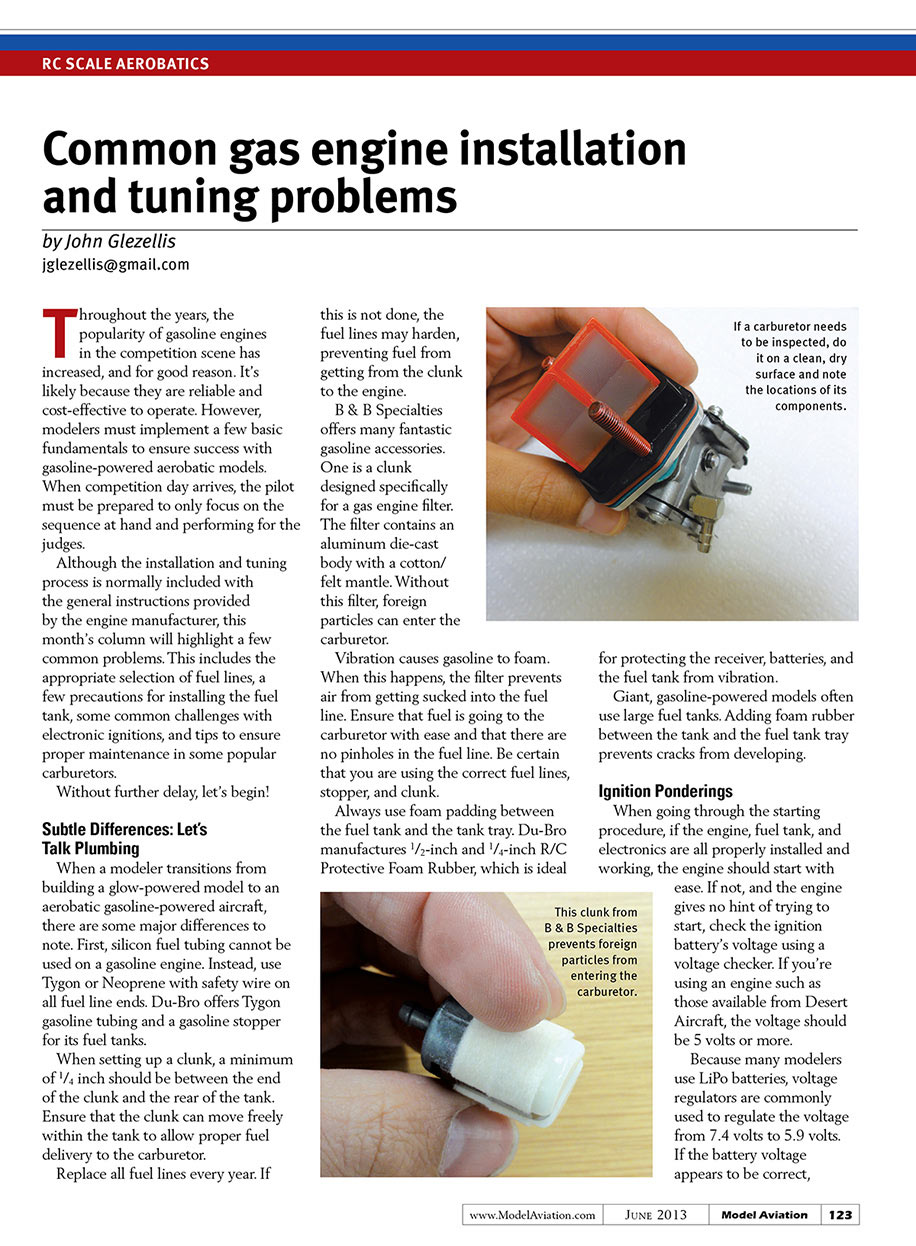
Engine manufacturers sell a carburetor kit that often contains the diaphragm, which may harden over time and can't respond to pressure changes. Whenever you pull apart the carburetor, always note the order in which the components are removed.
Final Thoughts
You should now be familiar with the common problems associated with operating gasoline-powered models. Although gasoline engines are reliable, normal maintenance must be performed. If you are unfamiliar with these practices, you may spend much time troubleshooting without success. It is important to know which engine tendencies contribute to which problems, and knowing where to look will save hours.
I recommend that you should only seek the advice from fellow expert modelers. Write to me with any questions that you have.
Until next time, fly hard!
SOURCES:
- B & B Specialties, LLC
(574) 277-0499 www.bennettbuilt.com
- Desert Aircraft
(520) 722-0607 www.desertaircraft.com
- Du-Bro
(800) 848-9411 www.dubro.com
- International Miniature Aerobatic Club
Transcribed from original scans by AI. Minor OCR errors may remain.

