
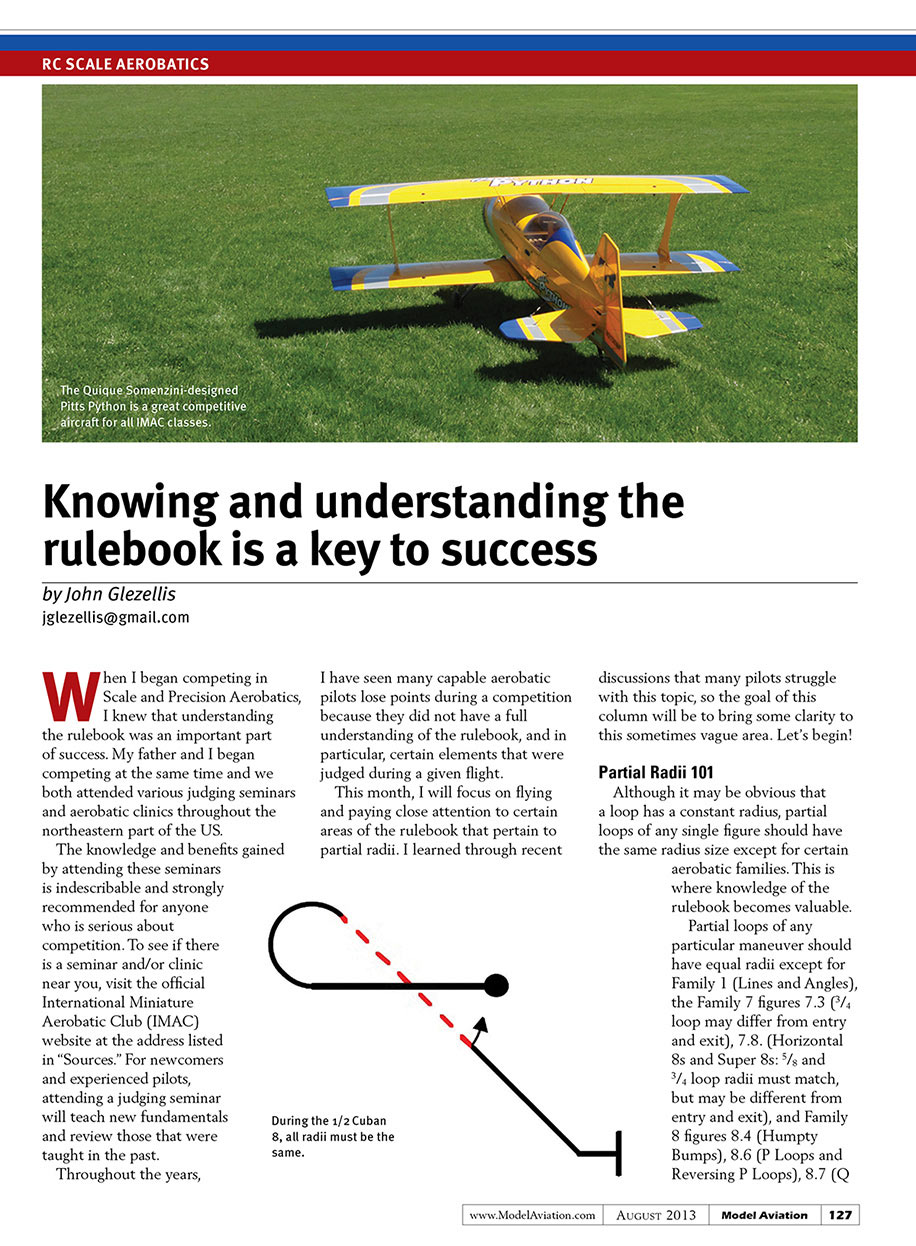
Knowing and understanding the rulebook is a key to success
by John Glezellis <REDACTED>
When I began competing in Scale and Precision Aerobatics, I knew that understanding the rulebook was an important part of success. My father and I began competing at the same time and we both attended various judging seminars and aerobatic clinics throughout the northeastern part of the US.
The knowledge and benefits gained by attending these seminars is indescribable and strongly recommended for anyone who is serious about competition. To see if there is a seminar and/or clinic near you, visit the official International Miniature Aerobatic Club (IMAC) website at the address listed in "Sources." For newcomers and experienced pilots, attending a judging seminar will teach new fundamentals and review those that were taught in the past.
Throughout the years, I have seen many capable aerobatic pilots lose points during a competition because they did not have a full understanding of the rulebook, and in particular, certain elements that were judged during a given flight.
This month, I will focus on flying and paying close attention to certain areas of the rulebook that pertain to partial radii. I learned through recent discussions that many pilots struggle with this topic, so the goal of this column will be to bring some clarity to this sometimes vague area. Let's begin!
Partial Radii 101
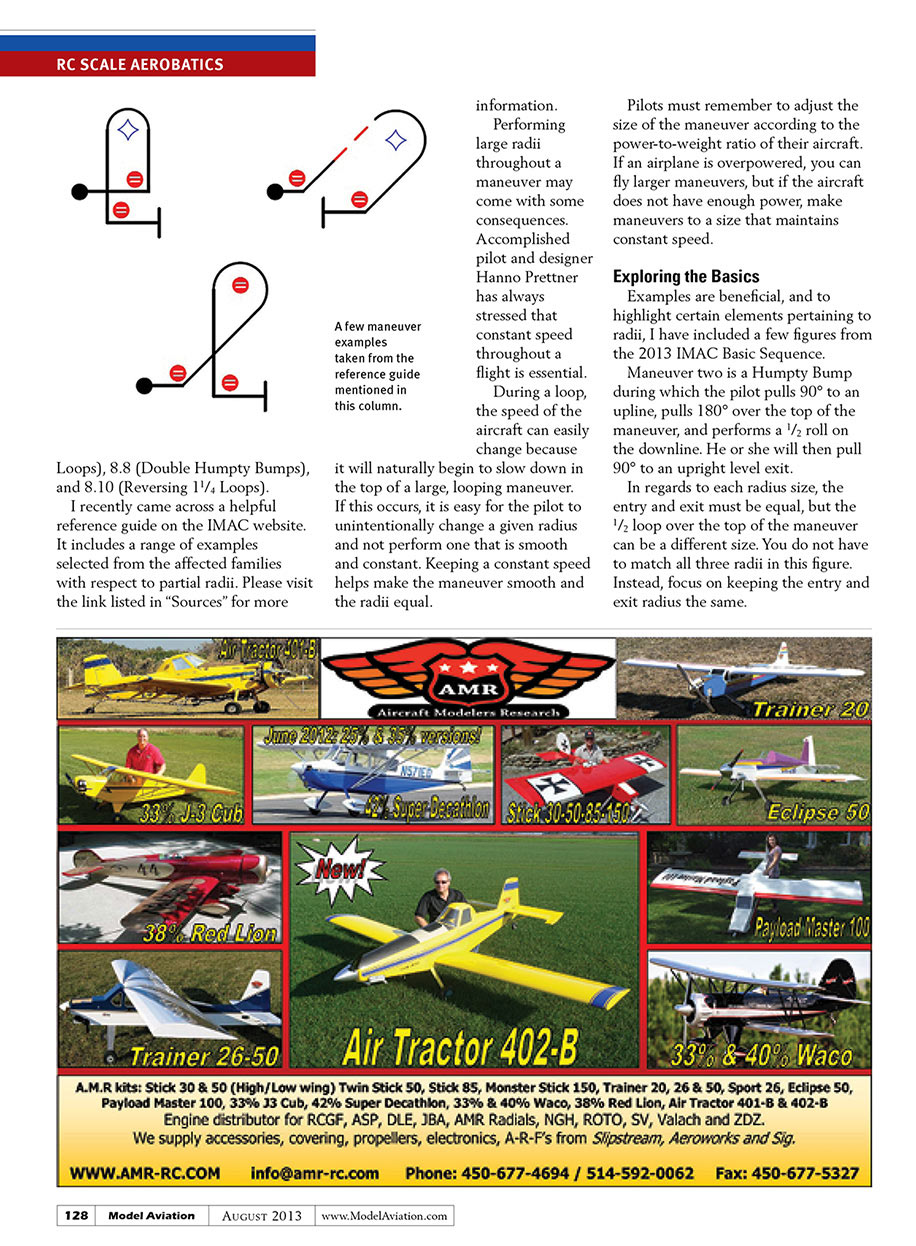
Although it may be obvious that a loop has a constant radius, partial loops of any single figure should have the same radius size except for certain aerobatic families. This is where knowledge of the rulebook becomes valuable.
Partial loops of any particular maneuver should have equal radii except for Family 1 (Lines and Angles), the Family 7 figures 7.3 (3/4 loop may differ from entry and exit), 7.8 (Horizontal 8s and Super 8s: 5/8 and 3/4 loop radii must match, but may be different from entry and exit), and Family 8 figures 8.4 (Humpty Bumps), 8.6 (P Loops and Reversing P Loops), 8.7 (Q Loops), 8.8 (Double Humpty Bumps), and 8.10 (Reversing 1¼ Loops).
I recently came across a helpful reference guide on the IMAC website. It includes a range of examples selected from the affected families with respect to partial radii. Please visit the link listed in "Sources" for more information.
Performing large radii throughout a maneuver may come with some consequences. Accomplished pilot and designer Hanno Prettner has always stressed that constant speed throughout a flight is essential.
During a loop, the speed of the aircraft can easily change because it will naturally begin to slow down in the top of a large, looping maneuver. If this occurs, it is easy for the pilot to unintentionally change a given radius and not perform one that is smooth and constant. Keeping a constant speed helps make the maneuver smooth and the radii equal.
Pilots must remember to adjust the size of the maneuver according to the power-to-weight ratio of their aircraft. If an airplane is overpowered, you can fly larger maneuvers, but if the aircraft does not have enough power, make maneuvers to a size that maintains constant speed.
Exploring the Basics
Examples are beneficial, and to highlight certain elements pertaining to radii, I have included a few figures from the 2013 IMAC Basic Sequence.
Maneuver two is a Humpty Bump during which the pilot pulls 90° to an upline, pulls 180° over the top of the maneuver, and performs a 1/2 roll on the downline. He or she will then pull 90° to an upright level exit.
In regards to each radius size, the entry and exit must be equal, but the 1/2 loop over the top of the maneuver can be a different size. You do not have to match all three radii in this figure. Instead, focus on keeping the entry and exit radius the same.
Transcribed from original scans by AI. Minor OCR errors may remain.

