
2012 Schedules Released
by John Glezellis [email protected]
As I write this column, the 2012 International Miniature Aerobatic Club (IMAC) schedules have recently been released. Although each of the five IMAC classes—Basic, Sportsman, Intermediate, Advanced, and Unlimited—contains ten maneuvers, each class differs greatly in complexity.
In the Basic routine there is a Hammerhead. Unlimited also contains a Hammerhead, but instead of performing this maneuver with nothing on the upline or downline, the pilot is to enter inverted and perform one-and-a-half negative snaps followed by a half roll in the opposite direction on the upward segment of the Hammerhead. Then, on the downline, a four-point roll must be executed before pushing to an inverted exit. What began as a basic maneuver can become tedious to perform!
Because these programs change on a yearly basis, I’d like to dedicate this column to learning a new sequence. As described in the Hammerhead example, elements can become difficult to remember, especially when ten maneuvers must be performed in a specific order.
In the past I have discussed the importance of having a caller—someone who will read off each individual maneuver to you throughout the course of a flight. This is great and certainly needed for a competition flight, but it is sometimes not possible if you are practicing alone.
I will discuss the methods I use, as well as a few practices other pilots have used. Now, let’s begin!
The Right Sequence for You
If you haven't already, visit the official IMAC website (listed in Sources) and print off your schedule.
If you are just getting started, I advise you to begin with the Basic routine.
Flying competition aerobatics requires time and dedication. I’ve dedicated a large portion of my life to flying, beginning with competing in Precision Aerobatics at age 11 and in Scale Aerobatics at age 14. I am 27 years old.
Even if you are a skilled pilot and can perform maneuvers from the Intermediate routine, for example, start from the beginning and work your way up. Important fundamentals are learned from competition.
Before I began competing in IMAC, I had a background in Precision Aerobatics and was actually in the Masters class; however, I still started off in the Sportsman class in IMAC. Take your time and never rush out of any class. Learning each fundamental is critical to ensuring future success.
Now, let’s see how your memorization skills stack up!
Memorization
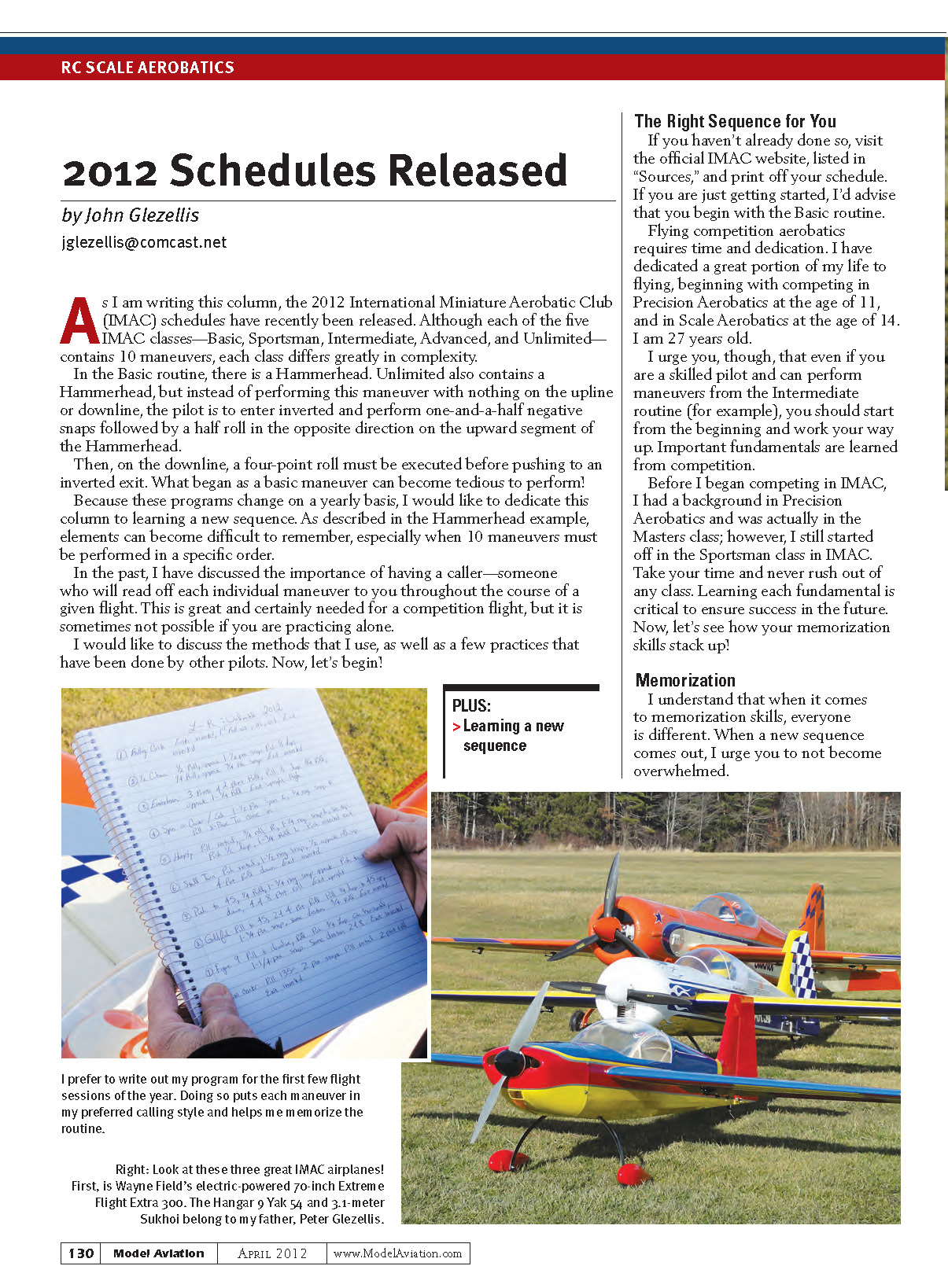
I understand that when it comes to memorization, everyone is different. When a new sequence comes out, don’t become overwhelmed. Bring a copy of the Aresti diagrams for your class, as well as a written description of the sequence so a fellow club member can read your sequence for you while you are flying. Even if you are familiar with Aresti, not everyone is.
To help you out, download the IMAC Lite application for your smartphone. This application contains a lot of useful information regarding sequences and even includes a written description of the sequence. Check it out for iPhone, iPad, or Android devices.
After you look at the application, compare the Aresti sequence with the written description and familiarize yourself with each symbol. Learning Aresti takes time, but having a text description and an actual Aresti sequence to compare it with will help you greatly, especially if you are just starting out.
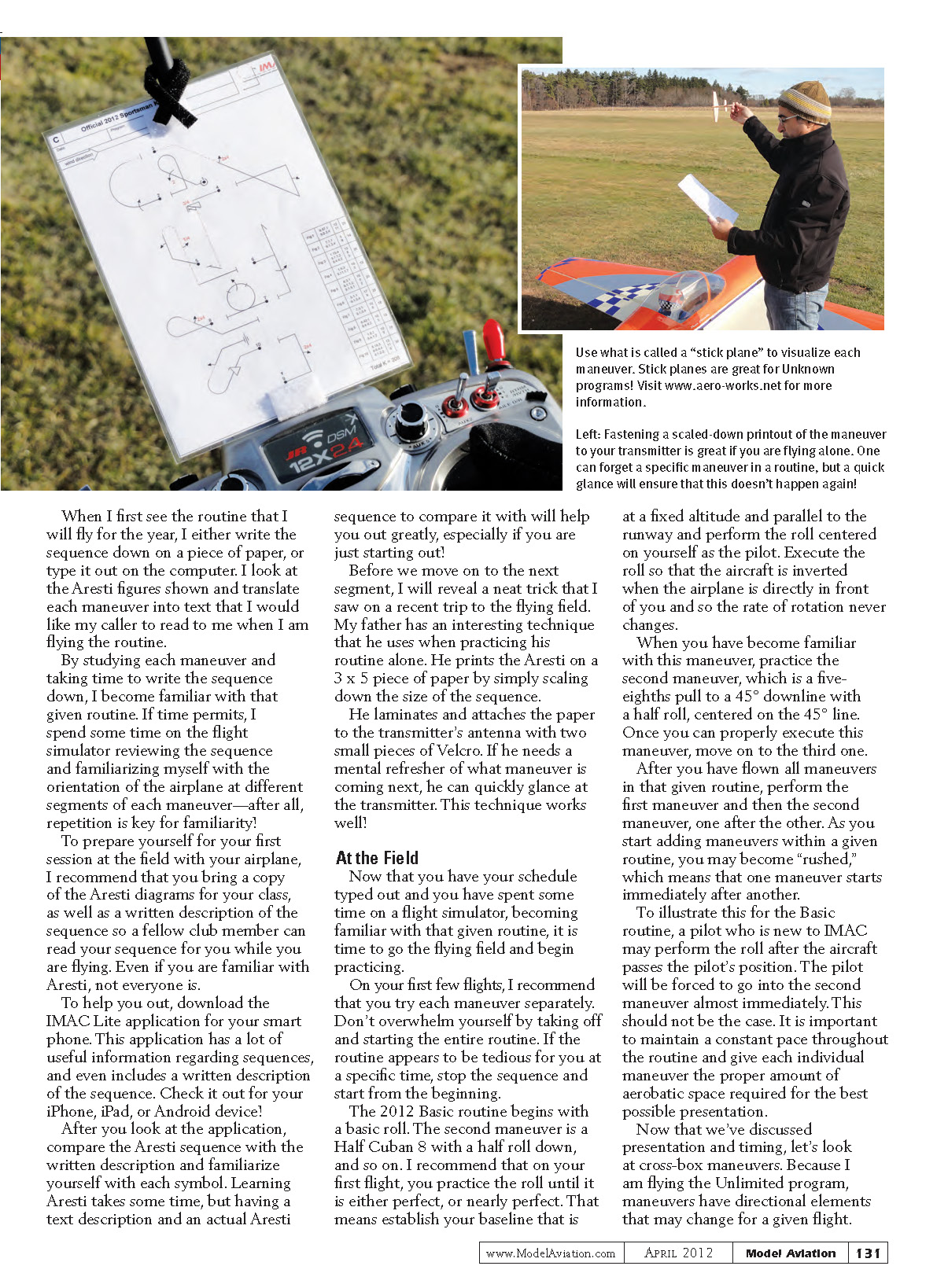
Here’s a neat trick I saw on a recent trip to the flying field. My father prints the Aresti on a 3 x 5 piece of paper by scaling down the size of the sequence. He laminates and attaches the paper to the transmitter’s antenna with two small pieces of Velcro. If he needs a mental refresher of what maneuver is coming next, he can quickly glance at the transmitter. This technique works well!
At the Field
Now that you have your schedule typed out and you have spent some time on a flight simulator becoming familiar with the routine, it is time to go to the flying field and begin practicing.
On your first few flights, try each maneuver separately. Don’t overwhelm yourself by taking off and starting the entire routine. If the routine becomes tedious at any point, stop the sequence and start from the beginning.
The 2012 Basic routine begins with a basic roll. The second maneuver is a Half Cuban 8 with a half roll down, and so on. On your first flight, practice the roll until it is either perfect or nearly perfect. Establish your baseline at a fixed altitude parallel to the runway and perform the roll centered on yourself as the pilot. Execute the roll so the aircraft is inverted when it is directly in front of you and so the rate of rotation does not change.
When you are comfortable with that maneuver, practice the second: a five-eighths pull to a 45° downline with a half roll, centered on the 45° line. Once you can properly execute this maneuver, move on to the third.
After you have flown all maneuvers in the routine separately, practice the first and second maneuvers back-to-back. As you add maneuvers within a routine, you may become “rushed,” which means one maneuver starts immediately after another.
For example, in the Basic routine a new IMAC pilot may perform the roll after the aircraft passes the pilot’s position and then immediately be forced into the second maneuver. That should not be the case. Maintain a constant pace throughout the routine and give each maneuver the proper amount of aerobatic space required for the best possible presentation.
Now let’s look at cross-box maneuvers. In the Unlimited program, maneuvers can have directional elements that change for a given flight.
I like to maintain cross-box references by selecting a small dot or crack on the runway and fixating on it as my reference point. When performing cross-box maneuvers, orienting the aircraft relative to the pilot becomes critical. During the roll, ensure the aircraft is centered on the pilot when it is in front of you. It is easy to get disoriented and drift left or right, which will cost you points. Always rehearse slow rolls with a reference on the ground.
For example, Maneuver 4 from the Unlimited program is a one-and-a-half-turn positive spin followed by a three-fourths negative snap with a pull to an upright cross-box exit. If the spin is performed in one direction, the snap will be in that direction and will determine whether the airplane will be coming in toward the pilot or traveling away from the pilot. This is what is considered a “cross-box” maneuver: the airplane will be traveling on the Z-axis rather than the traditional X- and Y-axes.
If an incoming crosswind exists, perform the maneuver so it exits traveling away from the pilot and into the wind. If the airplane exits coming in, the wind will push the airplane closer to the pilot, and you will be rushed to perform the next maneuver.
Closing Thoughts
I’ve shared a few tips that should help you memorize your new routine. If you have aerobatic competition fever, I hope you take and apply some of these key fundamentals.
Spend time looking at the sequence from both directions and examine any cross-box elements. The Basic class does not contain cross-box components and is the ideal introductory class to basic aerobatics. It is important to be able to perform your sequence in all types of winds.
As mentioned earlier, many beginners have difficulty reading Aresti symbols. Over the years I have written a few columns discussing full routines or individual maneuvers and what each symbol means.
If you are looking at a particular symbol or figure and still have difficulty even after using the IMAC Lite application, post a question on the IMAC website under the Forums section or write to me.
Until next time, fly hard!
SOURCES
- IMAC — www.mini-iac.com
- Aeroworks — (303) 371-4222 — www.aero-works.net
- Android — www.android.com
- Apple — www.apple.com
- Extreme Flight RC — (770) 887-1794 — www.extremeflightrc.com
- Hangar 9 / Horizon Hobby — (800) 338-4639 — www.horizonhobby.com
- Velcro — (800) 225-0180 — www.velcro.com
Transcribed from original scans by AI. Minor OCR errors may remain.

