
Properly mixing control surfaces
by John Glezellis [email protected]
Aerobatic competition is no different from any other competitive sport. Points and separation between competitors can be minimal at times, and the pilots strive to have an advantage over the others.
Although some feel that finding the perfect airplane is the solution, experienced pilots know that the difference lies within the aircraft's setup. Taking time to properly trim an airplane will decrease the pilot's workload so he or she can focus on perfecting any given sequence. After all, it is difficult to find an airplane that is neutral in all aspects and doesn't exhibit some type of undesired tendency!
When rolled into knife-edge flight, for example, an airplane sometimes rolls one direction or another, and/or will pitch to the undercarriage. Typically, aircraft roll the same direction as the provided rudder and exhibit what is called proverse roll. If the airplane rolls in the opposite direction, it is showing adverse-roll coupling.
Because many sequences incorporate hesitation rolls, this can be a problem for an aerobatic pilot. If he or she has to constantly hold various corrections to keep the aircraft tracking straight, there is more room for error.
I will discuss the mixing of two control surfaces to correct the aforementioned tendencies. In addition to an overview, I will describe the process of testing for and implementing it, allowing the aerobatic newcomer to focus on climbing his or her way up the competition ladder!
Let's begin!
An Overview of Common Mixing
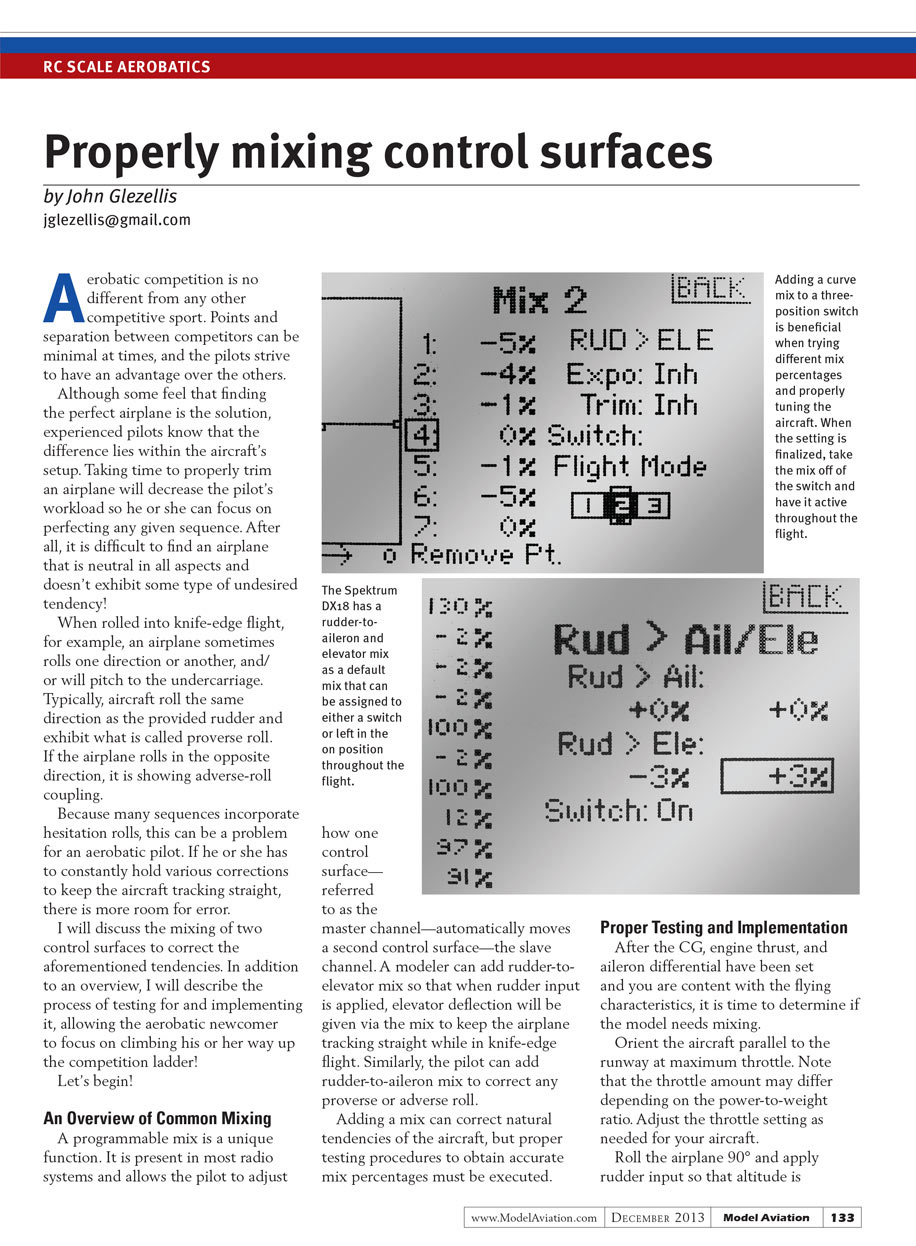
A programmable mix is a unique function. It is present in most radio systems and allows the pilot to adjust how one control surface—referred to as the master channel—automatically moves a second control surface—the slave channel. A modeler can add rudder-to-elevator mix so that when rudder input is applied, elevator deflection will be given via the mix to keep the airplane tracking straight while in knife-edge flight. Similarly, the pilot can add rudder-to-aileron mix to correct any proverse or adverse roll.
Adding a mix can correct natural tendencies of the aircraft, but proper testing procedures to obtain accurate mix percentages must be executed.
Proper Testing and Implementation
After the CG, engine thrust, and aileron differential have been set and you are content with the flying characteristics, it is time to determine if the model needs mixing.
Orient the aircraft parallel to the runway at maximum throttle. Note that the throttle amount may differ depending on the power-to-weight ratio. Adjust the throttle setting as needed for your aircraft.
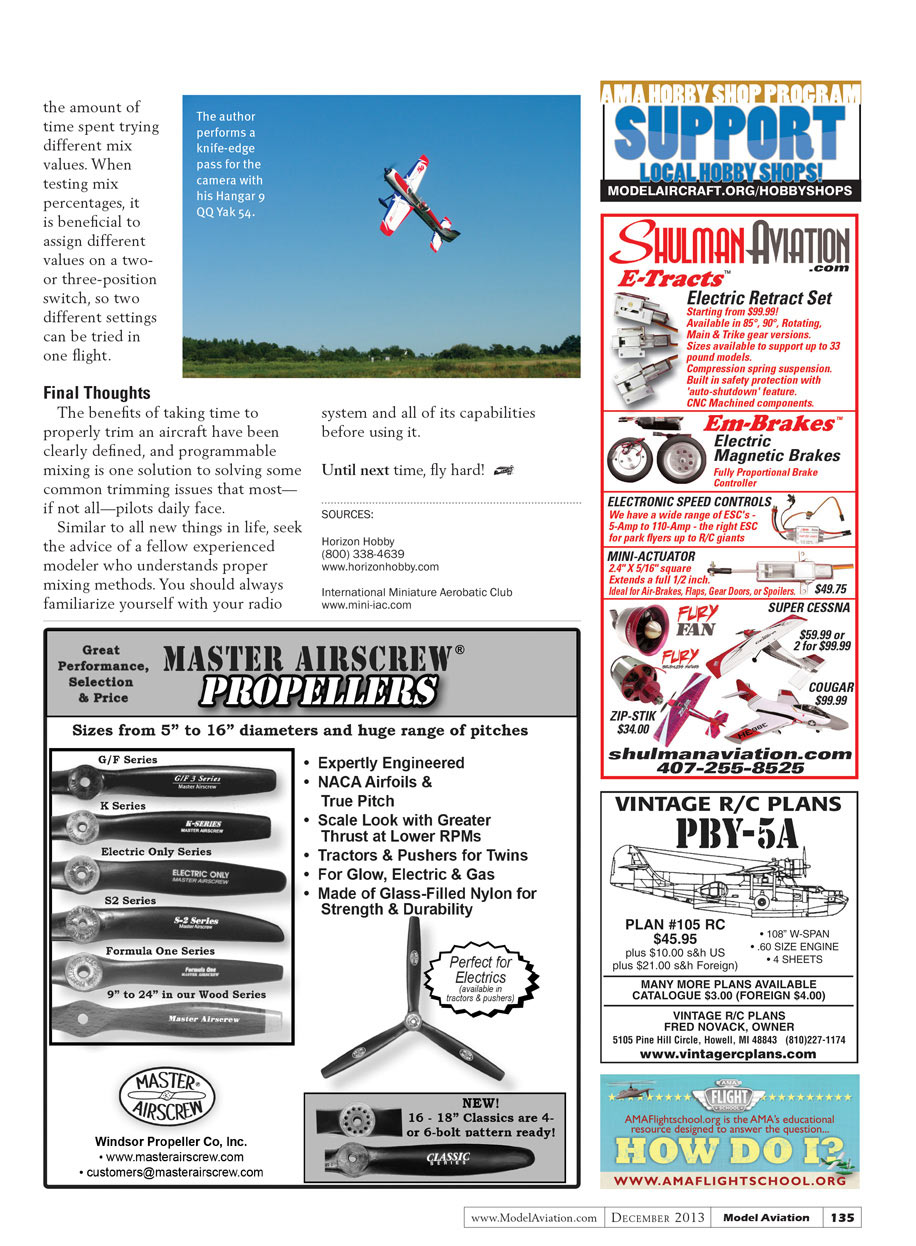
Roll the airplane 90° and apply rudder input so that altitude is sustained. Notice how the aircraft is tracking. If it pitches to the undercarriage and/or rolls while you are trying to keep it in knife-edge, mixing is needed.
Throughout this process, fly a few passes parallel to the runway and verify that the results are consistent. Make sure that the knife-edge pass was properly entered. (Be sure that no excessive elevator inputs were applied, causing the aircraft to veer off — this is seen while the rudder is at full deflection.)
Depending on the speed of the aircraft and how much rudder is used, the percentage needed for knife-edge may have a negative impact when the pilot uses more rudder deflection to perform a stall turn.
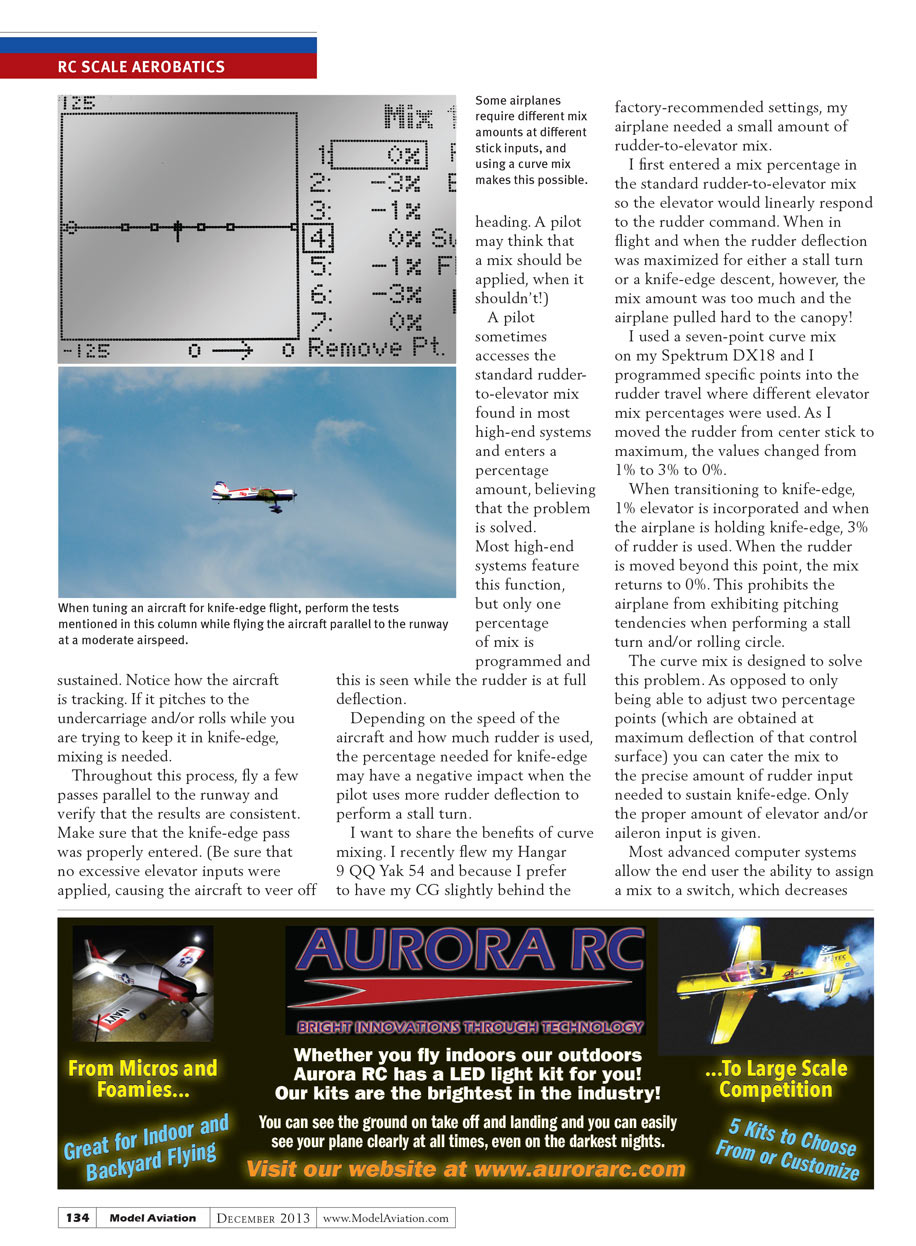
I want to share the benefits of curve mixing. I recently flew my Hangar 9 QQ Yak 54 and because I prefer to have my CG slightly behind the factory-recommended settings, my airplane needed a small amount of rudder-to-elevator mix.
I first entered a mix percentage in the standard rudder-to-elevator mix so the elevator would linearly respond to the rudder command. When in flight and when the rudder deflection was maximized for either a stall turn or a knife-edge descent, however, the mix amount was too much and the airplane pulled hard to the canopy!
I used a seven-point curve mix on my Spektrum DX18 and I programmed specific points into the rudder travel where different elevator mix percentages were used. As I moved the rudder from center stick to maximum, the values changed from 1% to 3% to 0%.
When transitioning to knife-edge, 1% elevator is incorporated and when the airplane is holding knife-edge, 3% of rudder is used. When the rudder is moved beyond this point, the mix returns to 0%. This prohibits the airplane from exhibiting pitching tendencies when performing a stall turn and/or rolling circle.
The curve mix is designed to solve this problem. As opposed to only being able to adjust two percentage points (which are obtained at maximum deflection of that control surface) you can cater the mix to the precise amount of rudder input needed to sustain knife-edge. Only the proper amount of elevator and/or aileron input is given.
Most advanced computer systems allow the end user the ability to assign a mix to a switch, which decreases
Final Thoughts
The benefits of taking time to properly trim an aircraft have been clearly defined, and programmable mixing is one solution to solving some common trimming issues that most—if not all—pilots daily face.
Similar to all new things in life, seek the advice of a fellow experienced modeler who understands proper mixing methods. You should always familiarize yourself with your radio system and all of its capabilities before using it.
Until next time, fly hard!
SOURCES:
Horizon Hobby (800) 338-4639 www.horizonhobby.com
International Miniature Aerobatic Club www.mini-iac.org
Transcribed from original scans by AI. Minor OCR errors may remain.

