
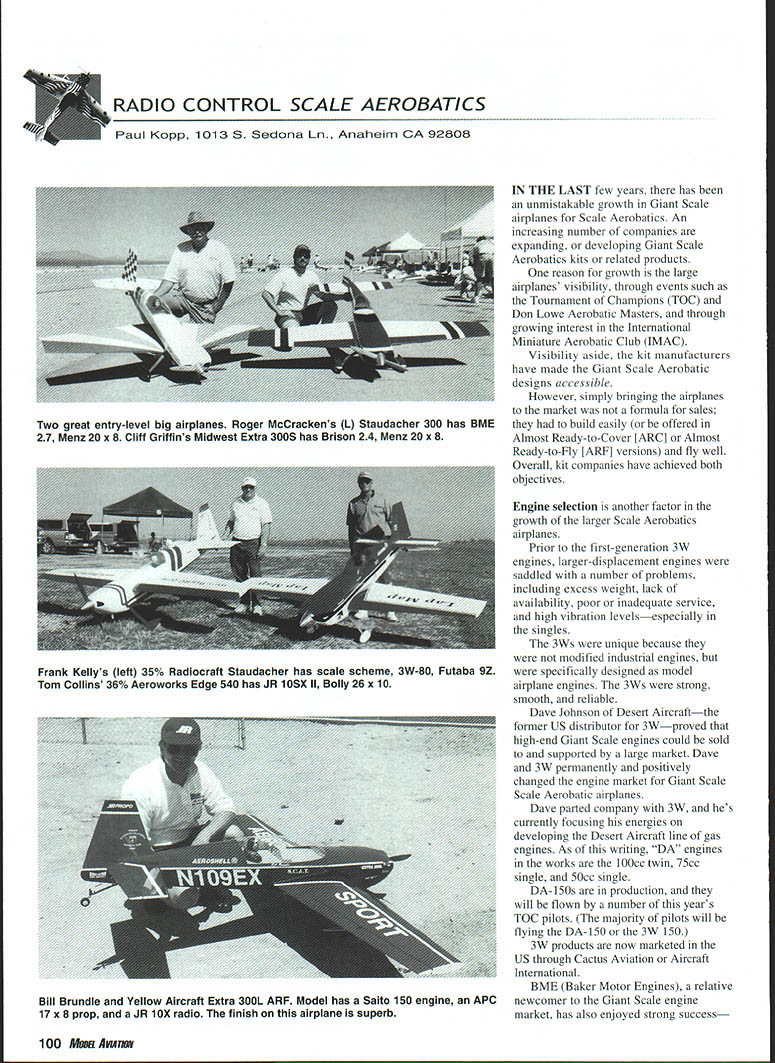
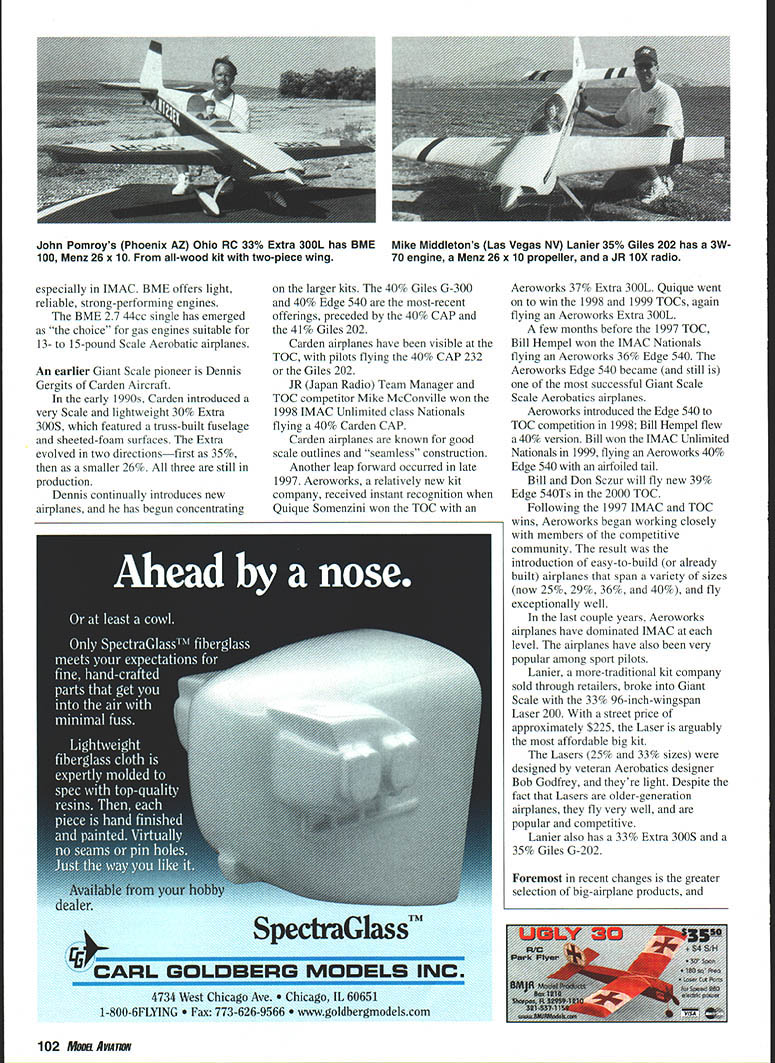
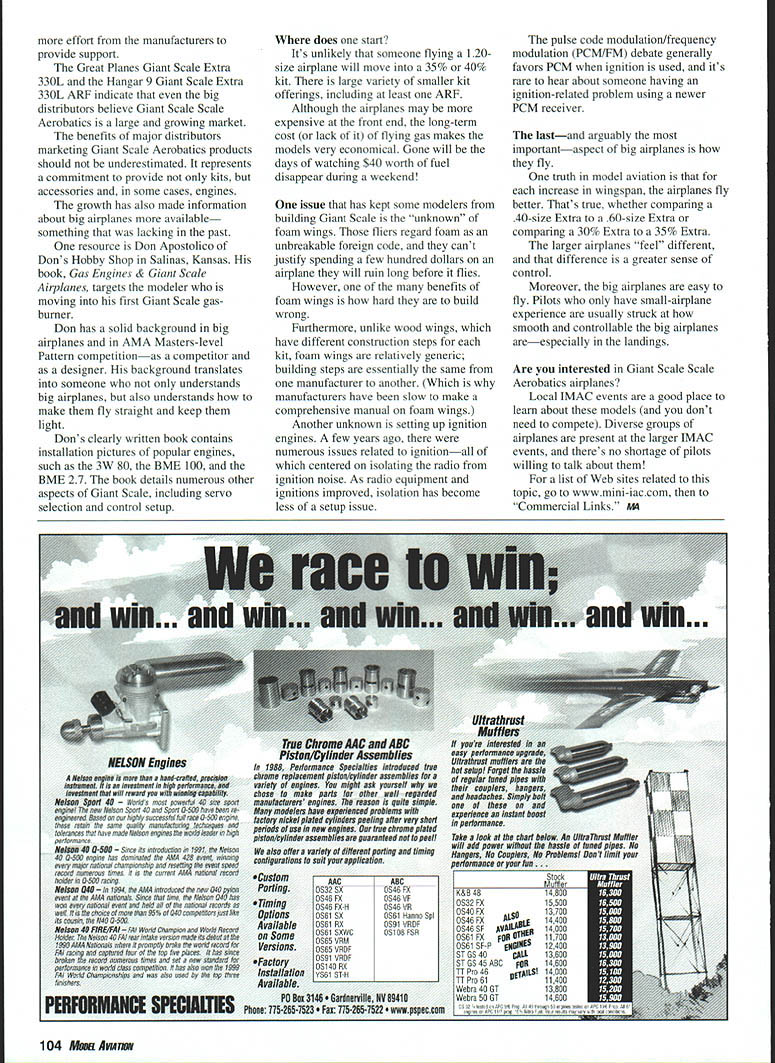
RC Scale Aerobatics
IN THE LAST few years, there has been an unmistakable growth in giant-scale airplanes for scale aerobatics. An increasing number of companies are expanding, or developing, giant-scale aerobatics kits and related products.
One reason for growth is the large airplanes' visibility through events such as the Tournament of Champions (TOC) and Don Lowe Aerobatic Masters, and through growing interest in the International Miniature Aerobatic Club (IMAC).
Visibility aside, kit manufacturers have made giant-scale aerobatic designs accessible. However, simply bringing the airplanes to market was not a formula for sales; they had to build easily (or be offered in Almost Ready-to-Cover [ARC] or Almost Ready-to-Fly [ARF] versions) and fly well. Overall, kit companies have achieved both objectives.
Engines and Powerplants
Engine selection is another factor in the growth of larger scale aerobatic airplanes.
Prior to the first-generation 3W engines, larger-displacement engines were saddled with a number of problems, including excess weight, lack of availability, poor or inadequate service, and high vibration levels—especially in single-cylinder engines.
The 3Ws were unique because they were not modified industrial engines, but were specifically designed as model airplane engines. The 3Ws were strong, smooth, and reliable.
Dave Johnson of Desert Aircraft—the former US distributor for 3W—proved that high-end giant-scale engines could be sold to and supported by a large market. Dave and 3W permanently and positively changed the engine market for giant-scale aerobatic airplanes.
Dave parted company with 3W and is currently focusing his energies on developing the Desert Aircraft line of gas engines. As of this writing, "DA" engines in the works are the 100cc twin, 75cc single, and 50cc single. DA-150s are in production, and they will be flown by a number of TOC pilots. The majority of pilots will be flying the DA-150 or the 3W 150.
3W products are now marketed in the US through Cactus Aviation or Aircraft International.
BME (Baker Motor Engines), a relative newcomer to the giant-scale engine market, has also enjoyed strong success—especially in IMAC. BME offers light, reliable, strong-performing engines. The BME 2.7 44cc single has emerged as the choice for gas engines suitable for 13- to 15-pound scale aerobatic airplanes.
Manufacturers and Notable Designs
An earlier giant-scale pioneer is Dennis Gergits of Carden Aircraft. In the early 1990s, Carden introduced a very scale and lightweight 30% Extra 300S, which featured a truss-built fuselage and sheeted-foam surfaces. The Extra evolved in two directions—first as 35%, then as a smaller 26%. All three are still in production.
Dennis continually introduces new airplanes and has begun concentrating on larger kits. The 40% Giles G-300 and 40% Edge 540 are the most recent offerings, preceded by the 40% CAP and the 41% Giles 202. Carden airplanes have been visible at the TOC, with pilots flying the 40% CAP 232 or the Giles 202.
JR (Japan Radio) Team Manager and TOC competitor Mike McConville won the 1998 IMAC Unlimited class Nationals flying a 40% Carden CAP. Carden airplanes are known for good scale outlines and "seamless" construction.
Another leap forward occurred in late 1997. Aeroworks, a relatively new kit company, received instant recognition when Quique Somenzi won the TOC with an Aeroworks 37% Extra 300L. Quique went on to win the 1998 and 1999 TOCs, again flying an Aeroworks Extra 300L.
A few months before the 1997 TOC, Bill Hempel won the IMAC Nationals flying an Aeroworks 36% Edge 540. The Aeroworks Edge 540 became (and remains) one of the most successful giant-scale aerobatics airplanes. Aeroworks introduced the Edge 540 to TOC competition in 1998; Bill Hempel flew a 40% version. Bill won the IMAC Unlimited Nationals in 1999, flying an Aeroworks 40% Edge 540 with an airfoiled tail.
Bill and Don Sczur planned to fly new 39% Edge 540Ts in the 2000 TOC.
Following the 1997 IMAC and TOC wins, Aeroworks began working closely with members of the competitive community. The result was the introduction of easy-to-build (or already built) airplanes spanning a variety of sizes (25%, 29%, 36%, and 40%) that fly exceptionally well. In recent years Aeroworks airplanes have dominated IMAC at each level and have been very popular among sport pilots.
Lanier, a more-traditional kit company sold through retailers, broke into giant scale with the 33%-to-96-inch-wingspan Laser 200. With a street price of approximately $225, the Laser is arguably the most affordable big kit. The Lasers (25% and 33% sizes) were designed by veteran aerobatics designer Bob Godfrey, and they're light. Despite being older-generation airplanes, they fly very well and are popular and competitive. Lanier also has a 33% Extra 300S and a 35% Giles G-202.
Foremost in recent changes is the greater selection of big-airplane products and more effort from manufacturers to provide support. The Great Planes Giant Scale Extra 330L and the Hangar 9 Giant Scale Extra 330L ARF indicate that even major distributors believe giant-scale aerobatics is a large and growing market.
The benefits of major distributors marketing giant-scale aerobatics products should not be underestimated: it represents a commitment to provide not only kits, but accessories and, in some cases, engines.
Information and Support
The growth has also made information about big airplanes more available—something that was lacking in the past.
One resource is Don Apostolico of Don’s Hobby Shop in Salinas, Kansas. His book, Gas Engines & Giant Scale Airplanes, targets the modeler who is moving into his first giant-scale gas burner. Don has a solid background in big airplanes and in AMA Masters-level pattern competition—as a competitor and as a designer. His background translates into someone who not only understands big airplanes, but also understands how to make them fly straight and keep them alight.
Don’s clearly written book contains installation pictures of popular engines, such as the 3W 80, the BME 100, and the BME 2.7. The book details numerous other aspects of giant scale, including servo selection and control setup.
Getting Started
Where does one start?
It’s unlikely that someone flying a .40-size airplane will move into a 35% or 40% kit immediately. There is a large variety of smaller kit offerings, including at least one ARF.
Although the airplanes may be more expensive at the front end, the long-term cost of flying gas can be economical. Gone are the days of watching $40 worth of fuel disappear during a weekend!
One issue that has kept some modelers from building giant scale is the “unknown” of foam wings. Those fliers regard foam as an unbreakable foreign code and can’t justify spending a few hundred dollars on an airplane they fear will be ruined long before it flies. However, one of the many benefits of foam wings is how hard they are to build up.
Furthermore, unlike wood wings, which have different construction steps for each kit, foam wings are relatively generic; building steps are essentially the same from one manufacturer to another. This is why manufacturers have been slow to make a comprehensive how-to manual on foam wings.
Another unknown is setting up ignition engines. A few years ago there were numerous issues related to ignition—all of which centered on isolating the radio from ignition noise. As radio equipment and ignitions improved, isolation has become less of a setup issue. The pulse code modulation/frequency modulation (PCM/FM) debate generally favors PCM when ignition is used, and it’s rare to hear about someone having an ignition-related problem using a newer PCM receiver.
How They Fly
The last—and arguably the most important—aspect of big airplanes is how they fly.
One truism in model aviation is that with each increase in wingspan, the airplanes fly better. That’s true whether comparing a .40-size Extra to a .60-size Extra or comparing a 30% Extra to a 35% Extra.
The larger airplanes “feel” different, giving a greater sense of control. Moreover, the big airplanes are easy to fly. Pilots who only have small-airplane experience are usually struck by how smooth and controllable the big airplanes are—especially in the landings.
Where to Learn More
Are you interested in giant-scale aerobatics airplanes?
Local IMAC events are a good place to learn about these models (and you don’t need to compete). Diverse groups of airplanes are present at the larger IMAC events, and there’s no shortage of pilots willing to talk about them.
For a list of websites related to this topic, go to www.mini-iac.com, then to “Commercial Links.”
Transcribed from original scans by AI. Minor OCR errors may remain.

