
Radio Control Scale Aerobatics
Eric Henderson, 303 Shady Ln., Marlton NJ 08053; E-mail: [email protected]
Anyone who has flown Radio Control (RC) Scale Aerobatics is probably used to the tiny size of the chicks we drive and the trailers we tow, but the distances that are driven to the Nationals (Nats) are even more impressive.
It does tend to capture your imagination when you see vehicles from California and Florida side by side.
This was the second year that the Scale Aerobatic Nationals event was held in Muncie IN. Many of the contestants had traveled more than a thousand miles, one way, just to be there.
The reality of Scale Aerobatics is that there is no easy way to put a 40% 3001 in an airline cargo crate, so drive and/or tow they must.
Mark Jorgenson was the event director for the second year running. AMA's Steve Kuluf is the overall Contest Director. Steve, his daughter, and his AMA team once again provided a very well-prepared site.
Mother Nature provided the beautiful weather, with stiff winds and deep blue skies all week.
Special thanks are due AMA for providing large marquees that afforded the shade that was so welcome during the hot Indiana summer days—especially when judging!
Wednesday, July 12—Contest Day Minus One:
In 2000 the contestant turn-out was approximately 40 pilots. The practice day consisted of maybe two or three people, including me.
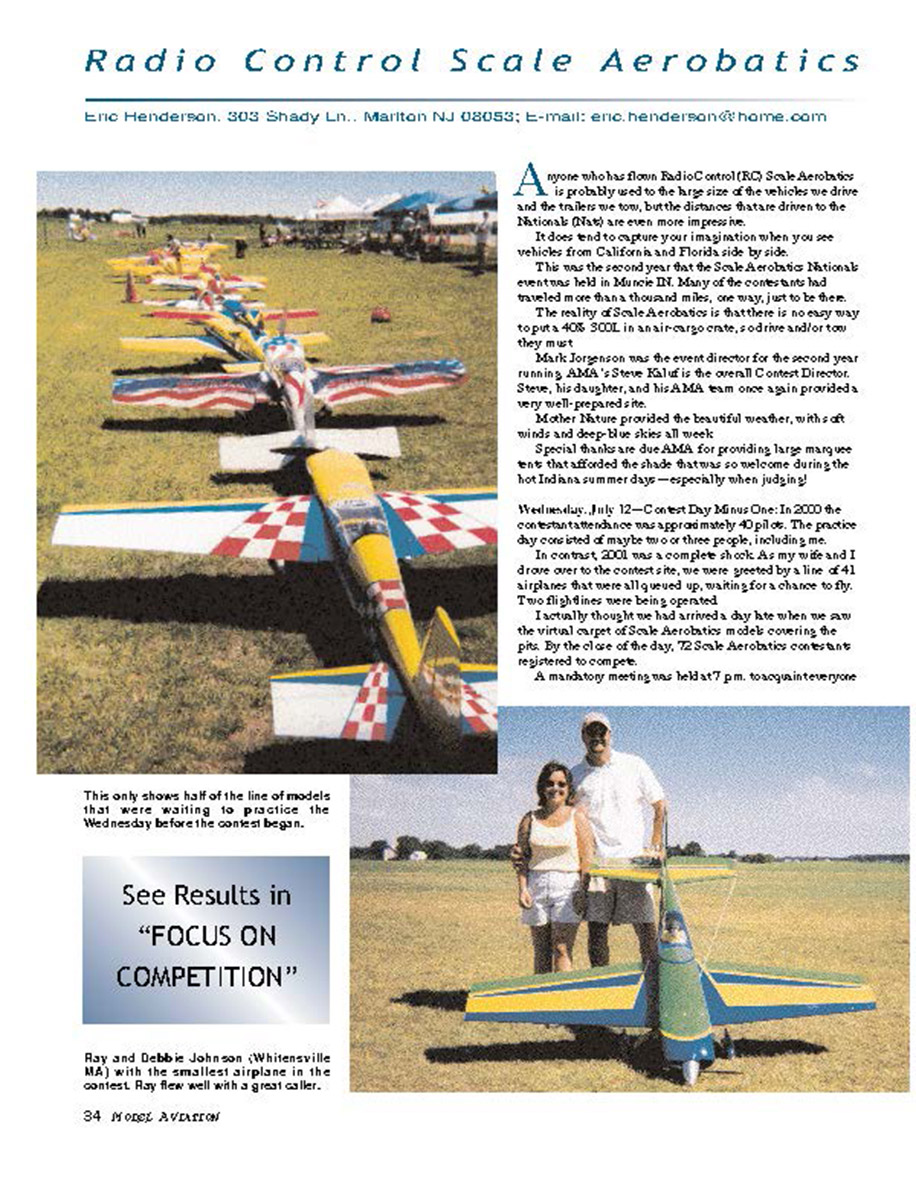
In contrast, 2001 was a complete shock. As my wife and I drove over to the contest site, we were greeted by a line of 41 airplanes that were all queued up, waiting for a chance to fly. Two flight lines were being operated.
I actually thought we had arrived a day late when we saw the virtual carpet of Scale Aerobatics models covering the pits. By the close of the day, 72 Scale Aerobatics contestants had registered to compete.
A mandatory meeting was held at 7 p.m. to acquaint everyone with the new rules and judging guidelines. The gathering was held in a conference room at AMA Headquarters. The new HQ is a first-class facility that can handle large meetings.
Afterward, Mark Jorgenson, his family, the event helpers, and the most necessary scorekeeper—"Bobby"—worked very late into the night to plan and organize how they would pull it all off.
Thursday, July 12—Contest Day One:
Let the games begin. The flying took place at what is commonly known as Site #5, RC Multipurpose.
It has a broad, open vista with a large, short-grassed grass runway and very convenient parking facilities. Three paces took you from your parking spot to your airplane—that is, if you got there early enough.
As early as 6 a.m., the AMA tents that were provided were joined by a huge number of "put-me-up" shades that converted the site into a small International Miniature Aircraft Club (IMAC) village.
Because this was the second consecutive time the event was held at the AMA site, there were a series of reunions.
Soon, classic conversations of aerobatics-data exchange could be heard throughout the campus. Everyone was checking out the latest models, engines, and propellers.
A pilots' meeting was held at 7 a.m. Names were picked from a hat to get the flight orders. Everyone was there, not wanting to miss any details of the contest plan. The organizers chose to have two flight lines, with two very experienced judges per line.
In the morning, the Advanced class was split into halves and all competitors were run by both sets of judges. This gave the pilots two flights in one session.
Scale Aerobatics pilots fly two rounds; one flight for the Known schedules. Neither takeoffs nor landings are scored, and they can even land and refuel between rounds in the same flight.
The Advanced and Sportsman classes flew twice. The Unlimited class flew once, to get the ball rolling. In terms of rounds, that translates into four scored rounds for Advanced and two scored rounds for Unlimited.
There were five Hear 9 330Ls in evidence. I think three made it to their respective Finals.
One crashed because a wing-retaining nut came loose. Please don't use coarse-threaded 1/4-20 butterfly nuts to retain your wings; the engine vibration will always win that battle.
A second airplane went down when a stabilizer came loose. The young pilot walked away from the crash and later watched his father's airplane fly in the Finals. In all, there were very few major crashes. The FAA and AMA safety rules were observed, and the weather was perfect for flying. Our thanks go to the host club and to the many volunteers who made the contest a success.
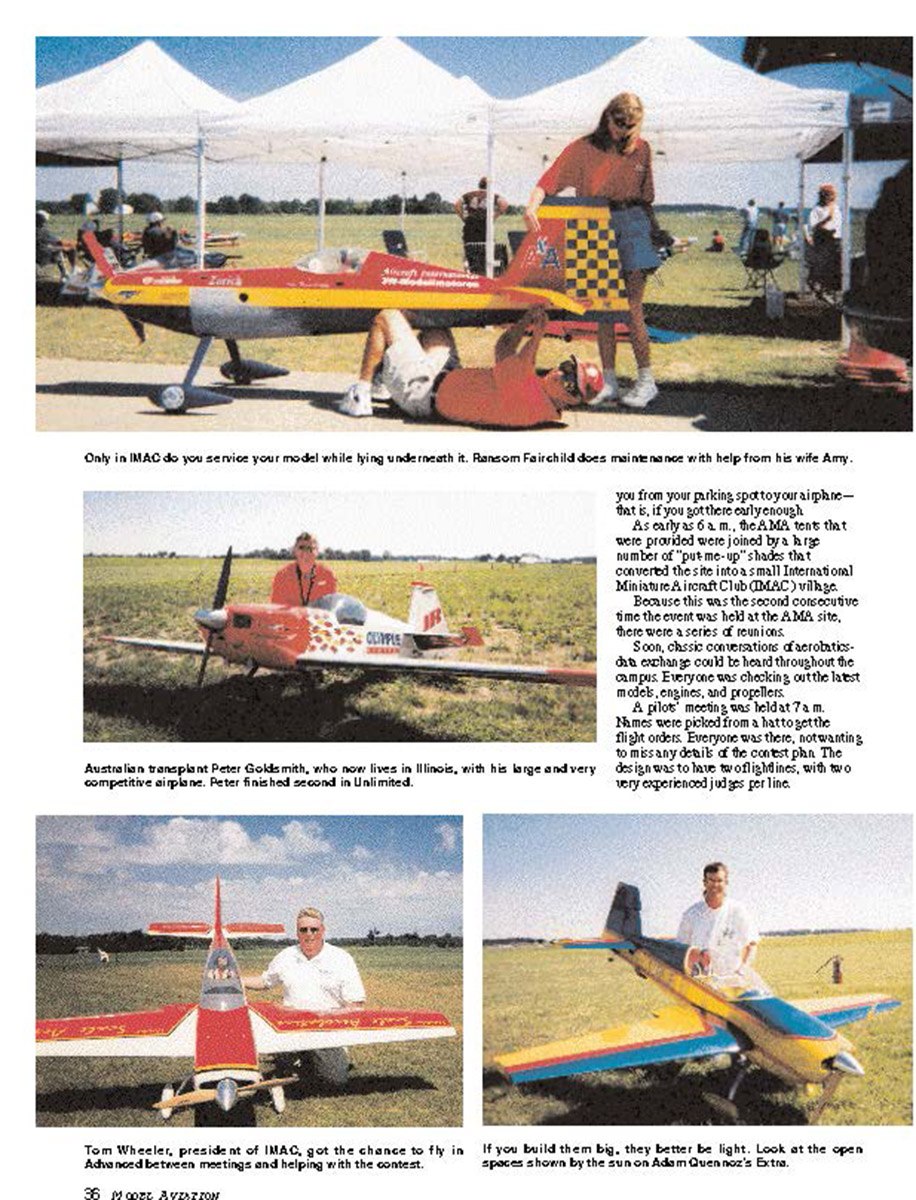
Winners in Unlimited class: Jason Shulman, first; Peter Goldsmith, second; Mike McConville, third; Ryan Taylor, fourth; and George Micks, fifth.
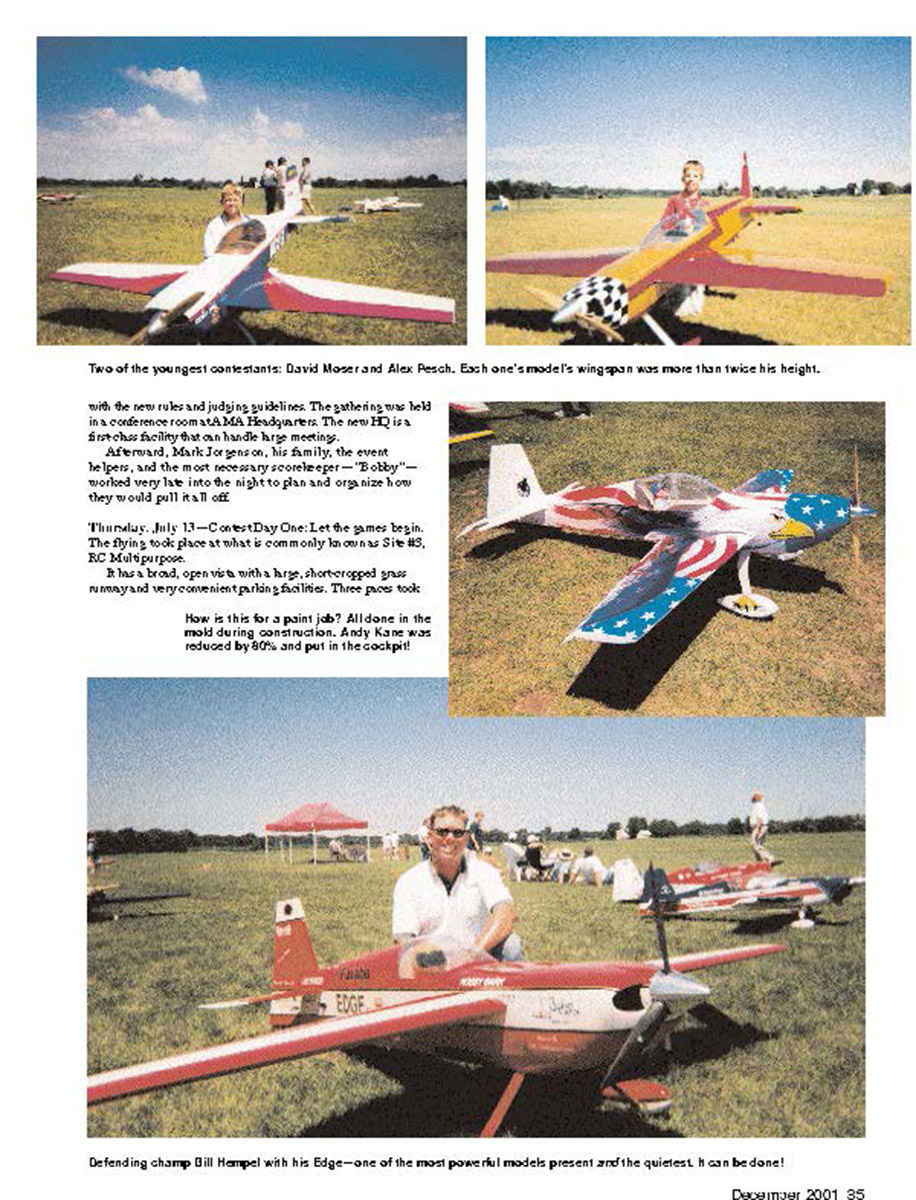
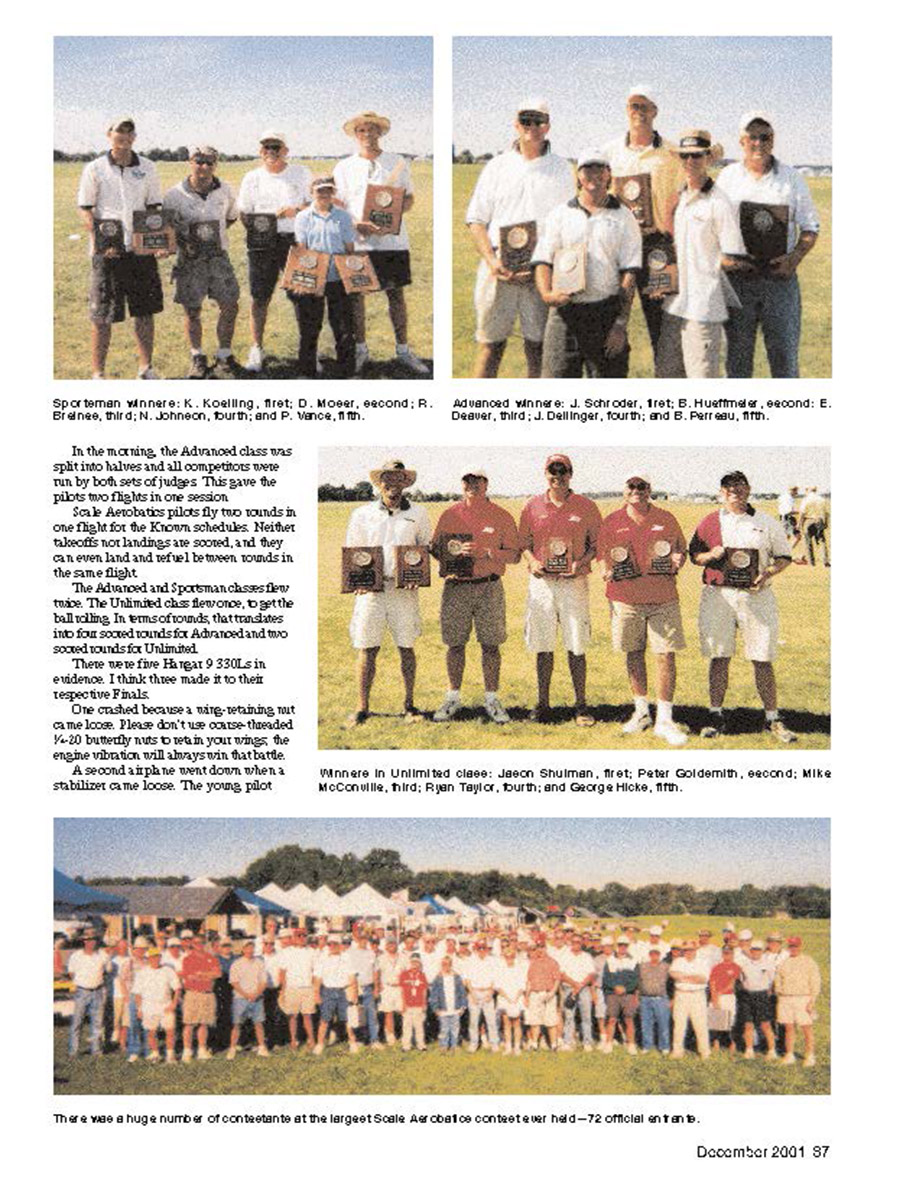
There was a huge number of contestants at the largest Scale Aerobatics contest ever held—72 official entrants.
The airplane was easily repaired with parts from the crashed 330L. I love all these interchangeable parts you get with almost Ready to Flys.
All in all, there was very little carnage and a high quality of flying from all the pilots. It was a truly national-level contest.
Friday, July 14—Contest Day Two:
This was a repeat of the previous day, except that Sportsman and Advanced classes flew once to give Unlimited two flights and the same number of Known rounds as everyone else. Cheryl Jorgenson threw an IMAC barbecue at the Nats HQ farmhouse for all the contestants and workers—as if she needed more work!
Saturday, July 15—Contest Day Three:
This was the first day that an Unknown schedule was flown. Each class flew the Unknown schedule once.
There is a marked difference in the atmosphere when an Unknown is on the flight agenda. The usual high hubbub of conversation is very low. Pilots and callers are waving their stickairplanes in concentrated gestures as they plan their flights.
That night was the IMAC banquet, which was held at the local golf club. This is a fun event, with tributes and a super raffle. The finalists were announced, and the first Unknown schedule was distributed. Sleep waited for some and study for others.
Sunday, July 16—The Finals:
There are many more stories to tell than just who won the contest. There is not enough room to describe all the battles that took place throughout the week.
If you study the scores on the IMAC Web site—www.imacusa.com—you can see much more detail of how it unfolded.
This year there were major changes in the pitching during the Finals, with the exception of winner Jason Shulman and second-place finisher Peter Goldsmith in Unlimited.
Last year the Finals were like adding another round. This year each pilot carried his Preliminary position as a normalized score, then had to fly a Finals Unknown and Known schedule.
The top eight from each class had the chance to see if they could change the outcome of the contest.
Kurt Koelling won the Sportsman class, and John Schroder won Advanced.
Freestyle is separate from the main contest. It is fun while the scores are tabulated for the Finals results. Unlike in the Tournament of Champions, the Freestyle scores are not added to ascertain the final standings.
All pilots are eligible to enter, and most take the opportunity to "stretch their stuff." Music is played, and the contest really becomes a spectator event as the pilots do things with their airplanes that are an insult to gravity.
It is so much fun to watch the pilots let themselves go after flying the disciplines of the Known and Unknown schedules.
A large crowd settled in to be entertained, and they were not disappointed. Steve Kaulf ran the sound system and initiated the three-minute countdowns on the commands of the pilot or caller.
However, music is not always played. A sound effect of an airplane taking off, followed by an antimatter gun, allowed Jason Shulman to show how a "diving-swan" or "clay-pigeon" Snap Roll could be choreographed into his takeoff routine.
In Mike McConville's routine, his model released the longest streamer I have ever seen toward an airplane. You have not seen smoke until you see a big twin using both exhausts to generate it.
There was clapping, hooting, and cheering as each pilot showed his stuff. Johnny Glezlinski made his model move to the music in such a way that you easily forgot an RC pilot was flying the airplane.
Peter Goldsmith made his model dance a slow Scottish Reel to the moving strains of the bagpipes playing, anyway you say it. Even the hearts of those who were more noticeable in origin could not help but be stirred.
When all the dust had settled, there was a new National Champion: Peter Goldsmith on the Freestyle, with style.
Then we all shook hands, packed our models into the big old airplane-movers, and vowed to be there again next year. It had been the biggest contest ever held for Scale Aerobatics—definitely one to remember.
Footnote: If you look at all of the contestants, particularly the winners, you can see that they come from parts of America with wide-open spaces—places where noise limits are not usually an issue. For the rest of us, and for the Nationals, it is an issue of major concern that needs to be urgently addressed.
The only negative issue that came up during the contest was the high noise levels of most of the airplanes. AMA-site and practice-site noise complaints cannot be ignored.
Scale Aerobatics airplanes use large gas engines—singles and twins of very powerful proportions. These airplanes, and the pilots, use large amounts of airspace.
On behalf of RC pilots, I urge the IMAC organization to take a strong position on noise immediately and to initiate constructive days of decibel awareness. Follow that closely with an emergency AMA rules proposal to change the rule book accordingly.
Let's close this door before the horse runs amok in the countryside and the towns wake to the noise and complain to the authorities.
The top fliers showed us that the models can be made quiet and still deliver tons of power.
I hope I can also encourage the engine and muffler manufacturers to make good silencing systems readily available. Scale Aerobatics does need scale sound effects!
Transcribed from original scans by AI. Minor OCR errors may remain.

