
Radio Control Slope Soaring
Dave Garwood [[email protected]]
Sample the delights of flying in small air
Grab an Eagles CD (or download some music) so you can hear "Peaceful, Easy Feeling" and "Take It Easy" while you read this column. I have "Eagles: Greatest Hits" spinning as I write this, and the music brings to mind some excellent, memorable, low-intensity flying sessions I have had with old flying buddies (OFBs) through the years.
I like adrenaline flying as much as the next pilot — what could be more fun than man-on-man Slope Racing, Slope Scale parties with fiberglass warbird half pipes, and fast turns on the backside? But there's another facet to Slope Soaring that is so quiet and peaceful that you might miss out on it if you're not open to it. And you don't want to miss it.
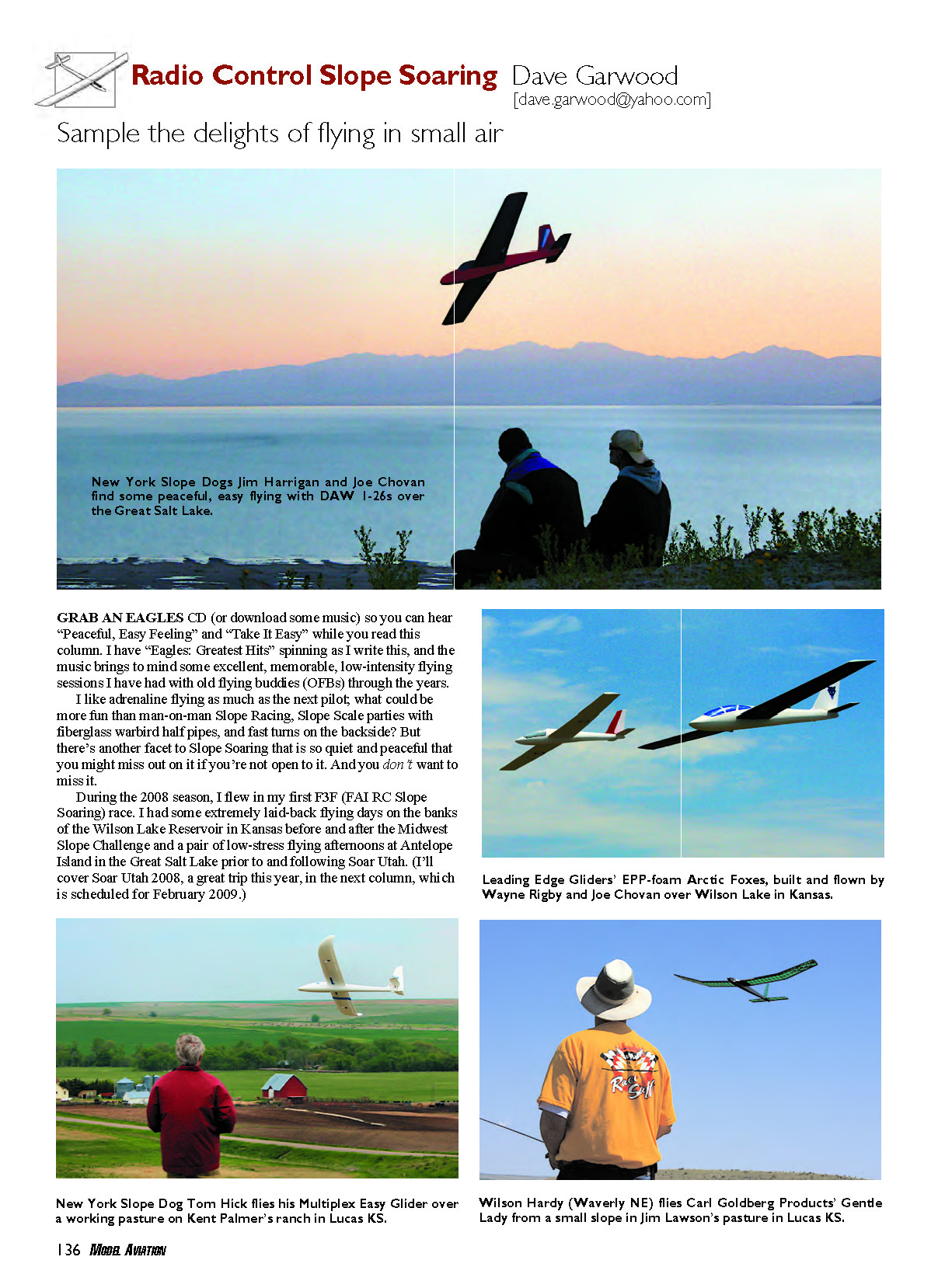
During the 2008 season, I flew in my first F3F (FAI RC Slope Soaring) race. I had some extremely laid-back flying days on the banks of the Wilson Lake Reservoir in Kansas before and after the Midwest Slope Challenge and a pair of low-stress flying afternoons at Antelope Island in the Great Salt Lake prior to and following Soar Utah. (I'll cover Soar Utah 2008, a great trip this year, in the next column, which is scheduled for February 2009.)
So put aside those ideas of going fast and embrace the joys of going slow — often late in the day, and most memorably with other slope pilots who join us in the same mellow groove. Consider the following sentiment written by Jackson Browne and Eagles band member Glenn Frey:
"Take it easy, take it easy Don't let the sound of your own wheels drive you crazy Lighten up while you still can Don't even try to understand Just find a place to make your stand and take it easy."
Mellow flying is something different to try when you're exhausted from fast-and-furious flying or as a destination in itself, when you select a glider and a hill and fly smoothly. In this column, I want to put a slightly different viewpoint in your head and turn you on to a type of flying you may have overlooked — a type that you might not discover on your own. The main thing is not to overlook opportunities to fly in extremely light lift. If I add another arrow to your quiver, I've done my job.
Sailplanes for Small Air
Light airframes and gliders with longer wings and fatter airfoils are best for this job. We will be flying low and slow, and light models work best for this. Any HLG (hand-launched glider) will work, as will a balsa 2-meter glider such as the Carl Goldberg Products Gentle Lady and the Sig Riser. If you have rocks or other rough spots in your landing zone (LZ), consider an EPP-foam glider such as the Leading Edge Gliders scale Fox.
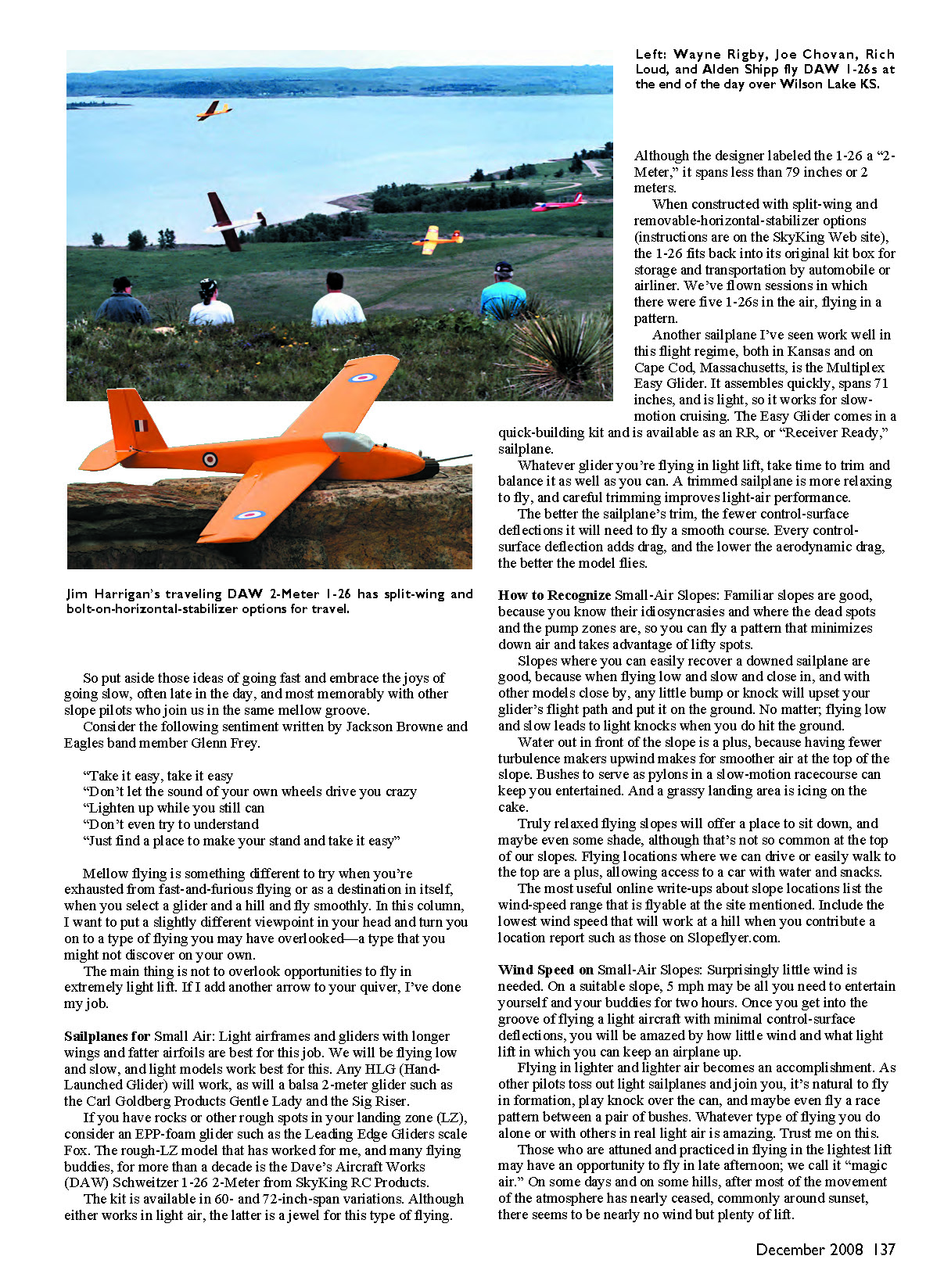
The rough-LZ model that has worked for me, and many flying buddies, for more than a decade is the Dave's Aircraft Works (DAW) Schweitzer 1-26 2-meter from SkyKing RC Products. The kit is available in 60- and 72-inch-span variations. Although either works in light air, the latter is a jewel for this type of flying. Although the designer labeled the 1-26 a "2-meter," it spans less than 79 inches (2 meters). When constructed with split-wing and removable-horizontal-stabilizer options (instructions are on the SkyKing web site), the 1-26 fits back into its original kit box for storage and transportation by automobile or airliner. We've flown sessions in which there were five 1-26s in the air, flying in a pattern.
Another sailplane I've seen work well in this flight regime, both in Kansas and on Cape Cod, Massachusetts, is the Multiplex Easy Glider. It assembles quickly, spans 71 inches, and is light, so it works for slow-motion cruising. The Easy Glider comes in a quick-building kit and is available as an RR, or "receiver ready," sailplane.
Whatever glider you're flying in light lift, take time to trim and balance it as well as you can. A trimmed sailplane is more relaxing to fly, and careful trimming improves light-air performance. The better the sailplane's trim, the fewer control-surface deflections; the better the model flies.
How to Recognize Small-Air Slopes
Familiar slopes are good, because you know their idiosyncrasies and where the dead spots and the pump zones are, so you can fly a pattern that minimizes down air and takes advantage of lofty spots.
Slopes where you can easily recover a downed sailplane are good, because when flying low and slow and close in, and with other models close by, any little bump or knock will upset your glider's flight path and put it on the ground. No matter; flying low and slow leads to light knocks when you do hit the ground.
Water out in front of the slope is a plus, because having fewer turbulence makers upwind makes for smoother air at the top of the slope. Bushes to serve as pylons in a slow-motion racecourse can keep you entertained. And a grassy landing area is icing on the cake.
Truly relaxed flying slopes will offer a place to sit down, and maybe even some shade, although that's not so common at the top of our slopes. Flying locations where we can drive or easily walk to the top are a plus, allowing access to a car with water and snacks.
The most useful online write-ups about slope locations list the wind-speed range that is flyable at the site mentioned. Include the lowest wind speed that will work at a hill when you contribute a location report such as those on Slopeflyer.com.
Wind Speed on Small-Air Slopes
Surprisingly little wind is needed. On a suitable slope, 5 mph may be all you need to entertain yourself and your buddies for two hours. Once you get into the groove of flying a light aircraft with minimal control-surface deflections, you will be amazed by how little wind and what light lift in which you can keep an airplane up.
Flying in lighter and lighter air becomes an accomplishment. As the day heats up, light-slope lift often moves inland and dies, so early mornings, late afternoons, and evenings can be the finest times for light-air flying. On some days and on some hills, after most of the movement of the atmosphere has nearly ceased, commonly around sunset, there seems to be nearly no wind but plenty of lift.
This is uncanny and has to be experienced to be understood. With almost no wind, lift is often possible for light, well-trimmed sailplanes that are flown by pilots who are open to the idea that flying in incredibly light lift can be tons of fun.
OFB Joe Chovan recalled:
"It always seems magic air is 'most magic' in Kansas because the shape of those hills allows a very smooth velocity gradient so when you’re sitting down, you can’t really feel any breeze in the fading light of day.
"However, about 10 feet up, there is some lift, and consequently you hear the air moving over the wings but no wind in your ears. The unpowered plane flies as if by magic. It’s magic air."
"Lighten up while you still can Don't even try to understand Just find a place to make your stand and take it easy."
Find an opportunity to fly in magic air. MA
Sources
- Carl Goldberg Products — (800) 637-7660, www.carlgoldbergproducts.com
- Sig Manufacturing — (641) 623-5154, www.sigmfg.com
- Leading Edge Gliders — (785) 525-6263, www.leadingedgegliders.com
- SkyKing RC Products — (612) 605-1128, http://skykingrcproducts.com
- Multiplex — (858) 748-6948, www.multiplexusa.com
- Slopeflyer.com — www.slopeflyer.com
Transcribed from original scans by AI. Minor OCR errors may remain.

