
An electric power flier tries Slope Soaring
by Dave Garwood Dave.Garwood.<REDACTED>
How would an experienced RC electric power pilot handle Slope Soaring for his or her first time? How long would it take to learn the basics or to fly loops and rolls? Would he or she enjoy the experience? What could that person learn from that experience for the next training day at the slope?
I am fortunate to fly with three generations of aeromodelers—all members of the Electric Powered Aeromodelers club of Scotia, New York. The oldest is Ted Strader, a legendary designer who was also the Flying Models magazine editor in the 1950s. He was inducted into the AMA Model Aviation Hall of Fame this year. His son is Eric Strader, a skilled builder, flier, and all-around good guy. The youngest is 11-year-old Sean Strader, an RC flying wonder, with a pleasing personality, a thirst for knowledge, and a love of model flying.
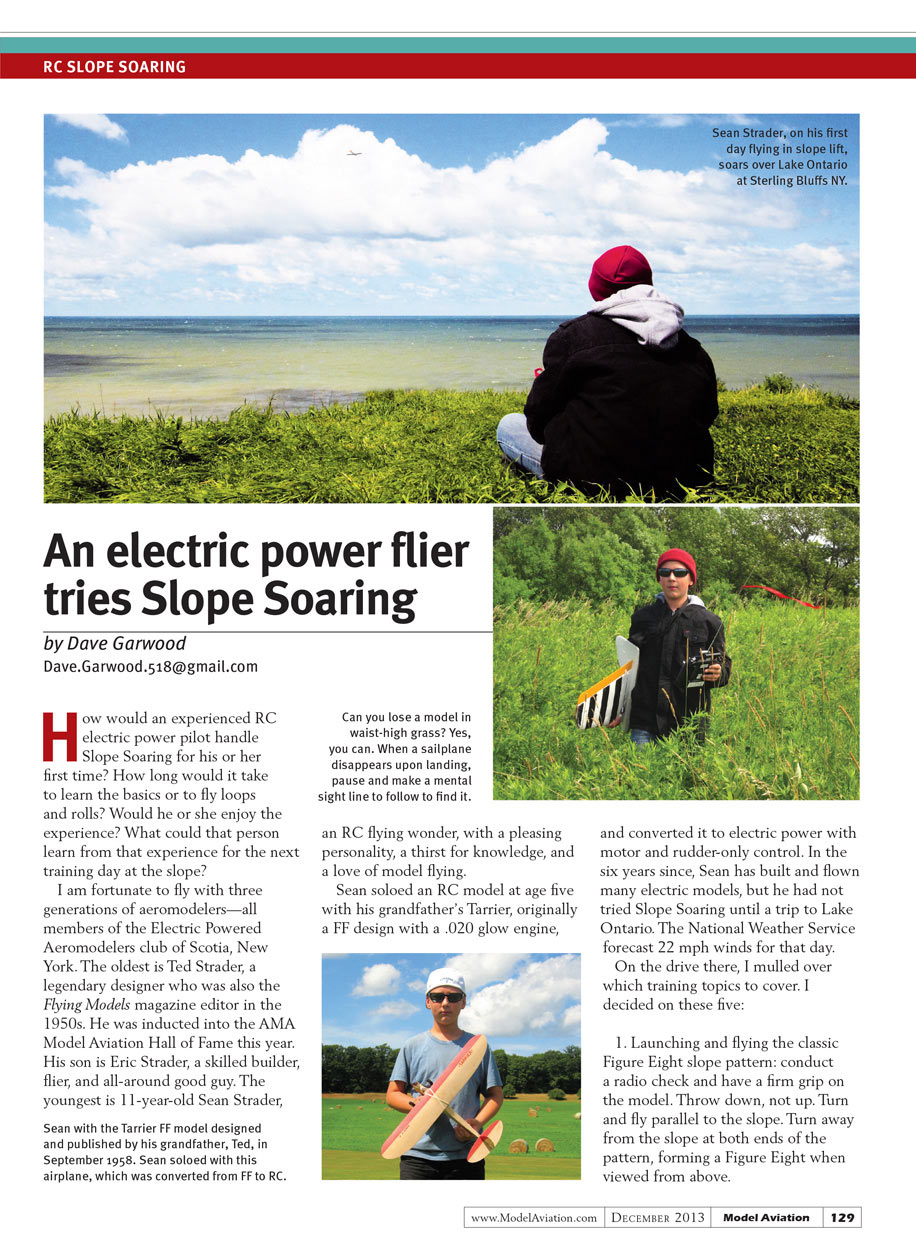
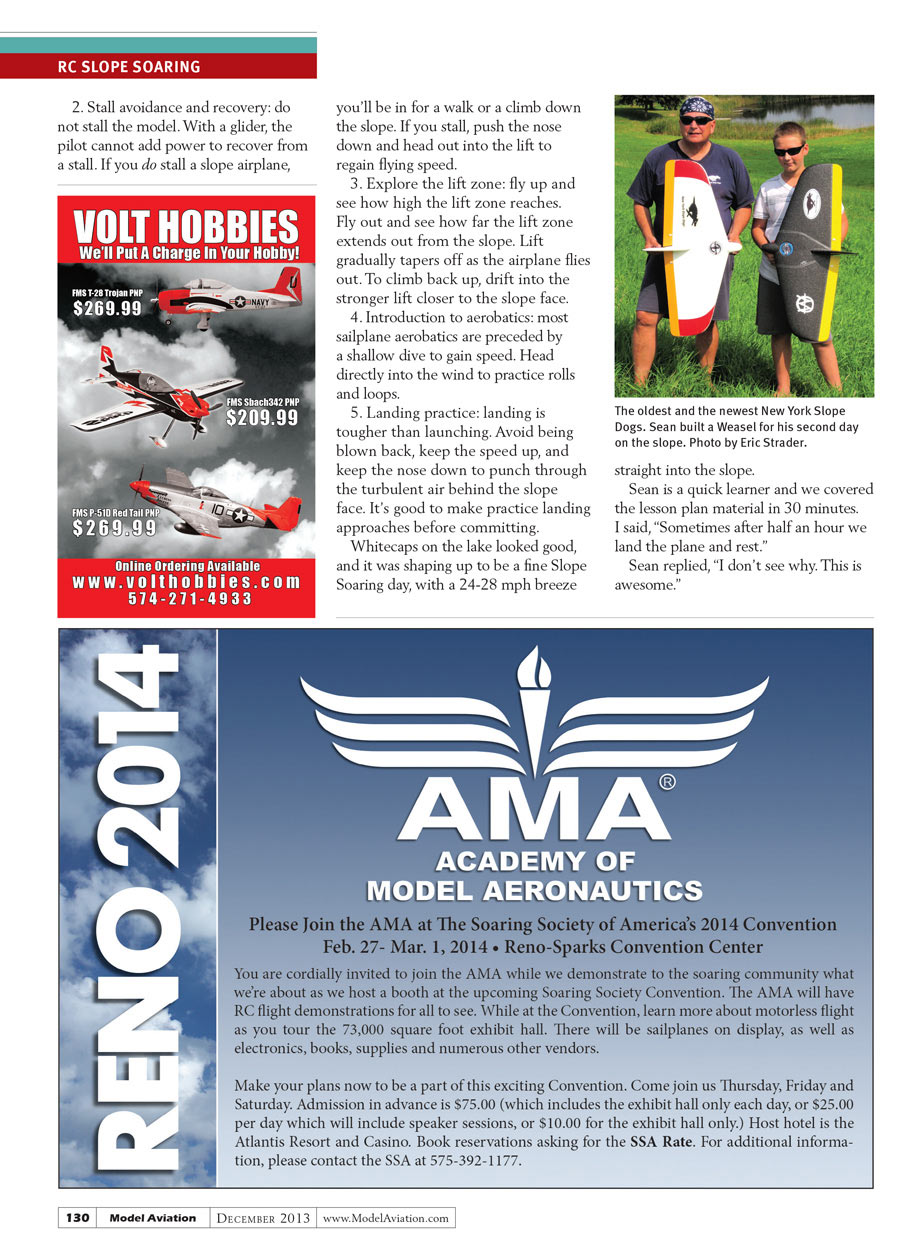
Sean soloed an RC model at age five with his grandfather’s Tarrier, originally a FF design with a .020 glow engine, and converted it to electric power with motor and rudder-only control. In the six years since, Sean has built and flown many electric models, but he had not tried Slope Soaring until a trip to Lake Ontario. The National Weather Service forecast 22 mph winds for that day.
On the drive there, I mulled over which training topics to cover. I decided on these five:
- Launching and flying the classic Figure Eight slope pattern: conduct a radio check and have a firm grip on the model. Throw down, not up. Turn and fly parallel to the slope. Turn away from the slope at both ends of the pattern, forming a Figure Eight when viewed from above.
- Stall avoidance and recovery: do not stall the model. With a glider, the pilot cannot add power to recover from a stall. If you do stall a slope airplane, you'll be in for a walk or a climb down the slope. If you stall, push the nose down and head out into the lift to regain flying speed.
- Explore the lift zone: fly up and see how high the lift zone reaches. Fly out and see how far the lift zone extends out from the slope. Lift gradually tapers off as the airplane flies out. To climb back up, drift into the stronger lift closer to the slope face.
- Introduction to aerobatics: most sailplane aerobatics are preceded by a shallow dive to gain speed. Head directly into the wind to practice rolls and loops.
- Landing practice: landing is tougher than launching. Avoid being blown back, keep the speed up, and keep the nose down to punch through the turbulent air behind the slope face. It's good to make practice landing approaches before committing.
Whitecaps on the lake looked good, and it was shaping up to be a fine Slope Soaring day, with a 24-28 mph breeze straight into the slope.
Sean is a quick learner and we covered the lesson plan material in 30 minutes. I said, "Sometimes after half an hour we land the plane and rest."
Sean replied, "I don't see why. This is awesome."
RC Slope Soaring
Dave Garwood
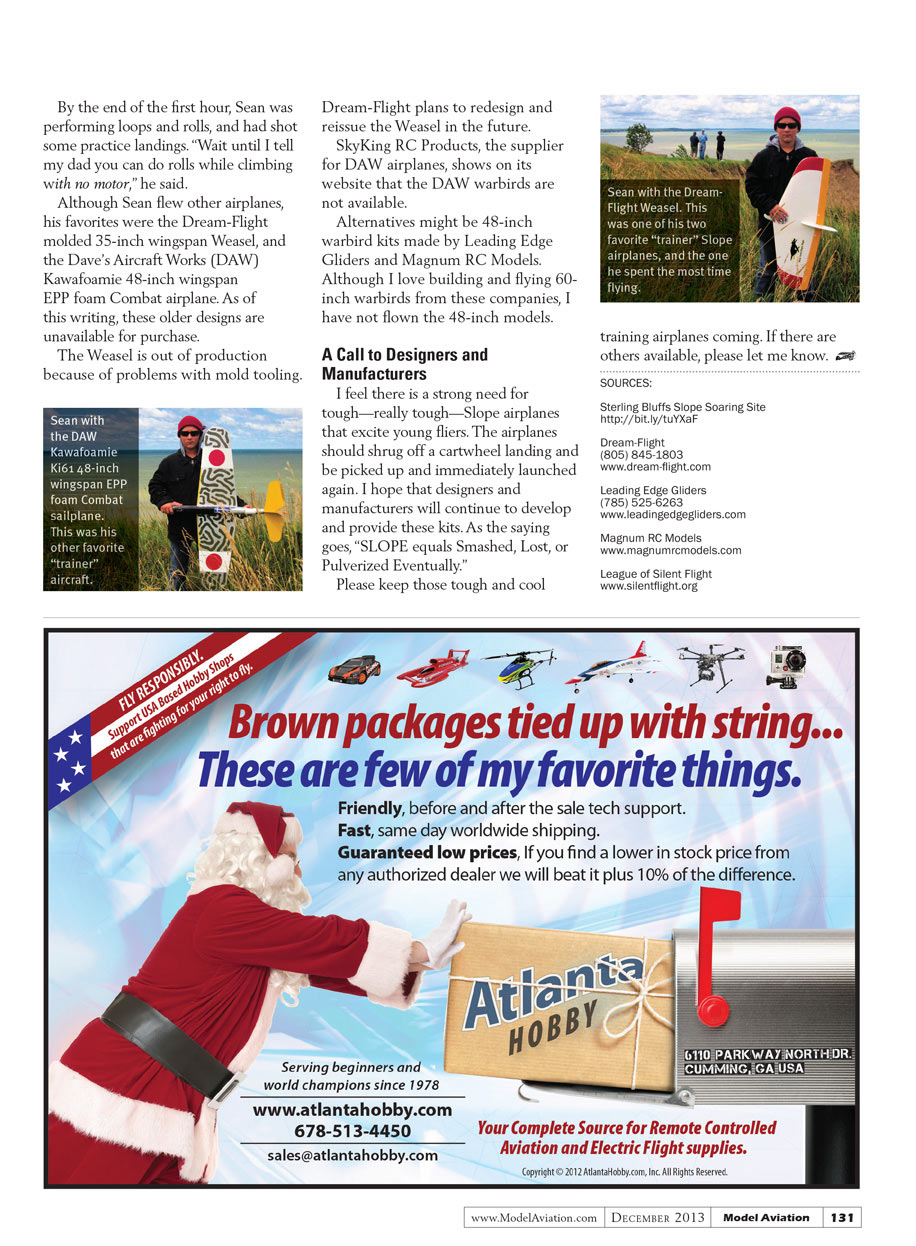
Although Sean flew other airplanes, his favorites were the Dream-Flight molded 35-inch wingspan Weasel, and the Dave’s Aircraft Works (DAW) Kawafouamie 48-inch wingspan EPP foam Combat airplane. As of this writing, these older designs are unavailable for purchase.
The Weasel is out of production because of problems with mold tooling. Dream-Flight plans to redesign and reissue the Weasel in the future. SkyKing RC Products, the supplier for DAW airplanes, shows on its website that the DAW warbirds are not available.
Alternatives might be 48-inch warbird kits made by Leading Edge Gliders and Magnum RC Models. Although I love building and flying 60-inch warbirds from these companies, I have not flown the 48-inch models.
A Call to Designers and Manufacturers
I feel there is a strong need for tough—really tough—Slope airplanes that excite young fliers. The airplanes should shrug off a cartwheel landing and be picked up and immediately launched again. I hope that designers and manufacturers will continue to develop and provide these kits. As the saying goes, “SLOPE equals Smashed, Lost, or Pulverized Eventually.”
Please keep those tough and cool training airplanes coming. If there are others available, please let me know. ✈
SOURCES:
- Sterling Bluffs Slope Soaring Site
- Dream-Flight
<REDACTED> www.dream-flight.com
- Leading Edge Gliders
<REDACTED> www.leadingedgegliders.com
- Magnum RC Models
- League of Silent Flight
Transcribed from original scans by AI. Minor OCR errors may remain.

