
Sailplane Kits for RC Pilots
by Dave Garwood [email protected]
David Barker, president of the Red Baron R/C Modelers club, which flies near Shelley, Idaho, wrote to me about his interest in slope soaring.
“I have an electric-power motorized glider, and find I’m becoming enticed to give slope soaring a try. A couple of club members have attended a glider meet in Joseph, Oregon, and frequently talk about how much fun they have, literally throwing their planes off the side of a mountain.
“I was wondering if you might be able to suggest a simple, inexpensive, but good design to help introduce us to slope soaring? Possibly something different than what the major distributors carry? As we’ve found with our club building projects, if we can keep the costs down, we tend to attract more fliers willing to try a new style of flying.
“Should we go with a heavier airframe for better ballast and wind penetration? Several of our members have powered gliders, but we’ve never really explored the slope soaring possibility.”
I was happy to answer Dave’s questions, and others may have similar ones. I have decided to repeat and expand my reply in this column.
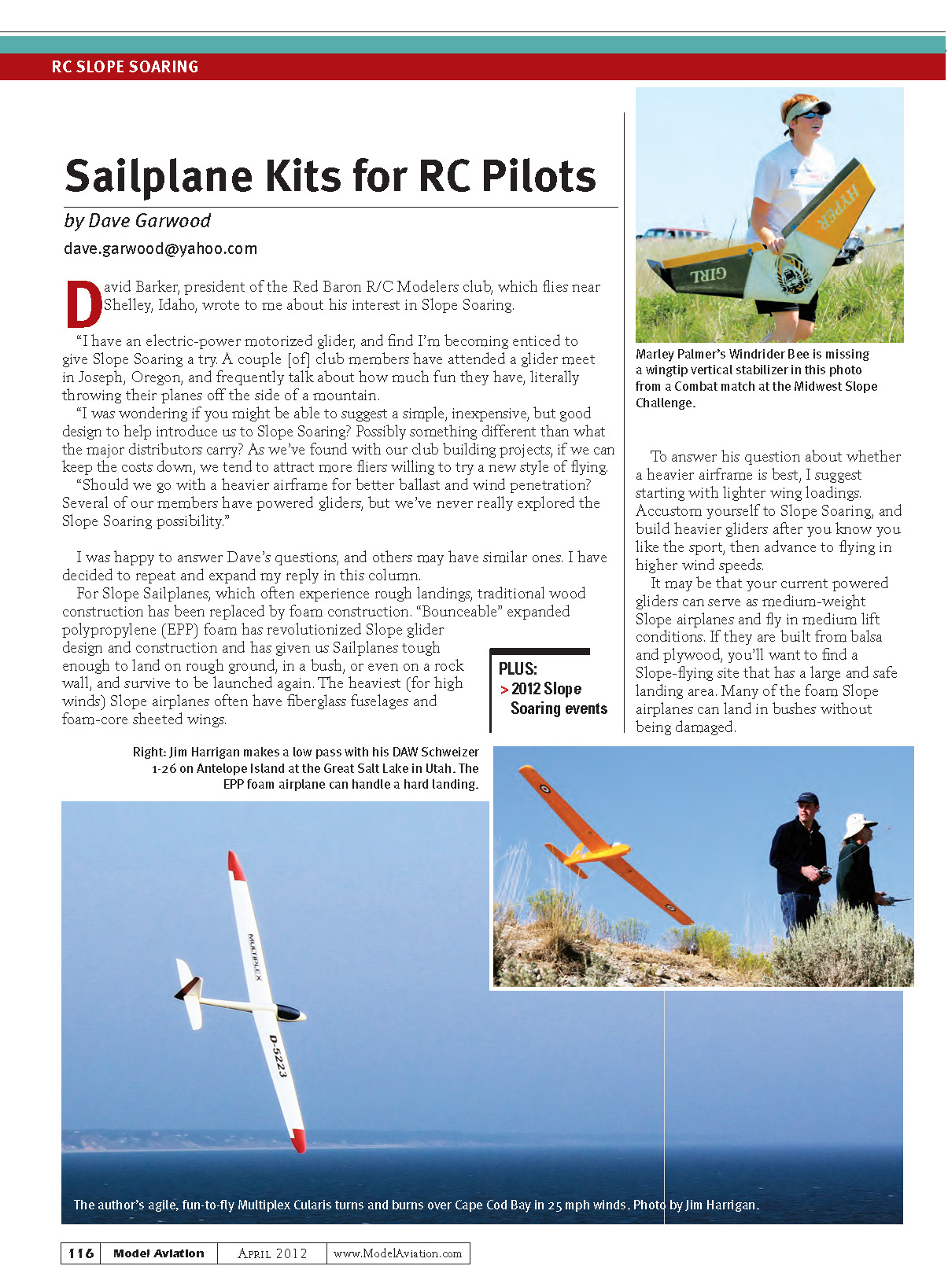
For slope sailplanes, which often experience rough landings, traditional wood construction has often been replaced by foam construction. “Bounceable” expanded polypropylene (EPP) foam has revolutionized slope glider design and construction and has given us sailplanes tough enough to land on rough ground, in a bush, or even on a rock wall, and survive to be launched again. The heaviest (for high winds) slope airplanes often have fiberglass fuselages and foam-core sheeted wings.
To answer his question about whether a heavier airframe is best, I suggest starting with lighter wing loadings. Accustom yourself to slope soaring, and build heavier gliders after you know you like the sport, then advance to flying in higher wind speeds.
It may be that your current powered gliders can serve as medium-weight slope airplanes and fly in medium lift conditions. If they are built from balsa and plywood, you’ll want to find a slope-flying site that has a large and safe landing area. Many of the foam slope airplanes can land in bushes without being damaged.
After checking with my flying buddies to round out the list of good designs for slope soaring beginners, here are some we have enjoyed flying throughout the years and kept ready to take on slope flying outings:
- Windrider Aviation Bee or Bee 2, 48-inch span
The Windrider Bee has introduced hundreds of slope pilots around the world to slope flying. Injection molded from EPP foam, the aircraft builds quickly and can be counted on to fly well in many wind conditions. It’s strong enough to fly in full-contact slope combat matches. The Windrider kits are made in Hong Kong and can be ordered directly or via importers such as Atlanta Hobby and Canuk Engineering. There are many makers of 48-inch span “flying wing” slope airplanes, and I haven’t seen one that did not fly well. The Windrider Bee has been in production for many years and is the wing with which my flying buddies and I have had the most experience.
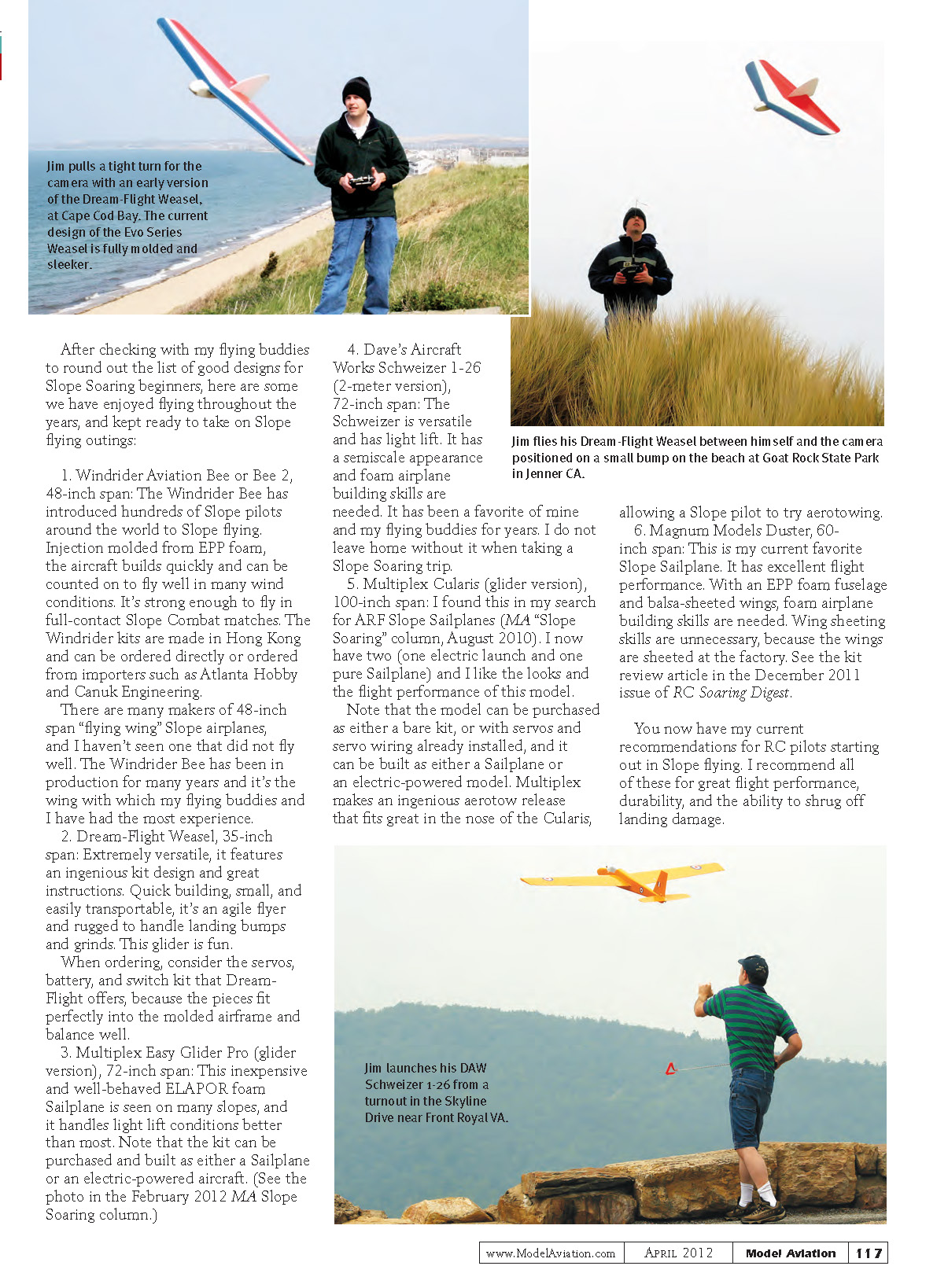
- Dream-Flight Weasel, 35-inch span
Extremely versatile, it features an ingenious kit design and great instructions. Quick building, small, and easily transportable, it’s an agile flyer and rugged enough to handle landing bumps and grinds. When ordering, consider the servos, battery, and switch kit that Dream-Flight offers, because the pieces fit perfectly into the molded airframe and balance well.
- Multiplex Easy Glider Pro (glider version), 72-inch span
This inexpensive and well-behaved ELAPOR foam sailplane is seen on many slopes, and it handles light lift conditions better than most. Note that the kit can be purchased as a sailplane or as an electric-powered aircraft. (See the photo in the February 2012 MA Slope Soaring column.)
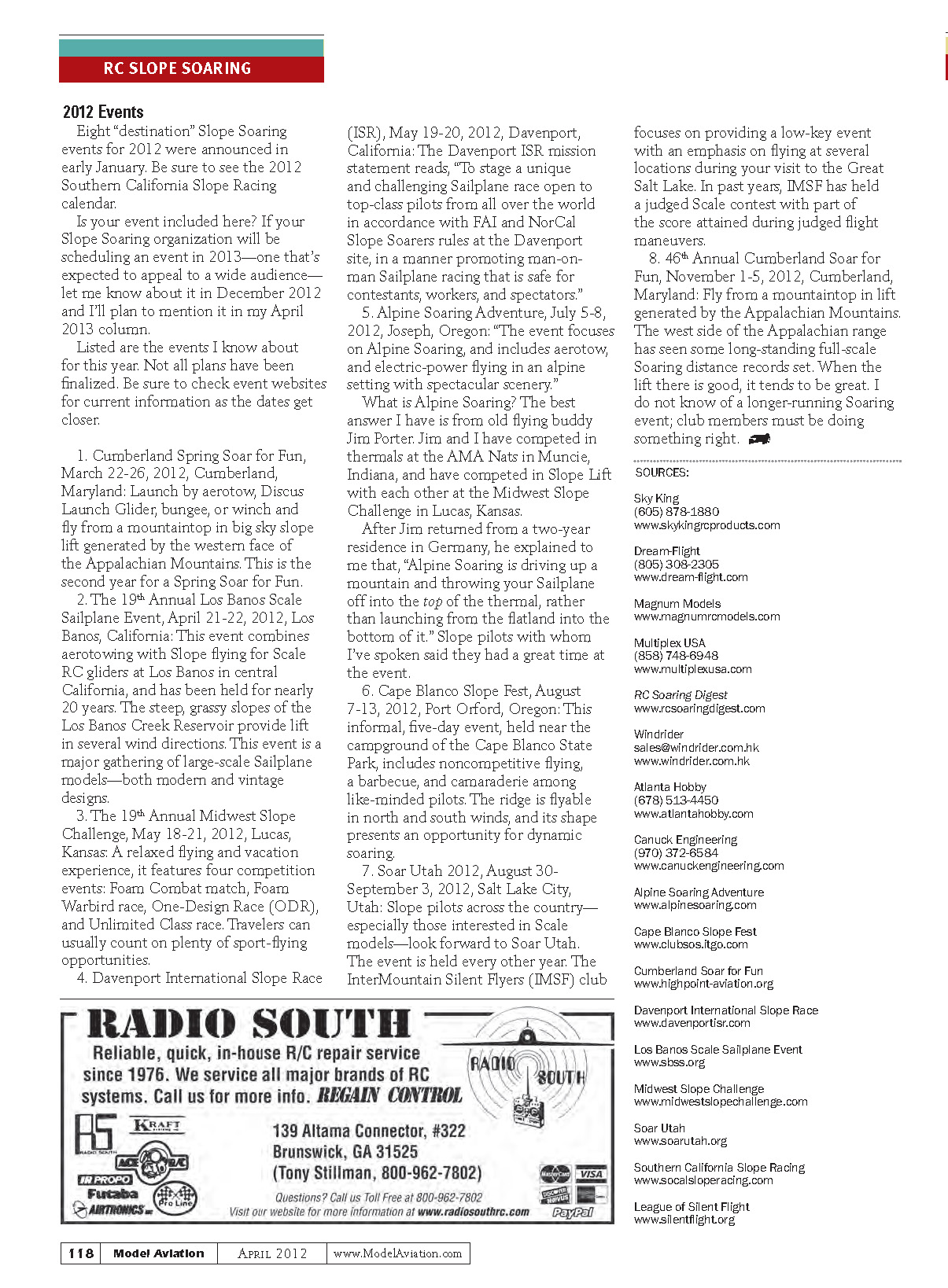
- Dave’s Aircraft Works Schweizer 1-26 (2-meter version), 72-inch span
The Schweizer is versatile and has good light-lift performance. It has a semiscale appearance and requires foam airplane building skills. It has been a favorite of mine and my flying buddies for years. I do not leave home without it when taking a slope soaring trip.
- Multiplex Cularis (glider version), 100-inch span
I found this in my search for ARF slope sailplanes (MA “Slope Soaring” column, August 2010). I now have two (one electric launch and one pure sailplane) and I like the looks and the flight performance of this model. The model can be purchased as either a bare kit or with servos and servo wiring already installed, and it can be built as either a sailplane or an electric-powered model. Multiplex makes an ingenious aerotow release that fits great in the nose of the Cularis, allowing a slope pilot to try aerotowing.
- Magnum Models Duster, 60-inch span
This is my current favorite slope sailplane. It has excellent flight performance. With an EPP foam fuselage and balsa-sheeted wings, foam airplane building skills are needed. Wing sheeting skills are unnecessary, because the wings are sheeted at the factory. See the kit review article in the December 2011 issue of RC Soaring Digest.
You now have my current recommendations for RC pilots starting out in slope flying. I recommend all of these for great flight performance, durability, and the ability to shrug off landing damage.
2012 Events
Eight "destination" slope soaring events for 2012 were announced in early January. Be sure to see the 2012 Southern California Slope Racing calendar.
Is your event included here? If your slope soaring organization will be scheduling an event in 2013—one that's expected to appeal to a wide audience—let me know about it in December 2012 and I'll plan to mention it in my April 2013 column.
Listed are the events I know about for this year. Not all plans have been finalized. Be sure to check event websites for current information as the dates get closer.
- Cumberland Spring Soar for Fun, March 22-26, 2012 — Cumberland, Maryland
Launch by aerotow, discus launch glider (DLG), bungee, or winch and fly from a mountaintop in big-sky slope lift generated by the western face of the Appalachian Mountains. This is the second year for a Spring Soar for Fun.
- The 19th Annual Los Banos Scale Sailplane Event, April 21-22, 2012 — Los Banos, California
This event combines aerotowing with slope flying for scale RC gliders at Los Banos in central California, and has been held for nearly 20 years. The steep, grassy slopes of the Los Banos Creek Reservoir provide lift in several wind directions. This event is a major gathering of large-scale sailplane models—both modern and vintage designs.
- The 19th Annual Midwest Slope Challenge, May 18-21, 2012 — Lucas, Kansas
A relaxed flying and vacation experience, it features four competition events: foam combat match, foam warbird race, one-design race (ODR), and unlimited class race. Travelers can usually count on plenty of sport-flying opportunities.
- Davenport International Slope Race (ISR), May 19-20, 2012 — Davenport, California
The Davenport ISR mission statement reads, "To stage a unique and challenging sailplane race open to top-class pilots from all over the world in accordance with FAI and NorCal Slope Soarers rules at the Davenport site, in a manner promoting man-on-man sailplane racing that is safe for contestants, workers, and spectators."
- Alpine Soaring Adventure, July 5-8, 2012 — Joseph, Oregon
The event focuses on alpine soaring, and includes aerotow and electric-power flying in an alpine setting with spectacular scenery.
What is Alpine Soaring?
The best answer I have is from old flying buddy Jim Porter. Jim and I have competed in thermals at the AMA Nats in Muncie, Indiana, and have competed in slope lift with each other at the Midwest Slope Challenge in Lucas, Kansas.
After Jim returned from a two-year residence in Germany, he explained to me that, "Alpine soaring is driving up a mountain and throwing your sailplane off into the top of the thermal, rather than launching from the flatland into the bottom of it." Slope pilots with whom I've spoken said they had a great time at the event.
- Cape Blanco Slope Fest, August 7-13, 2012 — Port Orford, Oregon
This informal, five-day event, held near the campground of the Cape Blanco State Park, includes noncompetitive flying, a barbecue, and camaraderie among like-minded pilots. The ridge is flyable in north and south winds, and its shape presents an opportunity for dynamic soaring.
- Soar Utah 2012, August 30-September 3, 2012 — Salt Lake City, Utah
Slope pilots across the country—especially those interested in scale models—look forward to Soar Utah. The event is held every other year. The InterMountain Silent Flyers (IMSF) club focuses on providing a low-key event with an emphasis on flying at several locations during your visit to the Great Salt Lake. In past years, IMSF has held a judged scale contest with part of the score attained during judged flight maneuvers.
- 46th Annual Cumberland Soar for Fun, November 1-5, 2012 — Cumberland, Maryland
Fly from a mountaintop in lift generated by the Appalachian Mountains. The west side of the Appalachian range has seen some long-standing full-scale soaring distance records set. When the lift there is good, it tends to be great. I do not know of a longer-running soaring event; club members must be doing something right.
Transcribed from original scans by AI. Minor OCR errors may remain.

