
Cool flying at the 2012 WeaselFest
by Dave Garwood [email protected]
Santa Barbara, California, is a fine slope-soaring destination and offers beach-cliff, light-lift slope soaring at Ellwood Bluffs overlooking the Pacific Ocean. It also has big-sky, high-lift, and dynamic slope-soaring opportunities above Knapp’s Castle in the Santa Ynez Mountains. Many would call it a slope-soaring paradise, and I’m happy I got a chance to fly at both sites during the 10th annual WeaselFest, held April 14–15, 2012.
WeaselFest is a tribute to the Dream-Flight Weasel—a compact, highly maneuverable flying-wing slope glider. The molded-foam Weasel builds quickly, transports easily, and its tough airframe resists collision and landing damage. It’s not a surprise that diehard fans of this plucky airframe organize fly-ins to share their enthusiasm for this venerable slope glider.
The first WeaselFest was held at Ellwood Mesa in Santa Barbara in June 2003. Most of them have been there, with one at Little Mountain in San Bernardino, California. Other WeaselFest events have taken place in Austin, Texas; Platteville, Wisconsin; and Bat Yam, Israel.
Day 1: Mountain Flying at Knapp's Castle
The 2012 WeaselFest was scheduled for two days. Saturday's weather was overcast, with steady 15 to 20 mph northwest winds and temperatures below 40°F.
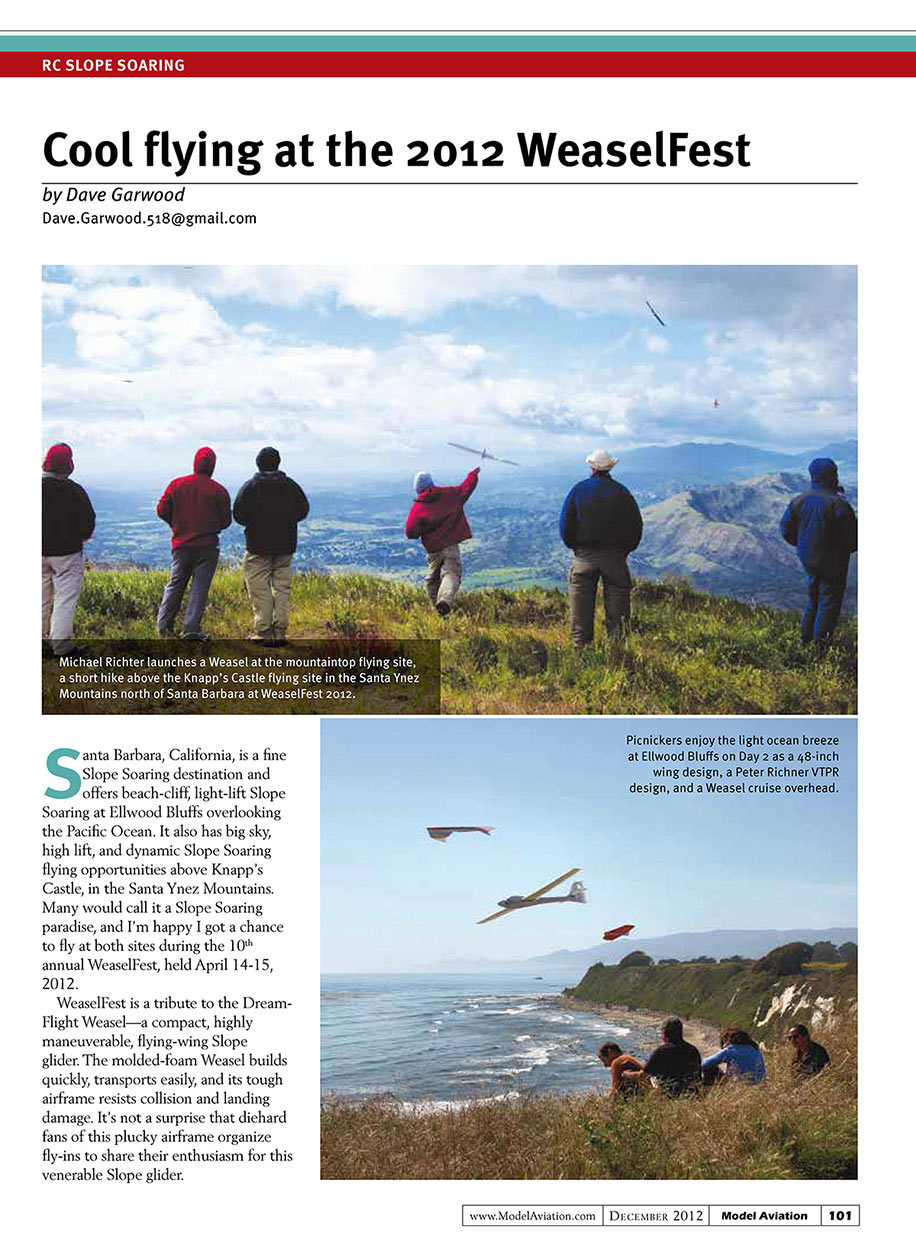
I was at Knapp’s Castle, or “The Ruins,” a mountain terrain flying site with magnificent views of Lake Cachuma and the Santa Ynez Valley. Fliers layered up against the cold in parkas, gloves, and goggles, and flew Weasels and a variety of other sailplanes in what seemed like unlimited lift.
Dave “Zenmaniac” Lorentzen from Madison, Wisconsin, described our first day of flying:
"Day 1 of WeaselFest—amazing flying. Friday's rain stopped, and Saturday brought the clearing winds which come from the northwest and give priority to their site called 'The Ruins,' after a mansion that burned down in the 1940s. This slope is at about 4,000 feet above a valley.
"The wind was measured at 25–30 mph, and the lift was unimaginable. I flew 45-minute stretches with about a half-hour in between, from 11 a.m. to about 4 p.m. The flying was exhausting, as was trying to track my Weasel in a mass of about 25 other Weasels, Zagis, and other foamies.
"We had a get-together at a pizza place for dinner and had drawings for door prizes. Tomorrow is supposed to have winds favorable for the Ellwood slope, which is a bluff along the ocean, promising a completely different style of slope flying (and about 20° warmer!)."
There were 20 or more sailplanes in the air most of the time—predominantly Weasels, 48-inch flying-wing designs, and VTPR aerobatic airplanes. I flew my ballasted Weasel (with 2 ounces of steel wire inside the carbon-fiber wing spar tube), and then switched to my Dave's Aircraft Works Schweizer 1-26 (available from Sky King RC Products), which was easier for me to see far away as it cruised out over the valley.
The lower Knapp’s Castle flying-site location is a shorter walk from the road, but it has a tighter available landing area. A brief hike up the ridgeline brings us to a flying site with spectacular views of the lake and valley below, and larger grass landing areas. Launching is tricky because the airplane must be thrown hard enough to get out past a ridge below, into the big lift. Once the model was up and out, we flew in classic big-sky, big-lift conditions.
On the way back to the cars, I watched some dynamic soaring. This is one impressive flying site.
Attending the flying event and the dinner were four slope aircraft designers and makers, in alphabetical order: Ward Hagaman (Ward Hagaman Designs), Steve Lange (LeFish and www.SlopeAerobatics.com), Michael Richter (Dream-Flight), and Martin Taraz (North County Flying Machines). We had fliers from California, Arizona, Wisconsin, and New York, as well as international visitors from Australia, New Zealand, and the Netherlands. That makes WeaselFest an international event and a continuing tribute to a well-designed and fun-to-fly Weasel.
Day 2: Beach Flying at Ellwood Bluffs
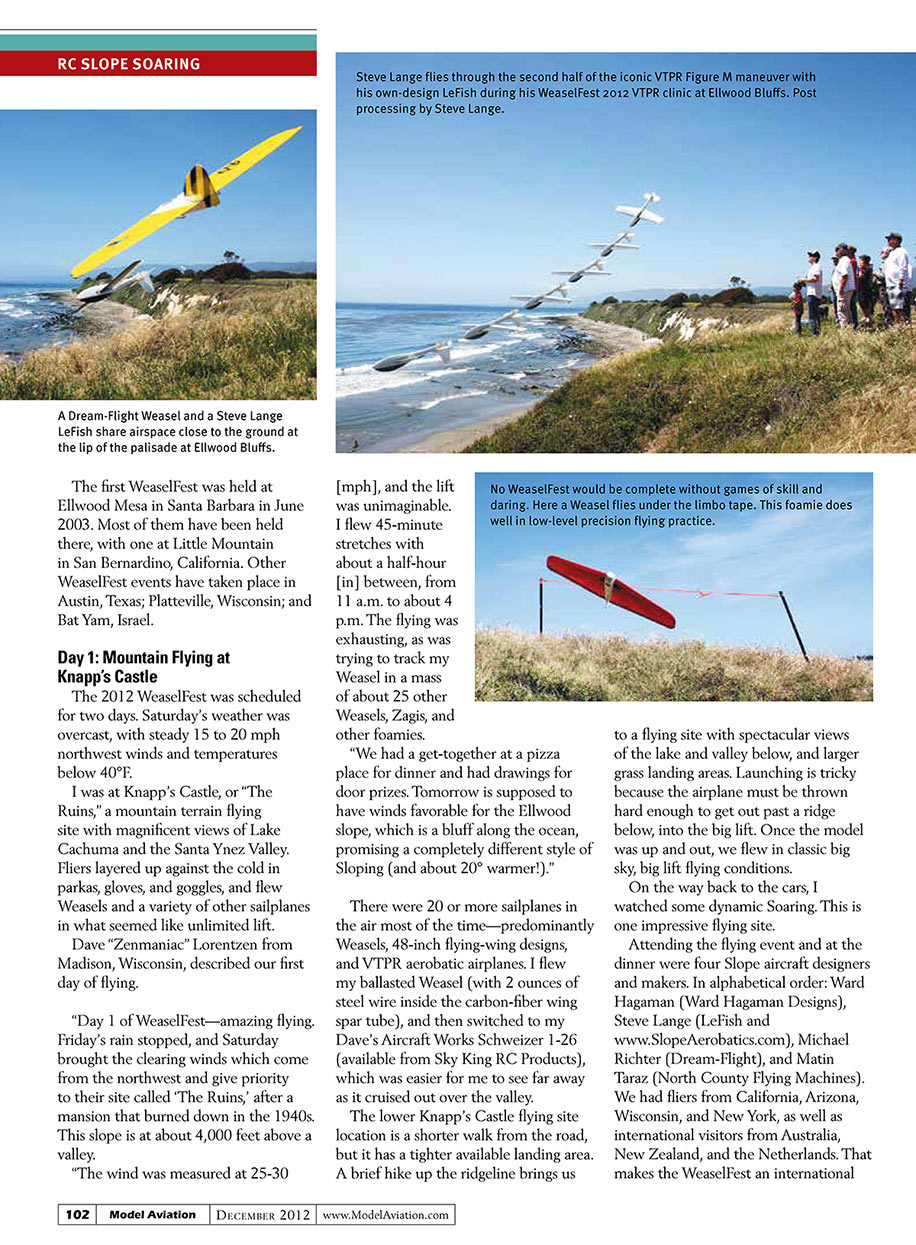
Sunday’s weather was sunny, a balmy 70°, with 5 to 10 mph ocean breezes—highly suitable for the 100-foot escarpment overlooking the Pacific Ocean known as Ellwood Bluffs. It was video footage of the easy-going action at this flying site that made me want to make the trip to California and attend my first WeaselFest.
The wind started out light and increased in strength as the day progressed. In addition to the Weasel, another Dream-Flight kit, the Alula, came into its own. The Alula is designed for tip launch, is lighter, and has a higher-aspect-ratio wing than its stablemate, the Weasel. As a result, the day started with Alulas flying in the light air.
As the lift built in the late morning and early afternoon, the Weasels were launched. I flew an Alula, a Weasel, and my trusty DAW 1-26.
It was a special treat to see expert pilots fly their specialized, super-light–wing-loading aerobatic VTPR and UltraBatics sailplanes. These great pilots included Justin Gafford, Dawson Henderson, Steve Lange, and Peter Richner of Switzerland. For more on how these airplanes and pilots perform the maneuvers, see Steve Lange’s guest “RC Slope Soaring” column about UltraBatics in the August 2012 issue of Model Aviation.
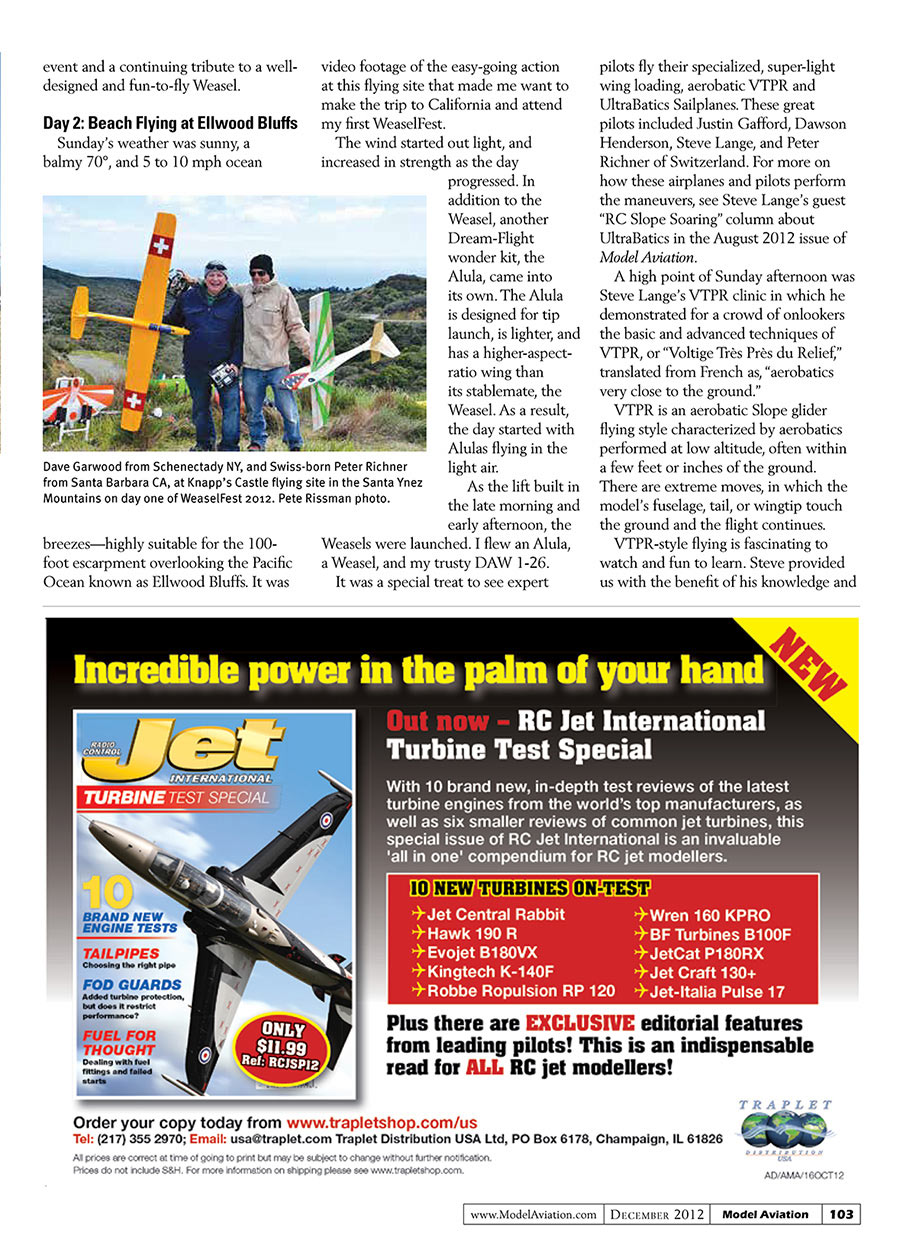
A high point of Sunday afternoon was Steve Lange’s VTPR clinic in which he demonstrated for a crowd of onlookers the basic and advanced techniques of VTPR, or “Voltige Très Près du Relief,” translated from French as “aerobatics very close to the ground.”
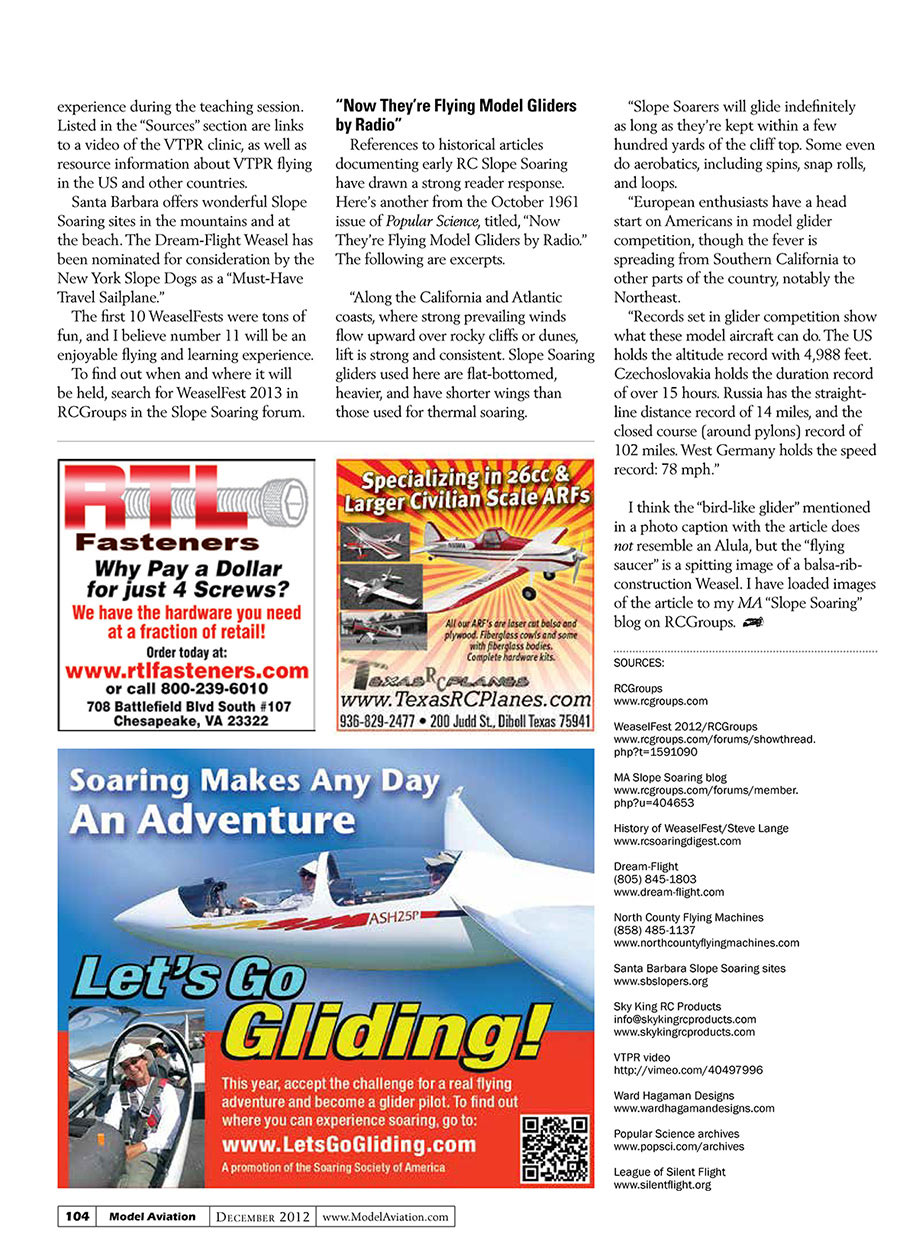
VTPR is an aerobatic slope-glider flying style characterized by aerobatics performed at low altitude, often within a few feet or inches of the ground. There are extreme moves in which the model’s fuselage, tail, or wingtip touch the ground and the flight continues.
VTPR-style flying is fascinating to watch and fun to learn. Steve provided us with the benefit of his knowledge and experience during the teaching session. Listed in the Sources section are links to a video of the VTPR clinic, as well as resource information about VTPR flying in the U.S. and other countries.
Santa Barbara offers wonderful slope-soaring sites in the mountains and at the beach. The Dream-Flight Weasel has been nominated for consideration by the New York Slope Dogs as a “must-have travel sailplane.”
The first 10 WeaselFests were tons of fun, and I believe number 11 will be an enjoyable flying and learning experience.
To find out when and where it will be held, search for WeaselFest 2013 in RCGroups in the Slope Soaring forum.
"Now They're Flying Model Gliders by Radio"
References to historical articles documenting early RC slope soaring have drawn a strong reader response. Here's another from the October 1961 issue of Popular Science, titled "Now They're Flying Model Gliders by Radio." The following are excerpts.
"Along the California and Atlantic coasts, where strong prevailing winds flow upward over rocky cliffs or dunes, lift is strong and consistent. Slope-soaring gliders used here are flat-bottomed, heavier, and have shorter wings than those used for thermal soaring.
"Slope soarers will glide indefinitely as long as they're kept within a few hundred yards of the cliff top. Some even do aerobatics, including spins, snap rolls, and loops.
"European enthusiasts have a head start on Americans in model glider competition, though the fever is spreading from Southern California to other parts of the country, notably the Northeast.
"Records set in glider competition show what these model aircraft can do. The U.S. holds the altitude record with 4,988 feet. Czechoslovakia holds the duration record of over 15 hours. Russia has the straight-line distance record of 14 miles, and the closed-course (around pylons) record of 102 miles. West Germany holds the speed record: 78 mph."
I think the "bird-like glider" mentioned in a photo caption with the article does not resemble an Alula, but the "flying saucer" is a spitting image of a balsa-rib–construction Weasel. I have loaded images of the article to my Model Aviation "Slope Soaring" blog on RCGroups.
Sources
- RCGroups — www.rcgroups.com
- WeaselFest 2012 / RCGroups — www.rcgroups.com/forums/showthread.php?t=1591090
- Model Aviation Slope Soaring blog — www.rcgroups.com/forums/member.php?u=404653
- History of WeaselFest / Steve Lange — www.rcsoaringdigest.com
- Dream-Flight — (805) 845-1803, www.dream-flight.com
- North County Flying Machines — (858) 485-1137, www.northcountyflyingmachines.com
- Santa Barbara Slope Soaring sites — www.sbslopers.org
- Sky King RC Products — [email protected], www.skykingrcproducts.com
- VTPR video — http://vimeo.com/40497996
- Ward Hagaman Designs — www.wardhagamandesigns.com
- Popular Science archives — www.popsci.com/archives
- League of Silent Flight — www.silentflight.org
Transcribed from original scans by AI. Minor OCR errors may remain.

