
RC Slope Soaring
F3F Slope Racing in America
Dave Garwood
THIS MONTH, guest writer David Klein will share his enthusiasm for F3F: a specialized race for exceptionally high-performance sailplanes that is amazingly approachable for those who are new to Slope Racing.
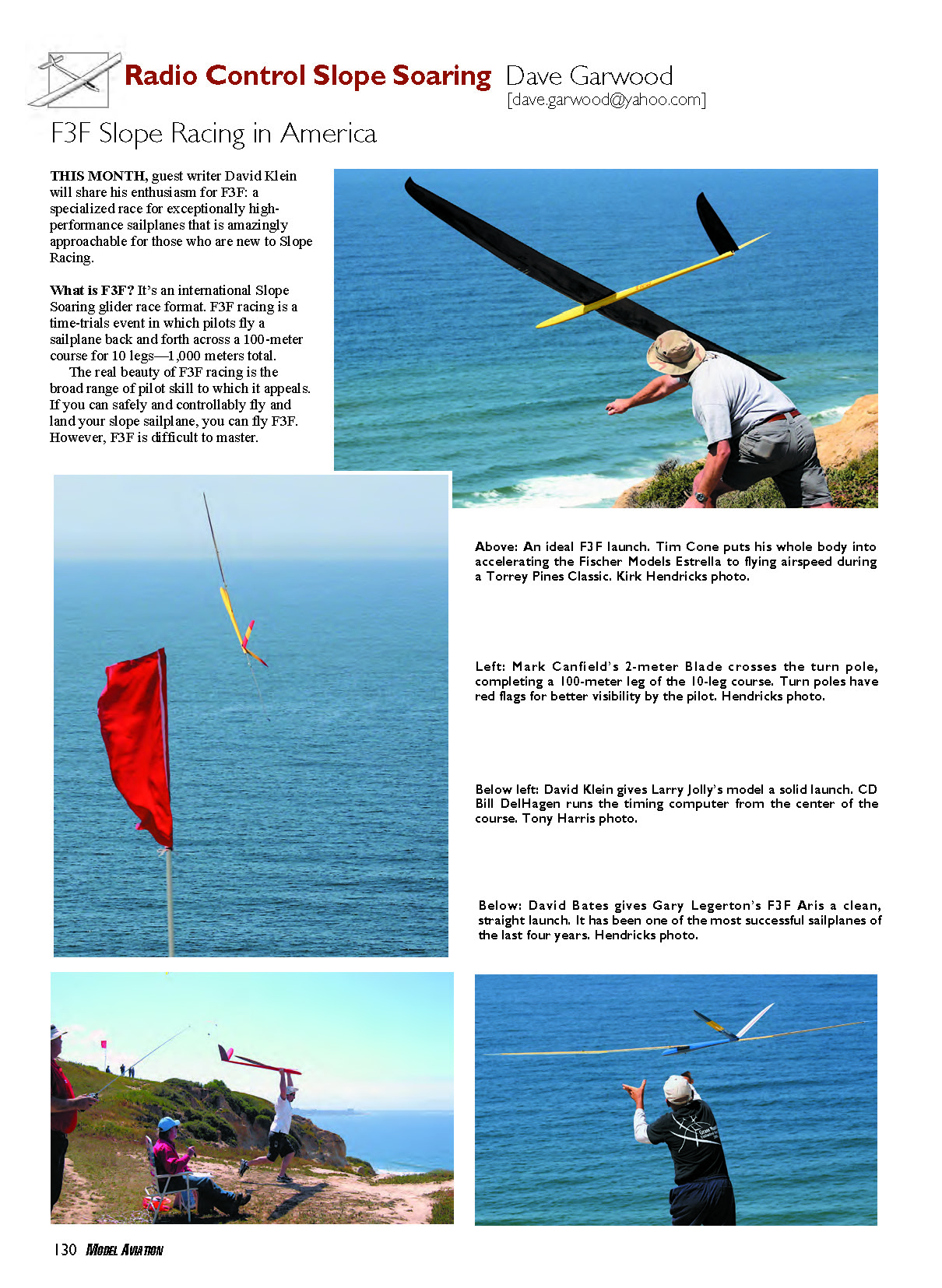
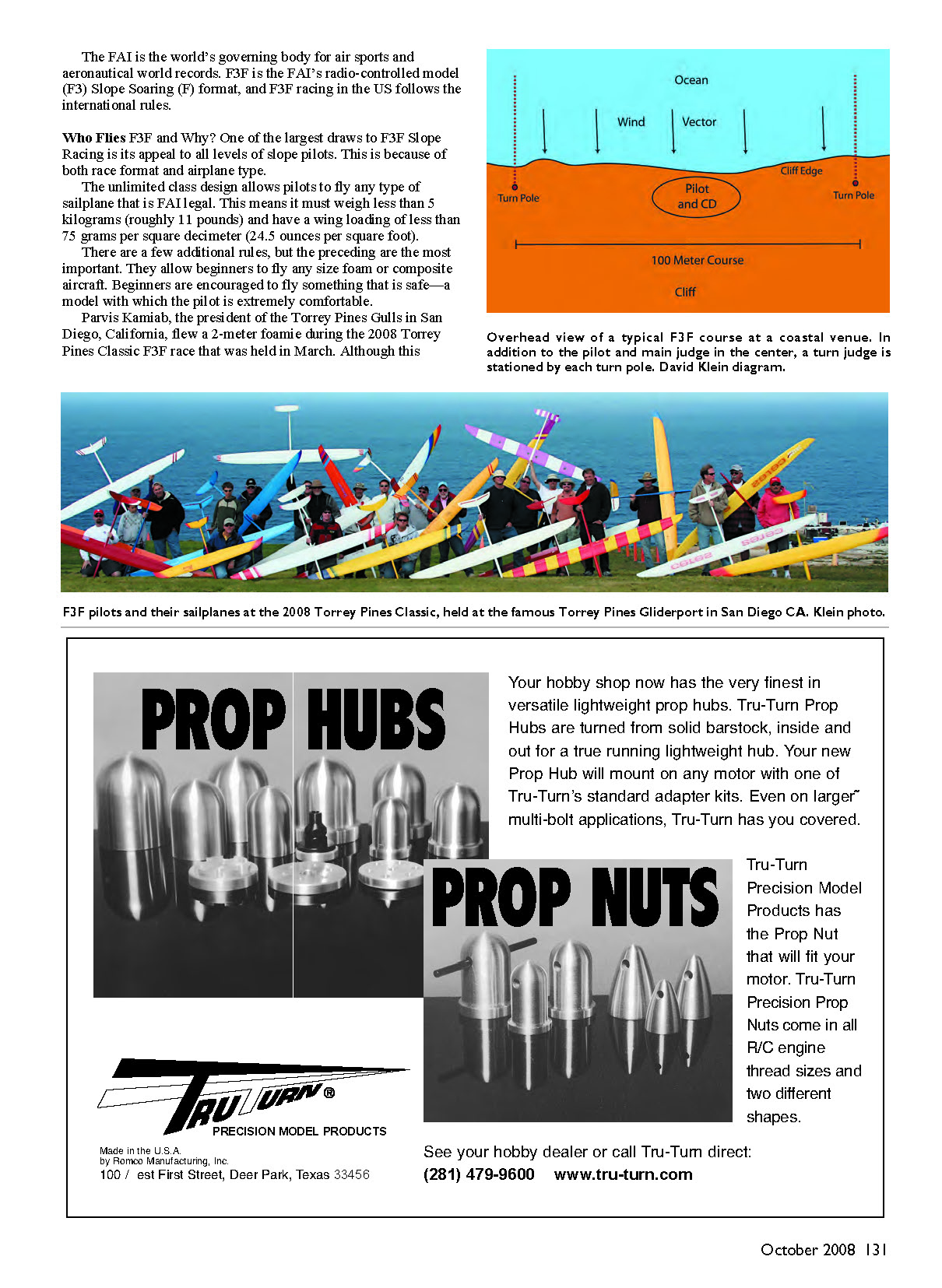
What is F3F? It's an international Slope Soaring glider race format. F3F racing is a time-trials event in which pilots fly a sailplane back and forth across a 100-meter course for 10 legs—1,000 meters total.
The real beauty of F3F racing is the broad range of pilot skill to which it appeals. If you can safely and controllably fly and land your slope sailplane, you can fly F3F. However, F3F is difficult to master. The FAI is the world's governing body for air sports and aeronautical world records. F3F is the FAI's radio-controlled model (F3) Slope Soaring (F) format, and F3F racing in the US follows the international rules.
Who Flies F3F and Why? One of the largest draws to F3F Slope Racing is its appeal to all levels of slope pilots. This is because of both race format and airplane type.
The unlimited class design allows pilots to fly any type of sailplane that is FAI legal. This means it must weigh less than 5 kilograms (roughly 11 pounds) and have a wing loading of less than 75 grams per square decimeter (24.5 ounces per square foot).
There are a few additional rules, but the preceding are the most important. They allow beginners to fly any size foam or composite aircraft. Beginners are encouraged to fly something that is safe—a model with which the pilot is extremely comfortable.
Parvis Kamiab, the president of the Torrey Pines Gulls in San Diego, California, flew a 2-meter foamie during the 2008 Torrey Pines Classic F3F race that was held in March. Although this
Brief History of F3F Racing:
During the late 1990s, Slope Racing dwindled in the US. The airplanes had evolved into fast, efficient models that were constructed from expensive composite materials. Many were home-built designs fabricated from vacuum-bagged foam-core carbon/epoxy and fiberglass/epoxy materials, with speed as the goal.
But newer commercial models emerged. Hollow molded sailplanes built from accurate CNCed molds raised the performance bar and increased the cost. This escalation reduced the number of pilots who were willing to risk expensive airplanes for "man-on-man"-style Slope Racing, in which midair collisions were common.
The pilots' unwillingness to toss out their "uber"-expensive models and swap paint with the next fliers opened the door for a new Slope Racing format. As a result, a time-trial type of racing became popular in Europe and was then brought to the US.
American Slope Racing pilots with international experience took notice of the larger slope races held around the world. In 1998, the international Viking Race—a large and prestigious slope contest—garnered significant international attention.
Many considered the Viking Race to be the pseudo-world championship of Slope Racing. It traveled to different locations each time it was held—similar to FAI-run world championships.
To introduce America to this style of Slope Racing, Tom Copp contacted some international friends and worked with the Torrey Pines Gulls to establish the first F3F event in America. He collaborated with some of the Southern California Slope Racers and sponsored the first F3F racing league in the US. This league grew in popularity and soon became the Southern California Slope Racers.
Tim Cone and Charley MacMurray were the first Americans to attend the prestigious Viking Race. As the year 2000 approached, the event gained so much in popularity that it became an invitational.
To establish official entries from each interested country, Preben Eriksen of the Viking Race Board requested that a committee be formed to regulate the selection of a US Viking Race team. This request led Tom Copp, Tim Cone, and Nathan Woods to organize and form the ASRO (American Slope Racing Organization).
In this "Golden Age" of American F3F racing, contests were held in San Diego, Laguna, Los Angeles, Northern California, and Kansas. These areas have since coalesced into three racing groups: the SCSR (Southern California Slope Racing organization), the Northern California Slope Soarers, and the Midwest Slope Challenge.
The Racecourse:
The F3F course is laid out along the front of a slope. Two pylons, or "turn poles," are set 100 meters apart, with the CD's chair in the middle. The two pylons are labeled base A and base B.
Base A is the side through which the pilot's model enters and exits the course. It can be put on either the right or left. The side that has the best lift is usually chosen for base A, to maximize the climbout.
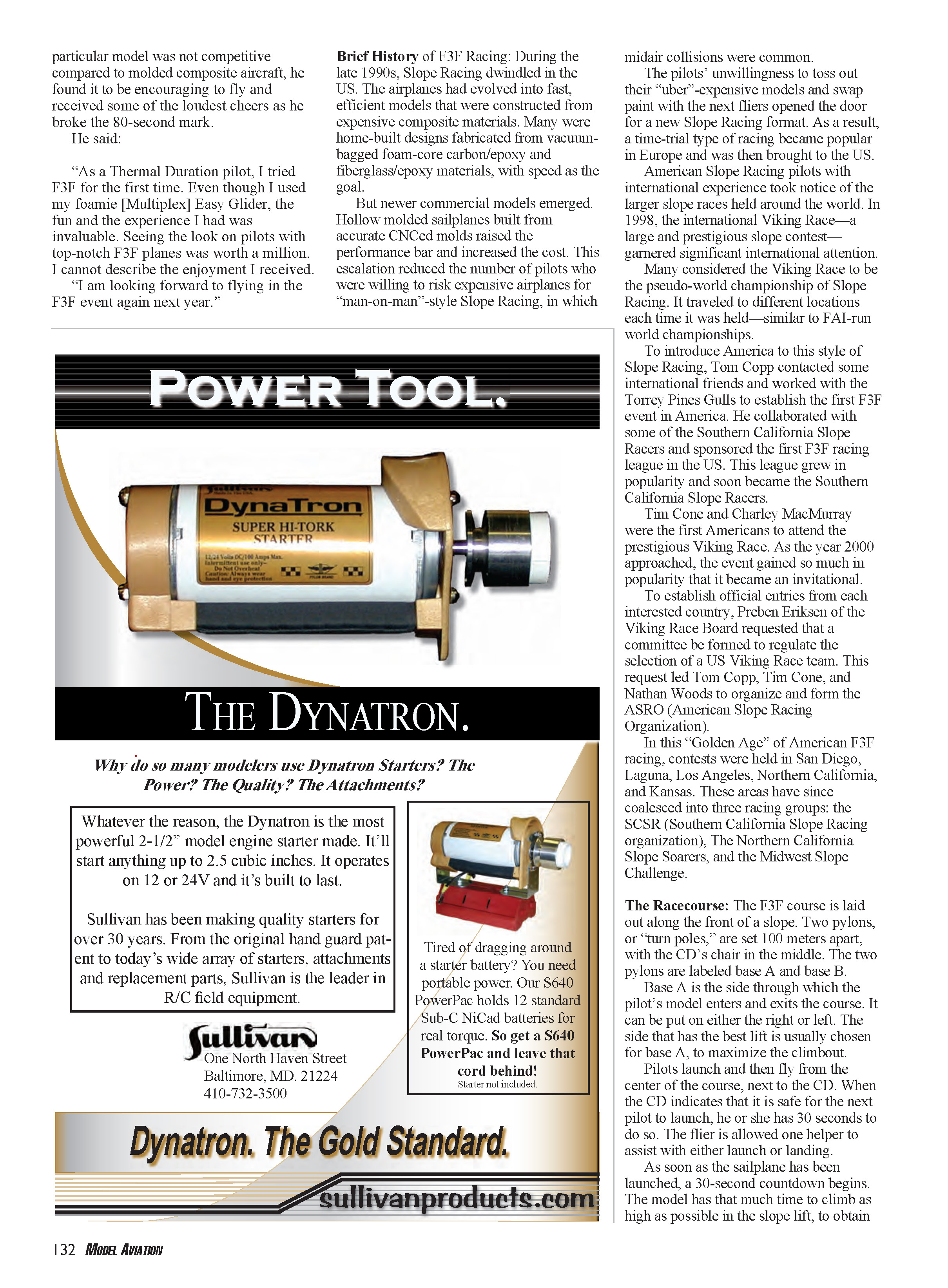
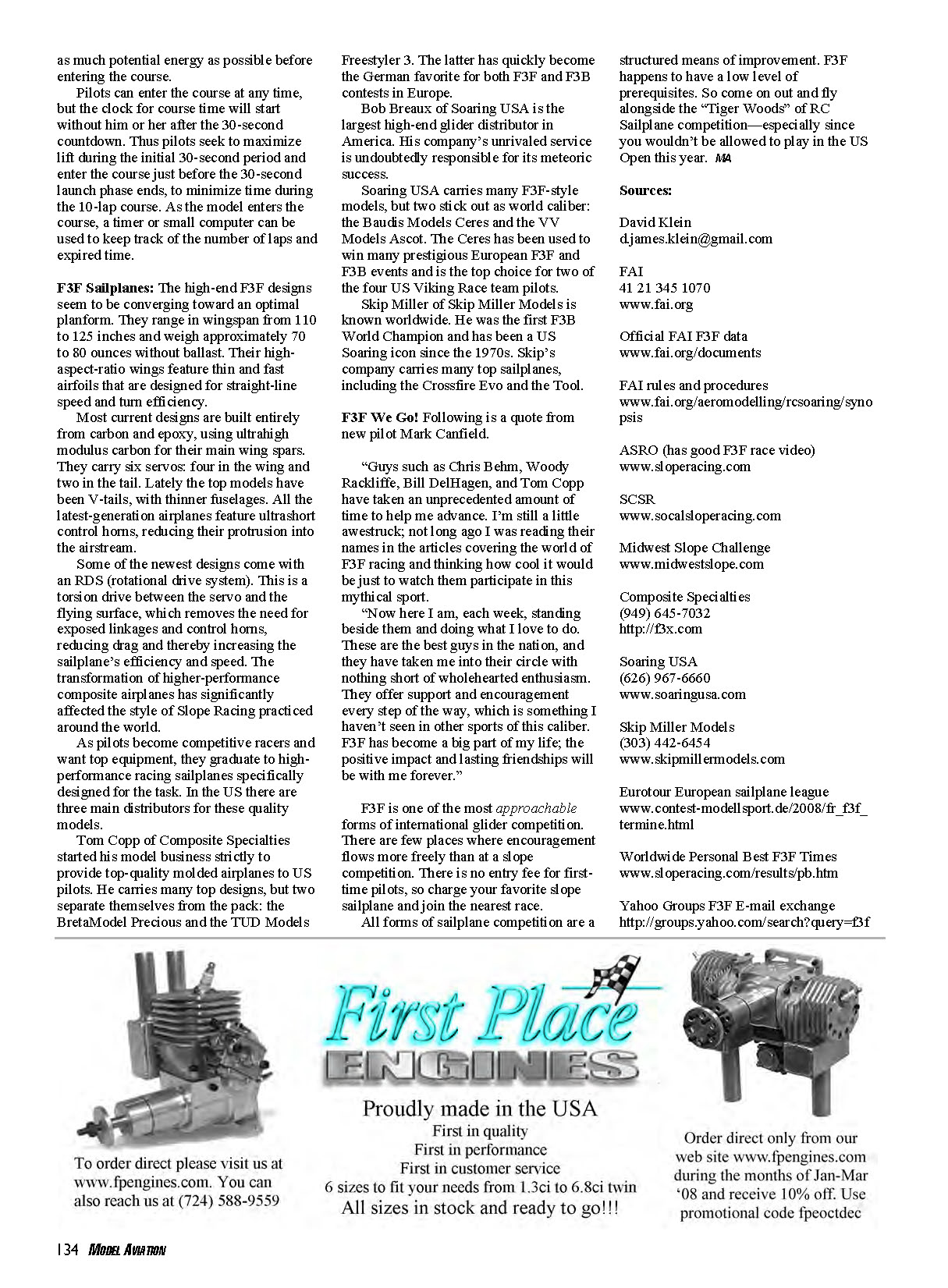
Pilots launch and then fly from the center of the course, next to the CD. When the CD indicates that it is safe for the next pilot to launch, he or she has 30 seconds to do so. The flier is allowed one helper to assist with either launch or landing.
As soon as the sailplane has been launched, a 30-second countdown begins. The model has that much time to climb as high as possible in the slope lift, to obtain as much potential energy as possible before entering the course.
Pilots can enter the course at any time, but the clock for course time will start without him or her after the 30-second countdown. Thus pilots seek to maximize lift during the initial 30-second period and enter the course just before the 30-second launch phase ends, to minimize time during the 10-lap course. As the model enters the course, a timer or small computer can be used to keep track of the number of laps and expired time.
F3F Sailplanes:
The high-end F3F designs seem to be converging toward an optimal planform. They range in wingspan from 110 to 125 inches and weigh approximately 70 to 80 ounces without ballast. Their high-aspect-ratio wings feature thin and fast airfoils that are designed for straight-line speed and turn efficiency.
Most current designs are built entirely from carbon and epoxy, using ultrahigh modulus carbon for their main wing spars. They carry six servos: four in the wing and two in the tail. Lately the top models have been V-tails, with thinner fuselages. All the latest-generation airplanes feature ultrashort control horns, reducing their protrusion into the airstream.
Some of the newest designs come with an RDS (rotational drive system). This is a torsion drive between the servo and the flying surface, which removes the need for exposed linkages and control horns, reducing drag and thereby increasing the sailplane’s efficiency and speed. The transformation of higher-performance composite airplanes has significantly affected the style of Slope Racing practiced around the world.
As pilots become competitive racers and want top equipment, they graduate to high-performance racing sailplanes specifically designed for the task. In the US there are three main distributors for these quality models.
Tom Copp of Composite Specialties started his model business strictly to provide top-quality molded airplanes to US pilots. He carries many top designs, but two separate themselves from the pack: the BretaModel Precocious and the TUD Models Freestyler 3. The latter has quickly become the German favorite for both F3F and F3B contests in Europe.
Bob Breaux of Soaring USA is the largest high-end glider distributor in America. His company’s unrivaled service is undoubtedly responsible for its meteoric success.
Soaring USA carries many F3F-style models, but two stick out as world caliber: the Baudis Models Ceres and the VV Models Ascot. The Ceres has been used to win many prestigious European F3F and F3B events and is the top choice for two of the four US Viking Race team pilots.
Skip Miller of Skip Miller Models is known worldwide. He was the first F3B World Champion and has been a US Soaring icon since the 1970s. Skip’s company carries many top sailplanes, including the Crossfire Evo and the Tool.
F3F We Go!
Following is a quote from new pilot Mark Canfield.
“Guys such as Chris Behm, Woody Rackliffe, Bill DelHagen, and Tom Copp have taken an unprecedented amount of time to help me advance. I’m still a little awestruck; not long ago I was reading their names in the articles covering the world of F3F racing and thinking how cool it would be just to watch them participate in this mythical sport.
“Now here I am, each week, standing beside them and doing what I love to do. These are the best guys in the nation, and they have taken me into their circle with nothing short of wholehearted enthusiasm. They offer support and encouragement every step of the way, which is something I haven’t seen in other sports of this caliber. F3F has become a big part of my life; the positive impact and lasting friendships will be with me forever.”
F3F is one of the most approachable forms of international glider competition. There are few places where encouragement flows more freely than at a slope contest. There is no entry fee for first-time pilots, so charge your favorite slope sailplane and join the nearest race.
All forms of sailplane competition are a structured means of improvement. F3F happens to have a low level of prerequisites. So come on out and fly alongside the “Tiger Woods” of RC Sailplane competition—especially since you wouldn’t be allowed to play in the US Open this year. MA
Sources:
- David Klein
- FAI
41 21 345 1070 www.fai.org
- Official FAI F3F data
- FAI rules and procedures
www.fai.org/aeromodelling/rcsoaring/synopsis
- ASRO (has good F3F race video)
- SCSR
- Midwest Slope Challenge
- Composite Specialties
(949) 645-7032 http://t3x.com
- Soaring USA
(626) 967-6660 www.soaringusa.com
- Skip Miller Models
(303) 442-6454 www.skipmillermodels.com
- Eurotour European sailplane league
www.contest-modellsport.de/2008/fr_f3f_terminne.html
- Worldwide Personal Best F3F Times
www.slopearacing.com/results/pb.htm
- Yahoo Groups F3F E-mail exchange
http://groups.yahoo.com/search?query=f3f
Transcribed from original scans by AI. Minor OCR errors may remain.

