
Aileron differential: why we need it and how to get it
by Dave Garwood [email protected]
What is aileron differential and why do we need to know about it? Differential is setting up ailerons so that they travel farther up than down, and we do it to make our turns smoother.
When an airplane rolls or banks to make a turn, more drag is created at the down-going aileron, and this pulls the nose of the airplane toward the outside of the intended turn. We call this undesirable effect adverse yaw.
Wikipedia explains it in more detail:
An unwanted side effect of aileron operation is adverse yaw — a yawing movement in the opposite direction to the roll. Using the ailerons to roll an aircraft to the right produces a yawing motion to the left. As the aircraft rolls, adverse yaw is caused primarily by the change in drag on the left and right wing. The rising wing generates increased lift, which causes increased induced drag. The descending wing generates reduced lift, which causes reduced induced drag. The difference in drag on each wing produces the adverse yaw. There is also often an additional adverse yaw contribution from a difference in profile drag between the up-aileron and down-aileron.
In a coordinated turn using rudder, adverse yaw is counteracted by deflecting the rudder, allowing the airplane to turn in the intended direction. That's great if you have a rudder, but many of our Slope sailplanes do not.
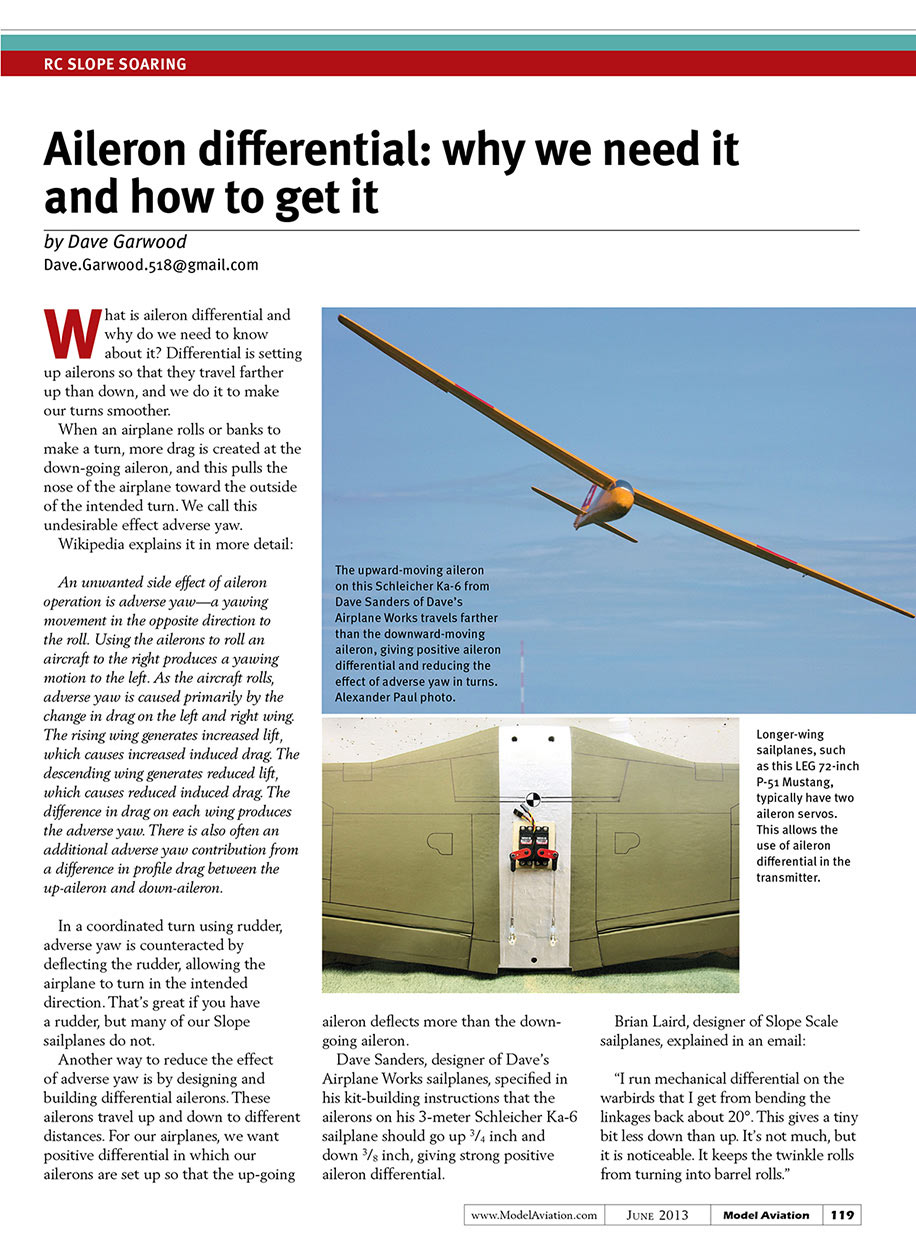
Another way to reduce the effect of adverse yaw is by designing and building differential ailerons. These ailerons travel up and down to different distances. For our airplanes, we want positive differential in which our ailerons are set up so that the up-going aileron deflects more than the down-going aileron.
Dave Sanders, designer of Dave's Airplane Works sailplanes, specified in his kit-building instructions that the ailerons on his 3-meter Schleicher Ka-6 sailplane should go up 3/4 inch and down 3/8 inch, giving strong positive aileron differential.
Brian Laird, designer of Slope Scale sailplanes, explained in an email:
"I run mechanical differential on the warbirds that I get from bending the linkages back about 20°. This gives a tiny bit less down than up. It's not much, but it is noticeable. It keeps the twinkle rolls from turning into barrel rolls."
will produce more drag than lift and the desired control response will reverse the dreaded "adverse yaw" effect. Differential of 2 to 1 or 2.5 to 1 prevents this from happening during landings, and also provides more efficient thermaling flight."
We want to design and build our sailplanes to have positive aileron differential, even if they have a rudder.
Here are three common methods to achieve this in models:
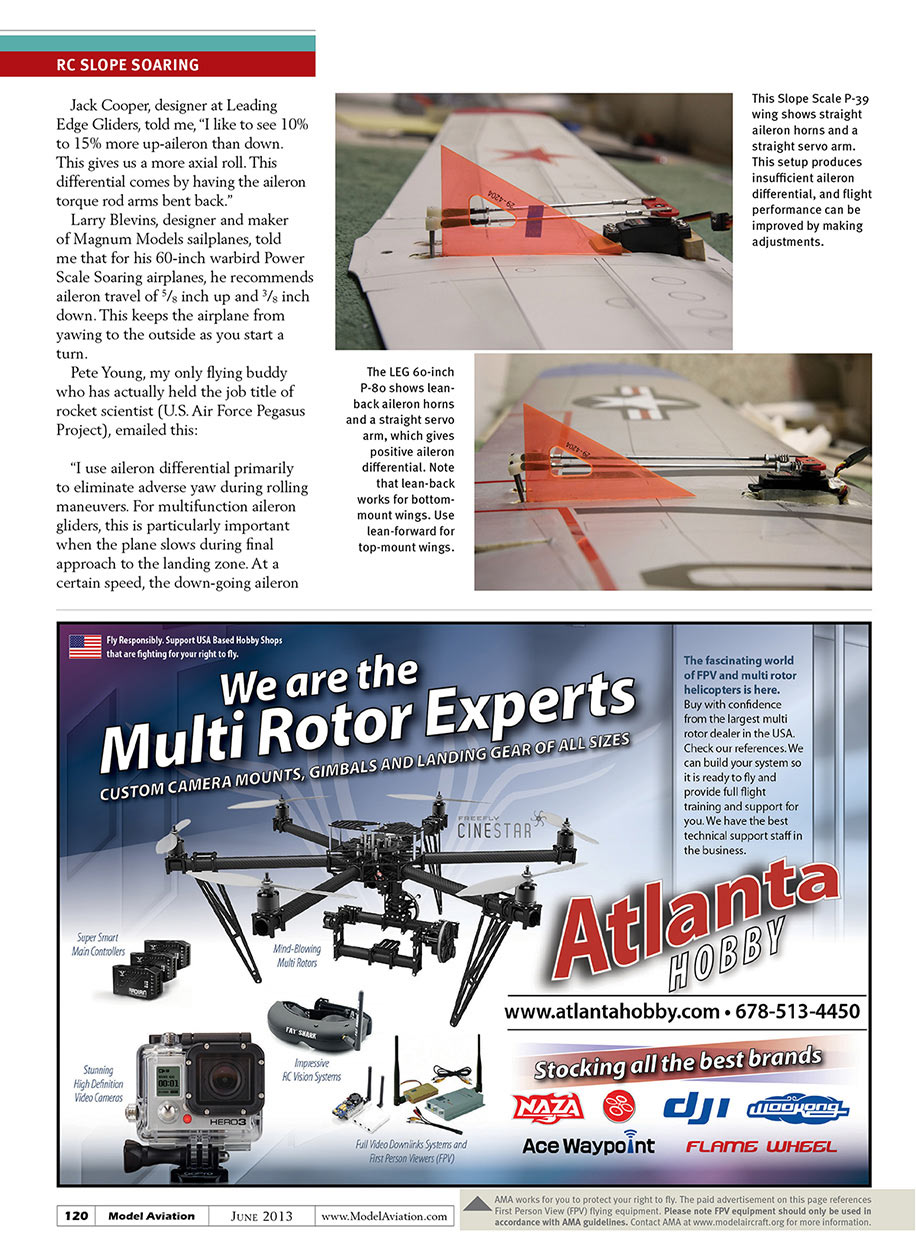
- Servo pair: Common in long-wing sailplanes, each servo is plugged into a separate aileron channel, and differential travel is set in the transmitter.
- The aileron control horns lean forward or back. On a low wing, with the linkage above the wing, leaning the control horn back gives positive differential. Reverse for a high-wing or mid-wing installation where the servo linkage is below the wing.
- The servo arms sweep forward or back. On a low wing, sweeping the servo arms back gives positive differential. Reverse for a high-wing or mid-wing installation where the servo linkage is below the wing. This method makes it easy to fine-tune the differential simply by cutting servo arms from a large servo wheel.
Expect some trial-and-error work to achieve the correct aileron differential for each airframe, and to match your preferences. The effort can pay big dividends by creating a smoother-flying sailplane.
SOURCES:
Leading Edge Gliders www.leadingedgegliders.com
Magnum Models Performance Aircraft www.magnumrcmodels.com
Sky King RC Products [email protected] www.skykingrcproducts.com
Slope Performance Glider Kits (Slope Scale) [email protected] http://flybuadan.blogspot.com
League of Silent Flight www.silentflight.org
MA Digital Library https://Library.ModelAviation.com
Transcribed from original scans by AI. Minor OCR errors may remain.

