

The 20th Annual Midwest Slope Challenge
by Dave Garwood
Coverage of the 20th Annual Midwest Slope Challenge (MWSC) is written by guest columnist David Lorentzen, from Madison, Wisconsin. Dave is "Zenmaniac" on RCGroups.com. His email address is listed in "Sources."
The History
RC Slope flying at Wilson Lake, Kansas, began in the early 1990s when RC sailplane fliers from the Lincoln, Nebraska, area, including Jim Porter, Mike Pratt, Steven Rhoman, Ed Harris, and Paul Wright, watched some hang gliders cruise the slopes around the lake and said, "We can do that with our sailplanes." Returning with their thermal Gentle Ladies, they quickly realized those were the wrong airplanes for the conditions.
Jim and Mike worked for Sig Manufacturing, and the first organized "challenge" in 1993 included races for Ninja- and Samurai-class airplanes (both kitted by Sig) and an Unlimited class. When Jim and Mike left Sig, the Ninja and Samurai classes were changed to the West Coast 60-inch One Design Rule (ODR) specifications, and the Unlimited class was retained. A Scale Foamy Fighter class and Zagi Combat competition were added in subsequent years.
Seven pilots flew the first MWSC, and by the early 2000s the number of entries had reached 70 pilots. It remains one of the longest continuously running RC Slope events.
The Journey
I met Dave Garwood last year at Weasel Fest in Santa Barbara, California, and he asked if I was going to the MWSC. That question stuck in the back of my mind until March of this year, when I decided yes, I'm going!
A road trip is more fun with company, so I called my brother, Bryan, in Milwaukee. He had a flying wing for Combat and I told him I would build him an ODR-compliant airplane because I was scratch-building one for myself. He ordered a 60-inch Leading Edge Gliders Kingcobra, and had Jack Cooper send it to me to build because I'm retired and had the time.
I had received a Bee 2 kit from Canuck Engineering, so a month-and-a-half before the event I had four airplanes to build. Yikes! I'll spare the details, but the day before we left I was finishing the fighter's covering and putting lead in the nose of the two ODR airplanes.
RC Slope Soaring
Dave Garwood
Although much of Kansas is flat, the Lucas area is an unexpected gem of Slope flying sites. Wilson Lake is a large reservoir surrounded by hills and bluffs, allowing flying in many wind directions. The size of the lake provides several miles of clear fetch in front of the slopes, creating beautiful, smooth lift.
The wind for our Thursday practice and two days of the formal event this year was from the southeast or east, allowing all activities to be held on the same slope.
The organizing club, Wings Over Wilson (WOW), has relationships with a number of local farmers for additional sites should wind conditions require a change of venue.
After arriving at the site on the morning of Thursday, May 16, Bryan got out his scratch-built ODR, and with me holding my breath, he gave it a toss. It flew well! I threw mine to the wind, trimmed it, and flew it hard for the next 30 minutes.
Bryan's P-63 Kingcobra, on the other hand, did not fare as well. He gave it a couple of tosses, and each time it waggled its way down to the bottom of the slope. As luck would have it, Jack Cooper showed up and volunteered to give Bryan a private lesson on the art of flying a warbird in marginal lift. Bryan doesn't have much Slope experience. Most of his RC experience is in powered Combat, where strong stick movements are rewarded with streamer cuts, and pulling back on the elevator makes the airplane go up. This is not so with a Slope fighter in marginal winds.
RC Slope Soaring
Dave Garwood
Jack gave Bryan the nickname of WSB, or Wisconsin Stick Banger, for his exaggerated control movements. With Jack's coaching though, Bryan soon flew in formation with Joe Chovan and Mike Bailey.
The Event
Twenty-six registrants flew some or all of the events. Interestingly, this appears to be a family affair. Among the 26 entrants were four sets of brothers ranging from 12 to 60 years old.
Day one was Friday, May 17. Blue cumulus-dotted skies made for some beautiful scenery. When the wind came up we began the event with 45 minutes of Foamy Combat at noon. Steven Ammon graciously volunteered to be the gopher, and scurried up and down the slope to retrieve downed airplanes.
This was my first experience with organized Slope Combat, and despite having roughly 20 airplanes in the air, knocking someone to the ground proved harder than I imagined—but we all had fun trying. Mike Bailey came away with first place; David Day, second; and 12-year-old Darren Ammon, with a borrowed airplane and a broken control horn that grounded him for the last 10 minutes of competition, took third place.
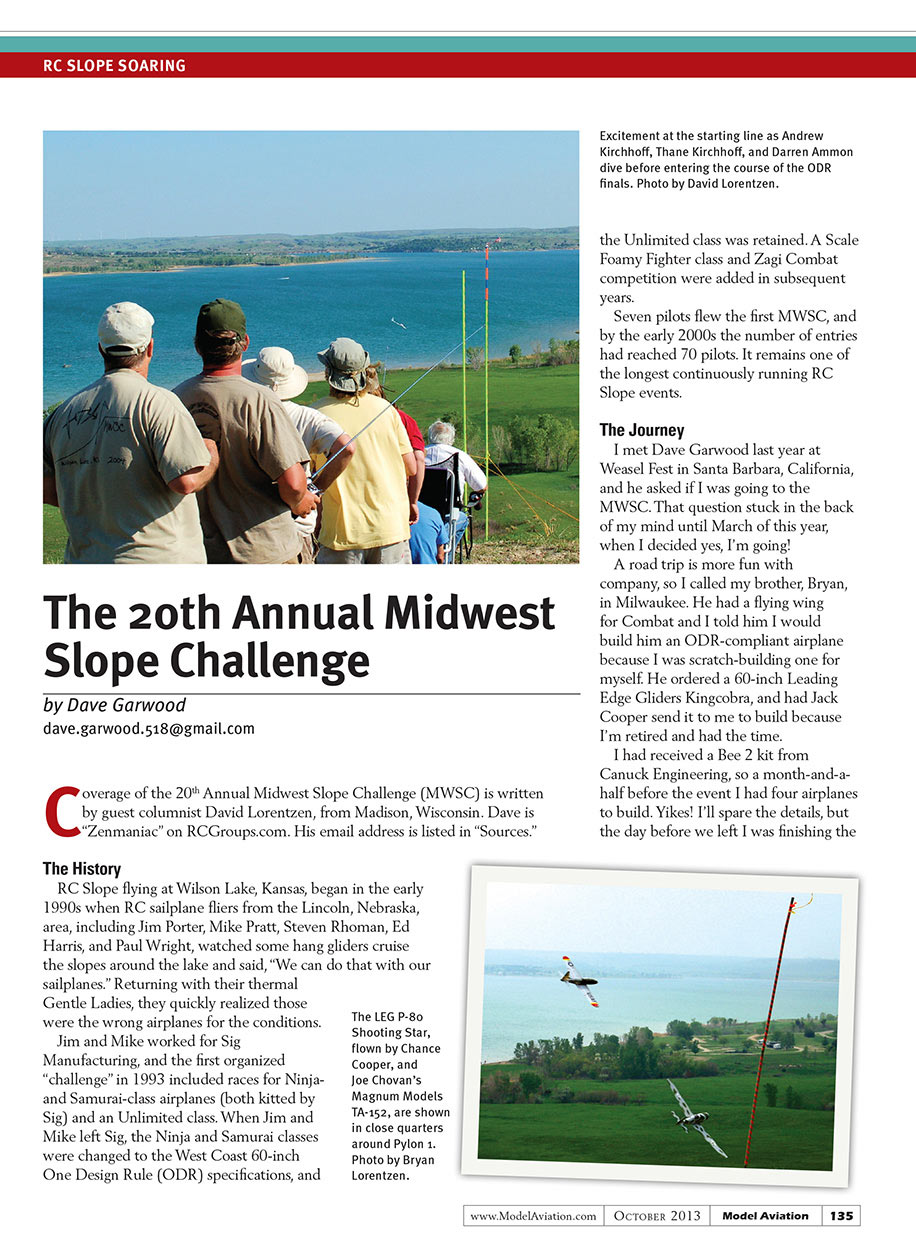
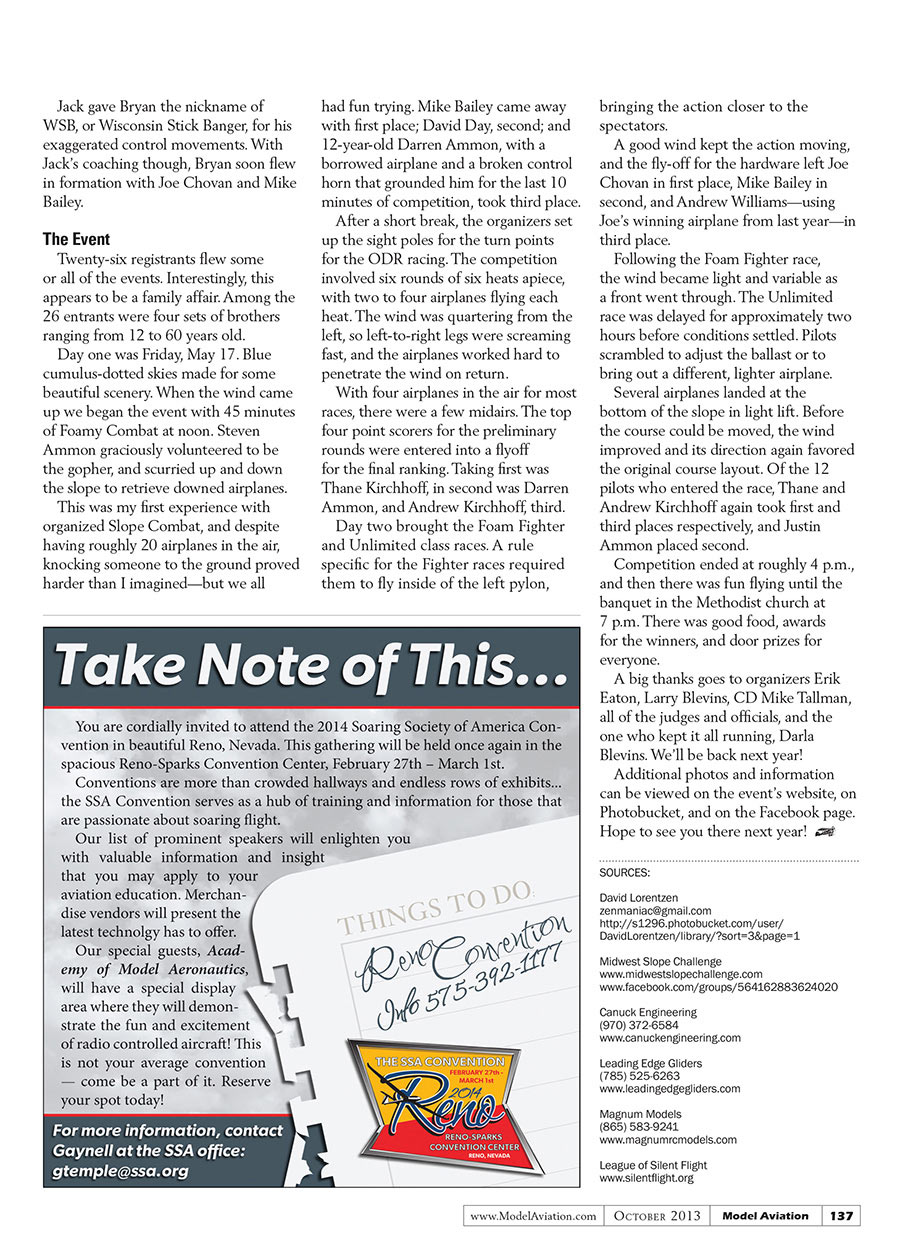
After a short break, the organizers set up the sight poles for the turn points for the ODR racing. The competition involved six rounds of six heats apiece, with two to four airplanes flying each heat. The wind was quartering from the left, so left-to-right legs were screaming fast, and the airplanes worked hard to penetrate the wind on return.
With four airplanes in the air for most races, there were a few midairs. The top four point scorers for the preliminary rounds were entered into a flyoff for the final ranking. Taking first was Thane Kirchhoff, in second was Darren Ammon, and Andrew Kirchhoff, third.
Day two brought the Foam Fighter and Unlimited class races. A rule specific for the Fighter races required them to fly inside of the left pylon, bringing the action closer to the spectators.
A good wind kept the action moving, and the fly-off for the hardware left Joe Chovan in first place, Mike Bailey in second, and Andrew Williams—using Joe's winning airplane from last year—in third place.
Following the Foam Fighter race, the wind became light and variable as a front went through. The Unlimited race was delayed for approximately two hours before conditions settled. Pilots scrambled to adjust the ballast or to bring out a different, lighter airplane.
Several airplanes landed at the bottom of the slope in light lift. Before the course could be moved, the wind improved and its direction again favored the original course layout. Of the 12 pilots who entered the race, Thane and Andrew Kirchhoff again took first and third places respectively, and Justin Ammon placed second.
Competition ended at roughly 4 p.m., and then there was fun flying until the banquet in the Methodist church at 7 p.m. There was good food, awards for the winners, and door prizes for everyone.
A big thanks goes to organizers Erik Eaton, Larry Blevins, CD Mike Tallman, all of the judges and officials, and the one who kept it all running, Darla Blevins. We'll be back next year!
Additional photos and information can be viewed on the event's website, on Photobucket, and on the Facebook page. Hope to see you there next year!
Transcribed from original scans by AI. Minor OCR errors may remain.

