
RC Soaring
Mike Garton, 506 NE 6th St., Ankeny IA 50021; E-mail: [email protected]
The Soaring portion of the AMA Nationals (Nats) was held July 22–29. We were graced with moderate temperatures and light winds the entire week. The site was AMA's International Aeromodeling Center in Muncie, IN. It has 1,000 acres of land groomed just for model airplanes.
Larrie Storie had the unenviable task of pulling together nearly 100 volunteers to run the contest, which was very smooth. The week started with Scale, Cross Country (XC), and F3B run concurrently Saturday. One frequency was allocated to each pilot by preregistration, which allowed the three events to take place simultaneously in different areas of the AMA site. In Scale, Pete George aerotowed competitors with his Dornier 27 towplane.
Scale
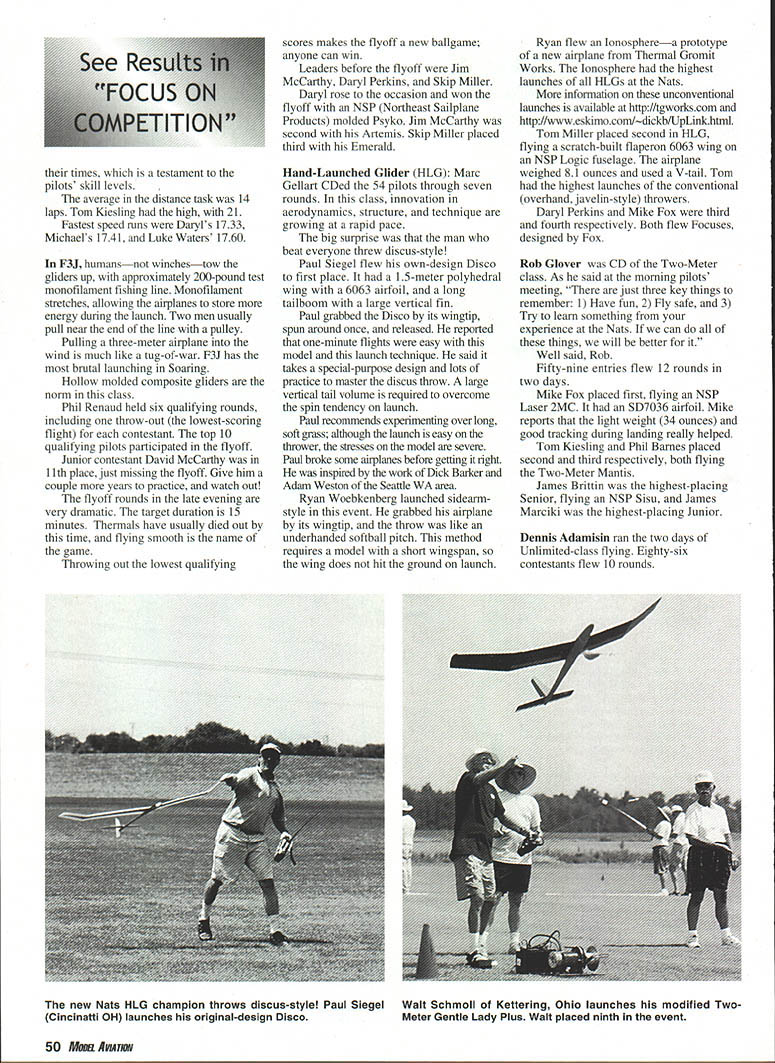
- Winner: Terry Edmonds — 4.5-meter ASW-20 with rudder, elevator, ailerons, flaps, spoilers, and retractable landing gear. Terry is a master at detailing and an extremely smooth flier.
- Second: Steve Leighton — 1/5-scale 1942 Piper TG-8 trainer glider (started life as a Sig J-3 Cub kit). The result weighed three pounds with a 72-inch wingspan. Steve reported the TG-8 flies well but has a "distinct rocklike quality." The glide is slightly flatter than a J-3 Cub's with the engine off. Steve looks forward to trying the model on the slope.
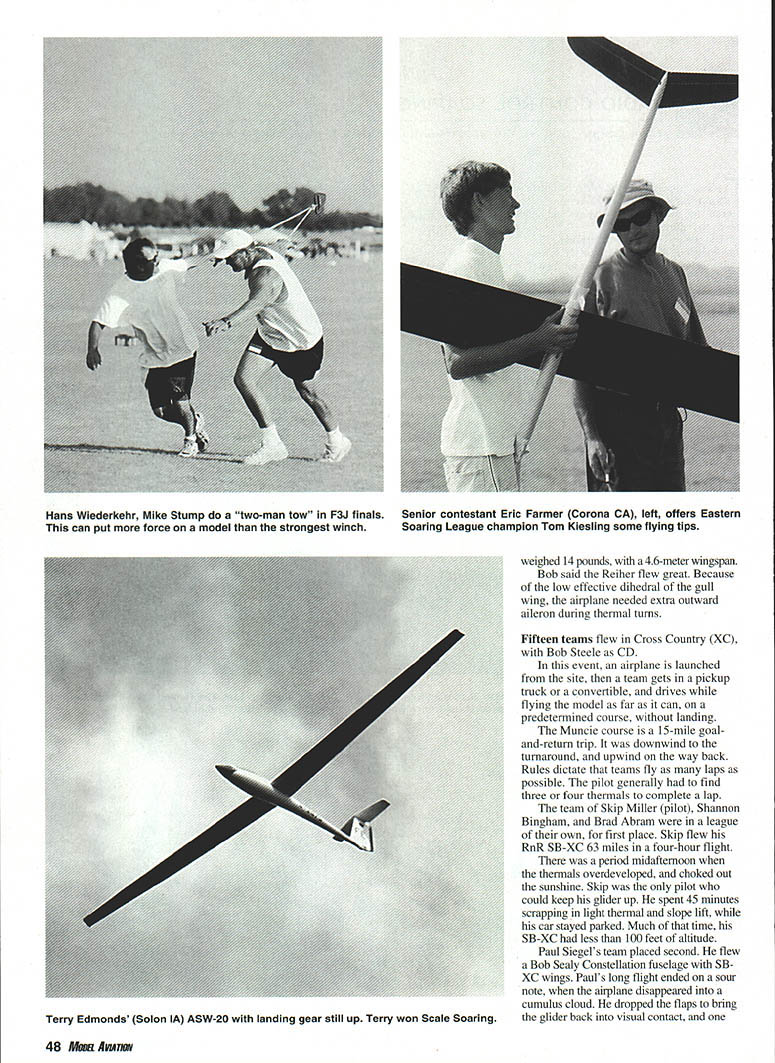
- Third: Bob Harold (Scale CD) — DFS Reiher 2 vintage glider, built from a Sealy short kit (fiberglass fuselage, foam wing cores, plans, and instructions). It weighed 14 pounds with a 4.6-meter wingspan. Bob said the Reiher flew great. Because of the low effective dihedral of the gull wing, the airplane needed extra outward aileron during thermal turns.
Cross Country (XC)
Fifteen teams flew in Cross Country (XC), with Bob Steele as CD. In this event, an airplane is launched from the site, then a team gets in a pickup truck or convertible and drives while flying the model as far as it can on a predetermined course without landing. The Muncie course is a 15-mile go-and-return trip: downwind to the turnaround and upwind on the way back. Rules dictate teams fly as many laps as possible; the pilot generally had to find three or four thermals to complete a lap.
- First: Team Skip Miller (pilot), Shannon Bingham, and Brad Abram — Skip flew his RnR SB-XC 63 miles in a four-hour flight. There was a period midafternoon when the thermals overdeveloped and choked out the sunshine. Skip was the only pilot who could keep his glider up. He spent 45 minutes scraping in light thermal and slope lift while his car stayed parked. Much of that time his SB-XC had less than 100 feet of altitude.
- Second: Paul Siegel’s team — Paul flew a Bob Sealy Constellation fuselage with SB-XC wings. His long flight ended when the airplane disappeared into a cumulus cloud; he dropped the flaps to bring the glider back into visual contact, and one wing was missing when the model reappeared below the cloud.
- Third: Eastern Iowa Soaring Society team (piloted by the author) — finished third with 17.1 miles.
On the XC course there was a half-mile area with tall trees lining the road that blocked the view of the sky and airplane; we called it the "tree tunnel." It was intimidating to go through the tree tunnel the first time. The model had to be high and in front of the vehicle. After zipping through the tree tunnel (at the speed limit), we had to stop the vehicle and look skyward to reacquire the glider. Those seconds seemed like hours.
F3B
Twelve pilots competed in F3B. Each round consists of a 10-minute duration flight, a closed-course distance task, and a timed "speed task" on a closed course. Dennis Phelan ran the event with six volunteers, and two complete rounds (six tasks total) were flown.
- Daryl Perkins achieved a perfect 3,000-point first round, and Michael Lachowski had a perfect second round. When the scores were tallied, Daryl's Round Two was better than Michael's Round One.
- Winner: Daryl Perkins — flew a Cobra (the most popular F3B airplane; five of the 12 pilots flew one).
- Other popular models: Muller 3-Cam (three pilots). Michael Lachowski flew a Tragi 702.
Making the 10-minute target duration is not easy with an 80-ounce F3B model. Seventeen of the 23 duration flights made in the contest were under four minutes. Fred Rettig's (Mobile, AL) Super-Vee Two-Meter airplane closes in on the spot, and Johnny Berlin times. Fred finished sixth in this event.
Scores makes the flyoff a new ballgame; anyone can win. Leaders before the flyoff were Jim McCarthy, Daryl Perkins, and Skip Miller. Daryl rose to the occasion and won the flyoff with an NSP (Northeast Sailplane Products) molded Psyko. Jim McCarthy was second with his Artemis. Skip Miller placed third with his Emerald.
Hand-Launched Glider (HLG)
Marc Gellart CDed the 54 pilots through seven rounds. In this class, innovation in aerodynamics, structure, and technique is growing rapidly. The big surprise was that the man who beat everyone threw discus-style!
- Winner: Paul Siegel — flew his own-design Disco: a 1.5-meter polyhedral wing with a 6063 airfoil and a long tailboom with a large vertical fin. Paul grabbed the Disco by its wingtip, spun around once, and released. He reported one-minute flights were easy with this model and launch technique. He cautioned that the launch is easy on the thrower but the stresses on the model are severe; he broke some airplanes before getting it right. He was inspired by Dick Barker and Adam Weston of the Seattle, WA area.
- Sidearm-style launch: Ryan Woekenberg — grabbed his airplane by its wingtip and threw underhand like a softball pitch. This method requires a short wingspan so the wing does not hit the ground on launch. Ryan flew an Ionosphere—a prototype of a new airplane from Thermal Gromit Works. The Ionosphere had the highest launches of all HLGs at the Nats.
- Second: Tom Miller — flew a scratch-built flaperon 6063 wing on an NSP Logic fuselage. The airplane weighed 8.1 ounces and used a V-tail. Tom had the highest launches among conventional (overhand, javelin-style) throwers.
- Third and fourth: Daryl Perkins and Mike Fox — both flew Focuses designed by Fox.
More information on these unconventional launches is available at http://www.rcsoaring.com and http://www.eskimo.com/~dickb/UpLink.html.
Two-Meter
Rob Glover was CD of the Two-Meter class. As he said at the morning pilots' meeting, "There are just three key things to remember: 1) Have fun, 2) Fly safe, and 3) Try to learn something from every experience at the Nats. If we can do all of these things, we will be better for it."
Fifty-nine entrants flew 12 rounds in two days.
- Winner: Mike Fox — flew an NSP Laser 2MC with an SD7036 airfoil. He reports the light weight (34 ounces) and good tracking made his glider really help.
- Second: Tom Kiesling — Two-Meter Mantis.
- Third: Phil Barnes — Two-Meter Mantis.
- Highest-placing Senior: James Brittlin — NSP Sisu.
- Highest-placing Junior: James Marcik.
Unlimited
Dennis Admasin ran the two days of Unlimited-class flying. Eighty-six contestants flew 10 rounds.
- Winner: Daryl Perkins — flew the NSP molded Psyko that he designed.
- Second: Jim Thomas — also flew a Psyko.
- Third: Karl Miller — NSP Victory C.
- Highest-placing Senior: Luke Waters.
- Top Junior: James Marcik.
I counted at least five Psykos in the top 10 places. Pilots report they like the way the Psyko covers sky and handles during landings. Joe Hahn's Spectre 120 stood out in this class. As with the HLG Spectre, this model had a very high aspect ratio and thin airfoils. At 46 ounces, it was probably the lightest three-meter airplane in Unlimited. The high aspect ratio keeps the wing loading up so the model can penetrate well. Joe was in the running for an Unlimited win; he said that seeing his name near the top of the list was too much pressure and he choked in the last rounds, finishing 15th.
Banquet and Awards
A banquet was held at the Muncie Convention Center Friday evening. Dinner was served. League of Silent Flight (LSF) officers spoke, special awards were presented, and the workers' raffle was held. The food was excellent. Anyone who goes to the Soaring Nationals should attend the banquet.
- Lee Gray award (outstanding contributions to Soaring): Cal Posztshuma (Coopersville, MI).
- Spirit of Soaring award: Bob Glover (Huntsville, AL).
- Dan Pruss Memorial award (team of three pilots from one club with highest combined place in Two-Meter and Unlimited): Long Island Silent Flyers — Tom Kiesling, Hans Wiederkehr, Luke Waters.
- Lee Renard award (best individual scores in Two-Meter and Unlimited combined): Tom Kiesling.
- Hi Johnson award (highest single score): Mike Fox — for his Two-Meter performance.
The Nats would not work without volunteers. Roy Simpson rounded up donations for the workers' raffle—$30,000 in prizes for the nearly 100 volunteers. To get a ticket, you had to volunteer at least one day at the contest. Many volunteers went home with a new airplane or radio.
RES and Nostalgia
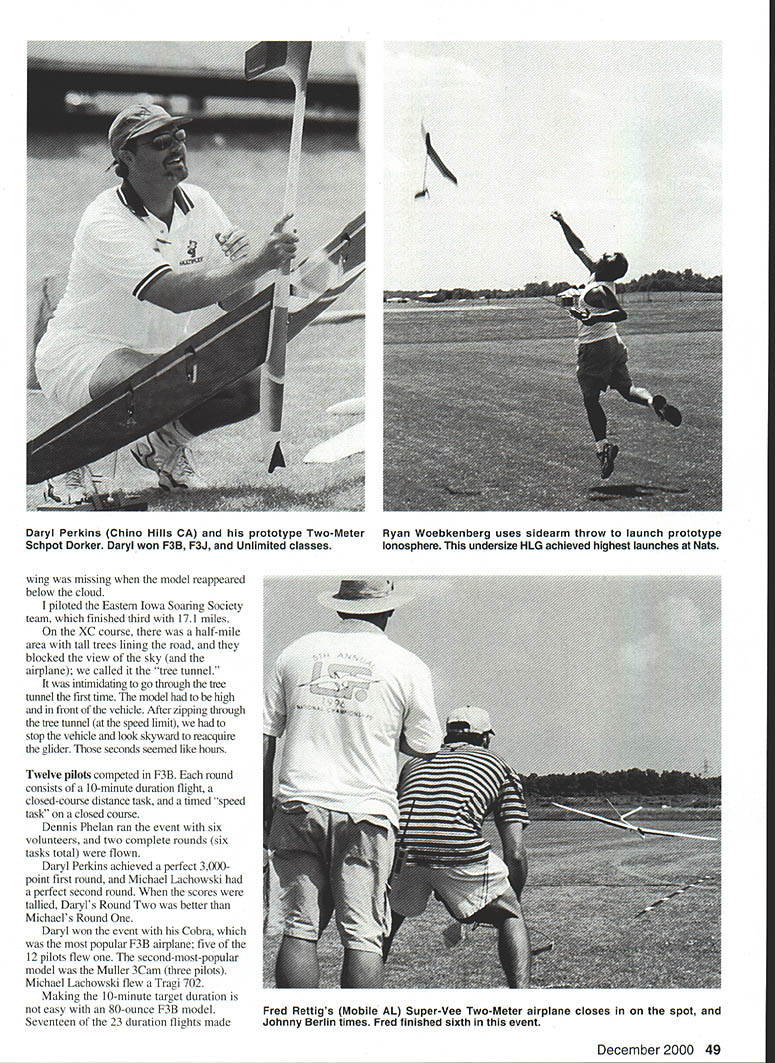
On the eighth day of the Nats, Jack Strother and Jack Iaferte ran RES and Nostalgia classes. There were 52 and 33 entries respectively. We got in two rounds of each before Nats Headquarters informed us of a quickly approaching thunderstorm. There was not time to complete a third round, so the contest was called. This was a good decision; many people had a long drive home. There was just enough time to put away the winches and hand out awards before the rain moved in.
RES class (Rudder-Elevator-Spoiler) does not allow flaps or ailerons.
- RES results:
- Lenny Keer — polyhedral version of the NSP Victory.
- Jim Thomas — Grand Esprit.
- Robert Johnson — Majestic.
Antique gliders can still be competitive in Nostalgia class. To be legal in this event, a design must have been published or released as a kit before January 1, 1980.
- Nostalgia results:
- Marc Gellart — Grand Esprit.
- John Agnew — Paragon.
- Ed Wilson — Aquila Grande.
- Robert Johnson — Bird of Time.
- Jack Iaferte (class founder) — Pierce-Aero Paragon.
I took group photos of Two-Meter, Unlimited, and Nostalgia/RES pilots with their airplanes. If you are interested in a reprint of any of these pictures, E-mail me or write to me. MA
Transcribed from original scans by AI. Minor OCR errors may remain.

