

RADIO CONTROL SOARING
Mike Garton, 2733 NE 95th Ave., Ankeny IA 50021; E-mail: [email protected]
This month I'll give a brief introduction to gyros for use in discus-launch gliders. The bulk of the column is coverage of the Midwest Slope Challenge.
Piezoelectric gyros for discus-launch gliders
At the International Hand Launch Glider Festival (IHLGF) this year I expected discus launching to be popular. It was. Only a couple guys threw javelin style. One surprise was that some of the top pilots were using piezoelectric gyroscopes (gyros).
The piezo gyros have been marketed for the tail rotors on Radio Control (RC) helicopters. They are rate gyros, not heading gyros; that means they sense the rate of angular movement rather than position.
The gyro does not steer the airplane for you; its purpose is to dampen oscillations.
On a typical discus launch, the glider leaves the thrower's hand with a little bit of a yawing motion. It is somewhat like the spin of a Frisbee, but much less severe.
An observer may be able to see the fuselage swing side to side a couple times, or "fishtail." The fishtailing typically dampens after one to two oscillations. All this takes place in a fraction of a second.
A large vertical tail and lightweight extremities will minimize the yaw oscillations in a passive way. Some pilots feel it is worthwhile to actively dampen the oscillations with a gyro. Some discus-launch glider fliers are hooking piezo gyros in series with the rudder servo.
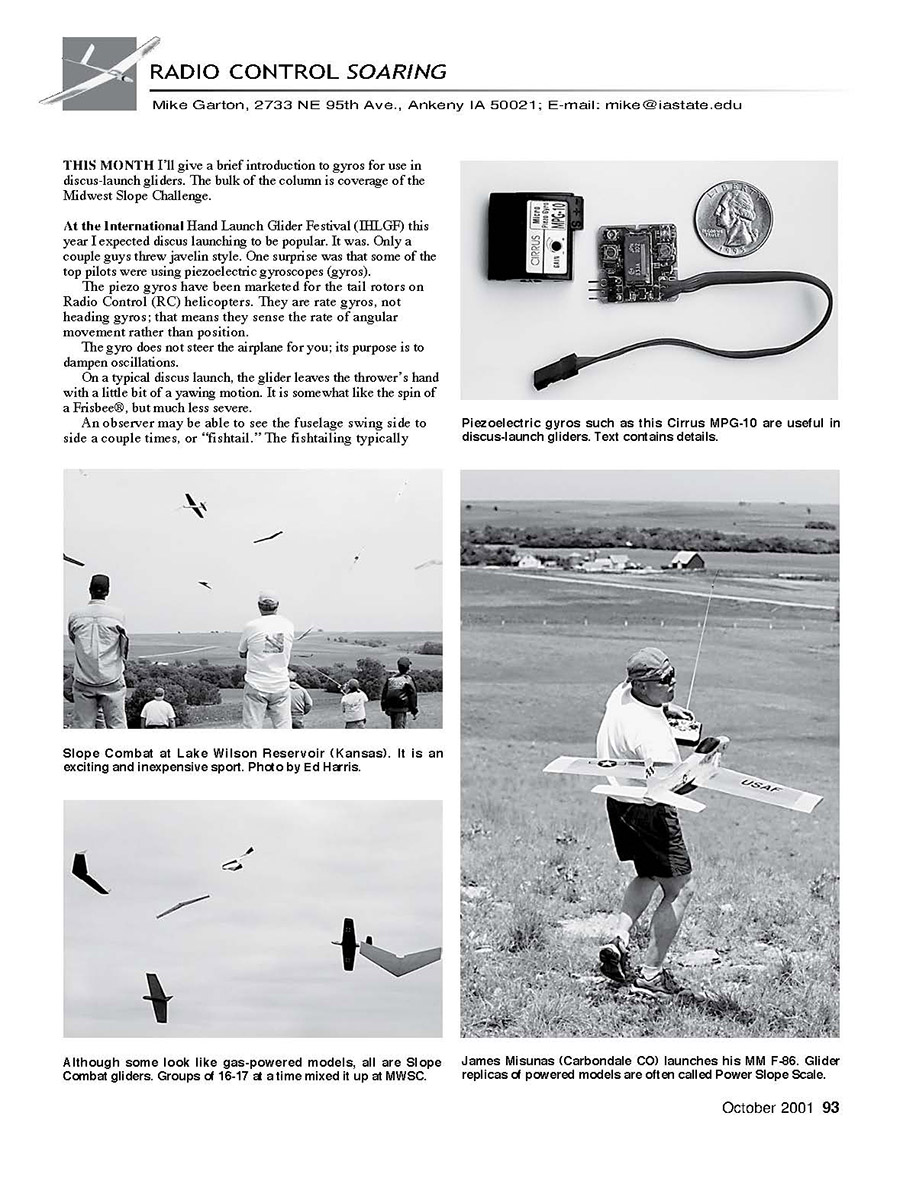
A piezo gyro is a solid-state device. It is just a circuit board with a special “piezoelectric” sensor chip on it. The term piezoelectric means that it produces a voltage when a force is put on it. The reverse works as well.
Piezo gyros are less expensive to manufacture, more durable, and more accurate than the old spinning-flywheel gyros.
However, the piezo gyro is not bulletproof; a crash that damages your receiver may also damage your gyro.
The gyro in use at the IHLGF has a Cirrus label on it and is distributed by Hobbico. It weighs 7 grams with its case and 4.8 grams without it. Included in the package are a couple pieces of padded double-stick tape for mounting. It has a gain-adjustment screw that cannot be controlled remotely.
There are a couple quirks involved with the use of a gyro.
- Initialization
- The airplane must be still for approximately five seconds after you power up the flight pack.
- The electronics in the gyro are setting the zero relative to the output of the sensor. If you move the model, you will need to turn it off and start over.
- Drift
- The gyro measures yaw rate many times in a second. Measurements will accumulate. It is perfectly normal for the neutral setting of a gyro to drift in time.
- This drift will show up as an out-of-trim rudder. In a one-minute Hand-Launched Glider (HLG) contest flight, it is probably not significant. You may want to check the centering of the rudder halfway through a round.
- If you fly a gyro-equipped HLG for 10–15 minutes, expect the rudder trim to become significantly off.
The gain must be set for your particular airplane. If you turn the gain up too high, a yaw disturbance will lead to forced oscillations. This means the rudder correction is overshooting or getting out of phase with the yawing. Instead of dampening the oscillations, the gyro drives it.
Try starting with the gain at 25% and slowly increase it until you see forced oscillations, then back it down a little.
The package for this gyro says nothing about temperature compensation. The servo or gyro will drift with temperature changes. Gyro users may want to paint the top of their carbon fuselages.
More expensive (larger and heavier) gyros are often temperature-compensated.
In my experience discus launching without a gyro, the harder I throw the model, the less fishtailing I see. Apparently the spin imparted on the glider stays relatively constant, but the yaw dampening of the tail increases with increased speed.
Some pilots report that they are getting an additional 10–20 feet in launch height with the gyro. The utility of the gyro will depend on the model you are flying and your launching style. If you can see much fishtailing on your typical launch, it will help.
Midwest Slope Challenge (MWSC)
The Midwest Slope Challenge (MWSC) is probably the largest slope event east of the Rockies. It is also one of the largest in the nation. This year 56 pilots from 12 states attended.
MWSC is hosted by the Lincoln (Nebraska) Area Soaring Society. The site is Lake Wilson Reservoir near Lucas, Kansas. This year the event was held May 16–18.
Wilson Reservoir is a world-class slope site. Six-foot bank hills with fern trees surround the water. Most wind directions except north can be accommodated. A north-facing slope in a private pasture approximately 10 miles from the lake was put into use for Friday’s flying at MWSC.
Many pilots choose to go to the Midwest Slope Challenge for the fun-flying before and after the scheduled events.
Lucas is literally in the middle of nowhere. You know you are far from civilization when houses have television antennas that extend 20 feet above their roofs.
Most pilots stay at the Lucas Country Inn. Some people would probably be appalled by the shared restrooms. Slope soarers and hunters find it to be worth $26 a night. There are also cottages in Lucas that are rented for $200–$250 per week.
Loren Bline and the Lincoln Area Soaring Society ran Combat, One-Design Racing (ODR), and Unlimited class racing. Fannie Warbird Racing was also scheduled, but the winds did not blow long enough to run it.
Slope Combat
Slope Combat has not been featured in this magazine recently, so I will describe it. All pilots fly expanded polypropylene (EPP) foam airframes. EPP is the springy foam that bounces back to shape after being compressed.
These models are reinforced with fiberglass filament packing tape. Typically, no spars are installed within the front three inches of the wing. Much of the construction uses Neco foam, which is one of the airframe materials used for safety.
Fannie Combat airplanes take crashes and midairs in stride, usually with no damage. It is common to see a model crash, be given a quick once-over, then be flying again in less than a minute. The airframes cost roughly $50. They only take one evening to build.
In a Combat contest, each pilot tries to knock the other pilots out of the sky. After midair collisions, both airplanes usually recover before hitting the slope. If one model goes down, the other pilot has the opportunity to earn a point.
To "claim the kill," you knock another airplane to the ground, then demonstrate control by completing a loop or roll. It is prudent for both pilots to immediately do a power-on circle in the hope that the other model will go down. In this manner, it is possible to earn points even while being more of a target than an aggressor.
In the MWSC Combat event, 51 pilots flew in three groups of 17. The winds were light most of the time.
The winners flew flying wings, such as the ZuZu SG or the Boomerang. Replica fighter airplanes, often called "foamies" or "warbirds," were put in the same class as the flying wings. These airplanes look like powered models, but with no engines.
The foamy warbirds had enough wind to stay airborne, but not enough wind to hunt aggressively. The flying wings have lighter wing loading, so they are more at home in the light-air conditions.
The flying wings also have a definite advantage in the ability to recover after contact. In stronger lift, the speed and controllability of the conventional warbirds would have evened the playing field.
Duane Jenkins of Carbondale, Colorado won the Combat event. Duane had five kills in the regular rounds and four in the final.
In second place was William Crane of Parkville, Missouri, who was nicknamed "Mr. Clean." Although this was Mr. Clean’s first slope Combat contest, he is an experienced power-Combat flier.
New kits and manufacturers
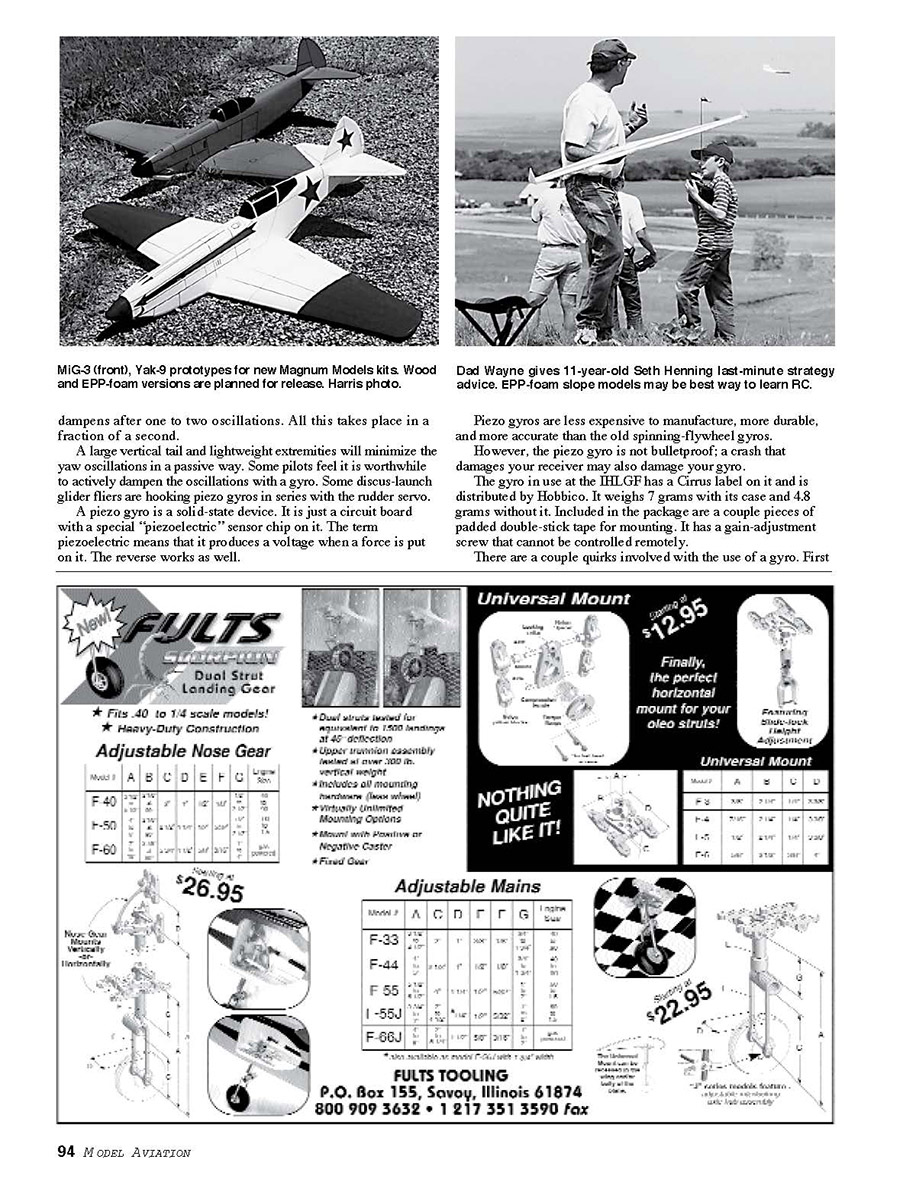
Larry Blevins of Magnum Models had a couple prototype slope airplanes at the event. Larry will be producing MiG-3 and Yak-9 kits. An EPP-foam Combat version and a wood-over-foam version of each kit will be produced.
Wood tails or Coroplast™ (corrugated plastic sign material) are available as options. The models typically weigh 28 ounces. The wood versions use the SD6060 airfoil. The foam warbirds use the S3016 airfoil for better light-lift performance.
The foamies will sell for $60 plus shipping and handling. They are suitable for bungee launches.
One-Design Racing (ODR)
Twenty-nine pilots entered the ODR class. The idea behind this category is to eliminate the expensive arms race that takes place in Unlimited racing. Affordable, well-matched aircraft maximize the racing fun.
All pilots fly the CR Fun One or clones in ODR. These 60-inch aircraft are efficient enough to race in light lift. They can also fly pretty fast in good lift. Because of the low winds at the lake, the minimum flying weight of 25 ounces was enforced.
Three or four models were flown per heat. After each pilot had flown in four heats, Paul Wright (London, England) was in first and four men were tied for second. A flyoff was required to determine which three would fly with Paul in the final round, in which each pilot has a clean slate.
Jim Porter (Bettendorf, Iowa), Wayne Henning (Bellevue, Nebraska), and Dave Garwood (Scotia, New York) beat poor Paul in the final.
The races are close and exciting in the ODR class. A Web-site address for the official rules is given at the end of the column. Look for more ODR-legal kits in the very near future.
Unlimited racing
Unlimited racing was the last event. Two airplanes were flown per heat in double-elimination brackets. After slow early rounds, the winds picked up to allow some high-speed racing. Jim Porter took top honors with his Shredair Brisk.
Pat McCleave was second, flying his Maple Leaf Image. Wayne Henning proved that it is more pilot than airplane by placing third with a Jouster — a thermal model designed by Harley Michaelis.
Sources
- Topography maps of Lake Wilson Reservoir: www.geocities.com/smillersmiller/lake_wilson/index.html
- Lucas Country Inn: (785) 525-6358
- Thacker’s Cottages (Lucas KS): (785) 525-7739
- CR High Performance Aircraft (Fun One): 205 Camille Way, Vista CA 92083; (760) 630-8775
- One-Design Racing rules: www.eiss.cnde.iastate.edu/articles/ODR.html
- Magnum Models: Larry Blevins, Box 47, Lake City TN 37769; Evening tel. (Eastern time): (865) 426-4826; [email protected]; www.magnum-models.com
- MM Glider Tech: Box 39908, Downey CA 90239; (562) 927-2583; [email protected]; www.mmglidertech.com/f86.html
- Midwest Slope Challenge write-ups:
- MWSC official Web page: www.alltel.net/~mwsc/index.html
- www.slopeflyer.com
- June EISS newsletter: www.eiss.cnde.iastate.edu
- Dave Garwood’s coverage in Model Airplane News magazine
Transcribed from original scans by AI. Minor OCR errors may remain.

