
RADIO CONTROL SOARING
Mike Garton, 2733 NE 95th Ave., Ankeny IA 50021-1904; E-mail: [email protected]
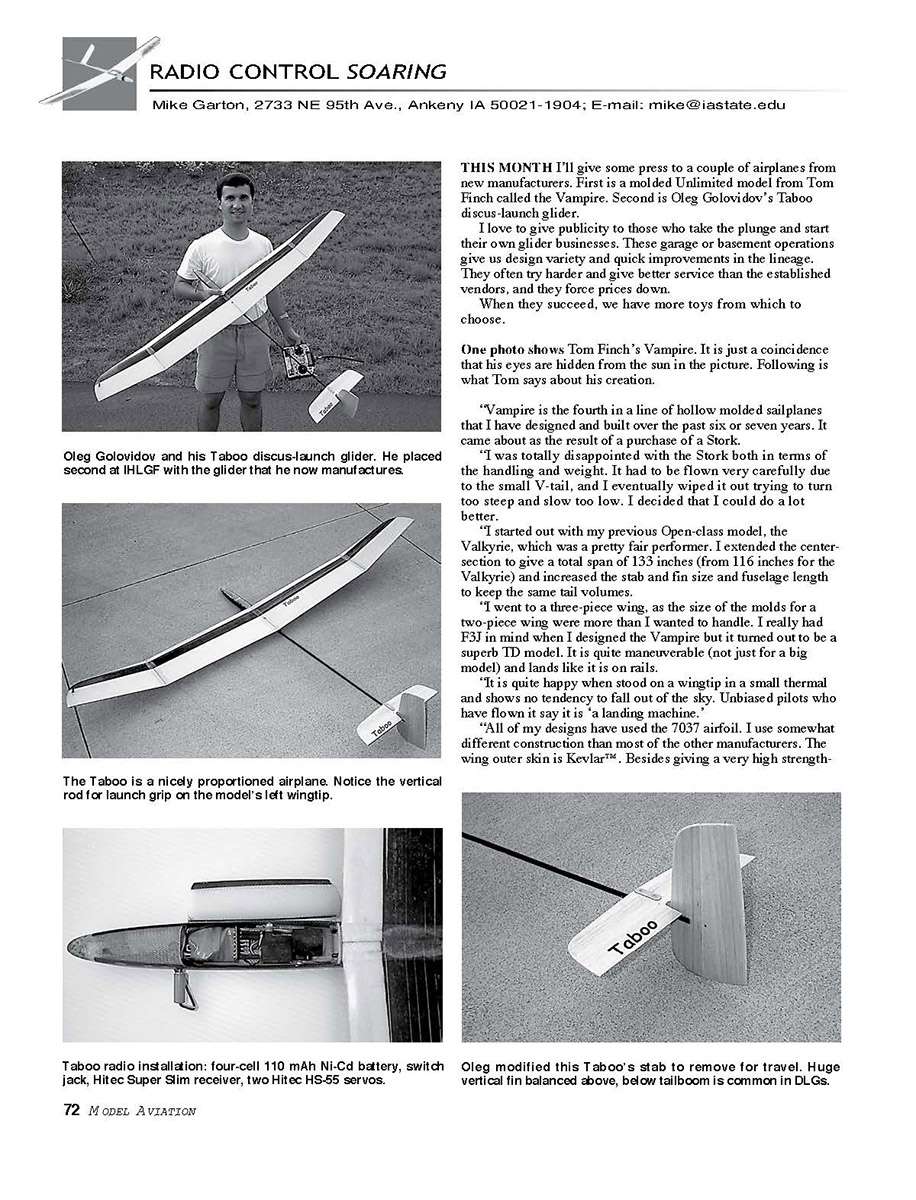
THIS MONTH I'll give some press to a couple of airplanes from new manufacturers. First is a molded Unlimited model from Tom Finch called the Vampire. Second is Oleg Golovidov's Taboo discus-launch glider.
I love to give publicity to those who take the plunge and start their own glider businesses. These garage or basement operations give us design variety and quick improvements in the lineage. They often try harder and give better service than the established vendors, and they force prices down.
When they succeed, we have more toys from which to choose.
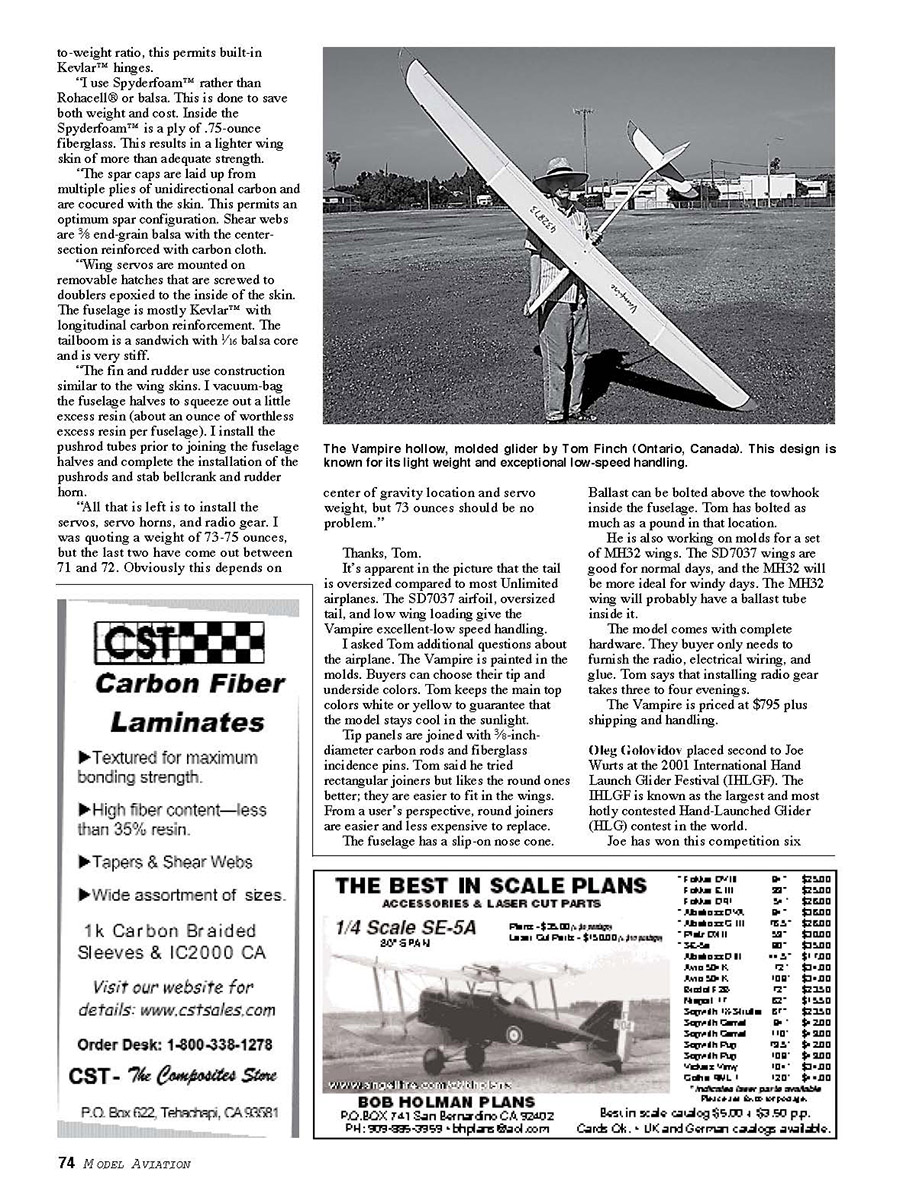
One photo shows Tom Finch's Vampire. It is just a coincidence that his eyes are hidden from the sun in the picture. Following is what Tom says about his creation.
"Vampire is the fourth in a line of hollow molded sailplanes that I have designed and built over the past six or seven years. It came about as the result of a purchase of a Stork.
"I was totally disappointed with the Stork both in terms of the handling and weight. It had to be flown very carefully due to the small V-tail, and I eventually wiped it out trying to turn too steep and slow too low. I decided that I could do a lot better.
"I started out with my previous Open-class model, the Valkyrie, which was a pretty fair performer. I extended the center section to give a total span of 133 inches (from 116 inches for the Valkyrie) and increased the stab and fin size and fuselage length to keep the same tail volumes.
"I went to a three-piece wing, as the size of the molds for a two-piece wing were more than I wanted to handle. I really had F3J in mind when I designed the Vampire but it turned out to be a superb TD model. It is quite maneuverable (not just for a big model) and lands like it is on rails.
"It is quite happy when stood on a wingtip in a small thermal and shows no tendency to fall out of the sky. Unbiased pilots who have flown it say it is 'a landing machine.'
"All of my designs have used the 7037 airfoil. I use somewhat different construction than most of the other manufacturers. The wing outer skin is Kevlar™. Besides giving a very high strength-to-weight ratio, this permits built-in Kevlar™ hinges.
"I use Spyderfoam™ rather than Rohacell® or balsa. This is done to save both weight and cost. Inside the Spyderfoam™ is a ply of .75-ounce fiberglass. This results in a lighter wing skin of more than adequate strength.
"The spar caps are laid up from multiple plies of unidirectional carbon and are covered with the skin. This permits an optimum spar configuration. Shear webs are 3/8 end-grain balsa with the centersection reinforced with carbon cloth.
"Wing servos are mounted on removable hatches that are screwed to doublers epoxied to the inside of the skin. The fuselage is mostly Kevlar™ with longitudinal carbon reinforcement. The tailboom is a sandwich with 1/16 balsa core and is very stiff.
"The fin and rudder use construction similar to the wing skins. I vacuum-bag the fuselage halves to squeeze out a little excess resin (about an ounce of worthless excess resin per fuselage). I install the pushrod tubes prior to joining the fuselage halves and complete the installation of the pushrods and stab bellcrank and rudder horn.
"All that is left is to install the servos, servo horns, and radio gear. I was quoting a weight of 73-75 ounces, but the last two have come out between 71 and 72. Obviously this depends on center of gravity location and servo weight, but 73 ounces should be no problem."
Thanks, Tom.
It's apparent in the picture that the tail is oversized compared to most Unlimited airplanes. The SD7037 airfoil, oversized tail, and low wing loading give the Vampire excellent low-speed handling.
I asked Tom additional questions about the airplane. The Vampire is painted in the molds. Buyers can choose their tip and underside colors. Tom keeps the main top colors white or yellow to guarantee that the model stays cool in the sunlight.
Tip panels are joined with 3/8-inch-diameter carbon rods and fiberglass incidence pins. Tom said he tried rectangular joiners but likes the round ones better; they are easier to fit in the wings. From a user's perspective, round joiners are easier and less expensive to replace.
The fuselage has a slip-on nose cone. Ballast can be bolted above the towhook inside the fuselage. Tom has bolted as much as a pound in that location.
He is also working on molds for a set of MH32 wings. The SD7037 wings are good for normal days, and the MH32 will be more ideal for windy days. The MH32 wing will probably have a ballast tube inside it.
The model comes with complete hardware. The buyer only needs to furnish the radio, electrical wiring, and glue. Tom says that installing radio gear takes three to four evenings.
The Vampire is priced at $795 plus shipping and handling.
This year he flew a combination of airplanes from Maple Leaf and Raptor Aerosports. I thought it would be worth taking a closer look at the guy from Raleigh, North Carolina who came within eight points of beating Joe.
Oleg calls his discus-launch glider design the Taboo. He has been refining his HLG designs for several years.
When the discus-launch technique became mainstream recently, Oleg modified his design for discus launching. As are all discus-launch airplanes, the Taboo is much stronger than the typical javelin-launch design.
The wings are blue foam, carbon, and 1.4 ounce fiberglass. The Taboo uses airfoils that Mark Dela designed. The root of the wing is the AG04, which is 6.42% thick with 1.75° camber. The wing transitions to the AG08 airfoil with 5.83% thickness and 1.87° camber.
Pilots report that this family of airfoils penetrates well and floats. Mark has created some of the very few airfoils designed from the outset to operate at low Reynolds numbers. All the published Selig sections are thicker than optimum for a small, slow model.
This AG-03 through AG-11 series covers the optimum thickness range for our airplanes without the need for crude thinning transformations.
The fuselage has a fiberglass pod reinforced with carbon. The flat fuselage bottom makes it easy to install servos on their sides with double-stick tape. Pushrods are .030-inch carbon rods in yellow Sullivan nylon tubes. Tails are light balsa covered with .75-ounce fiberglass.
The total weight with 110 mAh NiCds, Hitec 555 receiver, and two HS-55 servos is approximately nine ounces.
I asked Oleg if he had tried the Cirrus gyro. His reply was:
"The gyro definitely helps during the launch by eliminating the one to two oscillations that happen right after release. With the gyro, the airplane behaves like it's on rails. Without the gyro, it wiggles a couple of times and then goes straight up.
The gain in altitude is probably on the order of 10-15 feet."
I also asked him if that was a Hollyday Switch back in the pictures.
"I use both Hollyday MicroSwitches and RadioS/mack switch jacks and highly recommend the Hollyday ones (if the money allows it) they are much better quality and have a very solid feel. It is the same difference as an molded glider and a built up glider—both can fly and thermal, but there is a big difference in performance (and price too)."
Oleg hand-builds each Taboo after it is ordered. He says this is the best way to ensure that each airplane has the best design improvements.
Hollyday Designs is handling Oleg's marketing and sales. Together they are advertising a 30-day money back guarantee and a one-year warranty against manufacturer's defect.
I like the money-back guarantee. If you would not have purchased an item after close inspection, the mail-order vendor has taken a advantage of you. The success of the manufacturer's defect warranty has potential of being abused by either party.
It is obvious that Oleg and Rich Hollyday are confident you will like their product. Hollyday stocks spare parts.
The Taboo's price as of my deadline was $325 plus shipping and handling.
Sources:
Vampire: Tom Finch 12226 S. Cypress Ave. Ontario CA 91762 (909) 391-2838
Taboo: Distributed through Hollyday Designs 4709 Randolph Ct Raleigh NC 27606 (919) 832-0199 (Monday through Friday, 9 a.m.-5 p.m. Eastern time) www.hollyday.com
Transcribed from original scans by AI. Minor OCR errors may remain.

