

RC Soaring
Mike Carton. 2733 NE 85th Ave., Ankeny IA 50021; e-mail: [email protected]
Pilots came from 26 states to attend the eight days of the AMA League of Silent Flight (LSF) Soaring Nationals (Nats), held July 21-28.
Some aspire to glory in one sense or another. The marathon-style scoring takes many resources, but it is the ultimate way to choose a National Champion.
Many pilots treat the Nats as a vacation with flying. No qualifying is necessary; if you can control your airplane in a safe manner, you can fly at the Nats.
This “boot camp for glider fliers” allows new people to learn from the seasoned competitors. All of the pilots look forward to seeing old friends and new toys at the Nationals.
Approximately 60 volunteers worked the contest. Some, such as Mary and Larry Jefferies, worked full-time all week. Most worked while they were not flying. Larry Storie was the lead volunteer.
Each year generous vendors donate radio systems, airplanes, and hardware that are raffled off to the volunteers. One day of helping earns one raffle ticket. Without the support of the volunteers, there could not be a Soaring Nats.
There were nine entries in FSB. Even with rain delays, Dennis Plehn managed to run three rounds each of distance, duration, and speed.
Michael Lachowski of Pittstown, New Jersey placed first. He flew a Taji 701 with full carbon wing and MHS2 airfoil. Mike had the most laps in a distance round with 24.
Tom Kiesling of Johnstown, Pennsylvania placed second, flying a Taji 702 with RG15 airfoil. He had the fastest speed time with 19.08 seconds.
In third place was Ben Lawless of Owings, Maryland with a Taji 701.
Sixteen teams showed up for Cross Country Tow in this event, a team needed to launch from the AMA grounds and fly as many laps of the 16-mile road course as possible without landing.
Each team rides in a pickup truck or convertible so the pilot can fly as they drive down the road.
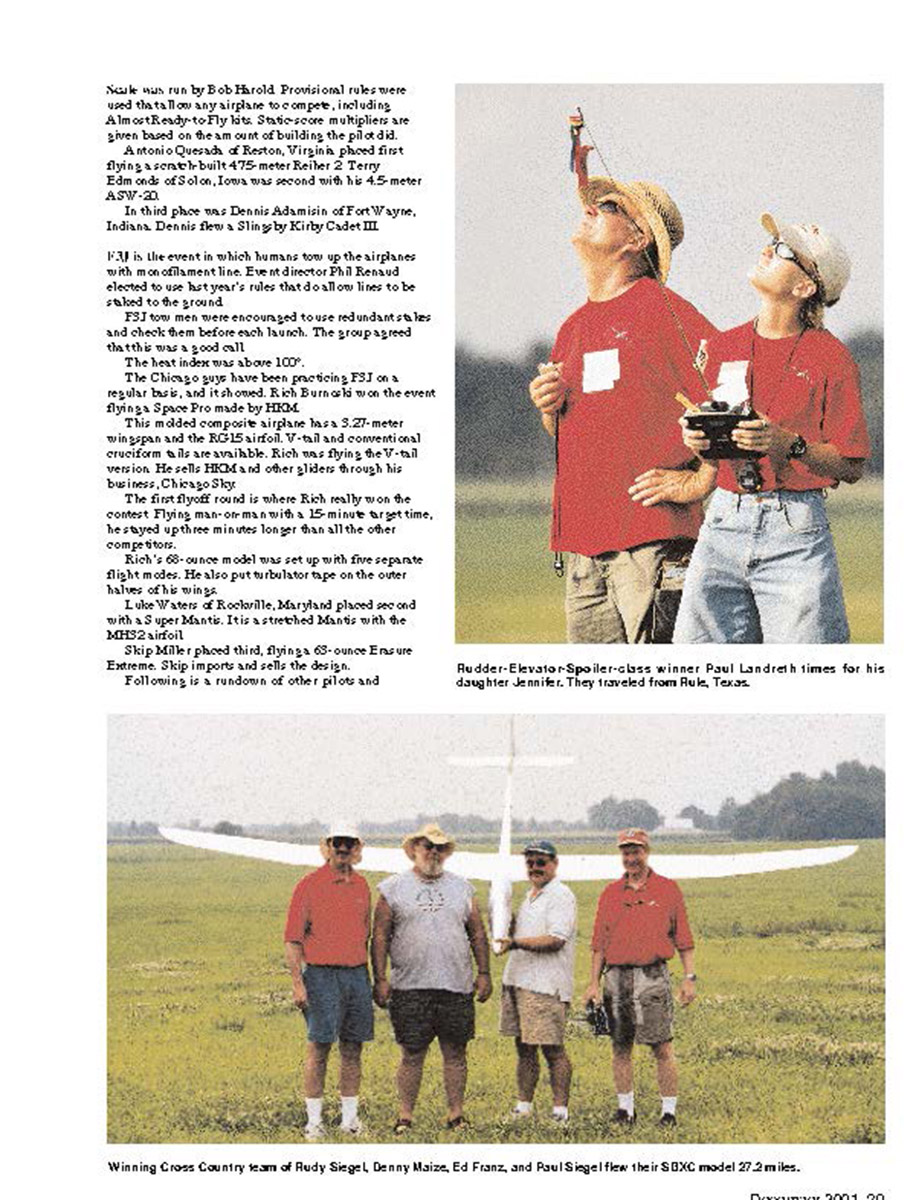
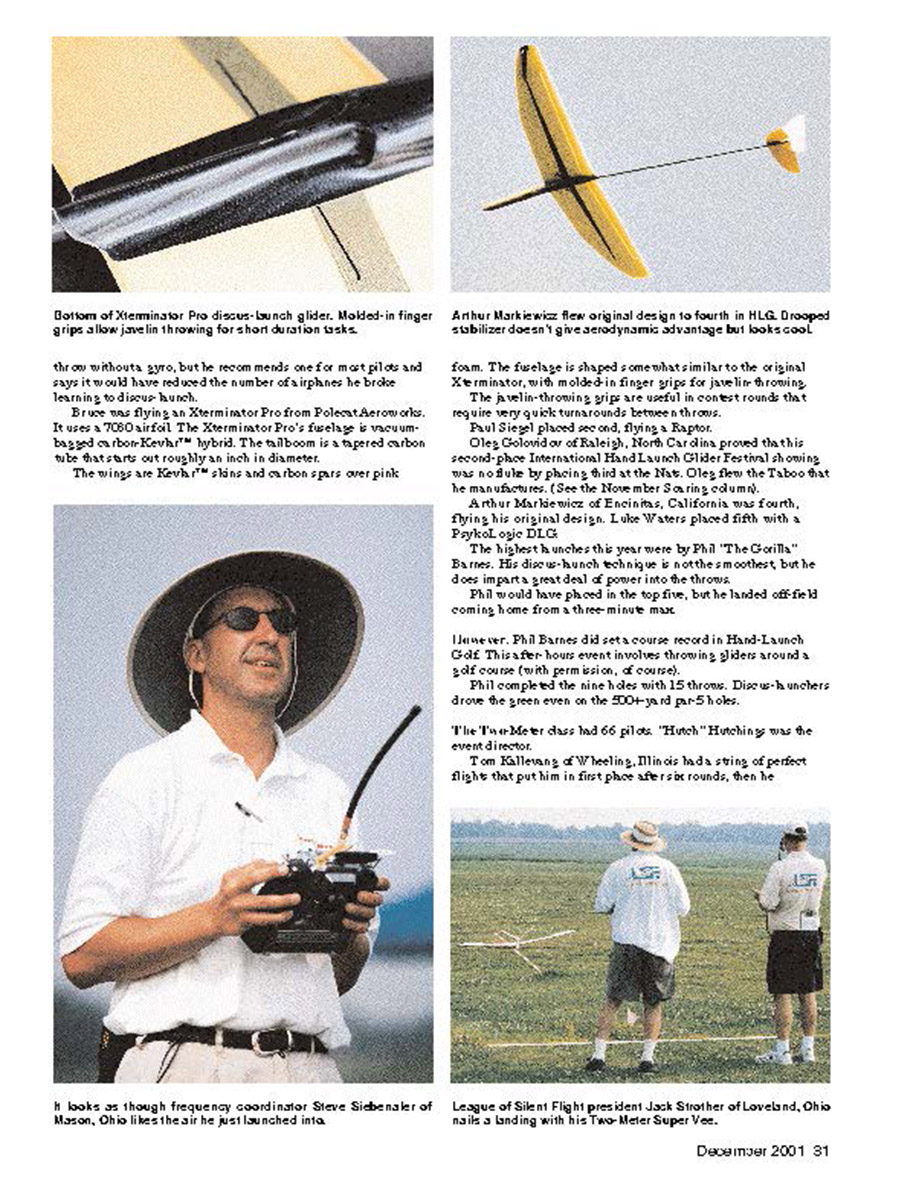
Paul Siegel of Cincinnati, Ohio and his Dayton Area Thermal Soarers (DARTS) team flew 27.2 miles for first place. His flight lasted two hours and 45 minutes. Paul was flying an SBXC and used a Telario Talk variometer.
Second place, with 22.2 miles, was team Eastern Iowa Soaring Society (EISS), piloted by me. I flew a Rusty Shaw design with a Multiplex variometer. The run took one hour and 57 minutes.
The lead changed hands on course six times between the EISS and DARTS teams. One of the times we passed Paul on course, his airplane was below treetop altitude. He caught a thermal and eventually went on for the win.
Skip Miller of Boulder, Colorado and the Rocky Mountain Soaring Society placed third. Skip flew his SBXC for 13.5 miles.
Don Richmond of San Diego, California flew his SBXC 10.0 miles for fourth place. Jack Strother of Loveland, Ohio placed fifth with 7.9 miles.
Task was run by Bob Harold. Provisional rules were used that allow any airplane to compete, including Almost-Ready-to-Fly kits. Static-score multipliers are given based on the amount of building the pilot did.
Antonio Quezada of Reston, Virginia placed first flying a scratch-built 4.75-meter Reiher 2. Terry Edmonds of Solon, Iowa was second with his 4.5-meter ASW-20.
In third place was Dennis Adamisin of Fort Wayne, Indiana. Dennis flew a Slinky by Kirby Cadet III.
F3J is the event in which humans tow up the airplanes with monofilament line. Event director Phil Renaud elected to use hot-peg rules that do allow lines to be staked to the ground.
F3J tow men were encouraged to use redundant stakes and check them before each launch. The group agreed that this was a good call.
The heat index was above 100.
The Chicago guys have been practicing F3J on a regular basis, and it showed. Rich Burnaski won the event flying a Space Pro made by HOK.
This molded composite airplane has a 3.27-meter wingspan and the RG15 airfoil. V-tail and conventional cruciform tails are available. Rich was flying the V-tail version. He sells HOK and other gliders through his business, Chicago Sky.
The first flyoff round is where Rich really won the contest. Flying man-on-man with a 15-minute target time, he stayed up three minutes longer than all the other competitors.
Rich's 68-ounce model was set up with five separate flight modes. He also put turbulator tape on the outer halves of his wing.
Luke Waters of Rockville, Maryland placed second with a Super Mantic. It is a stretched Mantic with the MH32 airfoil.
Skip Miller placed third, flying a 63-ounce Ensure Extreme. Skip imports and sells the design.
Following is a rundown of other pilots and airplanes that made the flyoff in order of final placing.
Jack Strother flew a 66-ounce Artemis Light. Jason Werner of Fallston, Maryland flew an Escape. Tom Kiesling flew a Super Mantic and a 3.7-meter Sharon. Bill Wingstedt of Oswego, Illinois also flew the big Sharon.
Shannon Bingham of Boulder, Colorado flew an Emerald. Paul Siegel flew a Super Mantic. Cal Plathum of Coopersville, Michigan flew a sturdy 63-ounce Sapphire. Cal used Vantablack™ on the obechi-skinned wing and lightened the tail.
Jim Carlin did a wonderful job of running Hand-Launched Glider (HLG). He used eight-minute working times instead of the normal 10. This allowed him to get in even rounds.
Fifty-two pilots preregistered for HLG, but only 34 showed up to fly. I speculate that the low entries are related to the obsolescence of the javelin airplanes and the short supply of discus models. Most of the discus kits became available this spring and have waiting lists.
In the long run, discus-launching will actually increase the number of pilots. Although there is technique to learn, it is much less stressful on the body. Little or no arm strength is required to get a high launch. Several retired gentlemen were throwing discus airplanes to great heights this year.
Piezoelectric gyros were widely used in HLG. They are used in discus-launch gliders in series with the rudder servo. That dampens the yawing or fishtailing sometimes seen right after the model leaves the thrower's hand.
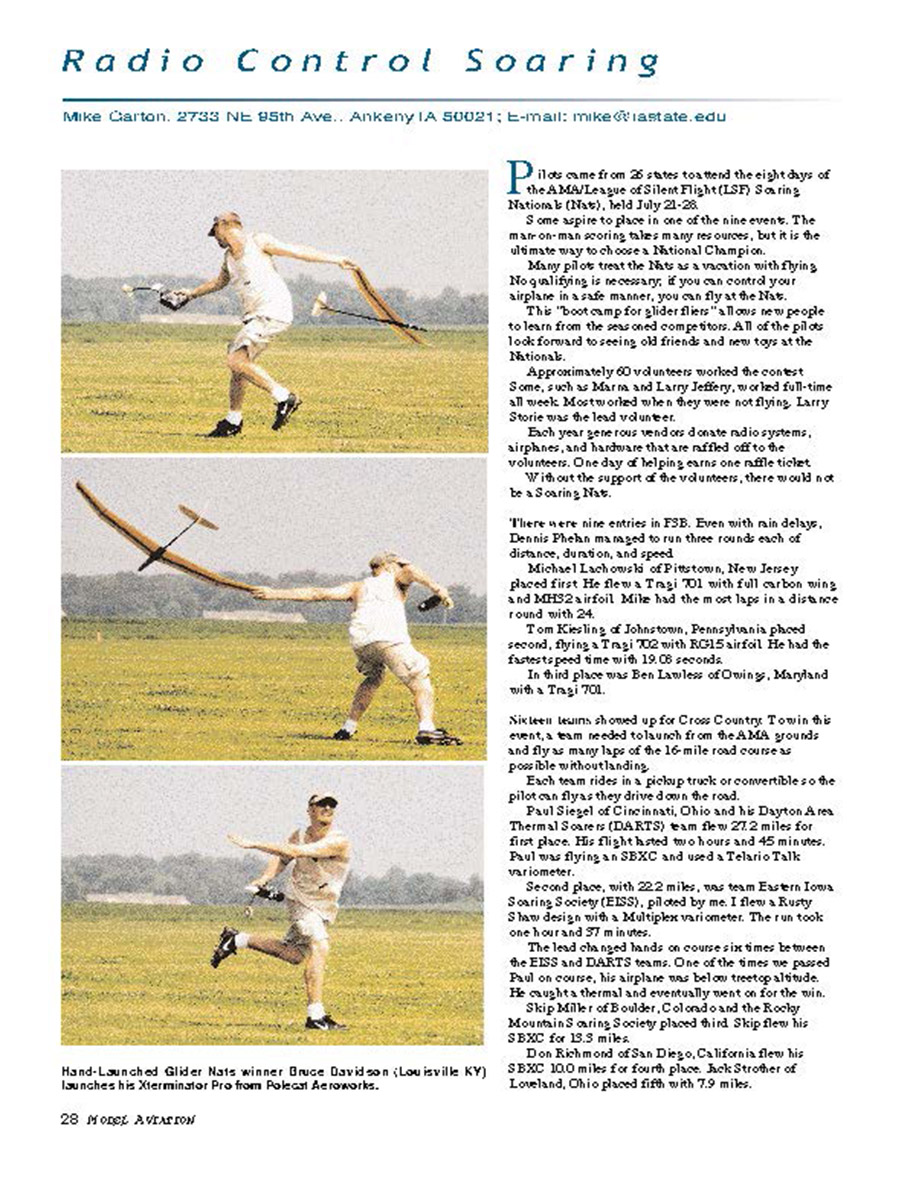
Bruce Davidson of Louisville, Kentucky won HLG. He reports that he practiced before and after work almost every day this year. The practice showed in his trimming and fast transitions.
Bruce did not use a gyro. He learned to discus-throw without a gyro, but he recommends one for most pilots and says it would have reduced the number of airplanes he broke learning to discus-launch.
Bruce was flying an Xterminator Pro from Pilot Aeroworks. It uses a 7075 airfoil—the Xterminator Pro's fuselage is a vacuum-based carbon/Kevlar™ hybrid. The tailboom is a tapered carbon tube that starts out roughly an inch in diameter.
The wings are Kevlar™ skins and carbon spars over pink foam. The fuselage is shaped somewhat similar to the original Xterminator, with molded-in finger grips for javelin throwing.
The javelin-throwing grips are useful in contest rounds that require very quick turnarounds between throws.
Paul Siegel placed second, flying a Raptor.
Oles Golovoi of Raleigh, North Carolina proved that his second-place International Hand-Launch Glider Festival showing was no fluke by placing third at the Nats. Oles flew the Taboo that he manufactures. (See the November Soaring column.)
Arthur Markiewicz of Encinitas, California was fourth, flying his original design. Luke Waters placed fifth with the PsykoLogic DLG.
The highest launches this year were by Phil "The Gorilla" Barnes. His discus-launch technique is not the smoothest, but he does impart a great deal of power into the throws.
Phil would have placed in the top five, but he landed off-field coming home from a three-minute max.
However, Phil Barnes did set a course record in Hand-Launch Golf. This after-hours event involves throwing gliders around a golf course (with permission, of course).
Phil completed the nine holes with 15 throws. Discus-launchers drove the green even on the 500-yard par-5 hole.
The Two-Meter class had 66 pilots. "Hutch" Hutchins was the event director.
Tom Kallem of Wheeling, Illinois had a string of perfect flights that put him in first place after six rounds, then he accidentally squeezed his fuselage too hard and damaged it.
He fixed it between rounds, but the field repair did not hold. The model's wing ripped from the top of the fuselage on the next winch-launch.
That put Arthur Markiewicz in the lead for a couple rounds. Feeling the pressure, he went for an all-out launch and folded a wing. He said it was the curse of the leader.
Michael Lachowski of Pittstown, New Jersey managed to complete the 12 rounds without a slip. He flew an Organic.
Cal Posthuma placed second with his Super Vee.
Luke Waters and Tom Kiesling were third and fourth respectively, flying Two-Meter versions of the Mantis. Tom's weighed 37 ounces.
Ron Scharck of San Diego, California placed fifth with his seven-year-old Shadow.
Rob Glover ran the two days of Unlimited flying.
Hans Wiederkehr of Wading River, New York won the event flying a Sharon. Hans was a professional football player, so the guys thought it appropriate to dump a cooler of ice water on him after his win.
Tom Kiesling placed second with his Super Mantis, and Michael Lachowski was third with his Escape. Luke Waters was fourth with his Mantis, and Doug Pike of Brampton, Canada placed fifth.
Pilots from other countries are allowed to compete at the Nats if they join AMA or belong to an organization with a reciprocal agreement.
The Rudder-Elevator-Spoiler (RES) class was run with the Nostalgia class Saturday, July 28. The events were run by Jack Strother and Jack Faflert respectively. The competition is much more laid-back on this last day of Soaring.
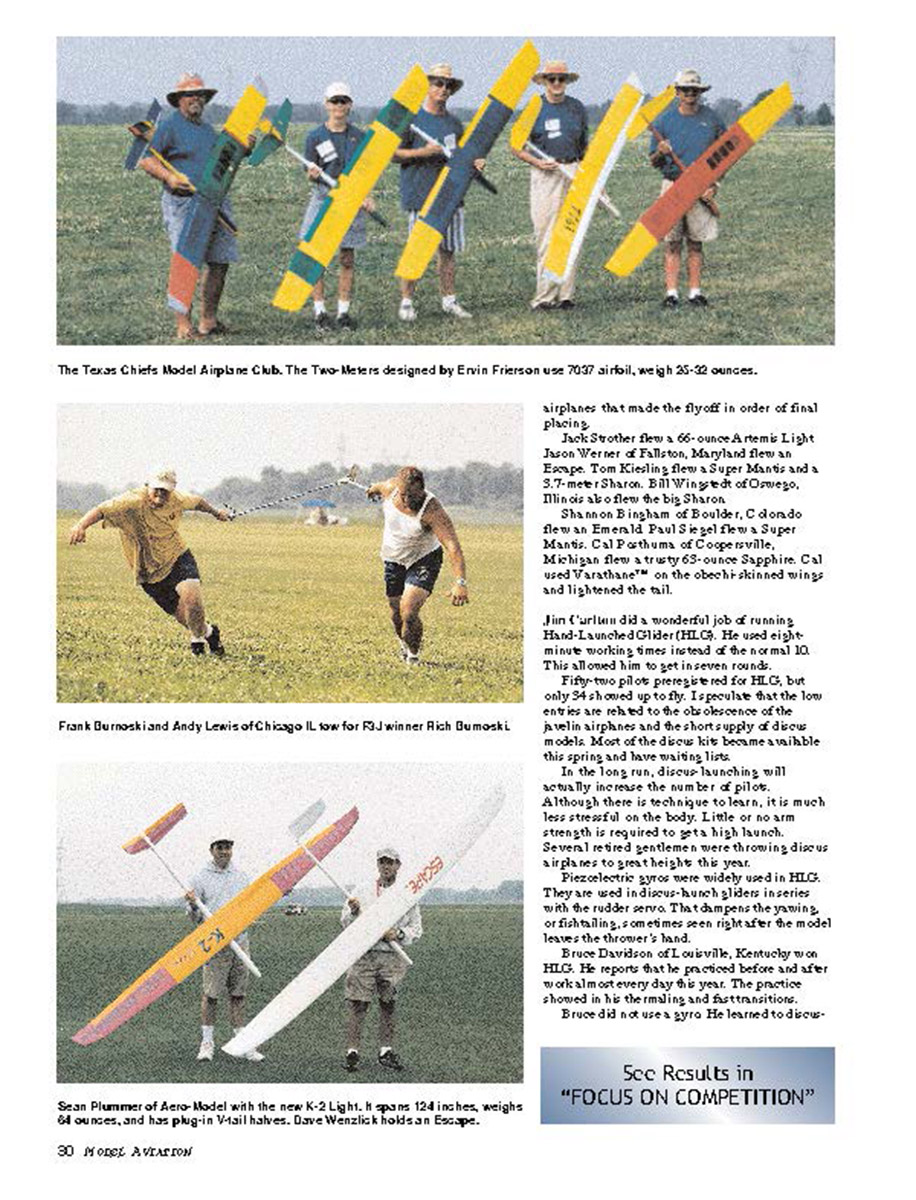
RES had 53 pilots. Paul Landreth of Rule, Texas won, flying a 99-inch original Ervin Frierson design. Tom Tock of Dwight, Illinois placed second, also with an original design.
Ray Hayes of Fort Wayne, Indiana was third with a stock Big Bird. The Big Bird looks like a Bird of Time, but the aerodynamics and structure are quite different. Ray sells the kit through his company, Sky Bench Aerotech.
Rich Burnoski placed fourth with his Chicago Style. The production airplanes are roughly 6¾ ounces ready-to-fly. That is 10 ounces lighter than the prototype I featured in the February 2001 column.
Bob Johnson of Fond Du Lac, Wisconsin placed fifth flying a Majestic.
Nostalgia is a special class limited to pre-1980 designs. Thirty-nine pilots entered.
Ed Wilson of Fern Creek, Kentucky earned first place flying his Aquila Grande. His model was built stock from an old Airtronics kit. Dean Catcher sells kits for this design. The Grand Esprit is back too.
Ray Hayes was second with a stock Challenger. Don Harris of Westerville, Ohio placed third flying a Gulf Coaster.
Robert Hicks of Predeville, Michigan flew his Bird of Time to fourth place, and Bob Densforth of Loveland, Ohio placed fifth with a Saliaire.
At the Friday-night banquet, there is food, drink, the volunteers' raffle, and the special awards.
Michael Lachowski won the Hi Johnson Memorial award for highest official score and the Lee Renaud Memorial award for the individual with the highest combined Two-Meter and Unlimited score.
The Long Island Silent Fliers team of Luke Waters, Hans Wiederkehr, and Tom Kiesling won the Dan Pruss Memorial award. This was for highest team placing in Two-Meter and Unlimited classes.
Special honors are also given to the Nats volunteers. Mike Stump won the Lee Gray award for "giving his time and talents in an outstanding manner in promotion of RC Soaring and the LSF."
Jim Thomas was awarded the Spirit of Soaring for his outstanding work.
Steve Meyer put Nats info on the LSF Web site after most days of flying. You can see more pictures and full score sheets on that page: www.silentflight.org/. MA
Transcribed from original scans by AI. Minor OCR errors may remain.

