
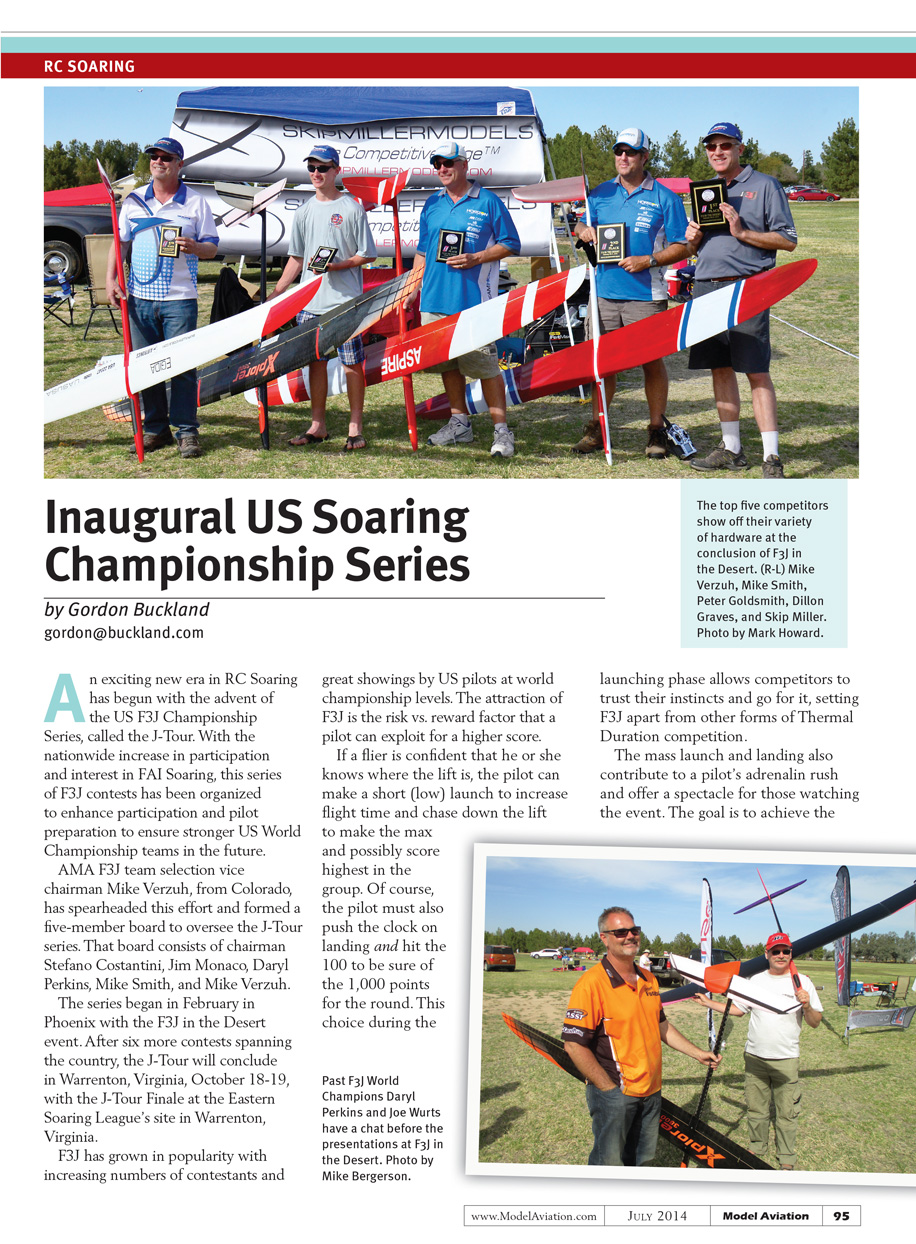
Inaugural US Soaring Championship Series
by Gordon Buckland [email protected]
Overview
An exciting new era in RC soaring has begun with the advent of the US F3J Championship Series, called the J-Tour. With a nationwide increase in participation and interest in FAI soaring, this series of F3J contests has been organized to enhance participation and pilot preparation and to ensure stronger US World Championship teams in the future.
J-Tour Organization
AMA F3J team selection vice chairman Mike Verzuh, from Colorado, has spearheaded this effort and formed a five-member board to oversee the J-Tour series. That board consists of chairman Stefano Costantini, Jim Monaco, Daryl Perkins, Mike Smith, and Mike Verzuh.
Events and Schedule
The series began in February in Phoenix with the "F3J in the Desert" event. After six more contests spanning the country, the J-Tour will conclude in Warrenton, Virginia, October 18–19, with the J-Tour Finale at the Eastern Soaring League’s site in Warrenton.
F3J Format and Strategy
F3J has grown in popularity, with increasing numbers of contestants and strong showings by US pilots at world championship levels. A key attraction of F3J is the risk-versus-reward factor a pilot can exploit for a higher score.
If a flyer is confident that he or she knows where the lift is, the pilot can make a short (low) launch to increase flight time and chase down the lift to max out and possibly score highest in the group. The pilot must also time the landing to hit the 100 landing score and secure the 1,000 points for the round. This choice during the launching phase allows competitors to trust their instincts and go for it, setting F3J apart from other forms of thermal duration competition.
The mass launch and landing contribute to a pilot’s adrenaline rush and offer a spectacle for spectators. The goal is to achieve the longest flight time in a 10-minute window: from when the model comes off the line to when it touches the ground again. The 10-minute window begins with an audible horn; the model cannot leave the thrower’s hand before the horn is sounded. The window ends with a countdown and the sound of a horn; the model must have touched the ground by that horn to score landing points and avoid a 30-point penalty. World-class pilots such as Joe Wurts regularly make 9:58-plus flights along with 100 landings. Such scores are achieved by tensioning the towline before the beginning of the 10-minute window and getting off the towline in less than a second for a 250- to 350-foot launch.
Awards and Goals
At the conclusion of the annual J-Tour, the top five US pilots will be recognized with prestigious awards and the annual J-Tour champion’s name will be engraved on a perpetual US F3J trophy.
The tour will also serve to enhance competitive US soaring in other ways, including:
- Encouraging club-level F3J events.
- Providing documentation on the logistics of running events.
- Serving as a knowledge base of tips and strategies for participants.
- Eventually sponsoring a US F3J junior program.
Expected Outcomes
The expected outcome of the nationwide J-Tour contests includes:
- More regional events developed, growing overall program participation, F3J knowledge, and US team support.
- Enhanced pilot experience and ability, providing more experienced world championship competitors.
Documentation and Support
Much of the foundation for the tour has been put in place through the efforts of Jim Monaco and Mike Verzuh, with documentation on how to fly and run F3J events. This information is available on the US F3J Championship Series and F3X Events websites.
Sponsors and 2014 Phoenix Kickoff
US soaring is fortunate to have sponsors and commercial support from companies such as:
- Skip Miller Models
- Tour Partners
- Soaring USA
- Horizon Hobby
- Kennedy Composites
- Jeti
- MKS Servos
The Phoenix event kicked off the J-Tour with 69 registered entrants, making it the best-attended US F3J event to date. More than $3,000 was raised to help the USA F3J team attend the World Championship in Slovakia in July 2014.
Transcribed from original scans by AI. Minor OCR errors may remain.

