
RC Soaring
If you are a Radio Control (RC) Soaring enthusiast, you prepare a variety of models for months in advance if you plan to compete during all eight days of the AMA/League of Silent Flight (LSF) Soaring Nationals (Nats). This year's events were held the week of Saturday, July 27, to Saturday, August 3, in the same format it has been for the last five years I have attended.
It's amazing that a contest of this caliber is run so smoothly with an all-volunteer crew that meshes in such a professional way in a short period of time. I can't say enough about volunteers who travel here just to help make this event run and do nothing but work the event all week — people such as Brian and Larry Jefferies. Marna makes the impound run like clockwork, and that directs the flow of a contest.
To all the Contest Directors (CDs) who traveled in and ran a contest they might rather be flying in and to all the people who give time to pull this off, thank you. The work you do makes the events so special to so many each year.
Cross Country, Scale, and F3B (Saturday, July 27)
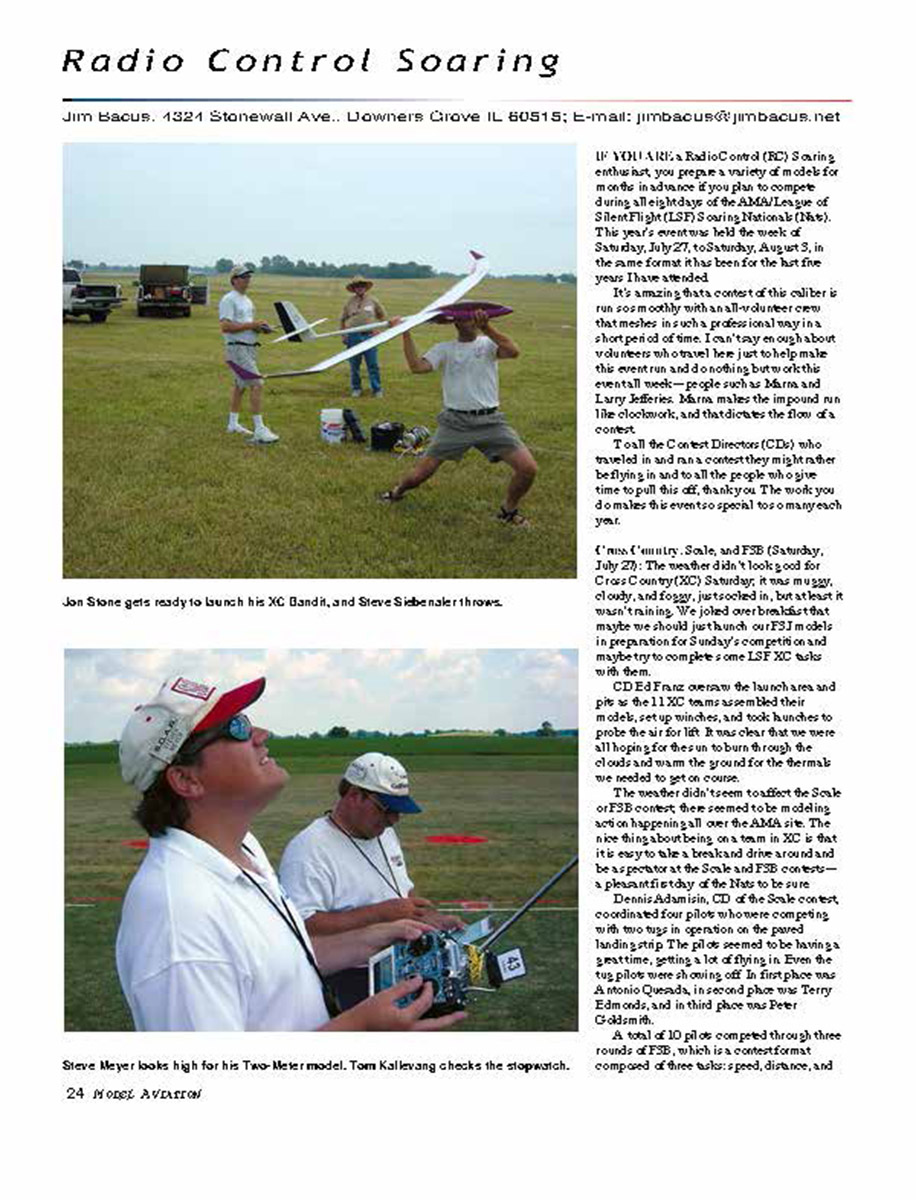
The weather didn't look good for Cross Country (XC) Saturday; it was muggy, cloudy, and foggy, just soaked in, but at least it wasn't raining. We joked over breakfast that maybe we should just launch our F3J models in preparation for Sunday's competition and maybe try to complete some LSF XC tasks with them.
CD Ed Franz oversaw the launch area and pits as the LSF XC teams assembled their models, set up winches, and took hunches to probe the air for lift. It was clear that we were all hoping for the sun to burn through the clouds and warm the ground for the thermals we needed to get on course.
The weather didn't seem to affect the Scale or F3B contests; there seemed to be modeling action happening all over the AMA site. The nice thing about being on a team in XC is that it's easy to take a break and drive around and be a spectator at the Scale and F3B contests — a pleasant city of the Nats to be sure.
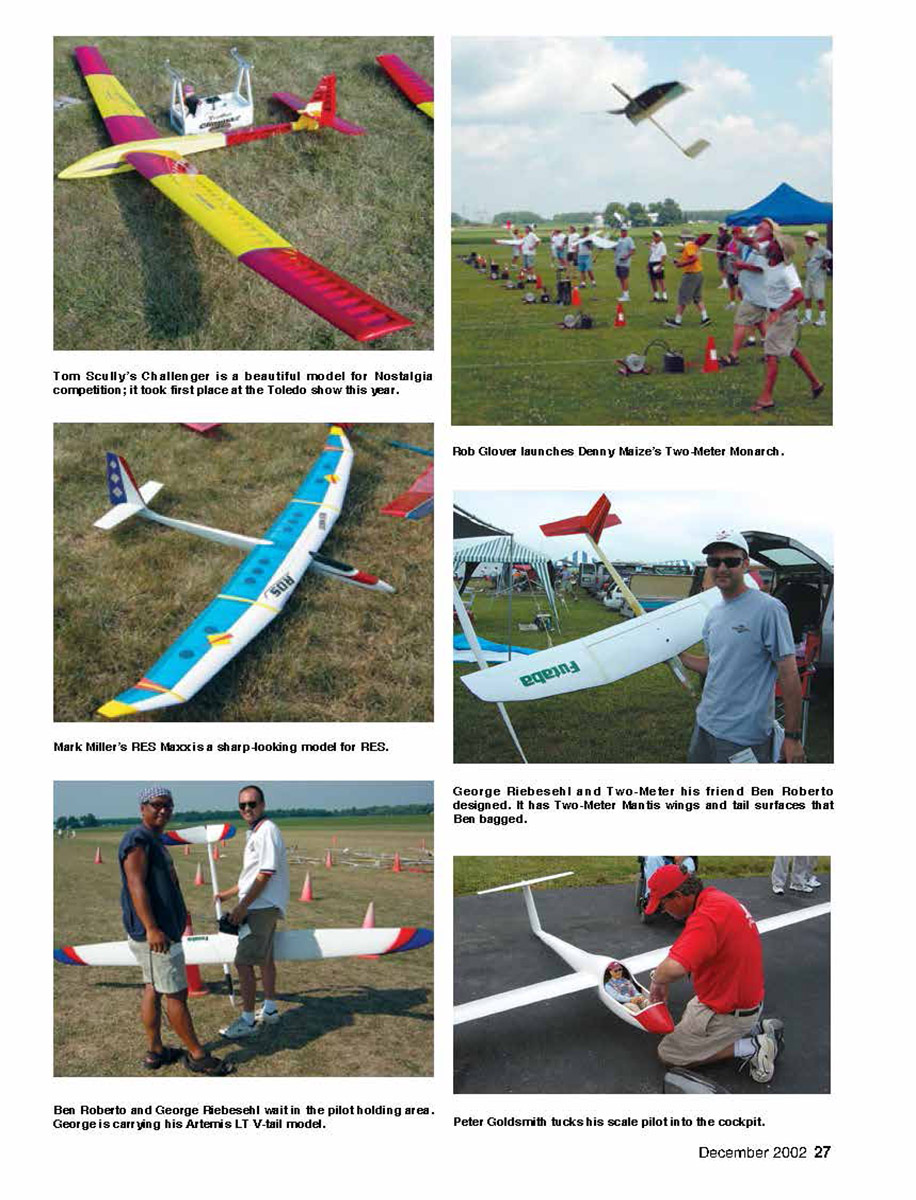
Dennis Admasian, CD of the Scale contest, coordinated four pilots who were competing with two trips in operation on the paved landing strip. The pilots seemed to be having a great time, getting a lot of flying in. Even the type pilots were showing off. In first place was Antonio Curada, in second place was Terry Edmonds, and in third place was Peter Goldstein.
A total of 10 pilots competed through three rounds of F3B, which is a contest format composed of three tasks: speed, distance, and duration. Bob Edson acted as CD for the competition.
Mike Lachowski flew the fastest speed run of the day at 17.64 seconds. Tom Keising had the best distance course of the day with 27 laps. Tom tipped his hand that day for what was to be a week of spectacular flying for him, finishing in first place. Mike finished in second place, and Ben Lawless was third. All three fly in the Eastern Soaring League club and are very serious about F3B.
Back at the XC flying area, no one had really gotten on course yet; there just wasn't enough lift to get a model to altitude for a serious run. Joe Dirr, a good friend of mine from Cincinnati, Ohio, wanted to launch his F3A motorglider to take a try at the course. He agreed that maybe kunching high and going for it might be a decent tactic at that point in the day, and he asked if I would ride in the truck with him to spot and if Tom Meyer would ride.
This was Joe's first XC flights as a pilot, but he was familiar with the format and course. I had seen him crew in XC at previous Nats. He held the lead in the contest 3.2 miles down the road. Later in the day he did it again for 47 miles, with Tom Meyer driving and Reece Brock in the back spotting. That was enough for Joe to win his first Nats trophy as XC National Champion.
Larry Stone finished in second place with the LIFT-club team, and Steve Schneider finished third with the SOAR-club team.
F3J (Sunday, July 28)
The weather looked better for a Soaring contest on Sunday. Maybe it was a little windy—we were flying in 10-20 mph winds all day long—but that kept the heat down. Since F3J relies on a team of typically two men to pull a monofilament towline to launch the model, keeping your tow people cool is a good thing. They don't mind a little wind; it allows them to take a few steps and plant their feet instead of running through the entire tow.
Phil Renaud, who was back to CD F3J this year and CD of the last US F3J team selection, oversaw a smooth and nicely run contest.
The wind became a factor almost immediately. At times every pilot encountered line breaks and downdraft off-field landings during the day. At one point I had broken my line on the first launch attempt in three consecutive rounds. Jack Strother, one of my teammates, had the same fate, causing us to repair lines during the contest.
There were a lot of max time scores in this contest, which made for an interesting and strategic day of contesting. The F3J format allows you to fly any of three models in the contest and have one optional relaunch (reflight per round in a 10 minute window). Relighting was common on this day.
There was some extreme downwind flying going on by David McCarthy, who flew on the US Junior F3J team this year, and Richard Burnoski, who was last year's F3J National Champion.
David had flown a dominating contest until an off-field landing caused a zero round, which was followed by an extreme downwind "hero or zero" flight in which he lost sight of his model. His father, who was also timing for him, still had the model in sight and flew it back to a point where they could retrieve it. When David turned his transmitter over to his father, that zeroed the flight but saved the model for the World Championships in Finland, which was less than a week away.
After flying six rounds, we were allowed one throw-out round and the top 10 pilots advanced into a two-round final that consisted of a 15-minute task with previous scores carrying through. The wind was subsiding by this point in the day, and so was any available lift. The first flyoff round was tough. I took a relight and flew less time than in my first flight—not something one wants to do. No one maxed the task time.
After the first flyoff round, Richard Burnoski's line was crossed such that his launch was impaired, so we got to refly the first flyoff round and take the higher score of the two. Richard alone had to take the score he received in this refight. In the refight I learned that each flight I took was getting shorter in duration as the sun got ready to settle upon the horizon.
The second flyoff round required the largest launch you could with the smoothest flying you could provide. I did not relight after my first flight; that was kind of a hard decision to make at the time because many teams did relight, but I just didn't think I could do any better.
As it turned out, the top three pilots did not change position after the flyoffs. For the second year in a row Richard Burnoski is the F3J National Champion, flying a Space Pro. Paul Siegel flew to second place with a Zenith, and I placed third with an F31 Icon.
Hand-Launched Glider (Monday, July 29)
It was immediately apparent that a new group of pilots was joining us Monday—probably only for the one day of Hand-Launched Glider (HLG) contest excitement. CD Mark Geinth, who has been CD of this event past Nats, ran a chaos contest. Pilots seemed to be buzzing about the new XP-3 from Polocat Aeroworks.
Wind became a huge factor in this contest. The weather wasn't bad to start, but as the day progressed, so did the wind. Timed launches for Steve Meyer, so I was out on the field quite a bit and saw some good pilots, including him, have models off the field for zeros after working extremely hard for a max time. As the wind picked up it became difficult for pilots to perform the discus launch; a wind gust could twist and blast a wing into the ground in an instant during launch.
Model range mounted as a 40 mph wind gust was recorded at AMA Headquarters.
Mark Gellatt immediately assembled a pilots' meeting, and the contest was called by pilot decision in the fifth round.
Phil Barnes is the new HLG National Champion, Oleg Golodov placed second and Donald Yett finished third.
Two-Meter Thermal Duration (Tuesday and Wednesday, July 30-31)
The front that had been causing windy conditions during the previous two days finally moved through Monday evening and provided us with the following several days of hot, pleasant soaring weather.
CD Hutch Hutchins was back to run the contest. I think he had it in his mind to set a contest similar to those he has run before because he kept the contest moving at a rapid pace from the outset. And the goal was achieved; 13 rounds were flown in two days—a Nat record that is a lot of flying.
Each day started with a seven-minute task and ended with one, but throughout the heart of the contest they went 10-minute tasks. This was the first time we got so close and flew the new hand-launched two-meter class, it was tight, but the same for everybody. Not one contestant was able to achieve a 10-point landing during the entire contest.
There were typical contest airs for Muncie; sometimes it was quite easy, and sometimes it was quite difficult. Since the format is man-on-man, that doesn't matter much—each round is scored only against the pilots who flew in it, so it's basically a head-to-head contest if a task time cannot be achieved. And that happened on more than several occasions.
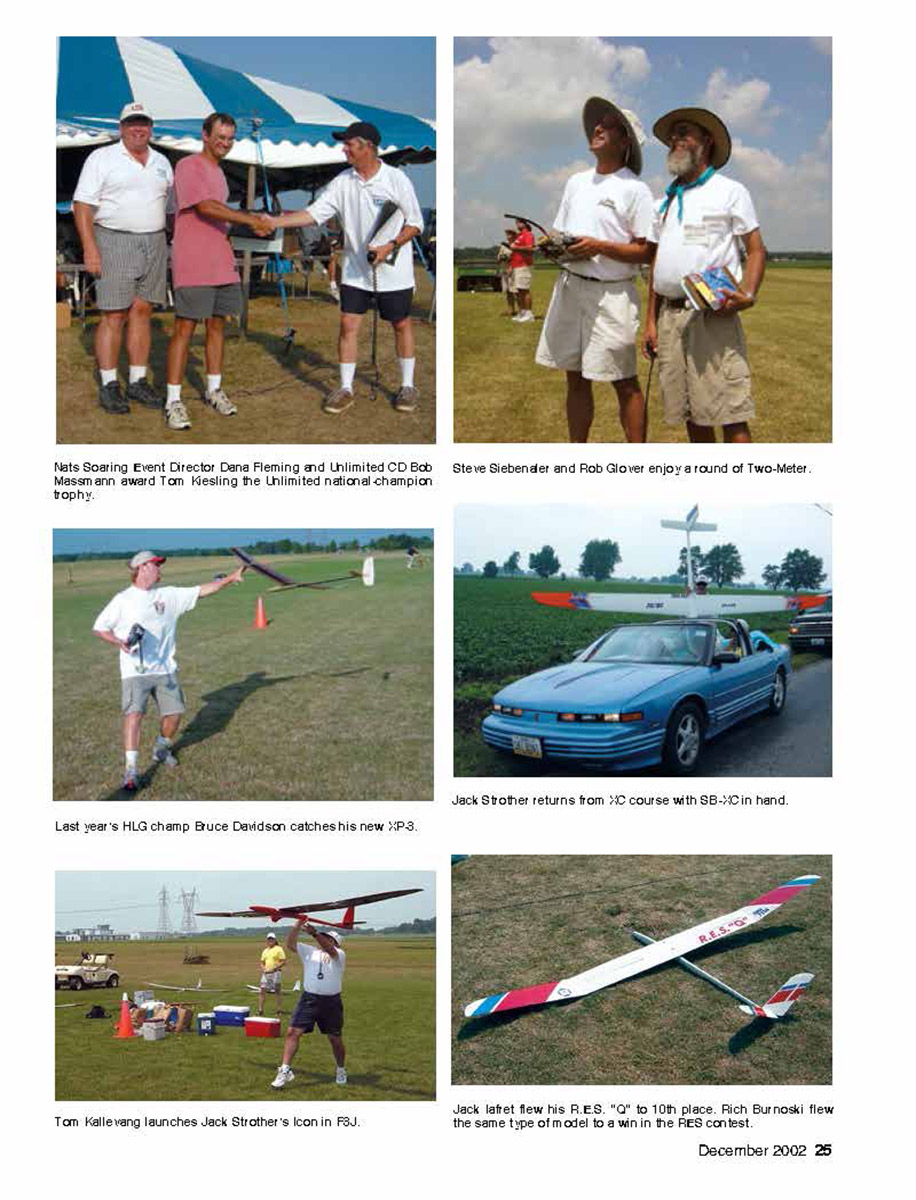
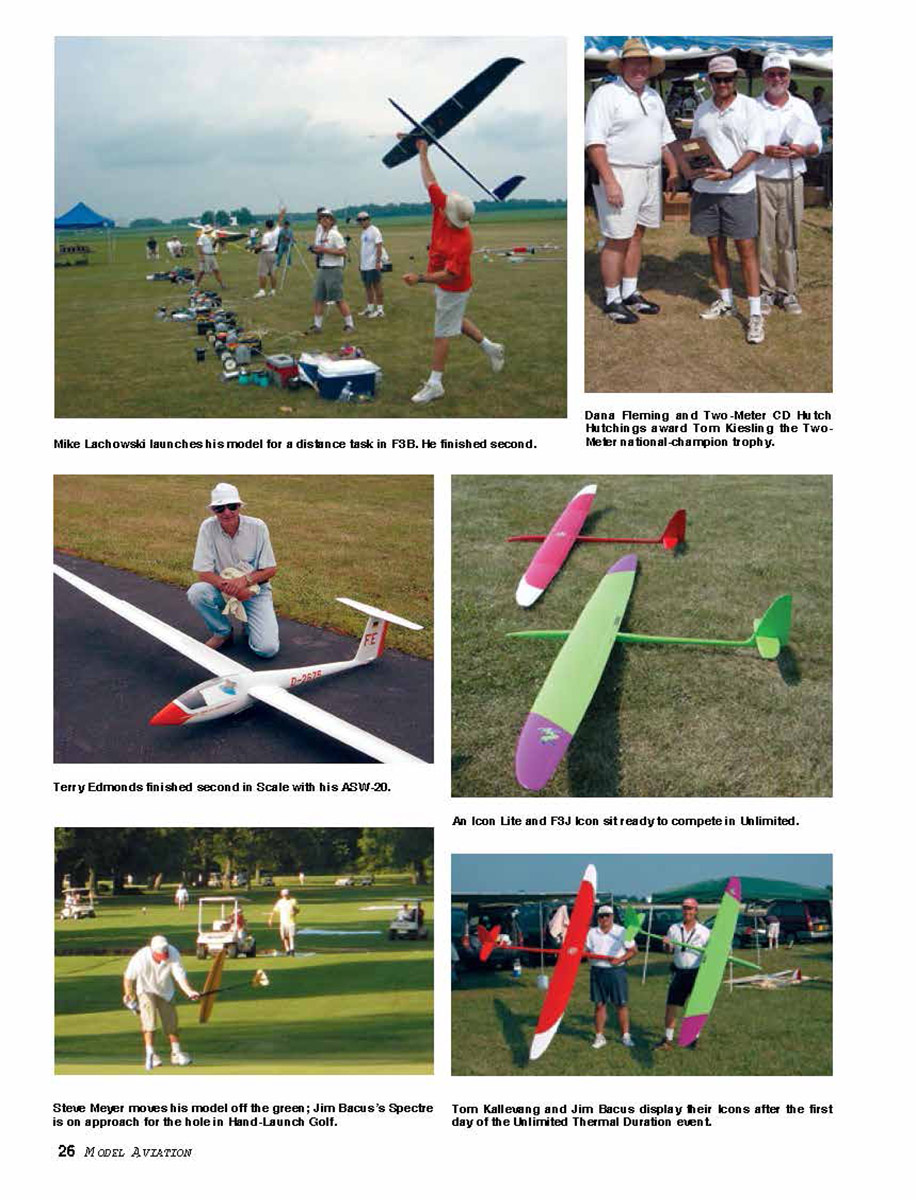
Nonetheless, it was a Tom Kiesling show from start to finish—complete domination. He jumped out to a lead of several hundred points, and no one could catch him. Flying his Two-Meter Matrix, he was awarded his second National Champion trophy of the week. In second place was Mike Lachowski flying an Energetic, and in third place was Phil Barnes flying a Two-Meter Matrix.
Unlimited Thermal Duration (Thursday and Friday, August 1-2)
The good weather continued on Thursday and Friday, albeit a little warm, but that is typical for Muncie this time of the year. Seasoned CD Bob Massman oversaw an extremely smooth contest. The landing zone was adjusted a bit to pace the pilots apart, but it was still tight and the same for everybody.
A new group of pilots started showing up Wednesday evening for this event, and there were all kinds of new faces on the field the next day. Mid-on-man flying with a group of pilots means minimizing or making no mistakes for two days; the flying is solid, and pilots' skills are honed. One little bobble can send you tumbling down the score sheets prominently displayed on the blue box by the scoring trailer.
For the first round Thursday the air was a little light, which may have caught some pilots off guard because it looked great. I was intent on getting a good start and keeping an eye on Tom Kiesling; I knew he was going to be the pilot to catch the rising air and not give it up. He did just that and again was the man to beat in Unlimited.
Transcribed from original scans by AI. Minor OCR errors may remain.

