

RC Soaring
Darwin Barrie, 4316 W. Rickenbacker Way, Chandler AZ 85226; E-mail: [email protected]
FIRST I HAVE a few housekeeping issues. I am going to revisit some items I have mentioned in previous columns and then start a new topic of discussion.
I have received favorable comments regarding the column so far. Many like the format and have contributed items of interest. This month will feature some of those contributions. Many enjoyed the information I shared regarding my building the Van’s Aircraft RV-7 (www.vansaircraft.com), but some did not feel it had a place in the Soaring column.
As I have stated in the past, I welcome information about new products, comments about the column, and any other information that is beneficial to the group. Please be kind enough to provide your name in your E-mails.
Okay, let’s get going. I did a minireview of the new Dremel Lithium-Ion-powered Moto-Tool in the April column. Dremel representatives contacted me and thanked me for the comments. They promised to keep me in the loop on new product developments.
I have been using the Moto-Tool for several months. It has become my number-one instrument and has all but replaced the cord version. My biggest issue is remembering to charge the battery!
I have put roughly 14 hours on my new Futaba 14MZ radio system. I have not flown it yet in a sailplane but have set up two six-function Thermal Duration models. This is by far the easiest system to program I’ve ever owned. Flights on my Giant Scale Aerobatics model have been rock solid with no problems or concerns. I will pass along information on sailplane use as it develops.
In the June column I discussed setups for Thermal Duration airplanes. As I was making notes for this column, a discussion was taking place on the RC Soaring Exchange (www.eclispe.net/~mikel/rcse/ rcse.htm) regarding setups and keeping things as simple as possible. I wholeheartedly agree with this philosophy.
The main issue to me is activating flaps for landing. My flap stick is active at all times. There is never a need to flip a switch to have landing flaps work.
Many of us have probably seen a flier (or have been that person) who has not activated the “landing switch” and then has proceeded to slide a model through the landing zone and into his or her, or someone else’s, ankles or shins. That is definitely not the neighborly thing to do. The following comments from Joe Wurts speak volumes on the subject.
“One thing that I’ve gotten away from is the concept of a separate landing mode. I just know that I’ll forget to activate the landing mode in the stress of a difficult flight, so I just don’t have a landing mode. (I’ve seen others who have a separate landing mode get in trouble when they forget to enable their landing mode before landing.)”
I have just two switches active on the transmitter: the launch switch and the three-position flight mode switch. The launch switch institutes the launch mode regardless of where the three-position switch is. The flight mode switch is active when the launch mode is not selected, and has speed, cruise, and thermal modes.
Coming up with building time to finish a project can be terribly difficult for many modelers. Dave Hauch of Watervliet, Michigan, contacted me regarding his building service; he can construct and/or cover anything from sailplanes to Giant Scale Aerobatics aircraft.
Dave sent me pictures of some of his customers' models. His prices are reasonable, and he offers excellent turnaround times. You can reach him at [email protected]. He recently launched a Web site that has many more details and photos of some of his completed models.
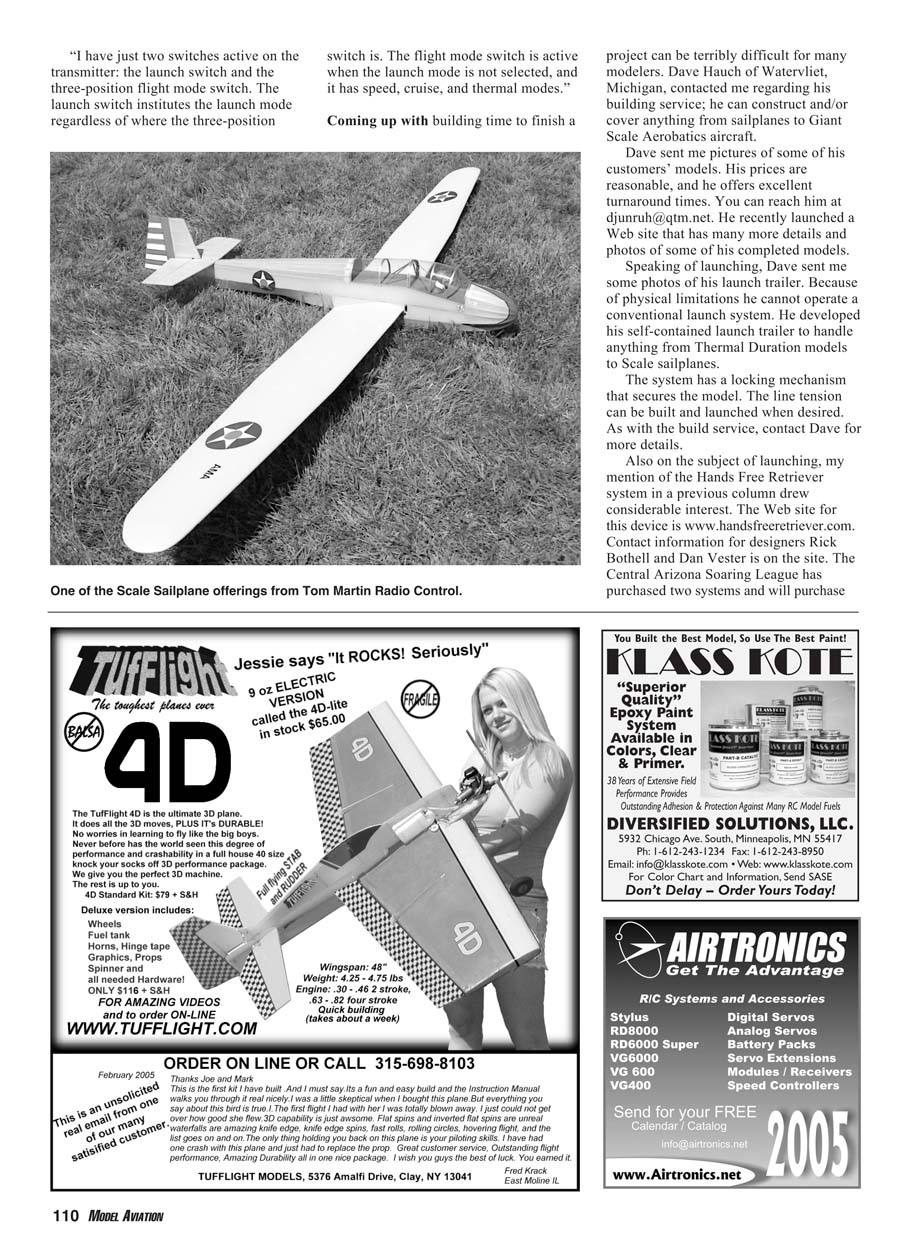
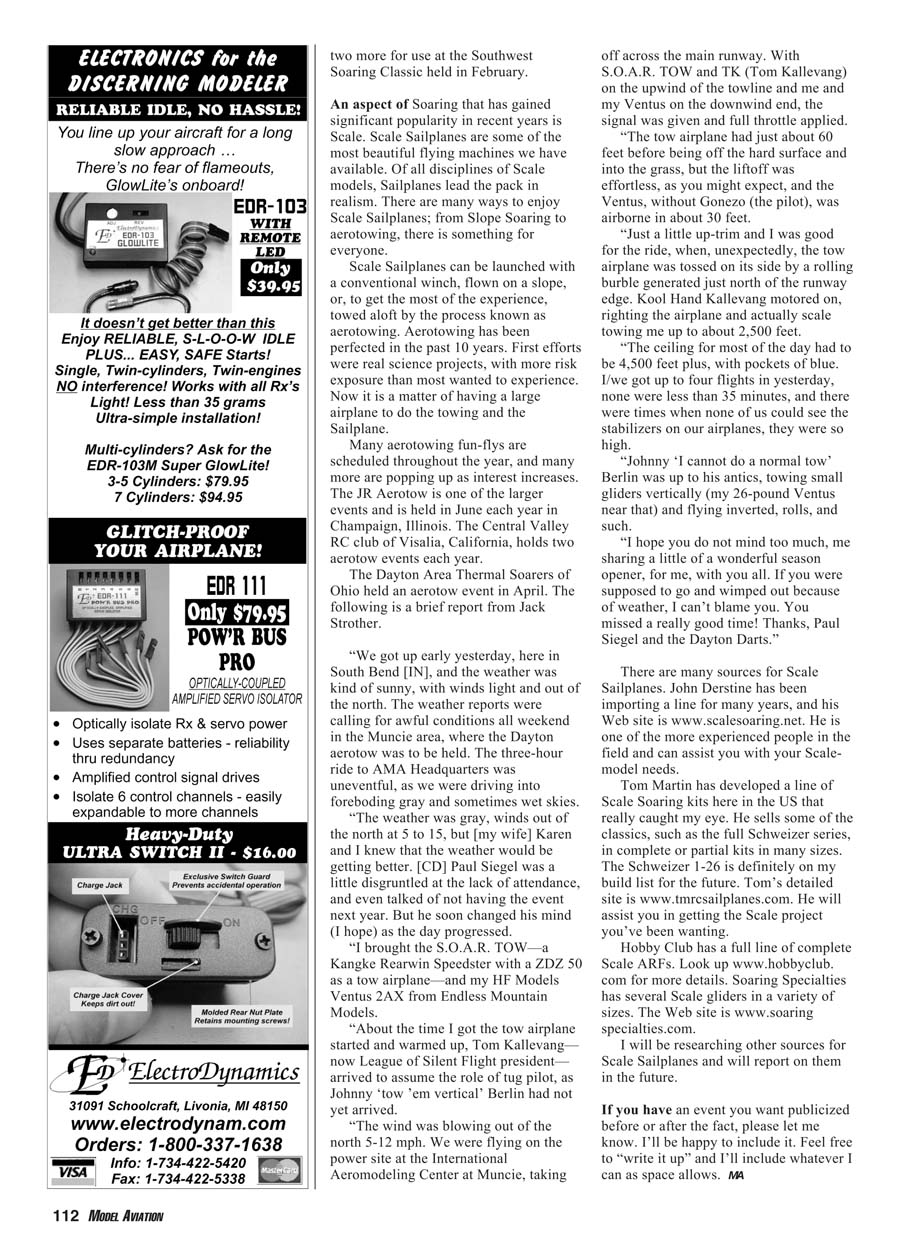
Speaking of launching, Dave sent me some photos of his launch trailer. Because of physical limitations he cannot operate a conventional launch system. He developed his self-contained launch trailer to handle anything from Thermal Duration models to Scale sailplanes.
The system has a locking mechanism that secures the model. The line tension can be built and launched when desired. As with the build service, contact Dave for more details.
Also on the subject of launching, my mention of the Hands Free Retriever system in a previous column drew considerable interest. The Web site for this device is www.handsfreeretriever.com. Contact information for designers Rick Bothell and Dan Vester is on the site. The Central Arizona Soaring League has purchased two systems and will purchase two more for use at the Southwest Soaring Classic held in February.
An aspect of Soaring that has gained significant popularity in recent years is Scale. Scale Sailplanes are some of the most beautiful flying machines we have available. Of all disciplines of Scale models, Sailplanes lead the pack in realism. There are many ways to enjoy Scale Sailplanes; from Slope Soaring to aerotowing, there is something for everyone.
Scale Sailplanes can be launched with a conventional winch, flown on a slope, or, to get the most of the experience, towed aloft by the process known as aerotowing. Aerotowing has been perfected in the past 10 years. First efforts were real science projects, with more risk exposure than most wanted to experience. Now it is a matter of having a large airplane to do the towing and a good Sailplane.
Many aerotowing fun-flys are scheduled throughout the year, and many more are popping up as interest increases. The JR Aerotow is one of the larger events and is held in June each year in Champlain, Illinois. The Central Valley RC club of Visalia, California, holds two aerotow events each year.
The Dayton Area Thermal Soarers of Ohio held an aerotow event in April. The following is a brief report from Jack Strother.
“We got up early yesterday, here in South Bend [IN], and the weather was kind of sunny, with winds light and out of the north. The weather reports were calling for awful conditions all weekend in the Muncie area, where the Dayton aerotow was to be held. The three-hour ride to AMA Headquarters was uneventful, as we were driving into foreboding gray and sometimes wet skies.
“The weather was gray, winds out of the north at 5 to 15, but [my wife] Karen and I knew that the weather would be getting better. [CD] Paul Siegel was a little disgruntled at the lack of attendance, and even talked of not having the event next year. But he soon changed his mind (I hope) as the day progressed.
“I brought the S.O.A.R. TOW—a Kankge Rearwin Speedster with a ZDZ 50 as a tow airplane—and my HF Models Ventus 2AX from Endless Mountain Models.
“About the time I got the tow airplane started and warmed up, Tom Kallevang—now League of Silent Flight president—arrived to assume the role of tug pilot, as Johnny ‘tow ’em vertical’ Berlin had not yet arrived.
“The wind was blowing out of the north 5-12 mph. We were flying on the power site at the International Aeromodeling Center at Muncie, taking off across the main runway. With S.O.A.R. TOW and TK (Tom Kallevang) on the upwind of the towline and me and my Ventus on the downwind end, the signal was given and full throttle applied.
“The tow airplane had just about 60 feet before being off the hard surface and into the grass, but the liftoff was effortless, as you might expect, and the Ventus, without Gonzoe (the pilot), was airborne in about 30 feet.
“Just a little up-trim and I was good for the ride, when, unexpectedly, the tow airplane was tossed on its side by a rolling burble generated just north of the runway edge. Kool Hand Kallevang motored on, righting the airplane and actually scale towing me up to about 2,500 feet.
“The ceiling for most of the day had to be 4,500 feet plus, with pockets of blue. I’ve got up to four flights in yesterday, none were less than 35 minutes, and there was one time when one of our models had the stabilizers on our airplanes, they were so high.
“Johnny ‘I cannot do a normal tow’ Berlin was up to his antics, towing small gliders vertically (my 26-pound Ventus near that) and flying inverted, rolls, and such.
“I hope you do not mind too much, me sharing a little of a wonderful season opener, for me, with you all. If you were supposed to go and wimped out because of weather, I can’t blame you. You missed a really good time! Thanks, Paul Siegel and the Dayton Darts.”
There are many sources for Scale Sailplanes. John Derstine has been importing a line for many years, and his Web site is www.scalemodels.com. He is one of the more experienced people in the field and can assist with your Scale-model needs.
Tom Martin has developed a line of Scale Soaring kits here in the US that really caught my eye. He sells some of the classics, such as the full Schweitzer series, in complete or partial kits in many sizes. The Schweitzer 1-26 is definitely on my build list for the future. Tom’s detailed site is www.tmrcslpplanes.com. He will assist you in getting the Scale project you’ve been wanting.
Hobby Club has a full line of complete Scale ARFs. Look up www.hobbyclub.com for more details. Soaring Specialties has several Scale gliders in a variety of sizes. The Web site is www.soaringspecialties.com.
I will be researching other sources for Scale Sailplanes and will report on them in the future.
If you have an event you want publicized before or after the fact, please let me know. I’ll be happy to include it. Feel free to “write it up” and I’ll include whatever I can as space allows. MA
Transcribed from original scans by AI. Minor OCR errors may remain.

