
RC Soaring
Darwin Barrie
THIS MONTH I'll cover a couple new products and review the International Hand Launch Glider Festival (IHLGF). The F3J World Championships is in the books. The US team didn't fare as well as hoped, but the Juniors kicked butt.
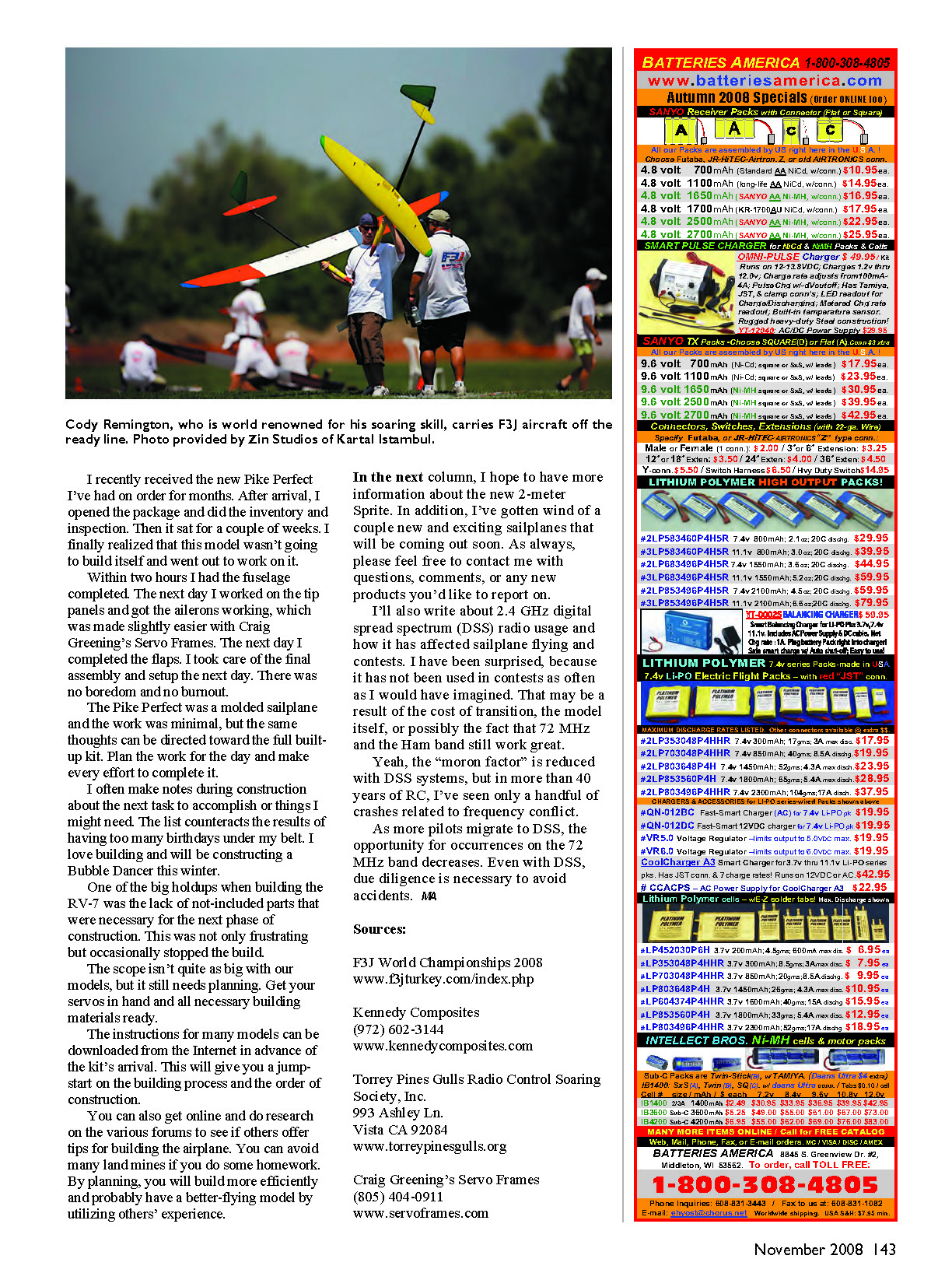
The 2008 F3J World Championships for Thermal Duration Soaring was held in Adapazari, Turkey, from June 27 to July 6. The US team consisted of Senior members Daryl Perkins, Ben Clerx, and Richard Burnoski; returning World Champion Cody Remington; and Juniors Jeffery Walter, A.J. McGowan, and Brendon Beardsley.
The logistics of putting together a World Championships team and getting it and the equipment to the event destination is monumental. Jim Monaco took on the task for the US F3J pilots.
What made it even more difficult was the rapidly changing economy from when the team was selected. The cost of gas raised the airfare, the drop in the value of the dollar raised the cost of hotel rooms, etc.
Amazingly, the American team fell only $1,000 short of the nearly $40,000 that was required to get to Turkey. That took an overwhelming burden off of the team members. Thanks to everyone who contributed to this effort.
There should be full write-up about the events of the World Championships soon. After such an incredible trip, it takes time to "debrief" before getting back in the saddle.
A sad aspect of the trip was the news that British Airways lost most of the gliders on the return trip. I am at a complete loss as to how you could lose extensively labeled model boxes. I'm not convinced it was accidental. One or two could be misdirected, but most of them?
I guess the good news is that the incident occurred on the way home. I have a close friend who is a British Airways 747 captain and a modeler. He is going to be doing some "inside" work to see if he can be of assistance. He was very sad that this occurred and has always said that British Airways is one of the best airlines in regards to minimal loss or redirection of baggage.
From the "new" department is the fully molded Sprite 2M from Kennedy Composites, which will be loosely based on the highly successful Supra design. Although the Sprite will be out by the time this issue hits the streets, Barry Kennedy had no specific details about it at the time of this writing. At least we know that it will span 2 meters.
I'm trying to get one of the early versions of the Sprite for the Fall Soaring Festival in Visalia, California; the timing will be close. One of the prototypes was lost in the British Airways fiasco.
In the last column, I wrote about the great-flying Blaster 2. Shortly after I submitted the text, I learned that the Blaster was going to be offered as an electric. It should be out by now.
The IHLGF was held in Poway, California, the first weekend in June. That is the traditional weekend for the event, which is international—this year even more so than others. Even though the overall attendance was down, the international attendance was way up.
The Kiwis (New Zealanders) were well represented with five participants. If you haven't had the opportunity to fly with these pilots, you have missed out. Not only are they fierce competitors, but they are also lots of fun after the day's activities. Don't even think about competing with them in the consumption of adult beverages. Brazil also had five pilots, and Japan had three; all were fun to be around and were excellent competitors.
There were many new faces and many of the same suspects. Conspicuously absent was Joe Wurts. I think this is the first IHLGF he has missed. But at least that opened a slot for someone else in the flyoffs.
Joe lives in New Zealand and will probably be selective about what events he attends in the States. Next year he will be eligible for the various team selections and will undoubtedly be representing New Zealand in some capacity.
Held in conjunction with the IHLGF this year was the FAI World Air Games qualifications. It involved three tasks, and the top half of the pilots advanced to flyoff rounds. The top two finishers—Oleg Golidov and Paul Anderson—are fairly certain to receive invitations to the World Air Games in Italy.
For a full explanation of the World Air Games and the tasks, visit the Torrey Pines Gulls club Web site. There you will also find the rundown of IHLGF scores and the top 10 finishers.
As I was writing this, I learned that the Torrey Pines Gulls has lost its longtime Soaring field in Poway. It has a great history, and it is downright sad that this field is gone. It was taken over to make room for the expansion of a nearby horse-riding operation. It is unknown if there will be an opportunity to utilize this field in the future.
The good news is that a new field is being secured and should be operational by the time this is in print. Although this site is more convenient to freeways and other amenities, the field is surrounded by houses and may present issues with some competitive events.
Motivation: How many of you have been excited to get that new kit, and then it doesn't get the attention when it arrives? New models are often stuck in the pile of kits that fell into the "gotta have" category but were never built. Trying to get motivated is tough, whether you have a full kit or a fancy European mold that requires minimal work to make flyable.
When I was building the full-scale Van's RV-7, motivation was lacking for me on a regular basis. I used models as a diversion to recharge the human battery and get back on track to continue building the airplane.
The fine people in the RV builders' fraternity say that the best possible course is to try to do something on the kit every day—even if it is for only 30 minutes. We should apply the same philosophy to our models. We should try to do something every day.
RC Soaring
Darwin Barrie
I recently received the new Pike Perfect I’ve had on order for months. After arrival, I opened the package and did the inventory and inspection. Then it sat for a couple of weeks. I finally realized that this model wasn’t going to build itself and went out to work on it.
Within two hours I had the fuselage completed. The next day I worked on the tip panels and got the ailerons working, which was made slightly easier with Craig Greening’s Servo Frames. The next day I completed the flaps. I took care of the final assembly and setup the next day. There was no boredom and no burnout.
The Pike Perfect was a molded sailplane and the work was minimal, but the same thoughts can be directed toward the full built-up kit. Plan the work for the day and make every effort to complete it.
I often make notes during construction about the next task to accomplish or things I might need. The list counteracts the results of having too many birthdays under my belt. I love building and will be constructing a Bubble Dancer this winter.
One of the big holdups when building the RV-7 was the lack of not-included parts that were necessary for the next phase of construction. This was not only frustrating but occasionally stopped the build.
The scope isn’t quite as big with our models, but it still needs planning. Get your servos in hand and all necessary building materials ready.
The instructions for many models can be downloaded from the Internet in advance of the kit’s arrival. This will give you a jump-start on the building process and the order of construction.
You can also get online and do research on the various forums to see if others offer tips for building the airplane. You can avoid many land mines if you do some homework. By planning, you will build more efficiently and probably have a better-flying model by utilizing others’ experience.
In the next column, I hope to have more information about the new 2-meter Sprite. In addition, I’ve gotten wind of a couple new and exciting sailplanes that will be coming out soon. As always, please feel free to contact me with questions, comments, or any new products you’d like to report on.
I’ll also write about 2.4 GHz digital spread spectrum (DSS) radio usage and how it has affected sailplane flying and contests. I have been surprised, because it has not been used in contests as often as I would have imagined. That may be a result of the cost of transition, the model itself, or possibly the fact that 72 MHz and the Ham band still work great.
Yeah, the “moron factor” is reduced with DSS systems, but in more than 40 years of RC, I’ve seen only a handful of crashes related to frequency conflict.
As more pilots migrate to DSS, the opportunity for occurrences on the 72 MHz band decreases. Even with DSS, due diligence is necessary to avoid accidents. MA
Sources:
F3J World Championships 2008 www.f3jturkey.com/index.php
Kennedy Composites (972) 602-3144 www.kennedycomposites.com
Torrey Pines Gulls Radio Control Soaring Society, Inc. 993 Ashley Ln. Vista CA 92084 www.torreypinesgulls.org
Craig Greening’s Servo Frames (805) 404-0911 www.servoframes.com
Transcribed from original scans by AI. Minor OCR errors may remain.

