
The essence of a world champion
by Gordon Buckland [email protected]
What is the essence of a world champion Soaring pilot? What is the secret ingredient that sets them apart from those who want to be? Did they do things differently to earn such success? Maybe there is a common denominator that we could all grasp to emulate their performance.
These are questions I have asked myself at one time or another, and I realized that there was a unique opportunity to find many of the past world champions in one place at the recent F3J World Championship in South Africa and also at the World Soaring Masters in Muncie, Indiana. Each of these six men kindly talked to me about how they made it to the top.
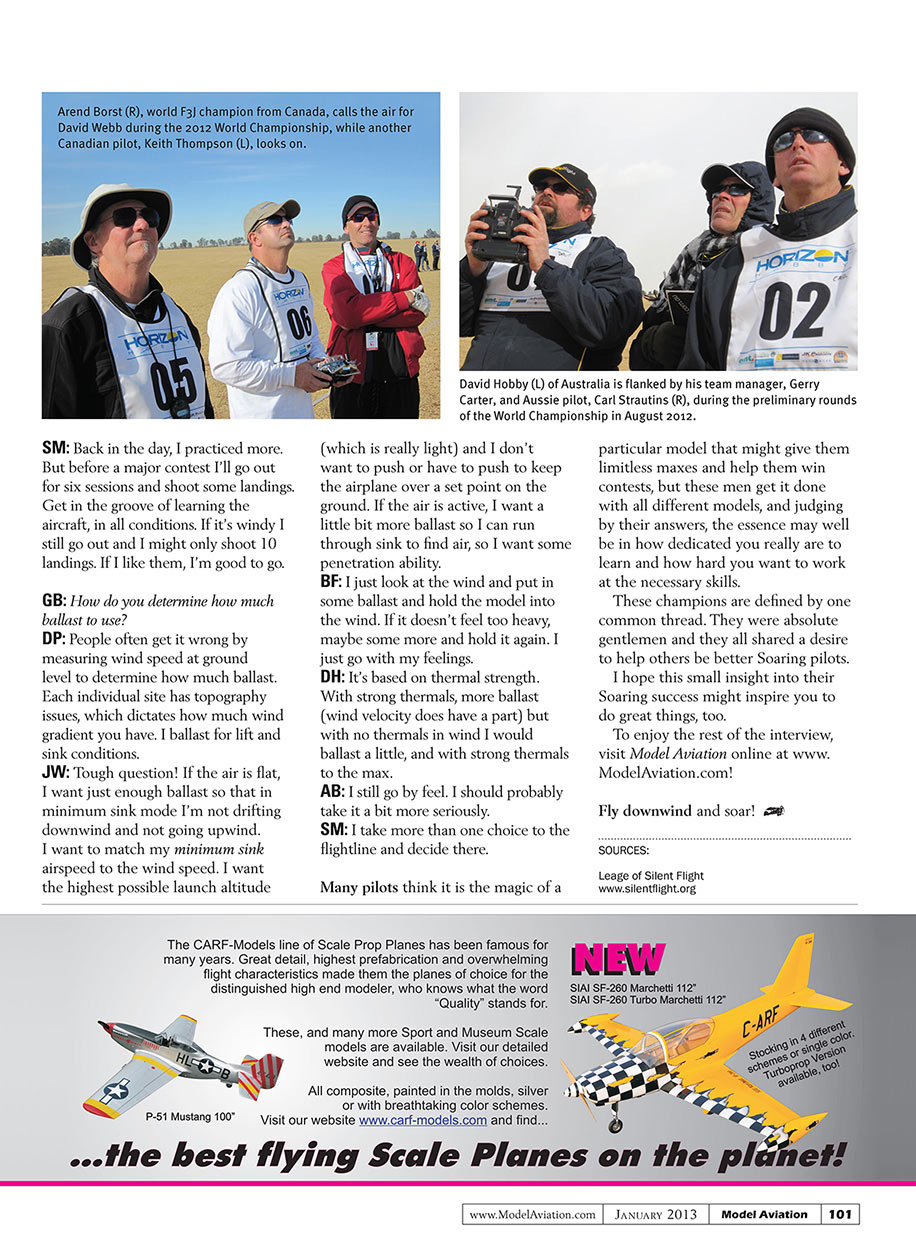
- Daryl Perkins (USA): four-time F3B and 2010 F3J champion
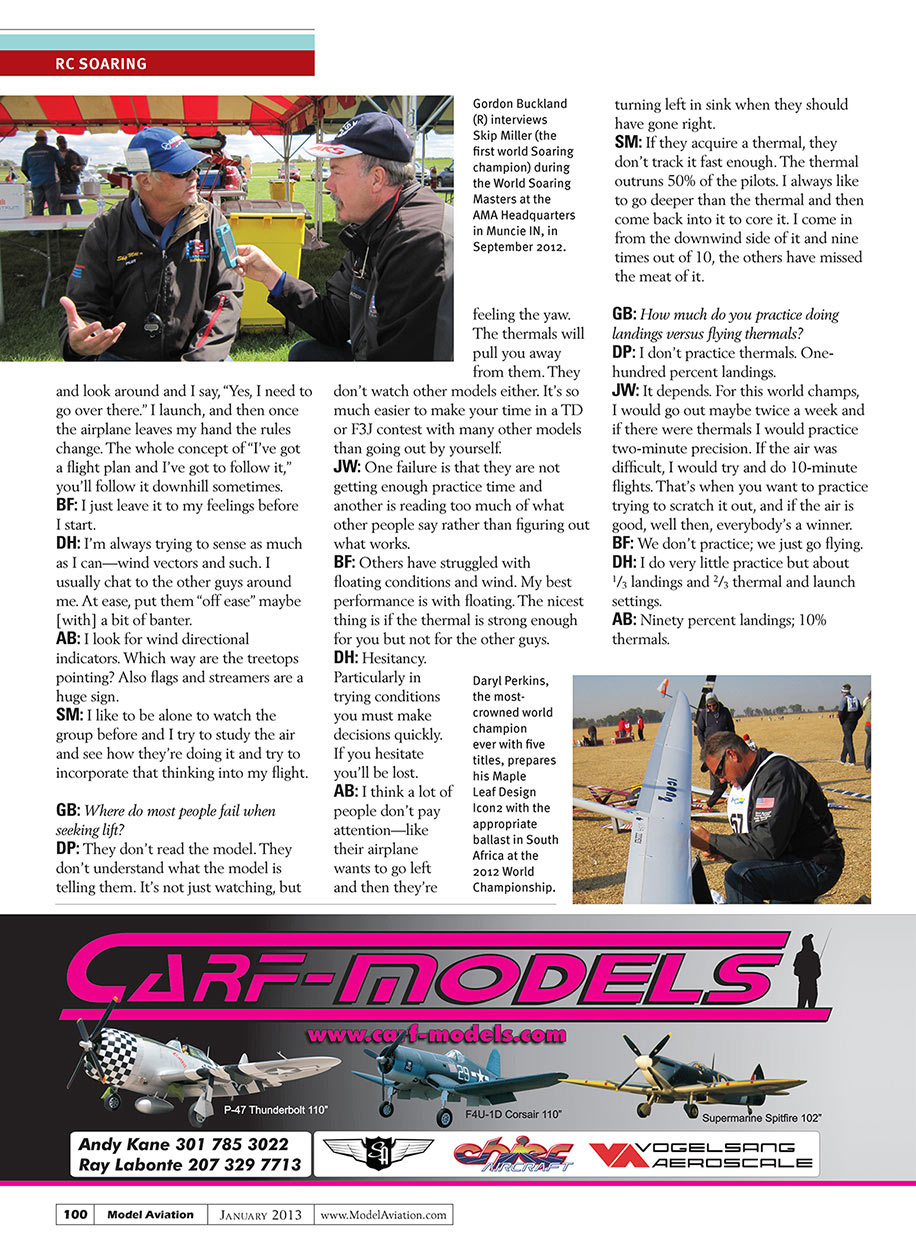
- Joe Wurts (New Zealand): 1991 F3B, 1998 F3J, and 2011 F3K champion
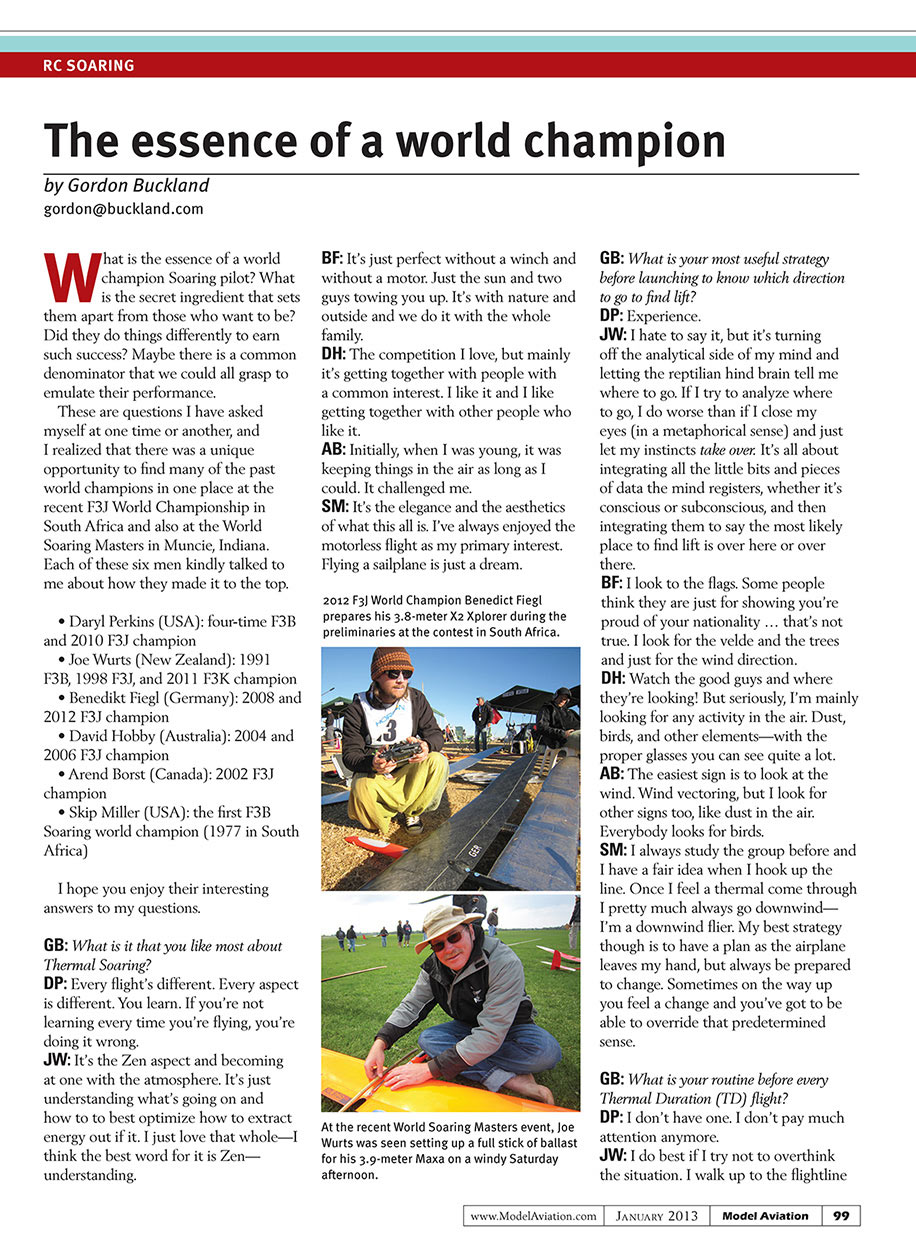
- Benedict Fiegl (Germany): 2008 and 2012 F3J champion
- David Hobby (Australia): 2004 and 2006 F3J champion
- Arend Borst (Canada): 2002 F3J champion
- Skip Miller (USA): the first F3B Soaring world champion (1977 in South Africa)
I hope you enjoy their interesting answers to my questions.
GB: What is it that you like most about Thermal Soaring? DP: Every flight's different. Every aspect is different. You learn. If you're not learning every time you're flying, you're doing it wrong. JW: It's the Zen aspect and becoming at one with the atmosphere. It's just understanding what's going on and how to best optimize how to extract energy out of it. I just love that whole—I think the best word for it is Zen—understanding. BF: It's just perfect without a winch and without a motor. Just the sun and two guys towing you up. It's with nature and outside and we do it with the whole family. DH: The competition I love, but mainly it's getting together with people with a common interest. I like it and I like getting together with other people who like it. AB: Initially, when I was young, it was keeping things in the air as long as I could. It challenged me. SM: It's the elegance and the aesthetics of what this all is. I've always enjoyed the motorless flight as my primary interest. Flying a sailplane is just a dream.
GB: What is your most useful strategy before launching to know which direction to go to find lift? DP: Experience. JW: I hate to say it, but it's turning off the analytical side of my mind and letting the reptilian hind brain tell me where to go. If I try to analyze where to go, I do worse than if I close my eyes (in a metaphorical sense) and just let my instincts take over. It's all about integrating all the little bits and pieces of data the mind registers, whether it's conscious or subconscious, and then integrating them to say the most likely place to find lift is over here or over there. BF: I look to the flags. Some people think they are just for showing you're proud of your nationality … that's not true. I look for the veldt and the trees and just for the wind direction. DH: Watch the good guys and where they're looking! But seriously, I'm mainly looking for any activity in the air. Dust, birds, and other elements—with the proper glasses you can see quite a lot. AB: The easiest sign is to look at the wind. Wind vectoring, but I look for other signs too, like dust in the air. Everybody looks for birds. SM: I always study the group before and I have a fair idea when I hook up the line. Once I feel a thermal come through I pretty much always go downwind—I'm a downwind flier. My best strategy though is to have a plan as the airplane leaves my hand, but always be prepared to change. Sometimes on the way up you feel a change and you've got to be able to override that predetermined sense.
GB: What is your routine before every Thermal Duration (TD) flight? DP: I don't have one. I don't pay much attention anymore. JW: I do best if I try not to overthink the situation. I walk up to the flightline and look around and I say, “Yes, I need to go over there.” I launch, and then once the airplane leaves my hand the rules change. The whole concept of “I’ve got a flight plan and I’ve got to follow it,” you’ll follow it downhill sometimes. BF: I just leave it to my feelings before I start. DH: I’m always trying to sense as much as I can—wind vectors and such. I usually chat to the other guys around me. At ease, put them “off ease” maybe [with] a bit of banter. AB: I look for wind directional indicators. Which way are the treetops pointing? Also flags and streamers are a huge sign. SM: I like to be alone to watch the group before and I try to study the air and see how they’re doing it and try to incorporate that thinking into my flight.
GB: Where do most people fail when seeking lift? DP: They don’t read the model. They don’t understand what the model is telling them. It’s not just watching, but don’t watch other models either. It’s so much easier to make your time in a TD or F3J contest with many other models than going out by yourself. JW: One failure is that they are not getting enough practice time and another is reading too much of what other people say rather than figuring out what works. BF: Others have struggled with floating conditions and wind. My best performance is with floating. The nicest thing is if the thermal is strong enough for you but not for the other guys. DH: Hesitancy. Particularly in trying conditions you must make decisions quickly. If you hesitate you’ll be lost. AB: I think a lot of people don’t pay attention—like their airplane wants to go left and then they’re turning left in sink when they should have gone right. SM: If they acquire a thermal, they don’t track it fast enough. The thermal outruns 50% of the pilots. I always like to go deeper than the thermal and then come back into it to core it. I come in from the downwind side of it and nine times out of 10, the others have missed the meat of it.
GB: How much do you practice doing landings versus flying thermals? DP: I don’t practice thermals. One-hundred percent landings. JW: It depends. For this world champs, I would go out maybe twice a week and if there were thermals I would practice two-minute precision. If the air was difficult, I would try and do 10-minute flights. That’s when you want to practice trying to scratch it out, and if the air is good, well then, everybody’s a winner. BF: We don’t practice; we just go flying. DH: I do very little practice but about 1/3 landings and 2/3 thermal and launch settings. AB: Ninety percent landings; 10% thermals. SM: Back in the day, I practiced more. But before a major contest I'll go out for six sessions and shoot some landings. Get in the groove of learning the aircraft, in all conditions. If it's windy I still go out and I might only shoot 10 landings. If I like them, I'm good to go.
GB: How do you determine how much ballast to use? DP: People often get it wrong by measuring wind speed at ground level to determine how much ballast. Each individual site has topography issues, which dictates how much wind gradient you have. I ballast for lift and sink conditions. JW: Tough question! If the air is flat, I want just enough ballast so that in minimum sink mode I'm not drifting downwind and not going upwind. I want to match my minimum sink airspeed to the wind speed. I want the highest possible launch altitude (which is really light) and I don't want to push or have to push to keep the airplane over a set point on the ground. If the air is active, I want a little bit more ballast so I can run through sink to find air, so I want some penetration ability. BF: I just look at the wind and put in some ballast and hold the model into the wind. If it doesn't feel too heavy, maybe some more and hold it again. I just go with my feelings. DH: It's based on thermal strength. With strong thermals, more ballast (wind velocity does have a part) but with no thermals in wind I would ballast a little, and with strong thermals to the max. AB: I still go by feel. I should probably take it a bit more seriously. SM: I take more than one choice to the flightline and decide there.
Many pilots think it is the magic of a particular model that might give them limitless maxes and help them win contests, but these men get it done with all different models, and judging by their answers, the essence may well be in how dedicated you really are to learn and how hard you want to work at the necessary skills. These champions are defined by one common thread. They were absolute gentlemen and they all shared a desire to help others be better Soaring pilots. I hope this small insight into their Soaring success might inspire you to do great things, too. To enjoy the rest of the interview, visit Model Aviation online at www.ModelAviation.com!
Fly downwind and soar!
SOURCES: League of Silent Flight www.silentflight.org
Transcribed from original scans by AI. Minor OCR errors may remain.

