

Soaring needs your help
by Gordon Buckland <REDACTED>
How can you help our hobby's future development? What has driven the remarkable innovation, improvement, and development of better radios, models, airfoils, and construction techniques during the last 20 years?
My perspective is unique. I left the hobby in 1986 to raise a family and didn't see a model sailplane for another 23 years. I originally flew a Dodgson Maestro and various 1980s F3B aircraft such as the Southern Sailplanes Ricochet. When I rediscovered Soaring in 2009, I picked up where I left off with an Onyx JW and a 3.7 Sharon Pro.
I couldn't believe how well these airplanes flew. In two decades, the performance of our models had improved tremendously. The multiple flight mode computer transmitters, and powerful, tiny, lightweight servos and receivers were amazing. What has driven this amazing technology?
The answer is competition! Would we see the same degree of technological advancement and model manufacturing refinement if there were no competitions? I am sure we would not.
The unique requirements of contest pilots and their involvement in competitions are the catalysts for development. Many analogies can be drawn, such as competitive motor racing, ski racing, and championship golf. All have top-level competitions that drive the improvements we all enjoy when we drive our cars or participate in our chosen sport. Even during the four years since I've returned to Soaring, I've seen amazing innovations in model construction materials and techniques.
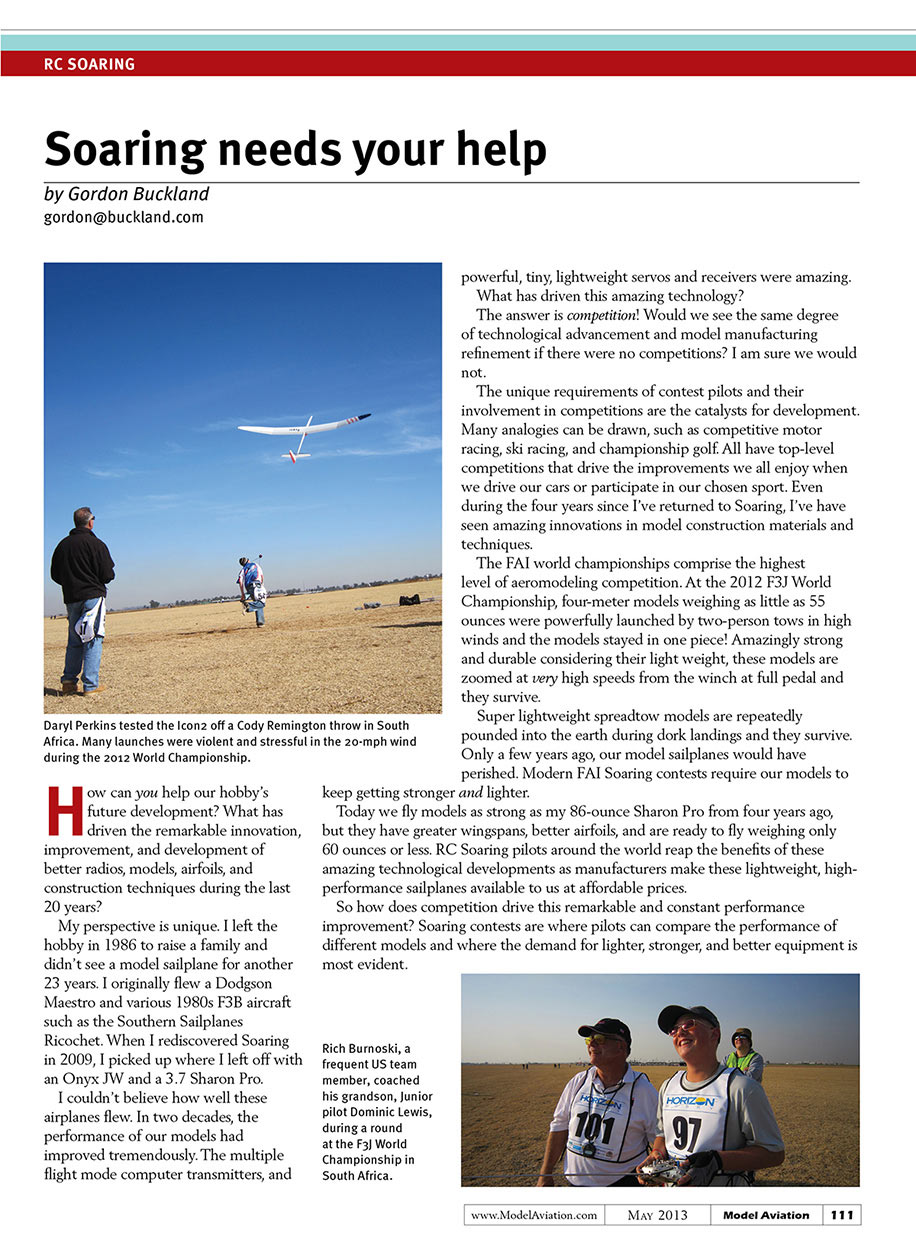
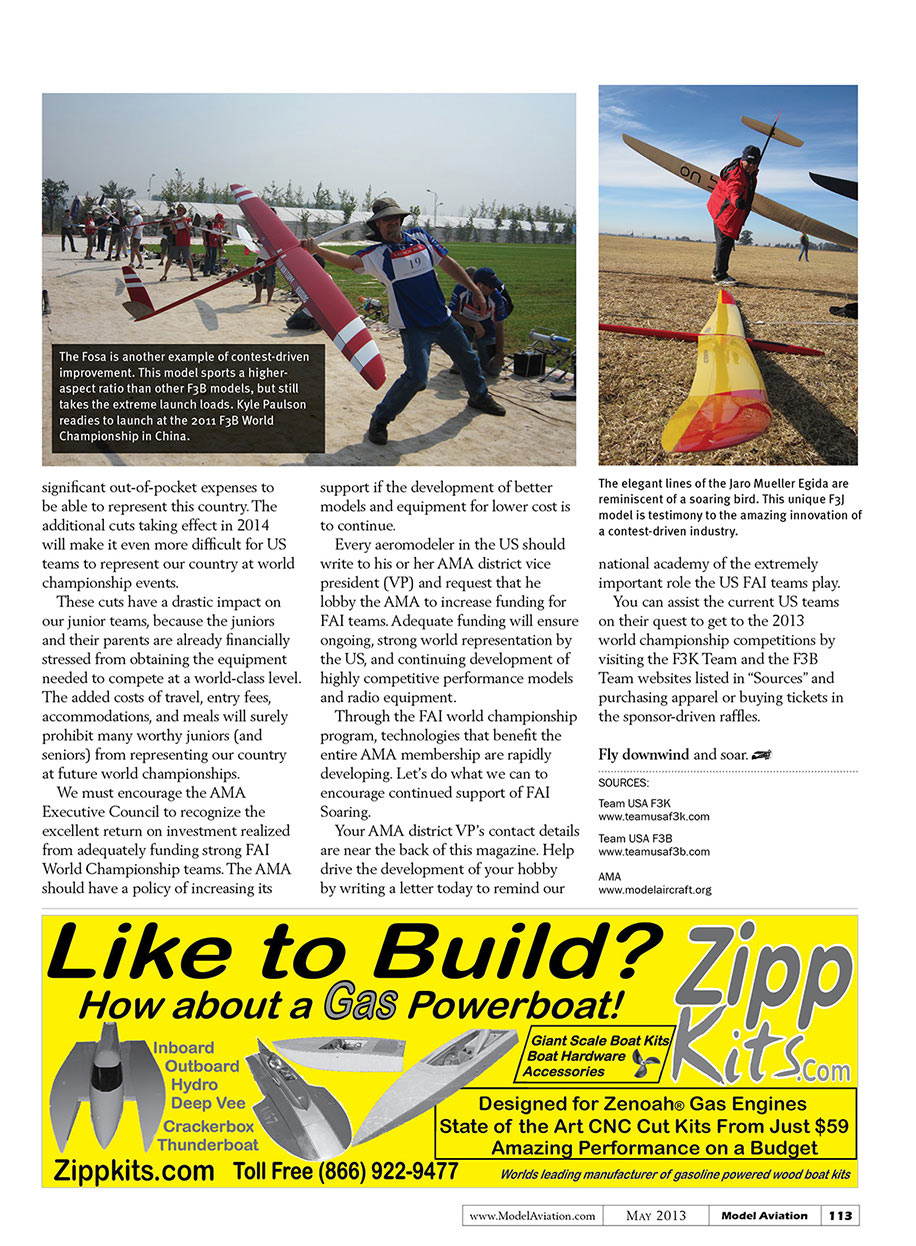
The FAI world championships comprise the highest level of aeromodeling competition. At the 2012 F3J World Championship, four-meter models weighing as little as 55 ounces were powerfully launched by two-person tows in high winds and the models stayed in one piece! Amazingly strong and durable considering their light weight, these models are zoomed at very high speeds from the winch at full pedal and they survive.
Super lightweight spreadtow models are repeatedly pounded into the earth during dork landings and they survive. Only a few years ago, our model sailplanes would have perished. Modern FAI Soaring contests require our models to keep getting stronger and lighter.
Today we fly models as strong as my 86-ounce Sharon Pro from four years ago, but they have greater wingspans, better airfoils, and are ready to fly weighing only 60 ounces or less. RC Soaring pilots around the world reap the benefits of these amazing technological developments as manufacturers make these lightweight, high-performance sailplanes available to us at affordable prices.
So how does competition drive this remarkable and constant performance improvement? Soaring contests are where pilots can compare the performance of different models and where the demand for lighter, stronger, and better equipment is most evident.
RC Soaring
Gordon Buckland
After each world championship is over, we want models such as those that were flown by the best. We want to use the radio that the champion used and to employ the latest trick servos our national team recommends.
This demand for excellence drives manufacturers to create these amazing machines in large numbers for US modelers to use. It also keeps our molded sailplanes and radios affordable, ensuring that we can recruit new pilots and more hobbyists can enjoy our unique sport using high-quality equipment.
This process of innovation and development is in jeopardy. The cost to send competitive teams to a world championship has risen greatly and the AMA has reduced its funding support for all FAI teams beginning in 2014. US Soaring teams sent to world championships are underfunded and require enormous fundraising efforts. Often, team members must bear some of their own cost. When teams can't be fully funded, we risk sending less experienced pilots and inferior equipment, which reduces our chance of winning. The loss of success at international competitions discourages manufacturers and reduces consumer demand, resulting in fewer new models and less technological progress.
We need to support our teams and continue to foster interest at the club level. Local contests, mentoring, and youth programs build the base of talent required for future champions.
These cuts have a drastic impact on our junior teams, because the juniors and their parents are already financially stressed from obtaining the equipment needed to compete at a world-class level. The added costs of travel, entry fees, accommodations, and meals will surely prohibit many worthy juniors (and seniors) from representing our country at future world championships.
We must encourage the AMA Executive Council to recognize the excellent return on investment realized from adequately funding strong FAI World Championship teams. The AMA should have a policy of increasing its support if the development of better models and equipment for lower cost is to continue.
Every aeromodeler in the US should write to his or her AMA district vice president (VP) and request that he lobby the AMA to increase funding for FAI teams. Adequate funding will ensure ongoing, strong world representation by the US, and continuing development of highly competitive performance models and radio equipment.
Through the FAI world championship program, technologies that benefit the entire AMA membership are rapidly developing. Let's do what we can to encourage continued support of FAI Soaring.
Your AMA district VP's contact details are near the back of this magazine. Help drive the development of your hobby by writing a letter today to remind our national academy of the extremely important role the US FAI teams play.
You can assist the current US teams on their quest to get to the 2013 world championship competitions by visiting the F3K Team and the F3B Team websites listed in "Sources" and purchasing apparel or buying tickets in the sponsor-driven raffles.
Fly downwind and soar.
SOURCES:
- Team USA F3K
- Team USA F3B
- AMA
Transcribed from original scans by AI. Minor OCR errors may remain.

